Table of Contents
- 1. Product Overview
- 1.1 Core Advantages and Target Market
- 2. In-Depth Technical Parameter Analysis
- 2.1 Absolute Maximum Ratings
- 2.2 Electro-Optical Characteristics
- 3. Performance Curve Analysis
- 3.1 Thermal Derating
- 3.2 On-Resistance and Switching Time Variation
- 3.3 Input/Output Relationship
- 4. Mechanical and Package Information
- 4.1 Pin Configuration and Schematic
- 4.2 Package Dimensions and Marking
- 5. Soldering and Assembly Guidelines
- 6. Ordering Information and Packaging
- 7. Application Suggestions and Design Considerations
- 7.1 Typical Application Scenarios
- 7.2 Critical Design Considerations
- 8. Technical Comparison and Differentiation
- 9. Frequently Asked Questions (Based on Technical Parameters)
- 9.1 Can this relay switch AC loads?
- 9.2 Why is the load current for the 600V version (ELM460A) lower than the 400V version (ELM440A)?
- 9.3 How do I ensure the relay turns off completely?
- 10. Practical Design Case Study
- 11. Operating Principle
- 12. Technology Trends
1. Product Overview
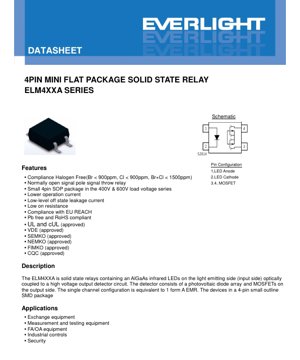
The ELM4XXA series represents a family of single-channel, normally open (1 Form A) solid-state relays (SSRs) packaged in a compact 4-pin Small Outline Package (SOP). These devices are designed to replace electromechanical relays (EMRs) in space-constrained applications requiring high reliability, fast switching, and low power consumption. The core technology involves an AlGaAs infrared LED optically coupled to a photovoltaic diode array which drives the output MOSFETs, providing galvanic isolation between the low-voltage control circuit and the high-voltage load circuit.
1.1 Core Advantages and Target Market
The primary advantages of the ELM4XXA series stem from its solid-state construction. Key benefits include silent operation, absence of contact bounce, long operational life, and resistance to shock and vibration. The low LED operating current minimizes the burden on control circuits like microcontrollers or logic gates. The series is particularly suited for modern electronic equipment where miniaturization, energy efficiency, and reliability are paramount.
Target Applications: This relay series is engineered for use in telecommunications exchange equipment, measurement and testing instruments, factory automation (FA) and office automation (OA) equipment, industrial control systems, and security systems.
2. In-Depth Technical Parameter Analysis
The performance of the ELM4XXA series is defined by a comprehensive set of electrical, optical, and thermal parameters. Understanding these specifications is crucial for proper circuit design and reliable operation.
2.1 Absolute Maximum Ratings
These ratings define the stress limits beyond which permanent damage to the device may occur. Operation under these conditions is not guaranteed.
- Input (LED Side): Maximum forward current (IF) is 50 mA DC. A peak forward current (IFP) of 1 A is allowed under pulsed conditions (0.1% duty cycle at 100 Hz). The maximum reverse voltage (VR) is 5 V.
- Output (MOSFET Side): The breakdown voltage (VL) differentiates the two main variants: 400 V for the ELM440A and 600 V for the ELM460A. Correspondingly, the maximum continuous load current (IL) is 120 mA for the 400V version and 50 mA for the 600V version. A higher pulse load current is permissible for short durations (100 ms single shot).
- Isolation: The device provides a high isolation voltage (Viso) of 3750 Vrms for 1 minute, ensuring safety and noise immunity between input and output.
- Thermal: The operating ambient temperature range is -40°C to +85°C. The total device power dissipation (PT) must not exceed 550 mW.
2.2 Electro-Optical Characteristics
These parameters, specified at TA = 25°C, define the device's operational behavior under normal conditions.
- Input Characteristics: The LED forward voltage (VF) is typically 1.18V at IF = 10 mA, with a maximum of 1.5V. This low VF contributes to low power consumption.
- Output Characteristics: A critical parameter is the on-state resistance (Rd(ON)). For the ELM440A, it is typically 20 Ω (max 30 Ω), and for the ELM460A, it is typically 40 Ω (max 70 Ω). This resistance directly affects the voltage drop and power loss across the relay when conducting. The off-state leakage current (Ileak) is guaranteed to be less than 1 μA, minimizing power loss when the relay is open.
- Transfer Characteristics: These define the relationship between input and output. The LED turn-on current (IF(on)) required to fully activate the output MOSFETs at maximum load is very low, typically 1 mA (max 5 mA). The LED turn-off current (IF(off)) is the maximum input current at which the output is guaranteed to be off (IL ≤ 1 μA), typically 0.6 mA.
- Switching Speed: The turn-on time (Ton) and turn-off time (Toff) are in the sub-millisecond range. Under standard test conditions (IF=10mA, IL=MAX, RL=200Ω), Ton is typically 0.1 ms and Toff is typically 0.2 ms. This is significantly faster than most EMRs.
3. Performance Curve Analysis
The datasheet provides several graphs illustrating how key parameters vary with operating conditions, which is essential for derating and robust design.
3.1 Thermal Derating
Figure 1: Load Current vs. Ambient Temperature shows the necessary derating of the maximum continuous load current as ambient temperature increases. Both the ELM440A and ELM460A must have their load current reduced linearly from their rated values at 25°C down to zero at approximately 100-120°C. This curve is critical for ensuring the device's total power dissipation (IL2 * Rd(ON)) does not exceed limits at high temperatures.
3.2 On-Resistance and Switching Time Variation
Figure 2: On-Resistance vs. Ambient Temperature indicates that Rd(ON) increases with temperature. For the ELM460A, Rd(ON) can increase by over 50% from 25°C to 100°C. This must be factored into voltage drop calculations at elevated temperatures.
Figure 3: Switching Time vs. Ambient Temperature demonstrates that both Ton and Toff increase moderately with decreasing temperature, particularly below 0°C. Designers of circuits operating in cold environments must account for slightly slower switching.
3.3 Input/Output Relationship
Figures 4 & 5: Switching Time vs. LED Forward Current show that increasing the LED drive current (IF) significantly reduces the turn-on and turn-off times. This allows designers to trade off switching speed against input power consumption. Driving the LED with 20-30 mA instead of 10 mA can cut switching times by more than half.
Figures 6 & 7: Normalized LED Operate Current vs. Temperature reveal that the required IF(on) to turn the output on decreases with rising temperature, while the IF(off) (the point where it turns off) increases. This narrowing of the operating window at high temperatures must be considered in margin design.
4. Mechanical and Package Information
4.1 Pin Configuration and Schematic
The device uses a standard 4-pin SOP footprint.
- Pin 1: LED Anode
- Pin 2: LED Cathode
- Pins 3 & 4: MOSFET Output (Source and Drain connections; the internal circuit shows these are connected in a way that makes the device a SPST switch).
4.2 Package Dimensions and Marking
The package has a body size of approximately 4.59mm x 3.81mm with a height of 1.73mm (max). The lead pitch is 2.54mm. A recommended PCB land pattern (pad layout) is provided to ensure reliable soldering and mechanical stability. The device is marked on the top with a code indicating the manufacturer logo, part number (e.g., M440A), year/week of manufacture, and an optional 'V' for VDE-approved versions.
5. Soldering and Assembly Guidelines
The device is designed for surface-mount assembly using reflow soldering processes. The absolute maximum rating for soldering temperature is 260°C for 10 seconds. This aligns with typical lead-free (Pb-free) reflow profiles. Designers should follow the recommended pad layout to prevent tombstoning and ensure proper solder joint formation. The device is compliant with halogen-free, Pb-free, and RoHS directives, making it suitable for environmentally conscious manufacturing.
6. Ordering Information and Packaging
The part number follows the structure: ELM4XXA(X)-VG.
- 4XXA: Part number core (440A for 400V, 460A for 600V).
- (X): Tape and reel option. 'TA' or 'TB' denote different reel specifications. If omitted, parts are supplied in tubes of 100 units.
- -V: Optional suffix denoting the unit is VDE approved.
- -G: Indicates Halogen Free compliance.
7. Application Suggestions and Design Considerations
7.1 Typical Application Scenarios
The ELM4XXA is ideal for switching moderate-voltage, low-current signals or loads. Examples include:
- Isolating analog or digital signal lines in test equipment.
- Switching heater elements or small solenoids in industrial controls.
- Providing isolated control inputs in power supplies or motor drives.
- Interface between low-voltage logic and higher-voltage peripheral circuits in security panels.
7.2 Critical Design Considerations
- Input Drive Circuit: A series resistor must always be used with the LED to limit current. The value is calculated as (Supply Voltage - VF) / Desired IF. To ensure reliable turn-off, the control circuit should pull the LED cathode to a voltage very close to the anode voltage, minimizing any leakage current that could inadvertently turn the output on.
- Output Load Considerations: The relay is designed for DC load switching. For AC loads, additional protection (like a snubber network) would be required, and the voltage rating refers to peak voltage, not RMS. The load current must be derated according to Figure 1 based on the maximum expected ambient temperature. The power dissipation in the on-state (IL2 * Rd(ON)) must be calculated at the operating temperature (using Rd(ON) from Figure 2) to ensure it does not exceed Pout.
- Thermal Management: While the package is small, ensuring adequate PCB copper area around the pins (especially pins 3 and 4) helps dissipate heat and improve current handling capability and longevity.
- Voltage Margin: For reliable long-term operation, the steady-state voltage applied across the output (VL) should have a comfortable margin below the rated breakdown voltage (400V or 600V), especially in environments with voltage transients.
8. Technical Comparison and Differentiation
Compared to traditional electromechanical relays (EMRs), the ELM4XXA offers superior life expectancy (billions of cycles vs. millions), faster switching, silent operation, and better resistance to shock/vibration. Compared to other SSRs or optocouplers with transistor outputs, its MOSFET output provides lower on-resistance and can switch both AC and DC loads with minimal offset voltage. The 4-pin SOP package is among the smallest available for SSRs with these voltage and current ratings, offering significant space savings. The inclusion of approvals from major international safety agencies (UL, cUL, VDE, etc.) simplifies end-product certification for global markets.
9. Frequently Asked Questions (Based on Technical Parameters)
9.1 Can this relay switch AC loads?
The output MOSFETs have a body diode. In the standard configuration, the device is primarily intended for DC load switching. For AC switching, two devices can be connected back-to-back (source-to-source), or an external circuit must manage current flow in both directions. The voltage rating applies to the peak voltage of the AC waveform.
9.2 Why is the load current for the 600V version (ELM460A) lower than the 400V version (ELM440A)?
Higher voltage MOSFETs typically have a higher specific on-resistance (Rds(on) * Area). To fit within the same small package, the 600V-rated MOSFET die will have a higher Rd(ON) (40-70 Ω vs. 20-30 Ω). For a given current, the power dissipation (I2R) is higher in the 600V part. To keep the junction temperature within safe limits and maintain reliability, the maximum continuous current must be reduced.
9.3 How do I ensure the relay turns off completely?
Ensure the control circuit reduces the current through the input LED below the maximum IF(off) specification (0.6 mA typical). In practice, this means driving the LED cathode to a voltage very close to its anode voltage, or using a series resistor large enough to limit any residual voltage difference to a current below this threshold. Avoid floating inputs.
10. Practical Design Case Study
Scenario: Designing a low-side switch for a 24V DC, 80mA solenoid valve in an industrial controller with a maximum ambient temperature of 60°C. The control signal is 3.3V from a microcontroller.
Device Selection: The ELM440A (400V rating) is chosen due to its higher current capability. The 24V load is well within its voltage rating.
Thermal Derating: From Figure 1, at 60°C, the ELM440A can handle approximately 90-95% of its 120mA rating. 80mA is ~67% of rating, which is acceptable.
Input Circuit Design: Assuming VF = 1.2V. To provide a drive current of 10mA for fast switching, the series resistor R = (3.3V - 1.2V) / 0.01A = 210 Ω. A standard 200 Ω resistor can be used. A GPIO pin can source this current directly.
Output Analysis: At 60°C, from Figure 2, Rd(ON) is ~22-23 Ω. Power dissipation P = (0.08A)2 * 23Ω = 0.147W. This is well below the Pout rating of 500mW. Voltage drop across the relay = 0.08A * 23Ω = 1.84V, leaving 22.16V for the solenoid.
Layout: Follow the recommended pad layout, and connect the drain/source pins (3 & 4) to generous copper pours to aid heat dissipation.
11. Operating Principle
The ELM4XXA operates on the principle of optical isolation. When a forward current is applied to the input AlGaAs infrared LED, it emits light. This light is detected by a photovoltaic diode array on the isolated output side. This array generates an open-circuit voltage sufficient to fully enhance the gates of the N-channel power MOSFETs that form the output switch. When the LED current is removed, the photovoltaic voltage decays, and the MOSFET gates discharge through internal paths, turning the output switch off. This mechanism provides several kilovolts of galvanic isolation between the input and output circuits, protecting sensitive control electronics from high-voltage transients on the load side.
12. Technology Trends
The solid-state relay market continues to evolve towards higher power density, lower on-resistance, and smaller packages. Advances in semiconductor materials, such as the use of silicon carbide (SiC) or gallium nitride (GaN) for the output switches, could enable future SSRs in similar packages to handle higher voltages and currents with lower losses. Integration of protection features like over-current detection, thermal shutdown, and state feedback directly into the SSR package is another growing trend, simplifying system design and improving robustness. The demand for miniaturization and high reliability in automotive, industrial IoT, and renewable energy applications will continue to drive innovation in this component category.
LED Specification Terminology
Complete explanation of LED technical terms
Photoelectric Performance
| Term | Unit/Representation | Simple Explanation | Why Important |
|---|---|---|---|
| Luminous Efficacy | lm/W (lumens per watt) | Light output per watt of electricity, higher means more energy efficient. | Directly determines energy efficiency grade and electricity cost. |
| Luminous Flux | lm (lumens) | Total light emitted by source, commonly called "brightness". | Determines if the light is bright enough. |
| Viewing Angle | ° (degrees), e.g., 120° | Angle where light intensity drops to half, determines beam width. | Affects illumination range and uniformity. |
| CCT (Color Temperature) | K (Kelvin), e.g., 2700K/6500K | Warmth/coolness of light, lower values yellowish/warm, higher whitish/cool. | Determines lighting atmosphere and suitable scenarios. |
| CRI / Ra | Unitless, 0–100 | Ability to render object colors accurately, Ra≥80 is good. | Affects color authenticity, used in high-demand places like malls, museums. |
| SDCM | MacAdam ellipse steps, e.g., "5-step" | Color consistency metric, smaller steps mean more consistent color. | Ensures uniform color across same batch of LEDs. |
| Dominant Wavelength | nm (nanometers), e.g., 620nm (red) | Wavelength corresponding to color of colored LEDs. | Determines hue of red, yellow, green monochrome LEDs. |
| Spectral Distribution | Wavelength vs intensity curve | Shows intensity distribution across wavelengths. | Affects color rendering and quality. |
Electrical Parameters
| Term | Symbol | Simple Explanation | Design Considerations |
|---|---|---|---|
| Forward Voltage | Vf | Minimum voltage to turn on LED, like "starting threshold". | Driver voltage must be ≥Vf, voltages add up for series LEDs. |
| Forward Current | If | Current value for normal LED operation. | Usually constant current drive, current determines brightness & lifespan. |
| Max Pulse Current | Ifp | Peak current tolerable for short periods, used for dimming or flashing. | Pulse width & duty cycle must be strictly controlled to avoid damage. |
| Reverse Voltage | Vr | Max reverse voltage LED can withstand, beyond may cause breakdown. | Circuit must prevent reverse connection or voltage spikes. |
| Thermal Resistance | Rth (°C/W) | Resistance to heat transfer from chip to solder, lower is better. | High thermal resistance requires stronger heat dissipation. |
| ESD Immunity | V (HBM), e.g., 1000V | Ability to withstand electrostatic discharge, higher means less vulnerable. | Anti-static measures needed in production, especially for sensitive LEDs. |
Thermal Management & Reliability
| Term | Key Metric | Simple Explanation | Impact |
|---|---|---|---|
| Junction Temperature | Tj (°C) | Actual operating temperature inside LED chip. | Every 10°C reduction may double lifespan; too high causes light decay, color shift. |
| Lumen Depreciation | L70 / L80 (hours) | Time for brightness to drop to 70% or 80% of initial. | Directly defines LED "service life". |
| Lumen Maintenance | % (e.g., 70%) | Percentage of brightness retained after time. | Indicates brightness retention over long-term use. |
| Color Shift | Δu′v′ or MacAdam ellipse | Degree of color change during use. | Affects color consistency in lighting scenes. |
| Thermal Aging | Material degradation | Deterioration due to long-term high temperature. | May cause brightness drop, color change, or open-circuit failure. |
Packaging & Materials
| Term | Common Types | Simple Explanation | Features & Applications |
|---|---|---|---|
| Package Type | EMC, PPA, Ceramic | Housing material protecting chip, providing optical/thermal interface. | EMC: good heat resistance, low cost; Ceramic: better heat dissipation, longer life. |
| Chip Structure | Front, Flip Chip | Chip electrode arrangement. | Flip chip: better heat dissipation, higher efficacy, for high-power. |
| Phosphor Coating | YAG, Silicate, Nitride | Covers blue chip, converts some to yellow/red, mixes to white. | Different phosphors affect efficacy, CCT, and CRI. |
| Lens/Optics | Flat, Microlens, TIR | Optical structure on surface controlling light distribution. | Determines viewing angle and light distribution curve. |
Quality Control & Binning
| Term | Binning Content | Simple Explanation | Purpose |
|---|---|---|---|
| Luminous Flux Bin | Code e.g., 2G, 2H | Grouped by brightness, each group has min/max lumen values. | Ensures uniform brightness in same batch. |
| Voltage Bin | Code e.g., 6W, 6X | Grouped by forward voltage range. | Facilitates driver matching, improves system efficiency. |
| Color Bin | 5-step MacAdam ellipse | Grouped by color coordinates, ensuring tight range. | Guarantees color consistency, avoids uneven color within fixture. |
| CCT Bin | 2700K, 3000K etc. | Grouped by CCT, each has corresponding coordinate range. | Meets different scene CCT requirements. |
Testing & Certification
| Term | Standard/Test | Simple Explanation | Significance |
|---|---|---|---|
| LM-80 | Lumen maintenance test | Long-term lighting at constant temperature, recording brightness decay. | Used to estimate LED life (with TM-21). |
| TM-21 | Life estimation standard | Estimates life under actual conditions based on LM-80 data. | Provides scientific life prediction. |
| IESNA | Illuminating Engineering Society | Covers optical, electrical, thermal test methods. | Industry-recognized test basis. |
| RoHS / REACH | Environmental certification | Ensures no harmful substances (lead, mercury). | Market access requirement internationally. |
| ENERGY STAR / DLC | Energy efficiency certification | Energy efficiency and performance certification for lighting. | Used in government procurement, subsidy programs, enhances competitiveness. |