Table of Contents
- 1. Product Overview
- 1.1 Core Advantages
- 1.2 Target Market and Applications
- 2. In-Depth Technical Parameter Analysis
- 2.1 Absolute Maximum Ratings
- 2.2 Recommended Operating Conditions
- 2.3 Electrical and Optical Characteristics
- 3. Performance Curve Analysis
- 3.1 Light Current vs. Illuminance
- 3.2 Dark Current vs. Temperature
- 3.3 Light Current vs. Temperature
- 3.4 Light Current vs. Supply Voltage
- 3.5 Spectral Response
- 4. Mechanical and Package Information
- 4.1 Package Dimensions
- 4.2 Polarity Identification
- 5. Soldering and Assembly Guidelines
- 5.1 Reflow Soldering Parameters
- 5.2 Handling and Storage
- 6. Packaging and Ordering Information
- 6.1 Packing Specifications
- 6.2 Label Format and Traceability
- 7. Application Design Considerations
- 7.1 Typical Application Circuit
- 7.2 Design Notes
- 8. Technical Comparison and Differentiation
- 9. Frequently Asked Questions (Based on Technical Parameters)
- 9.1 How accurate is the Lux measurement with this sensor?
- 9.2 Can it be used outdoors in direct sunlight?
- 9.3 What is the purpose of the "CAT" and "HUE" on the label?
- 10. Practical Use Case Example
- 11. Operating Principle
- 12. Industry Trends
1. Product Overview
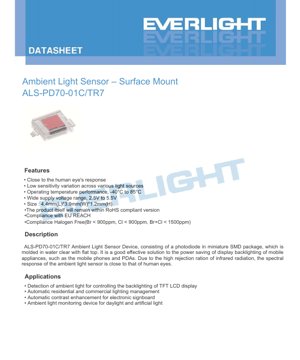
The ALS-PD70-01C/TR7 is a surface-mount ambient light sensor device. It consists of a photodiode housed in a miniature SMD package, molded in water-clear material with a flat top. This sensor is designed as an effective solution for power-saving in display backlighting applications for mobile appliances, such as mobile phones and PDAs. A key feature is its high rejection ratio of infrared radiation, which results in a spectral response closely matching that of the human eye.
1.1 Core Advantages
- Close to the human eye's spectral response.
- Low sensitivity variation across various light sources.
- Wide operating temperature range from -40°C to +85°C.
- Broad supply voltage range from 2.5V to 5.5V.
- Compact size: 4.4mm (L) x 3.9mm (W) x 1.2mm (H).
- Compliant with RoHS, EU REACH, and Halogen-Free standards (Br < 900ppm, Cl < 900ppm, Br+Cl < 1500 ppm).
1.2 Target Market and Applications
This sensor is primarily targeted at portable and energy-conscious electronic devices. Its main applications include:
- Detection of ambient light for controlling the backlighting of TFT LCD displays to save power.
- Automatic residential and commercial lighting management systems.
- Automatic contrast enhancement for electronic signboards.
- Ambient light monitoring devices for both daylight and artificial light conditions.
2. In-Depth Technical Parameter Analysis
2.1 Absolute Maximum Ratings
These ratings define the limits beyond which permanent damage to the device may occur. Operation outside these conditions is not advised.
- Reverse Breakdown Voltage (VBR): 35 V (at IR=100µA). This indicates the maximum reverse voltage the photodiode can withstand before breakdown.
- Forward Voltage (VF): 0.5 V to 1.3 V (at IF=10mA). This is the voltage drop across the diode when forward-biased, relevant for testing but not typical in photoconductive mode operation.
- Operating Temperature (Topr): -40°C to +85°C.
- Storage Temperature (Tstq): -40°C to +85°C.
- Soldering Temperature (Tsol): 260°C. This is critical for reflow soldering processes.
2.2 Recommended Operating Conditions
The device is designed to operate within the following conditions to ensure specified performance.
- Operating Temperature (Topr): -40°C to +85°C.
2.3 Electrical and Optical Characteristics
These parameters are measured at Ta=25°C and define the sensor's core performance.
- Dark Current (ID): Typ. 2 nA, Max. 10 nA (at VR=5V, EV=0 Lux). This is the small leakage current when no light is present. A lower value is better for sensitivity in low-light conditions.
- Light Current (IL1): Typ. 1.1 µA (at VR=5V, EV=100 Lux, White Fluorescent/LED light). This is the photocurrent generated under specified illumination.
- Light Current (IL2): Typ. 9.5 µA (at VR=5V, EV=1000 Lux, White Fluorescent/LED light).
- Light Current (IL3): Typ. 12 µA (at VR=5V, EV=1000 Lux, CIE Standard Illuminant-A / 2856K incandescent lamp). The difference between IL2 and IL3 highlights the sensor's varying response to different light source spectra.
- Peak Sensitivity Wavelength (λp): Typ. 630 nm. This confirms the sensor's peak response is in the visible red-orange region, aligning with human eye sensitivity.
- Sensitivity Wavelength Range (λ): 390 nm to 700 nm. This covers the majority of the visible light spectrum, with strong rejection of infrared (IR) and ultraviolet (UV) light.
3. Performance Curve Analysis
The datasheet references several typical electro-optical characteristic curves which are crucial for design engineers.
3.1 Light Current vs. Illuminance
This curve shows the relationship between the output photocurrent and the ambient light level (in Lux). It is typically linear over a wide range, allowing for straightforward calibration of light levels in an application. The slope of this curve represents the sensor's responsivity.
3.2 Dark Current vs. Temperature
This graph illustrates how the dark current (ID) increases with temperature. Since dark current acts as noise, understanding this relationship is vital for applications operating in extreme temperature environments to ensure accurate low-light readings.
3.3 Light Current vs. Temperature
This curve shows the variation of photocurrent with temperature at a fixed illuminance. Some temperature dependence is expected, and this data is necessary for designing temperature-compensated circuits if high accuracy is required across the full operating range.
3.4 Light Current vs. Supply Voltage
This plot demonstrates the stability of the photocurrent output over the recommended supply voltage range (2.5V to 5.5V). A stable output across voltage variations simplifies power supply design.
3.5 Spectral Response
This is one of the most important graphs. It plots the sensor's relative sensitivity against wavelength. The curve should peak around 630 nm (as specified) and show a sharp roll-off beyond 700 nm, confirming effective IR rejection. Comparing this curve to the CIE photopic luminosity function (standard human eye response) visually validates the claim of "close to human eye's response."
4. Mechanical and Package Information
4.1 Package Dimensions
The sensor comes in a surface-mount package. The key dimensions are:
- Length (L): 4.4 mm ±0.1 mm
- Width (W): 3.9 mm ±0.1 mm
- Height (H): 1.2 mm
Detailed mechanical drawings in the datasheet provide exact measurements for land pattern design, including pad size and spacing, which are critical for PCB layout and solder joint reliability.
4.2 Polarity Identification
The datasheet drawing indicates the cathode and anode markings on the package body. Correct polarity orientation during assembly is essential for proper circuit operation.
5. Soldering and Assembly Guidelines
5.1 Reflow Soldering Parameters
The absolute maximum rating for soldering temperature is 260°C. This implies the device can withstand typical lead-free reflow profiles. Designers should follow standard SMD reflow soldering practices, ensuring the peak temperature does not exceed 260°C and the time above liquidus is controlled according to the PCB assembly specifications.
5.2 Handling and Storage
The device should be stored in its original moisture-barrier bag under the specified storage temperature conditions (-40°C to +85°C). Standard ESD (Electrostatic Discharge) precautions should be observed during handling and assembly.
6. Packaging and Ordering Information
6.1 Packing Specifications
- Standard Packing: 1000 pieces per volume/bag.
- Carton Packing: 10 boxes per carton.
- Reel Packing: Available with 1000 pieces per reel for automated pick-and-place assembly.
6.2 Label Format and Traceability
The packaging label includes fields for traceability and identification:
- CPN (Customer's Product Number)
- P/N (Product Number: ALS-PD70-01C/TR7)
- QTY (Packing Quantity)
- CAT (Ranks - potentially for performance binning)
- HUE (Peak Wavelength)
- REF (Reference)
- LOT No (Lot Number for traceability)
7. Application Design Considerations
7.1 Typical Application Circuit
The sensor operates in photoconductive mode. A typical application circuit involves connecting the photodiode in reverse bias (cathode to VCC, anode to a transimpedance amplifier or a pull-down resistor). The current generated is proportional to light intensity. This current can be converted to a voltage using a resistor or a more sophisticated operational amplifier-based transimpedance amplifier (TIA) for better sensitivity and bandwidth.
7.2 Design Notes
- Biasing: Ensure the reverse bias voltage (VR) is within the 2.5V to 5.5V range. A stable supply is recommended for consistent readings.
- Signal Conditioning: The output is a small current (microamps). Careful PCB layout is needed to minimize noise pickup. Shielding the sensor from direct IR sources (like sunlight or incandescent bulbs) can improve accuracy due to its IR rejection, but some spectral dependency remains (as seen in IL2 vs. IL3).
- Calibration: Due to typical variations and the non-linear perception of brightness by humans, end-product calibration against a known light source is often necessary for precise Lux measurement.
- Optical Design: The "water clear" flat-top package may require a light guide or diffuser in the final product to ensure the sensor receives a representative sample of the ambient light and is not affected by point sources or shadows.
8. Technical Comparison and Differentiation
The ALS-PD70-01C/TR7 differentiates itself through its combination of key features:
- Human Eye Response: Unlike simple photodiodes, its filtered response minimizes IR sensitivity, making its output more directly useful for brightness perception tasks without complex software correction.
- Wide Voltage Range: The 2.5V to 5.5V range allows it to be used directly with both 3.3V and 5V logic systems common in microcontrollers, eliminating the need for a level shifter or regulator.
- Robust Temperature Performance: The specified operating range from -40°C to +85°C makes it suitable for automotive, industrial, and outdoor applications, beyond typical consumer electronics.
- Compliance: Full compliance with modern environmental regulations (RoHS, REACH, Halogen-Free) is a mandatory requirement for most global markets today.
9. Frequently Asked Questions (Based on Technical Parameters)
9.1 How accurate is the Lux measurement with this sensor?
The sensor provides a photocurrent proportional to light intensity. For accurate Lux measurement, calibration against a reference light meter under the specific type of light source (e.g., daylight, fluorescent, LED) used in the application is essential. The datasheet provides typical responses under different sources (see IL2 and IL3), highlighting the inherent spectral dependence of any light sensor.
9.2 Can it be used outdoors in direct sunlight?
While the operating temperature range allows it, direct sunlight has very high IR content. The sensor's IR rejection helps, but the illuminance level in direct sun (often >50,000 Lux) may saturate the sensor or the following amplifier stage. An optical attenuator (neutral density filter) or careful range selection in the signal conditioning circuit would be necessary.
9.3 What is the purpose of the "CAT" and "HUE" on the label?
These likely indicate performance binning. "CAT" (Category/Rank) might bin devices based on light current sensitivity (e.g., higher/lower output at a standard test condition). "HUE" (Peak Wavelength) bins devices based on the exact wavelength of peak spectral sensitivity (around the typical 630 nm). This allows manufacturers to select sensors with tighter performance matching for high-volume production.
10. Practical Use Case Example
Scenario: Automatic Backlight Dimming for a Mobile Device
The ALS-PD70-01C/TR7 is placed behind a small aperture or light guide on the device's bezel. It is connected to an analog-to-digital converter (ADC) input of a microcontroller via a simple resistor. The microcontroller's firmware periodically reads the voltage, which corresponds to ambient light level. Based on a pre-programmed lookup table or algorithm (often mimicking a logarithmic human perception curve), the microcontroller adjusts the PWM (Pulse Width Modulation) duty cycle driving the display's LED backlight. In a dark room, the backlight dims to save power and reduce eye strain. In bright sunlight, it increases to maximum for readability. The sensor's fast response and human-eye-like spectral sensitivity ensure smooth and natural-looking adjustments under various lighting conditions (office fluorescent, home LED, outdoor sun).
11. Operating Principle
The device is a silicon photodiode. When photons with energy greater than the bandgap of silicon strike the semiconductor junction, they generate electron-hole pairs. Under a reverse bias voltage, these charge carriers are swept across the junction, creating a measurable photocurrent that is linearly proportional to the incident light intensity (over a wide range). The package incorporates an optical filter that attenuates infrared wavelengths, shaping the spectral response to approximate the photopic response of the human eye.
12. Industry Trends
Ambient light sensing is a mature but evolving technology. Current trends include:
- Integration: Combining the photodiode, amplifier, ADC, and digital logic (I2C/SPI interface) into a single chip to create digital light sensors. This simplifies design but may trade-off some performance or flexibility.
- Proximity Sensing: Often paired with an IR LED to create a proximity sensor, used for features like turning off a display during a phone call.
- Flicker Detection: Advanced sensors can detect the frequency of artificial light flicker (e.g., from LEDs or fluorescents) to enable cameras to adjust shutter speed and reduce banding effects.
- Ultra-Low Power: For always-on applications in IoT devices, sensors with nanoamp-level quiescent current are in demand.
The ALS-PD70-01C/TR7 represents a high-performance discrete solution, offering design flexibility and optimized analog performance for applications where these factors are prioritized over integration.
LED Specification Terminology
Complete explanation of LED technical terms
Photoelectric Performance
| Term | Unit/Representation | Simple Explanation | Why Important |
|---|---|---|---|
| Luminous Efficacy | lm/W (lumens per watt) | Light output per watt of electricity, higher means more energy efficient. | Directly determines energy efficiency grade and electricity cost. |
| Luminous Flux | lm (lumens) | Total light emitted by source, commonly called "brightness". | Determines if the light is bright enough. |
| Viewing Angle | ° (degrees), e.g., 120° | Angle where light intensity drops to half, determines beam width. | Affects illumination range and uniformity. |
| CCT (Color Temperature) | K (Kelvin), e.g., 2700K/6500K | Warmth/coolness of light, lower values yellowish/warm, higher whitish/cool. | Determines lighting atmosphere and suitable scenarios. |
| CRI / Ra | Unitless, 0–100 | Ability to render object colors accurately, Ra≥80 is good. | Affects color authenticity, used in high-demand places like malls, museums. |
| SDCM | MacAdam ellipse steps, e.g., "5-step" | Color consistency metric, smaller steps mean more consistent color. | Ensures uniform color across same batch of LEDs. |
| Dominant Wavelength | nm (nanometers), e.g., 620nm (red) | Wavelength corresponding to color of colored LEDs. | Determines hue of red, yellow, green monochrome LEDs. |
| Spectral Distribution | Wavelength vs intensity curve | Shows intensity distribution across wavelengths. | Affects color rendering and quality. |
Electrical Parameters
| Term | Symbol | Simple Explanation | Design Considerations |
|---|---|---|---|
| Forward Voltage | Vf | Minimum voltage to turn on LED, like "starting threshold". | Driver voltage must be ≥Vf, voltages add up for series LEDs. |
| Forward Current | If | Current value for normal LED operation. | Usually constant current drive, current determines brightness & lifespan. |
| Max Pulse Current | Ifp | Peak current tolerable for short periods, used for dimming or flashing. | Pulse width & duty cycle must be strictly controlled to avoid damage. |
| Reverse Voltage | Vr | Max reverse voltage LED can withstand, beyond may cause breakdown. | Circuit must prevent reverse connection or voltage spikes. |
| Thermal Resistance | Rth (°C/W) | Resistance to heat transfer from chip to solder, lower is better. | High thermal resistance requires stronger heat dissipation. |
| ESD Immunity | V (HBM), e.g., 1000V | Ability to withstand electrostatic discharge, higher means less vulnerable. | Anti-static measures needed in production, especially for sensitive LEDs. |
Thermal Management & Reliability
| Term | Key Metric | Simple Explanation | Impact |
|---|---|---|---|
| Junction Temperature | Tj (°C) | Actual operating temperature inside LED chip. | Every 10°C reduction may double lifespan; too high causes light decay, color shift. |
| Lumen Depreciation | L70 / L80 (hours) | Time for brightness to drop to 70% or 80% of initial. | Directly defines LED "service life". |
| Lumen Maintenance | % (e.g., 70%) | Percentage of brightness retained after time. | Indicates brightness retention over long-term use. |
| Color Shift | Δu′v′ or MacAdam ellipse | Degree of color change during use. | Affects color consistency in lighting scenes. |
| Thermal Aging | Material degradation | Deterioration due to long-term high temperature. | May cause brightness drop, color change, or open-circuit failure. |
Packaging & Materials
| Term | Common Types | Simple Explanation | Features & Applications |
|---|---|---|---|
| Package Type | EMC, PPA, Ceramic | Housing material protecting chip, providing optical/thermal interface. | EMC: good heat resistance, low cost; Ceramic: better heat dissipation, longer life. |
| Chip Structure | Front, Flip Chip | Chip electrode arrangement. | Flip chip: better heat dissipation, higher efficacy, for high-power. |
| Phosphor Coating | YAG, Silicate, Nitride | Covers blue chip, converts some to yellow/red, mixes to white. | Different phosphors affect efficacy, CCT, and CRI. |
| Lens/Optics | Flat, Microlens, TIR | Optical structure on surface controlling light distribution. | Determines viewing angle and light distribution curve. |
Quality Control & Binning
| Term | Binning Content | Simple Explanation | Purpose |
|---|---|---|---|
| Luminous Flux Bin | Code e.g., 2G, 2H | Grouped by brightness, each group has min/max lumen values. | Ensures uniform brightness in same batch. |
| Voltage Bin | Code e.g., 6W, 6X | Grouped by forward voltage range. | Facilitates driver matching, improves system efficiency. |
| Color Bin | 5-step MacAdam ellipse | Grouped by color coordinates, ensuring tight range. | Guarantees color consistency, avoids uneven color within fixture. |
| CCT Bin | 2700K, 3000K etc. | Grouped by CCT, each has corresponding coordinate range. | Meets different scene CCT requirements. |
Testing & Certification
| Term | Standard/Test | Simple Explanation | Significance |
|---|---|---|---|
| LM-80 | Lumen maintenance test | Long-term lighting at constant temperature, recording brightness decay. | Used to estimate LED life (with TM-21). |
| TM-21 | Life estimation standard | Estimates life under actual conditions based on LM-80 data. | Provides scientific life prediction. |
| IESNA | Illuminating Engineering Society | Covers optical, electrical, thermal test methods. | Industry-recognized test basis. |
| RoHS / REACH | Environmental certification | Ensures no harmful substances (lead, mercury). | Market access requirement internationally. |
| ENERGY STAR / DLC | Energy efficiency certification | Energy efficiency and performance certification for lighting. | Used in government procurement, subsidy programs, enhances competitiveness. |