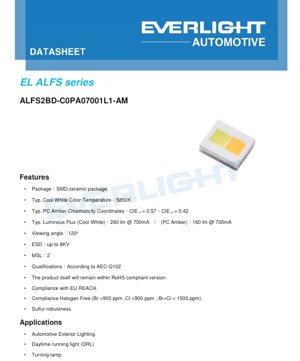
1. Product Overview
The ALFS2BD-C0PA07001L1-AM is a high-performance, surface-mount LED designed specifically for demanding automotive exterior lighting applications. It is part of the EL ALFS series, featuring a robust SMD ceramic package that ensures excellent thermal management and long-term reliability in harsh environmental conditions. The device is offered in two distinct color options: a Cool White variant with a typical color temperature of 5850K, and a PC (Phosphor Converted) Amber variant. Its primary design goals are to deliver high luminous output, consistent color performance, and unwavering reliability for safety-critical automotive functions.
The core advantages of this LED include its compliance with the stringent AEC-Q102 qualification standard for discrete optoelectronic semiconductors in automotive applications. This certification process validates the component's performance and longevity under extreme temperatures, humidity, and mechanical stress. Furthermore, the product adheres to RoHS, REACH, and halogen-free regulations, making it suitable for global automotive markets with strict environmental and material restrictions. Its sulfur robustness is a critical feature for applications exposed to atmospheric pollutants that can corrode standard LED packages.
The target market is exclusively automotive, with a focus on exterior lighting modules. Its performance characteristics are tailored to meet the high brightness and reliability requirements of modern vehicle lighting systems.
2. In-Depth Technical Parameter Analysis
2.1 Photometric and Color Characteristics
The LED's performance is characterized under a standard test current of 700mA. The Cool White version delivers a typical luminous flux of 260 lumens (lm), with a minimum of 220 lm and a maximum of 300 lm, accounting for production tolerances. The PC Amber version provides a typical output of 160 lm, ranging from 120 lm to 200 lm. The viewing angle for both colors is a wide 120 degrees, providing a broad and uniform light distribution pattern suitable for signaling functions.
Color metrics are precisely defined. The Cool White variant has a correlated color temperature (CCT) range from 5180K to 6680K, centered around a typical 5850K. The PC Amber variant's chromaticity is specified by its CIE 1931 coordinates: a typical x = 0.57 and y = 0.42. This places it firmly in the amber region of the color space, essential for turn signal and parking light applications where specific color regulations apply.
2.2 Electrical and Thermal Parameters
The forward voltage (Vf) for the Cool White LED at 700mA is typically 3.35V, with a range from 2.90V to 3.80V. The PC Amber version's Vf is comparable. These parameters are crucial for driver design and power management. Two key thermal resistance values are provided: the real thermal resistance (Rth JS real) from the semiconductor junction to the solder point is typically 4.6 K/W (max 9.0 K/W), while the electrical method-derived thermal resistance (Rth JS el) is typically 3.6 K/W (max 8.0 K/W). The lower electrical value often indicates the thermal path's performance under operating conditions, which is vital for predicting junction temperature and managing lumen maintenance.
2.3 Absolute Maximum Ratings
These ratings define the operational limits beyond which permanent damage may occur. Key limits include a maximum forward current (IF) of 1500 mA, a maximum power dissipation (Pd) of 5700 mW, and a maximum junction temperature (Tj) of 150°C. The device is rated for an operating temperature range (Topr) of -40°C to +125°C, confirming its suitability for automotive environments. It can withstand an ESD (Electrostatic Discharge) level of up to 8 kV (Human Body Model), enhancing its handling robustness. The maximum reflow soldering temperature is 260°C, aligning with standard PCB assembly processes.
3. Performance Curve Analysis
3.1 Spectral Distribution
The provided graphs show the relative spectral power distribution for both Cool White and PC Amber LEDs at 700mA and 25°C. The Cool White spectrum shows a broad emission peak in the blue region from the LED chip, combined with a broader yellow phosphor emission, creating white light. The PC Amber spectrum is dominated by a single, broad peak in the yellow-amber region, resulting from the phosphor conversion, with minimal blue light leakage, which is ideal for pure amber color requirements.
3.2 Current vs. Performance Relationships
The Forward Current vs. Forward Voltage graph shows a sub-linear relationship, typical for LEDs. The Relative Luminous Flux vs. Forward Current graphs demonstrate that light output increases with current but begins to show signs of saturation at higher currents (e.g., above 1000mA), likely due to increased thermal effects and efficiency droop. The Chromaticity Coordinates Shift vs. Forward Current graphs indicate minimal change in color coordinates (ΔCIE x, ΔCIE y) across the current range from 300mA to 1500mA, which is critical for maintaining consistent color output under different drive conditions, such as dimming.
3.3 Temperature Dependence
The Relative Forward Voltage vs. Junction Temperature graph shows a negative temperature coefficient; forward voltage decreases linearly as junction temperature increases, which is a standard characteristic of semiconductor diodes. The Relative Luminous Flux vs. Junction Temperature graphs are crucial for thermal design. They show that luminous output decreases as junction temperature rises. For the Cool White LED, output at 125°C is approximately 85-90% of its output at 25°C. The PC Amber version shows a slightly different thermal quenching behavior. Effective heat sinking is therefore essential to maintain brightness. The Chromaticity Coordinates Shift vs. Junction Temperature graphs show very minor shifts, indicating good color stability over the operating temperature range.
4. Binning Information
The datasheet includes a dedicated section for binning information (Section 4 in the contents), although the specific binning criteria (e.g., flux bins, chromaticity bins, Vf bins) are not detailed in the provided excerpt. For automotive-grade LEDs, binning is typically very stringent. Components are sorted into tight groups based on luminous flux, forward voltage, and chromaticity coordinates (CIE x, y or CCT and Duv for white) to ensure consistency and color uniformity within a lighting assembly. Designers must consult the full binning table to select the appropriate part number suffix that meets their specific application's uniformity requirements.
5. Mechanical, Assembly, and Packaging
5.1 Mechanical Dimensions and Pad Layout
The mechanical drawing (Section 7) defines the exact physical footprint of the SMD ceramic package, including length, width, height, and the location of the thermal pad and electrical contacts. The recommended soldering pad layout (Section 8) is provided to guide PCB design. This layout is critical for ensuring proper solder joint formation, electrical connection, and most importantly, optimal thermal transfer from the LED's thermal pad to the PCB's copper plane. An incorrect pad design can severely limit heat dissipation, leading to premature failure or reduced light output.
5.2 Reflow Soldering and Handling
A reflow soldering profile (Section 9) is specified, with a peak temperature of 260°C. Adhering to this profile is essential to avoid thermal shock to the ceramic package and internal die attach materials. The \"Precaution for Use\" section (Section 11) likely contains vital handling instructions, such as moisture sensitivity level (MSL 2 is noted in the features), storage conditions, and cleaning recommendations. Proper ESD precautions should always be followed during handling and assembly.
5.3 Packaging and Ordering
Packaging information (Section 10) details how the LEDs are supplied (e.g., on tape and reel), including reel dimensions and component orientation. The ordering information and part number structure (Sections 5 & 6) explain how to decode the part number (ALFS2BD-C0PA07001L1-AM) to select the correct flux bin, color, and other optional characteristics for purchase.
6. Application Guidelines and Design Considerations
6.1 Target Applications
The primary applications listed are Automotive Exterior Lighting, specifically Daytime Running Lights (DRL) and Turning Lamps. For DRLs, the high luminous flux and cool white color provide high visibility. For turning lamps, the PC Amber color meets regulatory requirements for turn signal color. The device's robustness also makes it suitable for other exterior functions like position lights or rear combination lamps.
6.2 Critical Design Considerations
- Thermal Management: This is the single most critical factor. The typical real thermal resistance of 4.6 K/W means that for every watt dissipated, the junction will be 4.6°C hotter than the solder point. At 700mA and a typical Vf of 3.35V, power dissipation is about 2.35W. This creates a temperature rise of approximately 10.8°C from the board to the junction, assuming ideal heat sinking. The PCB must have an adequately designed thermal path (using vias, thick copper layers) to keep the solder point temperature low, ensuring the junction stays well below its 150°C maximum, preferably below 110-120°C for long life.
- Drive Current: While the LED can be pulsed up to 1500mA, the recommended operating point for optimal efficiency and lifetime is likely around 700mA, as used for the typical specifications. Operating at higher currents increases heat generation exponentially and accelerates lumen depreciation.
- Optical Design: The 120° viewing angle requires secondary optics (lenses, reflectors) to shape the beam for specific applications like DRLs or turn signals. The optical system must account for the LED's spatial radiation pattern.
- Electrical Design: A constant-current LED driver is mandatory to ensure stable light output and prevent thermal runaway. The driver should be designed to operate within the full automotive voltage range (e.g., 9V-16V with load dump protection).
7. Technical Comparison and Differentiation
Compared to standard commercial or even industrial-grade LEDs, this device's key differentiators are its automotive qualification (AEC-Q102) and material robustness (sulfur resistance, halogen-free). Compared to other automotive LEDs, its combination of a ceramic package (superior thermal performance and reliability over plastic packages) and high flux output in both white and amber from a single package platform is a significant advantage. It simplifies the bill of materials for lighting modules that require both colors.
8. Frequently Asked Questions (Based on Technical Data)
Q: Can I drive this LED at 1000mA continuously?
A: While the absolute maximum rating is 1500mA, the typical specifications are given at 700mA. Continuous operation at 1000mA will generate significantly more heat (~3.35W vs. ~2.35W). This is possible only with exceptional thermal management to keep the junction temperature within safe limits, and it may reduce the LED's lifetime. Refer to the derating curves.
Q: How do I interpret the two different thermal resistance values (Real vs. Electrical)?
A: The \"real\" thermal resistance (4.6 K/W) is often measured under a specific thermal test condition. The \"electrical\" method (3.6 K/W) uses the LED's own forward voltage as a temperature sensor under operating conditions and may represent a more practical in-situ value. For conservative design, using the higher \"real\" value is recommended for calculating the worst-case temperature rise.
Q: Is a lens required for a turn signal application?
A: Yes. The LED itself has a Lambertian-like 120° emission pattern. A turn signal requires a specific beam pattern and angular visibility defined by regulations (e.g., ECE or SAE). A secondary optic (lens) is necessary to collimate and shape the light to meet these legal photometric requirements.
9. Practical Design Case Study
Scenario: Designing a Daytime Running Light (DRL) module using the Cool White version of this LED.
Step 1 - Optical Requirements: Determine the required luminous intensity (candelas) at various angles as per the automotive regulation (e.g., ECE R87).
Step 2 - LED Count & Drive: Based on the LED's typical 260 lm output and the efficiency of the chosen optical system, calculate the number of LEDs needed to achieve the target intensity. Decide on a drive current (e.g., 700mA).
Step 3 - Thermal Design: Calculate total power dissipation (Number of LEDs * Vf * Current). Design the metal-core PCB or standard PCB with thermal vias to achieve a target solder point temperature (e.g., 85°C) in the worst-case ambient temperature (e.g., 80°C engine compartment). Use the thermal resistance (Rth JS) to ensure the junction temperature remains below 110°C.
Step 4 - Electrical Design: Select an AEC-Q100 qualified constant-current LED driver that can supply the required total current, handle the automotive input voltage range, and include PWM dimming if needed for functionality (e.g., dimming when headlights are on).
Step 5 - Validation: Build a prototype and measure photometric output, color, and thermal performance (junction temperature via Vf method) under high-temperature operating conditions to validate the design.
10. Operating Principle and Technology Trends
10.1 Basic Operating Principle
This LED is a solid-state light source based on semiconductor physics. When a forward voltage is applied across the device, electrons and holes recombine in the active region of the semiconductor chip (typically based on InGaN for blue emission), releasing energy in the form of photons (light). For the Cool White version, a portion of the blue light is absorbed by a phosphor coating (YAG:Ce is common), which re-emits it as broad-spectrum yellow light. The mixture of remaining blue and converted yellow light is perceived as white. For the PC Amber version, a different phosphor formulation is used to absorb nearly all the blue light and re-emit it in the amber wavelength range.
10.2 Industry Trends
The automotive lighting industry is continuously evolving. Key trends influencing devices like this LED include:
Increased Luminance and Efficiency: Demand for smaller, brighter light sources to enable sleek, stylized lighting designs.
Advanced Functionality: Integration of adaptive driving beams (ADB) and pixelated lighting, which may drive future versions towards smaller pixel pitches or integrated driver capabilities.
Color Tuning: Interest in tunable white light for ambient interior lighting, though exterior lights remain tightly regulated on color.
Enhanced Reliability and Robustness: As LEDs become the sole light source for critical functions, requirements for longevity and performance under extreme conditions (vibration, thermal cycling, chemical exposure) continue to tighten, reinforcing the need for qualified components like this one.
LED Specification Terminology
Complete explanation of LED technical terms
Photoelectric Performance
| Term | Unit/Representation | Simple Explanation | Why Important |
|---|---|---|---|
| Luminous Efficacy | lm/W (lumens per watt) | Light output per watt of electricity, higher means more energy efficient. | Directly determines energy efficiency grade and electricity cost. |
| Luminous Flux | lm (lumens) | Total light emitted by source, commonly called "brightness". | Determines if the light is bright enough. |
| Viewing Angle | ° (degrees), e.g., 120° | Angle where light intensity drops to half, determines beam width. | Affects illumination range and uniformity. |
| CCT (Color Temperature) | K (Kelvin), e.g., 2700K/6500K | Warmth/coolness of light, lower values yellowish/warm, higher whitish/cool. | Determines lighting atmosphere and suitable scenarios. |
| CRI / Ra | Unitless, 0–100 | Ability to render object colors accurately, Ra≥80 is good. | Affects color authenticity, used in high-demand places like malls, museums. |
| SDCM | MacAdam ellipse steps, e.g., "5-step" | Color consistency metric, smaller steps mean more consistent color. | Ensures uniform color across same batch of LEDs. |
| Dominant Wavelength | nm (nanometers), e.g., 620nm (red) | Wavelength corresponding to color of colored LEDs. | Determines hue of red, yellow, green monochrome LEDs. |
| Spectral Distribution | Wavelength vs intensity curve | Shows intensity distribution across wavelengths. | Affects color rendering and quality. |
Electrical Parameters
| Term | Symbol | Simple Explanation | Design Considerations |
|---|---|---|---|
| Forward Voltage | Vf | Minimum voltage to turn on LED, like "starting threshold". | Driver voltage must be ≥Vf, voltages add up for series LEDs. |
| Forward Current | If | Current value for normal LED operation. | Usually constant current drive, current determines brightness & lifespan. |
| Max Pulse Current | Ifp | Peak current tolerable for short periods, used for dimming or flashing. | Pulse width & duty cycle must be strictly controlled to avoid damage. |
| Reverse Voltage | Vr | Max reverse voltage LED can withstand, beyond may cause breakdown. | Circuit must prevent reverse connection or voltage spikes. |
| Thermal Resistance | Rth (°C/W) | Resistance to heat transfer from chip to solder, lower is better. | High thermal resistance requires stronger heat dissipation. |
| ESD Immunity | V (HBM), e.g., 1000V | Ability to withstand electrostatic discharge, higher means less vulnerable. | Anti-static measures needed in production, especially for sensitive LEDs. |
Thermal Management & Reliability
| Term | Key Metric | Simple Explanation | Impact |
|---|---|---|---|
| Junction Temperature | Tj (°C) | Actual operating temperature inside LED chip. | Every 10°C reduction may double lifespan; too high causes light decay, color shift. |
| Lumen Depreciation | L70 / L80 (hours) | Time for brightness to drop to 70% or 80% of initial. | Directly defines LED "service life". |
| Lumen Maintenance | % (e.g., 70%) | Percentage of brightness retained after time. | Indicates brightness retention over long-term use. |
| Color Shift | Δu′v′ or MacAdam ellipse | Degree of color change during use. | Affects color consistency in lighting scenes. |
| Thermal Aging | Material degradation | Deterioration due to long-term high temperature. | May cause brightness drop, color change, or open-circuit failure. |
Packaging & Materials
| Term | Common Types | Simple Explanation | Features & Applications |
|---|---|---|---|
| Package Type | EMC, PPA, Ceramic | Housing material protecting chip, providing optical/thermal interface. | EMC: good heat resistance, low cost; Ceramic: better heat dissipation, longer life. |
| Chip Structure | Front, Flip Chip | Chip electrode arrangement. | Flip chip: better heat dissipation, higher efficacy, for high-power. |
| Phosphor Coating | YAG, Silicate, Nitride | Covers blue chip, converts some to yellow/red, mixes to white. | Different phosphors affect efficacy, CCT, and CRI. |
| Lens/Optics | Flat, Microlens, TIR | Optical structure on surface controlling light distribution. | Determines viewing angle and light distribution curve. |
Quality Control & Binning
| Term | Binning Content | Simple Explanation | Purpose |
|---|---|---|---|
| Luminous Flux Bin | Code e.g., 2G, 2H | Grouped by brightness, each group has min/max lumen values. | Ensures uniform brightness in same batch. |
| Voltage Bin | Code e.g., 6W, 6X | Grouped by forward voltage range. | Facilitates driver matching, improves system efficiency. |
| Color Bin | 5-step MacAdam ellipse | Grouped by color coordinates, ensuring tight range. | Guarantees color consistency, avoids uneven color within fixture. |
| CCT Bin | 2700K, 3000K etc. | Grouped by CCT, each has corresponding coordinate range. | Meets different scene CCT requirements. |
Testing & Certification
| Term | Standard/Test | Simple Explanation | Significance |
|---|---|---|---|
| LM-80 | Lumen maintenance test | Long-term lighting at constant temperature, recording brightness decay. | Used to estimate LED life (with TM-21). |
| TM-21 | Life estimation standard | Estimates life under actual conditions based on LM-80 data. | Provides scientific life prediction. |
| IESNA | Illuminating Engineering Society | Covers optical, electrical, thermal test methods. | Industry-recognized test basis. |
| RoHS / REACH | Environmental certification | Ensures no harmful substances (lead, mercury). | Market access requirement internationally. |
| ENERGY STAR / DLC | Energy efficiency certification | Energy efficiency and performance certification for lighting. | Used in government procurement, subsidy programs, enhances competitiveness. |