Table of Contents
- 1. Product Overview
- 2. Technical Parameter Deep Dive
- 2.1 Photometric and Optical Characteristics
- 2.2 Electrical Characteristics
- 2.3 Thermal Characteristics
- 2.4 Reliability and Environmental Ratings
- 3. Binning System Explanation
- 3.1 Luminous Flux Binning
- 3.2 Forward Voltage Binning
- 3.3 Dominant Wavelength Binning
- 4. Performance Curve Analysis
- 4.1 IV Curve and Relative Luminous Flux
- 4.2 Temperature Dependence
- 4.3 Forward Current Derating and Pulse Handling
- 4.4 Spectral Distribution
- 5. Mechanical and Package Information
- 5.1 Physical Dimensions
- 5.2 Recommended Soldering Pad Layout
- 5.3 Polarity Identification
- 6. Soldering and Assembly Guidelines
- 6.1 Reflow Soldering Profile
- 6.2 Precautions for Use
- 6.3 Storage Conditions
- 7. Packaging and Ordering Information
- 7.1 Packaging Specifications
- 7.2 Part Numbering System
- 8. Application Recommendations
- 8.1 Typical Application Scenarios
- 8.2 Design Considerations
- 9. Technical Comparison and Differentiation
- 10. Frequently Asked Questions (FAQ)
- 11. Practical Design Case Study
- 12. Operating Principle
- 13. Technology Trends
1. Product Overview
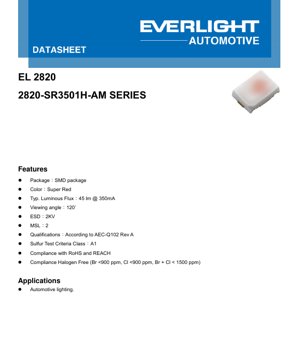
The 2820-SR3501H-AM series is a high-brightness, surface-mount Super Red LED specifically engineered for demanding automotive lighting applications. This component is part of a product family designed to meet stringent automotive-grade reliability and performance standards. Its primary function is to provide a reliable, efficient, and intense red light source for various signaling and illumination functions within a vehicle.
The core advantages of this LED include its qualification according to AEC-Q102 standards, ensuring robustness for the automotive environment, and its high luminous flux output of 45 lumens typical at a standard drive current. The device features a wide 120-degree viewing angle, making it suitable for applications requiring broad angular light distribution. It is compliant with RoHS, REACH, and halogen-free directives, reflecting modern environmental and safety regulations.
The target market is exclusively automotive lighting, including but not limited to interior ambient lighting, center high-mount stop lights (CHMSL), rear combination lamps, and other signal functions where a distinct red color and high reliability are paramount.
2. Technical Parameter Deep Dive
2.1 Photometric and Optical Characteristics
The photometric performance is centered around a typical luminous flux (Φv) of 45 lumens when driven at 350 mA. This measurement has a tolerance of ±8% and is taken with the thermal pad stabilized at 25°C. The dominant wavelength (λd) is typically 632 nm, defining its Super Red color point, with a specified range from 627 nm to 639 nm and a measurement tolerance of ±1 nm. The spatial light distribution is characterized by a wide viewing angle (2φ) of 120 degrees, with a tolerance of ±5 degrees. This wide beam is ideal for applications needing good visibility from various angles.
2.2 Electrical Characteristics
The forward voltage (VF) is a key electrical parameter, typically 2.45 V at 350 mA, with a range from 2.00 V to 2.75 V and a measurement tolerance of ±0.05 V. The device is rated for a continuous forward current (IF) up to 500 mA, with an absolute maximum of 1500 mA for surge conditions (pulse width ≤10 μs, duty cycle 0.005). It is crucial to note that this LED is not designed for reverse operation; applying a reverse voltage can cause immediate damage.
2.3 Thermal Characteristics
Thermal management is critical for LED performance and longevity. The junction-to-solder point thermal resistance (RthJS) is specified through two methods: a real measurement yielding 12.8 K/W typical (max 16.2 K/W) and an electrical measurement yielding 10 K/W typical (max 13 K/W). The maximum permissible junction temperature (TJ) is 150°C. The device can operate and be stored within an ambient temperature range of -40°C to +125°C. Proper heat sinking is essential to maintain the junction temperature within safe limits, especially when operating at higher currents.
2.4 Reliability and Environmental Ratings
The LED meets several key reliability benchmarks. It has an ESD sensitivity rating of 2 kV (Human Body Model, HBM), which is standard for automotive components. It is qualified according to AEC-Q102 Revision A, the global standard for discrete optoelectronic semiconductors in automotive applications. Furthermore, it meets Sulfur Test Criteria Class A1, indicating resistance to corrosive sulfur environments. The component is also compliant with RoHS, REACH, and is halogen-free (Br <900 ppm, Cl <900 ppm, Br+Cl <1500 ppm). Its Moisture Sensitivity Level (MSL) is 2.
3. Binning System Explanation
To ensure color and brightness consistency in production, LEDs are sorted into bins. The 2820-SR3501H-AM uses three independent binning criteria.
3.1 Luminous Flux Binning
LEDs are grouped based on their light output at 350 mA. The standard bin for this series is F3, with a luminous flux range of 39 lm (min) to 45 lm (max). Other available bins include F4 (45-52 lm) and F5 (52-60 lm). This allows designers to select a brightness level appropriate for their application.
3.2 Forward Voltage Binning
Forward voltage is binned to aid in circuit design and power supply matching. Bins include 2022 (2.00-2.25 V), 2225 (2.25-2.50 V), and 2527 (2.50-2.75 V). Knowing the VF bin helps predict power consumption and thermal load more accurately.
3.3 Dominant Wavelength Binning
The color (dominant wavelength) is tightly controlled through binning. Groups are defined as 2730 (627-630 nm), 3033 (630-633 nm), 3336 (633-636 nm), and 3639 (636-639 nm). This ensures minimal color shift between individual LEDs in an array, which is critical for aesthetic and signaling applications.
4. Performance Curve Analysis
4.1 IV Curve and Relative Luminous Flux
The Forward Current vs. Forward Voltage graph shows a characteristic exponential relationship. At 350 mA, the typical VF is 2.45V. The Relative Luminous Flux vs. Forward Current curve demonstrates that light output is sub-linear at lower currents and becomes more linear as current increases, approaching a plateau near the maximum rated current. This highlights the importance of driving the LED at or near its recommended current for optimal efficiency.
4.2 Temperature Dependence
The performance graphs clearly show the impact of temperature. The Relative Forward Voltage vs. Junction Temperature curve has a negative slope, meaning VF decreases as temperature increases (typically -2 mV/°C for red LEDs). This can be used for junction temperature monitoring. The Relative Luminous Flux vs. Junction Temperature curve shows light output decreasing significantly as temperature rises, a phenomenon known as thermal droop. The Relative Wavelength vs. Junction Temperature curve indicates a slight shift in dominant wavelength (typically 0.03-0.05 nm/°C for AlInGaP red LEDs) with temperature, which is generally minimal for this material system.
4.3 Forward Current Derating and Pulse Handling
The Forward Current Derating Curve is critical for thermal design. It shows the maximum allowable continuous forward current as a function of the solder pad temperature (TS). At the maximum operating TS of 125°C, the maximum IF is 500 mA. The current must be reduced at higher pad temperatures to prevent exceeding the 150°C junction limit. The Permissible Pulse Handling Capability graph provides guidance for pulsed operation, showing the peak pulse current (IFP) allowable for a given pulse width (tp) and duty cycle (D), with the solder point at 25°C.
4.4 Spectral Distribution
The Relative Spectral Distribution graph confirms the monochromatic nature of this Super Red LED. The emission is concentrated in a narrow band centered around 632 nm, with virtually no emission in the blue or green regions. This results in a highly saturated red color, ideal for automotive signal functions where color purity is regulated.
5. Mechanical and Package Information
5.1 Physical Dimensions
The LED uses a 2820 surface-mount device (SMD) package. The name denotes the approximate dimensions: 2.8 mm in length and 2.0 mm in width. The exact mechanical drawing provides detailed dimensions, including overall height, lens geometry, and lead frame placement. Tolerances are typically ±0.1 mm unless otherwise specified. The package is designed for compatibility with automated pick-and-place assembly equipment.
5.2 Recommended Soldering Pad Layout
A dedicated land pattern (footprint) is provided for PCB design. This pattern is optimized for reliable solder joint formation during reflow soldering and for effective heat transfer from the LED's thermal pad to the PCB. Adhering to this recommended layout is essential for mechanical stability, electrical performance, and most importantly, thermal management. The pad design includes exposed thermal vias or a copper pour to act as a heat sink.
5.3 Polarity Identification
The datasheet's mechanical drawing indicates the anode and cathode terminals. Typically, the package may have a marking such as a notch, a dot, or a chamfered corner to identify the cathode. Correct polarity must be observed during assembly, as reverse connection will prevent operation and likely damage the device.
6. Soldering and Assembly Guidelines
6.1 Reflow Soldering Profile
A detailed reflow soldering profile is provided to ensure reliable attachment without damaging the LED. The profile specifies key parameters: preheat slope, soak time and temperature, time above liquidus (TAL), peak temperature, and cooling rate. The absolute maximum soldering temperature is 260°C for 30 seconds. Following this profile is critical to avoid thermal shock, delamination, or solder joint defects.
6.2 Precautions for Use
General precautions include: avoiding mechanical stress on the lens, preventing contamination of the optical surface, using appropriate ESD handling procedures (as it is rated for 2kV HBM), and ensuring the device is stored in a dry environment according to its MSL 2 rating before use. The LED should not be operated below 50 mA as indicated on the derating curve.
6.3 Storage Conditions
Components should be stored in their original moisture-barrier bags with desiccant at temperatures between -40°C and +125°C, in a non-corrosive environment. Once the bag is opened, components rated MSL 2 must be assembled within a specific timeframe (typically 1 year at <30°C/60% RH) or be re-baked according to the manufacturer's instructions to remove absorbed moisture and prevent "popcorning" during reflow.
7. Packaging and Ordering Information
7.1 Packaging Specifications
The LEDs are supplied on tape and reel, which is the standard for automated SMD assembly. The packaging information details the reel dimensions, tape width, pocket spacing, and component orientation. This ensures compatibility with standard feeder systems on assembly lines.
7.2 Part Numbering System
The part number 2820-SR3501H-AM is deciphered as follows:
- 2820: Product family and package size (2.8mm x 2.0mm).
- SR: Color (Super Red).
- 350: Test current in milliamps (350 mA).
- 1: Lead frame type (1 = Gold-plated).
- H: Brightness level (H = High).
- AM: Designates Automotive application grade.
8. Application Recommendations
8.1 Typical Application Scenarios
The primary application is automotive lighting. Specific uses include:
- Exterior Signaling: Rear tail lights, brake lights, center high-mount stop lights (CHMSL), turn signals.
- Interior Lighting: Dashboard backlighting, switch illumination, ambient lighting, warning indicators.
8.2 Design Considerations
Driver Circuit: A constant-current driver is strongly recommended over a constant-voltage source to ensure stable light output and prevent thermal runaway. The driver should be designed to accommodate the VF bin range.
Thermal Management is the most critical aspect of design. The PCB must provide an adequate thermal path from the LED's solder pads to a heatsink or the board's ground plane. Use the provided thermal resistance (RthJS) and derating curve to calculate the necessary thermal design to keep TJ below 150°C under worst-case conditions.
Optical Design: The 120-degree viewing angle may require secondary optics (lenses, light guides) to shape the beam for specific applications like creating a uniform lit appearance or a focused signal.
9. Technical Comparison and Differentiation
Compared to standard commercial-grade red LEDs, the 2820-SR3501H-AM series offers distinct advantages for automotive use:
- Reliability: AEC-Q102 qualification involves rigorous stress testing (high temp operating life, temperature cycling, humidity resistance, etc.) far beyond commercial specs.
- Extended Temperature Range: Operation from -40°C to +125°C is essential for automotive environments, whereas commercial LEDs typically top out at +85°C.
- Color and Flux Binning: Tighter binning ensures consistency in appearance and performance across all units in a vehicle's lighting assembly.
- Sulfur Resistance: Class A1 sulfur test compliance protects against corrosion from sulfur-containing gases found in some automotive environments (e.g., from tires or certain seals).
- Traceability: Automotive-grade components typically have stricter traceability requirements throughout the supply chain.
10. Frequently Asked Questions (FAQ)
Q: Can I drive this LED directly from a 12V automotive battery?
A: No. The LED requires a constant current driver. Connecting it directly to 12V would cause catastrophic overcurrent and immediate failure. A driver circuit (linear or switching) that regulates current to 350 mA (or another desired level within spec) is mandatory.
Q: What is the purpose of the gold-plated lead frame (Type "1")?
A: Gold plating provides superior corrosion resistance and excellent solderability over time, which is important for long-term reliability in harsh automotive environments. It also ensures a stable, low-resistance electrical connection.
Q: How do I interpret the two different thermal resistance values (Real vs. Electrical)?
A: The "Real" value (12.8 K/W) is measured directly using a thermal test method. The "Electrical" value (10 K/W) is derived from the temperature-sensitive forward voltage characteristic. For conservative thermal design, it is advisable to use the higher "Real" value or the maximum specified value (16.2 K/W) in calculations.
Q: Is a heatsink always required?
A: It depends on the drive current, ambient temperature, and PCB design. At the full 500 mA current and/or in high ambient temperatures, an effective thermal path (via the PCB to a heatsink or large copper area) is absolutely necessary to stay within the junction temperature limit. At lower currents and in cool environments, the PCB itself may suffice.
11. Practical Design Case Study
Scenario: Designing a high-mounted brake light (CHMSL) array.
A designer needs to create a CHMSL using 10 LEDs. The goal is uniform brightness and color, operating from the vehicle's 12V system, with a maximum solder point temperature of 100°C.
Steps:
- Electrical Design: Choose a constant-current driver capable of supplying ~3.5A total (10 x 350mA). The driver output voltage must be higher than the sum of the maximum VF of the series string. For 10 LEDs in series with VF(max)=2.75V, the driver needs >27.5V output. Alternatively, use parallel strings with ballast resistors or individual drivers.
- Thermal Design: Using the derating curve, at TS=100°C, the max continuous IF is ~520 mA, so 350 mA is safe. Calculate the required thermal impedance from junction to ambient: ΔT = TJ(max) - TS = 150°C - 100°C = 50°C. Power per LED PD ≈ IF * VF = 0.35A * 2.45V = 0.8575W. Required RthJA ≤ ΔT / PD = 50°C / 0.8575W ≈ 58.3 K/W. Since RthJS is ~12.8 K/W, the PCB and environment must provide RthSA ≤ 45.5 K/W.
- Optical/Mechanical: Place LEDs on the PCB according to the recommended pad layout. Design a light guide or diffuser to blend the light from the 10 discrete sources into a single, uniform bar of light as required by regulations.
- Binning: Specify tight bins for luminous flux (e.g., F3 or F4) and dominant wavelength (e.g., 3033) to ensure all 10 LEDs match closely.
12. Operating Principle
The 2820-SR3501H-AM is based on an Aluminum Indium Gallium Phosphide (AlInGaP) semiconductor material system. When a forward voltage exceeding the material's bandgap energy is applied across the p-n junction, electrons and holes are injected into the active region. Their recombination releases energy in the form of photons (light). The specific composition of the AlInGaP layers is engineered to produce photons with a wavelength centered around 632 nm, which the human eye perceives as a saturated red color. The epoxy lens encapsulates the semiconductor chip, provides environmental protection, and shapes the emitted light into the 120-degree viewing angle.
13. Technology Trends
The trend in automotive LED lighting, including for red signal functions, is towards higher efficiency (more lumens per watt), increased power density (smaller packages with higher light output), and enhanced reliability. There is also a move towards integrated smart LED drivers with diagnostics and communication capabilities (e.g., via LIN or CAN bus). Furthermore, the push for standardized, scalable lighting modules is influencing package and optical design. The 2820 package represents a mature, reliable platform, while newer designs may focus on chip-scale packages (CSP) or integrated multi-chip modules for even greater design flexibility and performance.
LED Specification Terminology
Complete explanation of LED technical terms
Photoelectric Performance
| Term | Unit/Representation | Simple Explanation | Why Important |
|---|---|---|---|
| Luminous Efficacy | lm/W (lumens per watt) | Light output per watt of electricity, higher means more energy efficient. | Directly determines energy efficiency grade and electricity cost. |
| Luminous Flux | lm (lumens) | Total light emitted by source, commonly called "brightness". | Determines if the light is bright enough. |
| Viewing Angle | ° (degrees), e.g., 120° | Angle where light intensity drops to half, determines beam width. | Affects illumination range and uniformity. |
| CCT (Color Temperature) | K (Kelvin), e.g., 2700K/6500K | Warmth/coolness of light, lower values yellowish/warm, higher whitish/cool. | Determines lighting atmosphere and suitable scenarios. |
| CRI / Ra | Unitless, 0–100 | Ability to render object colors accurately, Ra≥80 is good. | Affects color authenticity, used in high-demand places like malls, museums. |
| SDCM | MacAdam ellipse steps, e.g., "5-step" | Color consistency metric, smaller steps mean more consistent color. | Ensures uniform color across same batch of LEDs. |
| Dominant Wavelength | nm (nanometers), e.g., 620nm (red) | Wavelength corresponding to color of colored LEDs. | Determines hue of red, yellow, green monochrome LEDs. |
| Spectral Distribution | Wavelength vs intensity curve | Shows intensity distribution across wavelengths. | Affects color rendering and quality. |
Electrical Parameters
| Term | Symbol | Simple Explanation | Design Considerations |
|---|---|---|---|
| Forward Voltage | Vf | Minimum voltage to turn on LED, like "starting threshold". | Driver voltage must be ≥Vf, voltages add up for series LEDs. |
| Forward Current | If | Current value for normal LED operation. | Usually constant current drive, current determines brightness & lifespan. |
| Max Pulse Current | Ifp | Peak current tolerable for short periods, used for dimming or flashing. | Pulse width & duty cycle must be strictly controlled to avoid damage. |
| Reverse Voltage | Vr | Max reverse voltage LED can withstand, beyond may cause breakdown. | Circuit must prevent reverse connection or voltage spikes. |
| Thermal Resistance | Rth (°C/W) | Resistance to heat transfer from chip to solder, lower is better. | High thermal resistance requires stronger heat dissipation. |
| ESD Immunity | V (HBM), e.g., 1000V | Ability to withstand electrostatic discharge, higher means less vulnerable. | Anti-static measures needed in production, especially for sensitive LEDs. |
Thermal Management & Reliability
| Term | Key Metric | Simple Explanation | Impact |
|---|---|---|---|
| Junction Temperature | Tj (°C) | Actual operating temperature inside LED chip. | Every 10°C reduction may double lifespan; too high causes light decay, color shift. |
| Lumen Depreciation | L70 / L80 (hours) | Time for brightness to drop to 70% or 80% of initial. | Directly defines LED "service life". |
| Lumen Maintenance | % (e.g., 70%) | Percentage of brightness retained after time. | Indicates brightness retention over long-term use. |
| Color Shift | Δu′v′ or MacAdam ellipse | Degree of color change during use. | Affects color consistency in lighting scenes. |
| Thermal Aging | Material degradation | Deterioration due to long-term high temperature. | May cause brightness drop, color change, or open-circuit failure. |
Packaging & Materials
| Term | Common Types | Simple Explanation | Features & Applications |
|---|---|---|---|
| Package Type | EMC, PPA, Ceramic | Housing material protecting chip, providing optical/thermal interface. | EMC: good heat resistance, low cost; Ceramic: better heat dissipation, longer life. |
| Chip Structure | Front, Flip Chip | Chip electrode arrangement. | Flip chip: better heat dissipation, higher efficacy, for high-power. |
| Phosphor Coating | YAG, Silicate, Nitride | Covers blue chip, converts some to yellow/red, mixes to white. | Different phosphors affect efficacy, CCT, and CRI. |
| Lens/Optics | Flat, Microlens, TIR | Optical structure on surface controlling light distribution. | Determines viewing angle and light distribution curve. |
Quality Control & Binning
| Term | Binning Content | Simple Explanation | Purpose |
|---|---|---|---|
| Luminous Flux Bin | Code e.g., 2G, 2H | Grouped by brightness, each group has min/max lumen values. | Ensures uniform brightness in same batch. |
| Voltage Bin | Code e.g., 6W, 6X | Grouped by forward voltage range. | Facilitates driver matching, improves system efficiency. |
| Color Bin | 5-step MacAdam ellipse | Grouped by color coordinates, ensuring tight range. | Guarantees color consistency, avoids uneven color within fixture. |
| CCT Bin | 2700K, 3000K etc. | Grouped by CCT, each has corresponding coordinate range. | Meets different scene CCT requirements. |
Testing & Certification
| Term | Standard/Test | Simple Explanation | Significance |
|---|---|---|---|
| LM-80 | Lumen maintenance test | Long-term lighting at constant temperature, recording brightness decay. | Used to estimate LED life (with TM-21). |
| TM-21 | Life estimation standard | Estimates life under actual conditions based on LM-80 data. | Provides scientific life prediction. |
| IESNA | Illuminating Engineering Society | Covers optical, electrical, thermal test methods. | Industry-recognized test basis. |
| RoHS / REACH | Environmental certification | Ensures no harmful substances (lead, mercury). | Market access requirement internationally. |
| ENERGY STAR / DLC | Energy efficiency certification | Energy efficiency and performance certification for lighting. | Used in government procurement, subsidy programs, enhances competitiveness. |