Table of Contents
- 1. Product Overview
- 1.1 Core Features and Advantages
- 1.2 Target Applications
- 2. Technical Specifications and In-Depth Analysis
- 2.1 Absolute Maximum Ratings
- 2.2 Electro-Optical Characteristics (Ta=25°C)
- 2.3 Binning System (IL Rank)
- 3. Performance Curve Analysis
- 3.1 Spectral Sensitivity
- 3.2 Temperature Dependence
- 3.3 Linearity and Dynamic Response
- 4. Mechanical and Package Information
- 4.1 Package Dimensions
- 4.2 Polarity Identification
- 5. Assembly and Handling Guidelines
- 5.1 Soldering
- 5.2 Storage and Handling
- 6. Packaging and Ordering Information
- 6.1 Packing Specifications
- 6.2 Label Information
- 7. Application Notes and Design Considerations
- 7.1 Circuit Configuration
- 7.2 Interface Electronics
- 7.3 Optical Considerations
- 8. Technical Comparison and Differentiation
- 9. Frequently Asked Questions (FAQs)
- 9.1 What is the difference between the ISC and IL parameters?
- 9.2 How do I select the correct bin for my application?
- 9.3 Can this sensor be used for visible light detection?
- 10. Operational Principle
- 11. Industry Trends
1. Product Overview
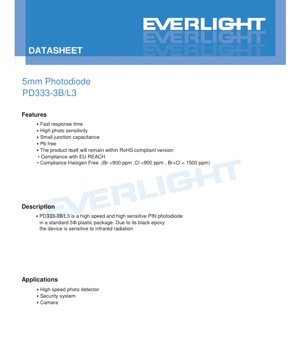
The PD333-3B/L3 is a high-performance silicon PIN photodiode encapsulated in a standard 5mm diameter plastic package. Its primary function is to convert incident light, particularly in the infrared spectrum, into an electrical current. The device is characterized by its fast response time and high photosensitivity, making it suitable for applications requiring precise and rapid light detection. The black epoxy lens material ensures optimal sensitivity to infrared radiation while providing a degree of ambient light filtering.
1.1 Core Features and Advantages
- Fast Response Time: Enables the detection of rapidly changing light signals, critical for high-speed communication and sensing.
- High Photo Sensitivity: Provides a strong electrical signal from low light levels, improving signal-to-noise ratio.
- Small Junction Capacitance: Contributes to the fast response time and allows for operation at higher frequencies.
- Environmental Compliance: The product is Pb-free, compliant with RoHS, EU REACH, and halogen-free standards (Br <900ppm, Cl <900ppm, Br+Cl <1500ppm).
- Standard Package: The 5mm form factor is widely used and compatible with common mounting hardware.
1.2 Target Applications
This photodiode is designed for use in various electronic systems where reliable light detection is paramount.
- High-speed photo detectors (e.g., in optical data links, encoders).
- Security and surveillance systems (e.g., beam break sensors, motion detectors).
- Camera systems (e.g., for exposure control, light metering).
- Industrial automation sensors.
- Consumer electronics with proximity or ambient light sensing.
2. Technical Specifications and In-Depth Analysis
2.1 Absolute Maximum Ratings
These ratings define the limits beyond which permanent damage to the device may occur. Operation under or at these limits is not guaranteed.
| Parameter | Symbol | Rating | Unit |
|---|---|---|---|
| Reverse Voltage | VR | 32 | V |
| Operating Temperature | Topr | -25 to +85 | °C |
| Storage Temperature | Tstg | -40 to +100 | °C |
| Soldering Temperature | Tsol | 260 | °C (for a limited time) |
| Power Dissipation | PC | 150 | mW |
Design Consideration: The reverse voltage rating of 32V provides a good safety margin for typical biasing circuits. The soldering temperature rating indicates compatibility with standard lead-free reflow processes, but time above liquidus must be controlled.
2.2 Electro-Optical Characteristics (Ta=25°C)
These parameters define the device's performance under specified test conditions.
| Parameter | Symbol | Min. | Typ. | Max. | Unit | Test Condition |
|---|---|---|---|---|---|---|
| Spectral Bandwidth (0.5 responsivity) | λ0.5 | 840 | -- | 1100 | nm | -- |
| Peak Sensitivity Wavelength | λP | -- | 940 | -- | nm | -- |
| Open-Circuit Voltage | VOC | -- | 0.44 | -- | V | Ee=5mW/cm², λp=940nm |
| Short-Circuit Current | ISC | -- | 10 | -- | μA | Ee=1mW/cm², λp=940nm |
| Reverse Light Current | IL | 10 | -- | -- | μA | Ee=1mW/cm², λp=940nm, VR=5V |
| Reverse Dark Current | ID | -- | -- | 10 | nA | Ee=0mW/cm², VR=10V |
| Reverse Breakdown Voltage | VBR | 32 | 170 | -- | V | Ee=0mW/cm², IR=100μA |
| Total Capacitance | Ct | -- | 10 | -- | pF | Ee=0mW/cm², VR=5V, f=1MHz |
| Rise / Fall Time | tr / tf | -- | 10 | -- | ns | VR=10V, RL=100Ω |
Technical Analysis: The spectral response from 840nm to 1100nm, peaking at 940nm, clearly identifies this as an infrared-sensitive device. The typical 10μA light current at 1mW/cm² irradiance defines its sensitivity. The low dark current (max 10nA) is crucial for detecting weak signals. The 10ns response time confirms its capability for high-speed applications. The junction capacitance of 10pF is a key factor determining the RC time constant of the detection circuit.
2.3 Binning System (IL Rank)
The photodiodes are sorted (binned) based on their Reverse Light Current (IL) measured under standard conditions (Ee=1mW/cm², λp=940nm, VR=5V). This ensures consistency in sensitivity for production batches.
| Bin Number | BIN1 | BIN2 | BIN3 | BIN4 |
|---|---|---|---|---|
| Min IL (μA) | 10 | 20 | 30 | 40 |
| Max IL (μA) | 20 | 30 | 40 | 50 |
Design Implication: For applications requiring tight sensitivity matching across multiple sensors, specifying a particular bin or a mix of bins may be necessary to maintain system performance uniformity.
3. Performance Curve Analysis
The datasheet provides several characteristic curves that illustrate how key parameters vary with operating conditions.
3.1 Spectral Sensitivity
The spectral response curve shows the device's relative sensitivity across wavelengths. It peaks at 940nm (near-infrared) and has significant response between approximately 840nm and 1100nm. This makes it ideal for use with common 850nm or 940nm infrared LEDs. The black lens helps attenuate visible light, reducing noise from ambient sources.
3.2 Temperature Dependence
Two key curves illustrate temperature effects: Reverse Dark Current vs. Ambient Temperature: Dark current (ID) increases exponentially with temperature. This is a fundamental semiconductor property. At elevated temperatures (e.g., near the maximum operating temperature of 85°C), the dark current can become significant, potentially masking weak optical signals. Designers must account for this in high-temperature environments. Power Dissipation vs. Ambient Temperature: The maximum allowable power dissipation decreases as ambient temperature rises. This derating curve is essential for ensuring the device does not overheat under its own electrical load, though for photodiodes operating primarily in photovoltaic or low-current modes, this is often less critical than for power devices.
3.3 Linearity and Dynamic Response
Reverse Light Current vs. Irradiance (Ee): This curve typically shows a linear relationship between incident light power and generated photocurrent over several decades. This linearity is a key advantage of PIN photodiodes for light measurement applications. Terminal Capacitance vs. Reverse Voltage: The junction capacitance (Ct) decreases with increasing reverse bias voltage. A lower capacitance results in a smaller RC time constant, enabling faster circuit response. Designers can trade off higher bias voltage (and thus slightly higher dark current) for improved speed. Response Time vs. Load Resistance: The rise/fall time (tr/tf) increases with larger load resistance (RL) due to the larger RC constant formed by the photodiode's junction capacitance and the load. For high-speed applications, a low-value load resistor or a transimpedance amplifier configuration is preferred.
4. Mechanical and Package Information
4.1 Package Dimensions
The device uses a standard radial-leaded 5mm diameter package. The dimensional drawing specifies the body diameter, lead spacing, lead diameter, and overall dimensions. A typical tolerance of ±0.25mm is applied unless otherwise noted on specific dimensions. The package is made of black plastic (epoxy) with a lens on top.
4.2 Polarity Identification
The cathode is typically identified by a longer lead, a flat spot on the package rim, or other marking as per the package drawing. Correct polarity must be observed when connecting the device in a circuit, with the cathode connected to the more positive voltage when reverse-biased.
5. Assembly and Handling Guidelines
5.1 Soldering
The device can withstand a peak soldering temperature of 260°C, which aligns with common lead-free reflow profiles. However, the duration of exposure to temperatures above the solder's liquidus point should be minimized to prevent thermal stress on the package and the semiconductor die. Hand soldering with a temperature-controlled iron is also acceptable, with care taken to limit lead heating time.
5.2 Storage and Handling
Devices should be stored in their original moisture-barrier bags in an environment within the storage temperature range (-40°C to +100°C) and at low humidity. Standard ESD (Electrostatic Discharge) precautions should be observed during handling, as the semiconductor junction can be damaged by static electricity.
6. Packaging and Ordering Information
6.1 Packing Specifications
The standard packing format is:
- 200 to 500 pieces per bag.
- 5 bags per inner box.
- 10 boxes per master carton.
6.2 Label Information
The product label contains key information for traceability and identification:
- P/N: Product Number (e.g., PD333-3B/L3).
- CAT: Luminous Intensity Rank (corresponds to the IL Bin).
- LOT No: Manufacturing Lot Number for traceability.
- Date code information.
7. Application Notes and Design Considerations
7.1 Circuit Configuration
PIN photodiodes can be used in two primary modes: Photovoltaic Mode (Zero Bias): The diode is not externally biased. It generates a voltage and current when illuminated. This mode offers very low dark current and good linearity at low light levels but has slower response due to higher junction capacitance. Photoconductive Mode (Reverse Bias): A reverse voltage is applied. This reduces junction capacitance (speeding up response) and widens the depletion region (improving efficiency). It is the preferred mode for high-speed and high-linearity applications, though dark current is higher.
7.2 Interface Electronics
For current output, a transimpedance amplifier (TIA) is often used to convert the photodiode's small current into a usable voltage signal while maintaining a virtual short across the diode (keeping it effectively at zero bias). For voltage output in photovoltaic mode, a high-input-impedance amplifier (e.g., JFET or CMOS input op-amp) should be used to avoid loading the signal.
7.3 Optical Considerations
To maximize performance:
- Align the infrared light source to the peak sensitivity wavelength (940nm).
- Use appropriate optical filters to block unwanted ambient light, especially if operating in environments with strong visible light sources.
- Consider the angular sensitivity of the photodiode; the package lens has a specific viewing angle.
8. Technical Comparison and Differentiation
Compared to phototransistors, the PD333-3B/L3 PIN photodiode offers:
- Faster Response: Photodiodes are inherently faster than phototransistors due to the absence of charge storage effects associated with transistor gain.
- Better Linearity: The photocurrent is more linearly proportional to light intensity across a wider range.
- Lower Noise: Generally has lower noise performance, beneficial for detecting weak signals.
- No Internal Gain: Provides only unity gain (one electron-hole pair per photon, ideally), requiring external amplification, whereas phototransistors provide internal current gain (beta).
9. Frequently Asked Questions (FAQs)
9.1 What is the difference between the ISC and IL parameters?
Short-Circuit Current (ISC): Measured with zero volts across the diode (photovoltaic mode). It represents the maximum photocurrent the device can generate under given illumination. Reverse Light Current (IL): Measured with a specified reverse bias voltage applied (photoconductive mode). This is the parameter used for the binning system and is often the relevant operating current in practical circuits.
9.2 How do I select the correct bin for my application?
If your circuit design has a fixed gain and requires a specific output signal level for a given light input, choose a bin that provides the necessary IL range. For applications using feedback or automatic gain control, a wider bin or any bin may be acceptable. For multi-sensor arrays, specifying a single tight bin ensures uniformity.
9.3 Can this sensor be used for visible light detection?
While it has some residual sensitivity in the visible red spectrum (near 700nm), its response is optimized for near-infrared (840-1100nm). The black lens further attenuates visible light. For primary visible light detection, a photodiode with a clear lens and a spectral peak in the visible range (e.g., 550nm for green) would be more appropriate.
10. Operational Principle
A PIN photodiode is a semiconductor device with a wide, lightly doped intrinsic (I) region sandwiched between P-type and N-type regions. When photons with energy greater than the semiconductor's bandgap are absorbed in the intrinsic region, they create electron-hole pairs. Under the influence of the built-in electric field (in photovoltaic mode) or an applied reverse bias field (in photoconductive mode), these charge carriers are swept apart, generating a measurable photocurrent that is proportional to the incident light intensity. The wide intrinsic region allows for efficient photon absorption and reduces junction capacitance, enabling high-speed operation.
11. Industry Trends
The market for infrared photodiodes continues to grow, driven by applications in:
- Automotive: LiDAR for autonomous driving, in-cabin occupancy sensing.
- Consumer Electronics: Proximity sensors, facial recognition, heart-rate monitoring in wearables.
- Industrial IoT: Machine vision, condition monitoring, level sensing.
- Communications: Short-range optical data links (VLC, IRDA).
Disclaimer: The information provided in this technical document is based on the referenced datasheet and is for informational purposes only. Specifications are subject to change. Always refer to the latest official documentation for critical design work. The graphs and typical values do not represent guaranteed specifications. The manufacturer assumes no liability for applications not adhering to the absolute maximum ratings or proper usage guidelines.
LED Specification Terminology
Complete explanation of LED technical terms
Photoelectric Performance
| Term | Unit/Representation | Simple Explanation | Why Important |
|---|---|---|---|
| Luminous Efficacy | lm/W (lumens per watt) | Light output per watt of electricity, higher means more energy efficient. | Directly determines energy efficiency grade and electricity cost. |
| Luminous Flux | lm (lumens) | Total light emitted by source, commonly called "brightness". | Determines if the light is bright enough. |
| Viewing Angle | ° (degrees), e.g., 120° | Angle where light intensity drops to half, determines beam width. | Affects illumination range and uniformity. |
| CCT (Color Temperature) | K (Kelvin), e.g., 2700K/6500K | Warmth/coolness of light, lower values yellowish/warm, higher whitish/cool. | Determines lighting atmosphere and suitable scenarios. |
| CRI / Ra | Unitless, 0–100 | Ability to render object colors accurately, Ra≥80 is good. | Affects color authenticity, used in high-demand places like malls, museums. |
| SDCM | MacAdam ellipse steps, e.g., "5-step" | Color consistency metric, smaller steps mean more consistent color. | Ensures uniform color across same batch of LEDs. |
| Dominant Wavelength | nm (nanometers), e.g., 620nm (red) | Wavelength corresponding to color of colored LEDs. | Determines hue of red, yellow, green monochrome LEDs. |
| Spectral Distribution | Wavelength vs intensity curve | Shows intensity distribution across wavelengths. | Affects color rendering and quality. |
Electrical Parameters
| Term | Symbol | Simple Explanation | Design Considerations |
|---|---|---|---|
| Forward Voltage | Vf | Minimum voltage to turn on LED, like "starting threshold". | Driver voltage must be ≥Vf, voltages add up for series LEDs. |
| Forward Current | If | Current value for normal LED operation. | Usually constant current drive, current determines brightness & lifespan. |
| Max Pulse Current | Ifp | Peak current tolerable for short periods, used for dimming or flashing. | Pulse width & duty cycle must be strictly controlled to avoid damage. |
| Reverse Voltage | Vr | Max reverse voltage LED can withstand, beyond may cause breakdown. | Circuit must prevent reverse connection or voltage spikes. |
| Thermal Resistance | Rth (°C/W) | Resistance to heat transfer from chip to solder, lower is better. | High thermal resistance requires stronger heat dissipation. |
| ESD Immunity | V (HBM), e.g., 1000V | Ability to withstand electrostatic discharge, higher means less vulnerable. | Anti-static measures needed in production, especially for sensitive LEDs. |
Thermal Management & Reliability
| Term | Key Metric | Simple Explanation | Impact |
|---|---|---|---|
| Junction Temperature | Tj (°C) | Actual operating temperature inside LED chip. | Every 10°C reduction may double lifespan; too high causes light decay, color shift. |
| Lumen Depreciation | L70 / L80 (hours) | Time for brightness to drop to 70% or 80% of initial. | Directly defines LED "service life". |
| Lumen Maintenance | % (e.g., 70%) | Percentage of brightness retained after time. | Indicates brightness retention over long-term use. |
| Color Shift | Δu′v′ or MacAdam ellipse | Degree of color change during use. | Affects color consistency in lighting scenes. |
| Thermal Aging | Material degradation | Deterioration due to long-term high temperature. | May cause brightness drop, color change, or open-circuit failure. |
Packaging & Materials
| Term | Common Types | Simple Explanation | Features & Applications |
|---|---|---|---|
| Package Type | EMC, PPA, Ceramic | Housing material protecting chip, providing optical/thermal interface. | EMC: good heat resistance, low cost; Ceramic: better heat dissipation, longer life. |
| Chip Structure | Front, Flip Chip | Chip electrode arrangement. | Flip chip: better heat dissipation, higher efficacy, for high-power. |
| Phosphor Coating | YAG, Silicate, Nitride | Covers blue chip, converts some to yellow/red, mixes to white. | Different phosphors affect efficacy, CCT, and CRI. |
| Lens/Optics | Flat, Microlens, TIR | Optical structure on surface controlling light distribution. | Determines viewing angle and light distribution curve. |
Quality Control & Binning
| Term | Binning Content | Simple Explanation | Purpose |
|---|---|---|---|
| Luminous Flux Bin | Code e.g., 2G, 2H | Grouped by brightness, each group has min/max lumen values. | Ensures uniform brightness in same batch. |
| Voltage Bin | Code e.g., 6W, 6X | Grouped by forward voltage range. | Facilitates driver matching, improves system efficiency. |
| Color Bin | 5-step MacAdam ellipse | Grouped by color coordinates, ensuring tight range. | Guarantees color consistency, avoids uneven color within fixture. |
| CCT Bin | 2700K, 3000K etc. | Grouped by CCT, each has corresponding coordinate range. | Meets different scene CCT requirements. |
Testing & Certification
| Term | Standard/Test | Simple Explanation | Significance |
|---|---|---|---|
| LM-80 | Lumen maintenance test | Long-term lighting at constant temperature, recording brightness decay. | Used to estimate LED life (with TM-21). |
| TM-21 | Life estimation standard | Estimates life under actual conditions based on LM-80 data. | Provides scientific life prediction. |
| IESNA | Illuminating Engineering Society | Covers optical, electrical, thermal test methods. | Industry-recognized test basis. |
| RoHS / REACH | Environmental certification | Ensures no harmful substances (lead, mercury). | Market access requirement internationally. |
| ENERGY STAR / DLC | Energy efficiency certification | Energy efficiency and performance certification for lighting. | Used in government procurement, subsidy programs, enhances competitiveness. |