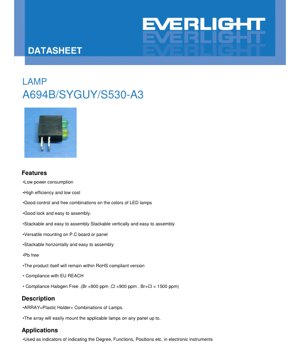
1. Product Overview
The A694B/SYGUY/S530-A3 is a versatile LED array indicator lamp designed for use in electronic instruments. It consists of a plastic holder that allows for combinations of individual LED lamps, providing flexibility in design and application. The primary function of this product is to serve as a visual indicator for various parameters such as degree, function, or position within electronic equipment.
1.1 Core Advantages
- Low power consumption, making it suitable for energy-sensitive applications.
- High efficiency and low cost, offering a cost-effective solution for indicator needs.
- Excellent color control and the ability to create free combinations of LED lamp colors within the array.
- Secure locking mechanism and easy assembly process.
- Stackable design, allowing for vertical and horizontal stacking to create multi-indicator panels.
- Versatile mounting options on printed circuit boards or panels.
- Compliant with environmental standards: Pb-free, RoHS compliant, EU REACH compliant, and Halogen Free (Br <900 ppm, Cl <900 ppm, Br+Cl < 1500 ppm).
1.2 Target Market and Applications
This LED array is primarily targeted at manufacturers of electronic instruments and control panels. Its main application is as an indicator for displaying status, levels, functions, or positions. Examples include signal strength indicators on communication devices, mode selectors on industrial controllers, or level indicators on test and measurement equipment.
2. Technical Parameters and Objective Interpretation
The datasheet provides detailed electrical, optical, and thermal specifications for the device. Two primary chip materials and their corresponding emitted colors are specified: Brilliant Yellow Green (SYG) and Brilliant Yellow (UY).
2.1 Absolute Maximum Ratings
These ratings define the limits beyond which permanent damage to the device may occur. They are not intended for normal operation.
- Continuous Forward Current (IF): 25 mA for both SYG and UY types. Exceeding this current can lead to overheating and reduced lifespan.
- Peak Forward Current (IFP): 60 mA (Duty 1/10 @ 1kHz). This rating is for pulsed operation only.
- Reverse Voltage (VR): 5 V. Applying a higher reverse voltage can cause junction breakdown.
- Power Dissipation (Pd): 60 mW. This is the maximum power the device can dissipate without exceeding its maximum junction temperature.
- Operating & Storage Temperature: -40°C to +85°C (operating), -40°C to +100°C (storage).
- Soldering Temperature: 260°C for 5 seconds, defining the reflow soldering profile tolerance.
2.2 Electro-Optical Characteristics
These are the typical performance parameters measured at 25°C under specified test conditions.
- Forward Voltage (VF): 1.7V to 2.4V at IF=20mA. Designers must ensure the driving circuit can provide this voltage.
- Luminous Intensity (IV): SYG: 25-50 mcd (Typ. 50 mcd). UY: 40-80 mcd (Typ. 80 mcd). This indicates the UY variant is generally brighter under the same test conditions.
- Viewing Angle (2θ1/2): 60 degrees (typical) for both, defining the angular spread of light.
- Peak Wavelength (λp): SYG: 575 nm (Yellow-Green). UY: 591 nm (Yellow).
- Dominant Wavelength (λd): SYG: 573 nm. UY: 589 nm. This is the wavelength perceived by the human eye.
- Spectrum Radiation Bandwidth (Δλ): 20 nm (typical), indicating the spectral purity of the emitted light.
3. Performance Curve Analysis
The datasheet includes several characteristic curves that are crucial for understanding device behavior under different operating conditions.
3.1 Relative Intensity vs. Wavelength
These curves for SYG and UY show the spectral distribution of light. The SYG curve peaks around 575nm (green-yellow), while the UY peaks around 591nm (yellow). The bandwidth of approximately 20nm confirms the monochromatic nature of the LEDs.
3.2 Directivity Pattern
The polar plots illustrate the viewing angle. The intensity is highest at 0 degrees (on-axis) and decreases to half its maximum value at approximately ±30 degrees, confirming the 60-degree full viewing angle.
3.3 Forward Current vs. Forward Voltage (I-V Curve)
This curve shows the exponential relationship typical of a diode. The voltage rises sharply once a certain threshold is passed (around 1.5V-1.7V). Operating at the recommended 20mA ensures stable performance within the typical VF range.
3.4 Relative Intensity vs. Forward Current
The light output increases linearly with current up to the maximum rated current. This allows for simple brightness control via current modulation (e.g., using PWM).
3.5 Temperature Dependence Curves
Relative Intensity vs. Ambient Temperature: Shows that luminous intensity decreases as ambient temperature increases. This is a critical consideration for high-temperature environments.
Forward Current vs. Ambient Temperature: Indicates the forward voltage has a negative temperature coefficient (decreases with increasing temperature), which must be accounted for in constant-current driver designs to prevent thermal runaway.
4. Mechanical and Package Information
4.1 Package Dimensions
The datasheet provides a detailed mechanical drawing. Key dimensions include the lead spacing, body size, and overall height. The note specifies that all dimensions are in millimeters with a general tolerance of ±0.25mm unless otherwise stated, and lead spacing is measured at the point where leads emerge from the package.
4.2 Polarity Identification and Lead Forming
The package drawing indicates the cathode (typically the shorter lead or a flat side on the lens). For lead forming, the document mandates bending at least 3mm from the base of the epoxy bulb to prevent stress damage. Leads must be formed before soldering, and the PCB holes must align perfectly with the LED leads to avoid mounting stress.
5. Soldering and Assembly Guidelines
5.1 Recommended Soldering Conditions
- Hand Soldering: Iron tip temperature: 300°C max (30W max). Soldering time: 3 seconds max. Maintain a minimum distance of 3mm from the solder joint to the epoxy bulb.
- Wave/DIP Soldering: Preheat temperature: 100°C max (60 sec max). Solder bath temperature: 260°C max for 5 seconds max. Maintain the same 3mm distance rule.
5.2 Soldering Profile
A recommended temperature-time profile is provided, emphasizing a controlled ramp-up, a peak temperature not exceeding 260°C for 5 seconds, and a controlled cooldown. A rapid cooling process is not recommended.
5.3 Critical Precautions
- Avoid stress on the lead frame during high-temperature operations.
- Do not perform dip or hand soldering more than once.
- Protect the epoxy bulb from mechanical shock until it returns to room temperature after soldering.
5.4 Storage Conditions
LEDs should be stored at ≤30°C and ≤70% Relative Humidity. The storage life from shipment is 3 months. For longer storage (up to 1 year), use a sealed container with a nitrogen atmosphere and moisture absorbent. Avoid rapid temperature transitions in humid environments to prevent condensation.
6. Packaging and Ordering Information
6.1 Packing Specification
The components are packed in moisture-resistant materials: anti-static bags, inner cartons, and outside cartons.
- Packing Quantity: 270 pieces per plate. 4 plates per inner carton. 10 inner cartons per outside carton (Total: 10,800 pieces per master carton).
6.2 Label Explanation
The label on the packaging includes fields such as Customer's Production Number (CPN), Production Number (P/N), Packing Quantity (QTY), Ranks (CAT), Dominant Wavelength (HUE), Forward Voltage (REF), and Lot Number (LOT No). This facilitates traceability and correct part identification.
7. Application Suggestions and Design Considerations
7.1 Typical Application Scenarios
- Status indicators on network switches, routers, and modems.
- Level indicators on audio equipment, power supplies, or battery chargers.
- Function mode selectors on industrial control panels and medical devices.
- Position indicators on switches, knobs, or sliders.
7.2 Design Considerations
- Current Limiting: Always use a series resistor or constant-current driver to limit the forward current to 20mA or less for continuous operation.
- Thermal Management: Although low power, ensure adequate ventilation if used in high-density arrays or high ambient temperatures to maintain brightness and longevity.
- ESD Protection:** Handle with appropriate ESD precautions during assembly.
- Optical Design: The 60-degree viewing angle is suitable for direct viewing. For wider illumination, secondary optics (diffusers) may be required.
8. Technical Comparison and Differentiation
Compared to discrete single LEDs, this array offers significant advantages:
- Ease of Assembly: The pre-assembled array on a holder simplifies PCB layout and assembly compared to placing multiple individual LEDs.
- Alignment and Consistency: Provides uniform spacing and alignment of multiple indicators, improving aesthetic and functional consistency.
- Design Flexibility: The stackable feature allows for creating custom-sized indicator bars or panels without complex mechanical design.
- Environmental Compliance: Meets modern environmental standards (RoHS, Halogen-Free), which may not be guaranteed with older or generic discrete LEDs.
9. Frequently Asked Questions (Based on Technical Parameters)
Q: Can I drive this LED array directly from a 5V or 3.3V logic supply?
A: No. You must use a current-limiting resistor. For example, with a 5V supply and a typical VF of 2.0V at 20mA, the required series resistor is R = (5V - 2.0V) / 0.02A = 150 Ω.
Q: What is the difference between SYG and UY types?
A: The SYG (Brilliant Yellow Green) emits light at a peak wavelength of ~575nm (green-yellow), while the UY (Brilliant Yellow) emits at ~591nm (yellow). The UY variant also has a higher typical luminous intensity (80 mcd vs. 50 mcd).
Q: Is this product suitable for outdoor applications?
A: The operating temperature range is -40°C to +85°C, which covers many outdoor conditions. However, the device is not inherently waterproof. For outdoor use, it must be housed in a sealed enclosure that protects it from moisture and UV radiation, which can degrade the epoxy resin over time.
Q: How do I interpret the 'Ranks' (CAT) on the label?
A> Ranks typically bin LEDs based on specific parameters like luminous intensity or forward voltage. Consult the manufacturer's full binning specification document (not provided in this excerpt) to select the correct rank for your application's consistency requirements.
10. Practical Use Case
Scenario: Designing a multi-level battery charge indicator for a portable device.
An engineer can use the stackable feature of this LED array. For a 5-level indicator, five individual LED positions within the array or five vertically/horizontally stacked arrays can be used. Each level is driven by a comparator circuit monitoring the battery voltage. The consistent spacing and color provided by the array ensure a professional and readable display. The low power consumption is critical for battery-operated devices. The design would involve calculating appropriate current-limiting resistors for each LED based on the driver circuit's voltage and ensuring the total current draw from the battery during indication is within acceptable limits.
11. Operating Principle Introduction
Light Emitting Diodes (LEDs) are semiconductor devices that emit light when an electric current passes through them. This phenomenon is called electroluminescence. When a forward voltage is applied across the p-n junction of the semiconductor material (AlGaInP in this case), electrons recombine with holes within the device, releasing energy in the form of photons. The specific wavelength (color) of the light is determined by the energy bandgap of the semiconductor material. The plastic holder (array) serves as a mechanical carrier and electrical interconnect, allowing multiple individual LED chips to be mounted and wired conveniently.
12. Technology Trends
The indicator LED market continues to evolve. Trends relevant to products like this array include:
- Increased Efficiency: Ongoing development of semiconductor materials and chip designs leads to higher luminous efficacy (more light output per watt), allowing for lower operating currents and reduced power consumption.
- Miniaturization: While this is a through-hole component, there is a general industry trend towards smaller surface-mount device (SMD) packages for higher density and automated assembly.
- Enhanced Reliability: Improvements in epoxy resin formulations and packaging techniques continue to extend operational lifespans and improve resistance to thermal cycling and humidity.
- Smart Integration: A broader trend is the integration of control logic and drivers directly with LED indicators, creating 'smart' indicator modules, though this specific product remains a passive component.
LED Specification Terminology
Complete explanation of LED technical terms
Photoelectric Performance
| Term | Unit/Representation | Simple Explanation | Why Important |
|---|---|---|---|
| Luminous Efficacy | lm/W (lumens per watt) | Light output per watt of electricity, higher means more energy efficient. | Directly determines energy efficiency grade and electricity cost. |
| Luminous Flux | lm (lumens) | Total light emitted by source, commonly called "brightness". | Determines if the light is bright enough. |
| Viewing Angle | ° (degrees), e.g., 120° | Angle where light intensity drops to half, determines beam width. | Affects illumination range and uniformity. |
| CCT (Color Temperature) | K (Kelvin), e.g., 2700K/6500K | Warmth/coolness of light, lower values yellowish/warm, higher whitish/cool. | Determines lighting atmosphere and suitable scenarios. |
| CRI / Ra | Unitless, 0–100 | Ability to render object colors accurately, Ra≥80 is good. | Affects color authenticity, used in high-demand places like malls, museums. |
| SDCM | MacAdam ellipse steps, e.g., "5-step" | Color consistency metric, smaller steps mean more consistent color. | Ensures uniform color across same batch of LEDs. |
| Dominant Wavelength | nm (nanometers), e.g., 620nm (red) | Wavelength corresponding to color of colored LEDs. | Determines hue of red, yellow, green monochrome LEDs. |
| Spectral Distribution | Wavelength vs intensity curve | Shows intensity distribution across wavelengths. | Affects color rendering and quality. |
Electrical Parameters
| Term | Symbol | Simple Explanation | Design Considerations |
|---|---|---|---|
| Forward Voltage | Vf | Minimum voltage to turn on LED, like "starting threshold". | Driver voltage must be ≥Vf, voltages add up for series LEDs. |
| Forward Current | If | Current value for normal LED operation. | Usually constant current drive, current determines brightness & lifespan. |
| Max Pulse Current | Ifp | Peak current tolerable for short periods, used for dimming or flashing. | Pulse width & duty cycle must be strictly controlled to avoid damage. |
| Reverse Voltage | Vr | Max reverse voltage LED can withstand, beyond may cause breakdown. | Circuit must prevent reverse connection or voltage spikes. |
| Thermal Resistance | Rth (°C/W) | Resistance to heat transfer from chip to solder, lower is better. | High thermal resistance requires stronger heat dissipation. |
| ESD Immunity | V (HBM), e.g., 1000V | Ability to withstand electrostatic discharge, higher means less vulnerable. | Anti-static measures needed in production, especially for sensitive LEDs. |
Thermal Management & Reliability
| Term | Key Metric | Simple Explanation | Impact |
|---|---|---|---|
| Junction Temperature | Tj (°C) | Actual operating temperature inside LED chip. | Every 10°C reduction may double lifespan; too high causes light decay, color shift. |
| Lumen Depreciation | L70 / L80 (hours) | Time for brightness to drop to 70% or 80% of initial. | Directly defines LED "service life". |
| Lumen Maintenance | % (e.g., 70%) | Percentage of brightness retained after time. | Indicates brightness retention over long-term use. |
| Color Shift | Δu′v′ or MacAdam ellipse | Degree of color change during use. | Affects color consistency in lighting scenes. |
| Thermal Aging | Material degradation | Deterioration due to long-term high temperature. | May cause brightness drop, color change, or open-circuit failure. |
Packaging & Materials
| Term | Common Types | Simple Explanation | Features & Applications |
|---|---|---|---|
| Package Type | EMC, PPA, Ceramic | Housing material protecting chip, providing optical/thermal interface. | EMC: good heat resistance, low cost; Ceramic: better heat dissipation, longer life. |
| Chip Structure | Front, Flip Chip | Chip electrode arrangement. | Flip chip: better heat dissipation, higher efficacy, for high-power. |
| Phosphor Coating | YAG, Silicate, Nitride | Covers blue chip, converts some to yellow/red, mixes to white. | Different phosphors affect efficacy, CCT, and CRI. |
| Lens/Optics | Flat, Microlens, TIR | Optical structure on surface controlling light distribution. | Determines viewing angle and light distribution curve. |
Quality Control & Binning
| Term | Binning Content | Simple Explanation | Purpose |
|---|---|---|---|
| Luminous Flux Bin | Code e.g., 2G, 2H | Grouped by brightness, each group has min/max lumen values. | Ensures uniform brightness in same batch. |
| Voltage Bin | Code e.g., 6W, 6X | Grouped by forward voltage range. | Facilitates driver matching, improves system efficiency. |
| Color Bin | 5-step MacAdam ellipse | Grouped by color coordinates, ensuring tight range. | Guarantees color consistency, avoids uneven color within fixture. |
| CCT Bin | 2700K, 3000K etc. | Grouped by CCT, each has corresponding coordinate range. | Meets different scene CCT requirements. |
Testing & Certification
| Term | Standard/Test | Simple Explanation | Significance |
|---|---|---|---|
| LM-80 | Lumen maintenance test | Long-term lighting at constant temperature, recording brightness decay. | Used to estimate LED life (with TM-21). |
| TM-21 | Life estimation standard | Estimates life under actual conditions based on LM-80 data. | Provides scientific life prediction. |
| IESNA | Illuminating Engineering Society | Covers optical, electrical, thermal test methods. | Industry-recognized test basis. |
| RoHS / REACH | Environmental certification | Ensures no harmful substances (lead, mercury). | Market access requirement internationally. |
| ENERGY STAR / DLC | Energy efficiency certification | Energy efficiency and performance certification for lighting. | Used in government procurement, subsidy programs, enhances competitiveness. |