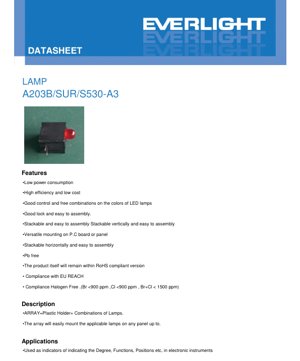
1. Product Overview
The A203B/SUR/S530-A3 is a low-power, high-efficiency LED lamp array designed primarily for use as an indicator in electronic instruments. The product consists of a plastic holder combined with individual LED lamps, forming a versatile array that can be easily mounted on printed circuit boards or panels. Its core advantages include minimal power consumption, cost-effectiveness, and excellent design flexibility for color combinations. The target market encompasses manufacturers of consumer electronics, industrial control panels, instrumentation, and any application requiring clear, reliable status or function indication.
1.1 Core Features and Advantages
- Low Power Consumption: Optimized for energy-efficient operation, making it suitable for battery-powered or power-sensitive devices.
- High Efficiency and Low Cost: Provides bright luminous output relative to its input power, offering a favorable performance-to-cost ratio.
- Design Flexibility: Allows for good control and free combinations of LED colors within the array, enabling customized indicator solutions.
- Mechanical Design: Features a secure locking mechanism and is designed for easy assembly. The array is stackable both vertically and horizontally, facilitating space-efficient and modular designs.
- Versatile Mounting: Can be mounted on PCBs or panels with ease.
- Environmental Compliance: The product is lead-free (Pb-free), complies with the RoHS directive, meets EU REACH requirements, and is halogen-free (Br <900 ppm, Cl <900 ppm, Br+Cl < 1500 ppm).
2. Technical Parameter Analysis
This section provides a detailed, objective interpretation of the key electrical, optical, and thermal parameters specified in the datasheet.
2.1 Absolute Maximum Ratings
These ratings define the limits beyond which permanent damage to the device may occur. Operation under or at these limits is not guaranteed.
- Continuous Forward Current (IF): 25 mA. This is the maximum DC current that can be continuously applied to the LED.
- Peak Forward Current (IFP): 60 mA (Duty 1/10 @ 1kHz). Short pulses of higher current are permissible under specific pulsed conditions.
- Reverse Voltage (VR): 5 V. Exceeding this voltage in reverse bias can cause junction breakdown.
- Power Dissipation (Pd): 60 mW. The maximum power the package can dissipate at Ta=25°C.
- Operating Temperature (Topr): -40 to +85 °C. The ambient temperature range for reliable operation.
- Storage Temperature (Tstg): -40 to +100 °C.
- Soldering Temperature (Tsol): 260 °C for 5 seconds. Defines the reflow soldering profile tolerance.
2.2 Electro-Optical Characteristics
These are typical performance parameters measured at Ta=25°C and IF=20mA, unless otherwise stated.
- Forward Voltage (VF): 2.0V (Typ.), with a range of 1.7V to 2.4V. This is the voltage drop across the LED when operating. Designers must ensure the driving circuit can provide this voltage.
- Luminous Intensity (IV): 200 mcd (Typ.), with a minimum of 100 mcd. This quantifies the perceived brightness of the red light output.
- Viewing Angle (2θ1/2): 30 degrees (Typ.). This defines the angular spread where the luminous intensity is at least half of the peak intensity. A 30-degree angle indicates a relatively focused beam, suitable for directional indication.
- Peak Wavelength (λp): 632 nm (Typ.). The wavelength at which the optical output power is greatest.
- Dominant Wavelength (λd): 624 nm (Typ.). The single wavelength perceived by the human eye, defining the color as \"Brilliant Red.\"
- Spectrum Radiation Bandwidth (Δλ): 20 nm (Typ.). The spectral width of the emitted light, indicating color purity.
- Chip Material: AlGaInP (Aluminum Gallium Indium Phosphide). This semiconductor material is known for high efficiency in the red to amber color range.
- Resin Color: Red Diffused. The lens is tinted red and diffused to soften the light output and improve viewing angle uniformity.
3. Performance Curve Analysis
The datasheet includes several characteristic curves that are crucial for understanding device behavior under varying conditions.
3.1 Relative Intensity vs. Wavelength
This curve shows the spectral power distribution, peaking around 632 nm (typical) with a bandwidth of approximately 20 nm. It confirms the emitted color is in the red spectrum.
3.2 Directivity Pattern
Illustrates the spatial distribution of light intensity, correlating with the 30-degree viewing angle. The pattern shows a Lambertian or near-Lambertian distribution common for diffused LEDs.
3.3 Forward Current vs. Forward Voltage (I-V Curve)
This non-linear curve is essential for driver design. It shows that VF increases with IF. For stable operation, a current-limiting resistor or constant-current driver is mandatory, as LEDs are current-driven devices.
3.4 Relative Intensity vs. Forward Current
Demonstrates that light output (intensity) is approximately proportional to forward current within the operating range. However, efficiency may drop at very high currents due to increased heat.
3.5 Relative Intensity vs. Ambient Temperature
Shows the negative temperature dependence of luminous output. As ambient temperature (Ta) increases, the luminous intensity typically decreases. This thermal derating must be considered in high-temperature applications.
3.6 Forward Current vs. Ambient Temperature
Indicates how the forward current characteristic might shift with temperature. It underscores the importance of thermal management to maintain consistent performance.
4. Mechanical and Package Information
4.1 Package Dimensions
The mechanical drawing specifies the physical size of the LED lamp array. Key dimensions include the overall length, width, and height, lead spacing, and the position of the epoxy bulb. All dimensions are in millimeters with a standard tolerance of ±0.25mm unless otherwise noted. The lead spacing is measured at the point where the leads emerge from the package body, which is critical for PCB footprint design.
4.2 Polarity Identification
While not explicitly detailed in the provided text, typical LED arrays have markings (such as a flat edge, notch, or longer lead) to indicate the cathode. The PCB footprint must be designed to match this polarity to ensure correct orientation during assembly.
5. Soldering and Assembly Guidelines
Proper handling is critical to prevent damage and ensure long-term reliability.
5.1 Lead Forming
- Bending must occur at least 3mm from the base of the epoxy bulb to avoid stress on the package.
- Form leads before soldering.
- Avoid applying stress to the package during forming.
- Cut leads at room temperature.
- Ensure PCB holes align perfectly with LED leads to avoid mounting stress.
5.2 Storage Conditions
- Recommended storage: ≤ 30°C and ≤ 70% Relative Humidity.
- Shelf life after shipment is 3 months under these conditions.
- For longer storage (up to 1 year), use a sealed container with a nitrogen atmosphere and desiccant.
- Avoid rapid temperature changes in humid environments to prevent condensation.
5.3 Soldering Process
General Rule: Maintain a minimum distance of 3mm from the solder joint to the epoxy bulb.
Hand Soldering: Iron tip temperature ≤ 300°C (for a 30W max iron), soldering time ≤ 3 seconds.
Wave/DIP Soldering: Preheat ≤ 100°C (for ≤ 60 sec), solder bath temperature ≤ 260°C for ≤ 5 seconds.
Critical Notes:
- Avoid stress on leads during high-temperature phases.
- Do not solder (dip or hand) more than once.
- Protect the LED from mechanical shock until it cools to room temperature after soldering.
- Avoid rapid cooling from peak temperature.
- Always use the lowest effective soldering temperature.
5.4 Cleaning
- If necessary, clean only with isopropyl alcohol at room temperature for ≤ 1 minute.
- Dry at room temperature.
- Avoid ultrasonic cleaning. If unavoidable, pre-qualify the process to ensure no damage occurs.
5.5 Heat Management
Proper thermal design is essential. The operating current should be derated appropriately based on the application's ambient temperature and thermal path, referring to the derating curves (implied in the datasheet). Inadequate heat dissipation can lead to reduced light output, accelerated aging, and premature failure.
6. Packaging and Ordering Information
6.1 Packing Specification
The components are packaged to prevent electrostatic discharge (ESD) and moisture damage. The packing system includes:
- Anti-electrostatic plates or trays.
- Inner cartons.
- Master (outside) cartons.
6.2 Packing Quantity
- 200 pieces per bag.
- 4 bags per inner carton (800 pieces total per inner carton).
- 10 inner cartons per outside carton (8000 pieces total per master carton).
6.3 Label Explanation
Labels contain key information for traceability and identification:
- CPN: Customer's Part Number.
- P/N: Manufacturer's Part Number (e.g., A203B/SUR/S530-A3).
- QTY: Quantity in the package.
- CAT: Performance rank or bin.
- HUE: Dominant wavelength.
- REF: Reference code.
- LOT No: Manufacturing lot number for traceability.
7. Application Notes and Design Considerations
7.1 Typical Application Scenarios
Primarily used as indicators for displaying status, degree, function, or position in a wide range of electronic instruments. Examples include:
- Power on/off indicators on consumer appliances.
- Mode or status indicators on industrial control panels.
- Level indicators on audio equipment or test instruments.
- Position markers on devices with multiple settings.
7.2 Circuit Design Considerations
- Current Limiting: Always use a series resistor or constant-current driver to set the forward current (IF). The resistor value can be calculated using R = (Vsupply - VF) / IF.
- Voltage Margin: Account for the variation in VF (1.7V to 2.4V) when designing the driving circuit to ensure consistent brightness across units.
- Reverse Voltage Protection: Although the LED can withstand 5V in reverse, it is good practice to avoid reverse bias conditions in the circuit. In AC or bipolar signal applications, a protection diode in parallel (reverse-biased) may be necessary.
- PCB Layout: Design the footprint according to the package dimensions and lead spacing. Ensure adequate clearance around the epoxy bulb as per soldering guidelines.
7.3 Stacking and Assembly
The stackable design (vertically and horizontally) allows for creating dense arrays or custom indicator shapes. When stacking, ensure mechanical clearance and consider potential thermal coupling between adjacent units.
8. Technical Comparison and Differentiation
While a direct comparison requires specific competitor data, the A203B/SUR/S530-A3 offers several differentiating features:
- Array Format: The integrated plastic holder with combinable lamps simplifies assembly and alignment compared to mounting multiple discrete LEDs.
- Stackability: This modular feature is not common in all indicator LEDs, offering unique design flexibility for vertical or horizontal arrangements.
- Comprehensive Compliance: Simultaneous compliance with RoHS, REACH, and stringent halogen-free standards makes it suitable for the most demanding global markets and environmentally conscious designs.
- Balanced Performance: Offers a good combination of brightness (200 mcd typ), viewing angle (30 deg), and low forward voltage (2.0V typ) for a red AlGaInP LED.
9. Frequently Asked Questions (FAQ)
Q1: What is the recommended operating current for this LED?
A1: The datasheet specifies characteristics at IF=20mA, which is a common operating point. The maximum continuous current is 25 mA. For optimal longevity and efficiency, operating at or below 20mA is advised.
Q2: Can I drive this LED directly from a 5V or 3.3V logic supply?
A2: Yes, but you must use a current-limiting resistor. For a 5V supply and a target IF of 20mA, with a typical VF of 2.0V, the resistor value would be (5V - 2.0V) / 0.02A = 150 Ohms. Use a similar calculation for 3.3V.
Q3: How do I identify the anode and cathode?
A3: Refer to the package drawing for polarity markings. Typically, the longer lead is the anode (positive), or the package may have a flat side or notch near the cathode.
Q4: Is this LED suitable for outdoor applications?
A4: The operating temperature range is -40 to +85°C, which covers many outdoor conditions. However, the package is not specifically rated for waterproofing or UV resistance. For outdoor use, additional environmental protection (conformal coating, sealed enclosure) would be necessary.
Q5: Why is the storage condition important?
A5: LEDs are sensitive to moisture absorption. Improper storage can lead to \"popcorning\" or internal damage during the high-temperature soldering process due to rapid vapor expansion.
10. Practical Application Example
Scenario: Designing a multi-level battery charge indicator for a portable device.
Implementation: Use multiple A203B/SUR/S530-A3 lamp arrays, each representing a charge level (e.g., 25%, 50%, 75%, 100%). They can be stacked vertically to form a bar graph. A simple microcontroller or dedicated battery gauge IC would monitor the battery voltage. At different voltage thresholds, it would turn on the corresponding number of LED arrays via transistor switches. The 30-degree viewing angle ensures the indicator is clearly visible from the front, while the low VF and current requirement minimize the load on the battery being monitored. The stackable design simplifies the physical layout on the PCB.
11. Operating Principle
The A203B/SUR/S530-A3 is a solid-state light source based on a semiconductor p-n junction. When a forward voltage exceeding the junction's built-in potential is applied, electrons from the n-type AlGaInP semiconductor recombine with holes from the p-type material in the active region. This recombination process releases energy in the form of photons (light). The specific composition of the AlGaInP alloy determines the bandgap energy, which directly corresponds to the wavelength (color) of the emitted light, in this case, brilliant red at approximately 624-632 nm. The diffused red epoxy resin lens serves to extract the light from the semiconductor, shape the beam (30-degree viewing angle), and provide mechanical and environmental protection for the chip.
12. Technology Trends
Indicator LEDs like the A203B/SUR/S530-A3 continue to evolve within broader LED technology trends. There is a constant drive towards higher luminous efficacy (more light output per watt of electrical input), which for colored LEDs often involves optimizing the epitaxial structure and phosphor systems (though less relevant for direct-color AlGaInP). Miniaturization remains a key trend, allowing for smaller indicators in compact devices. Integration is another direction, with more complex driver circuitry or multiple colors (RGB) being incorporated into single packages. Furthermore, the demand for even stricter environmental compliance and sustainability drives the development of new, greener materials for packages and substrates. The stackable and modular concept seen in this product aligns with the trend towards design flexibility and ease of assembly in modern electronics manufacturing.
LED Specification Terminology
Complete explanation of LED technical terms
Photoelectric Performance
| Term | Unit/Representation | Simple Explanation | Why Important |
|---|---|---|---|
| Luminous Efficacy | lm/W (lumens per watt) | Light output per watt of electricity, higher means more energy efficient. | Directly determines energy efficiency grade and electricity cost. |
| Luminous Flux | lm (lumens) | Total light emitted by source, commonly called "brightness". | Determines if the light is bright enough. |
| Viewing Angle | ° (degrees), e.g., 120° | Angle where light intensity drops to half, determines beam width. | Affects illumination range and uniformity. |
| CCT (Color Temperature) | K (Kelvin), e.g., 2700K/6500K | Warmth/coolness of light, lower values yellowish/warm, higher whitish/cool. | Determines lighting atmosphere and suitable scenarios. |
| CRI / Ra | Unitless, 0–100 | Ability to render object colors accurately, Ra≥80 is good. | Affects color authenticity, used in high-demand places like malls, museums. |
| SDCM | MacAdam ellipse steps, e.g., "5-step" | Color consistency metric, smaller steps mean more consistent color. | Ensures uniform color across same batch of LEDs. |
| Dominant Wavelength | nm (nanometers), e.g., 620nm (red) | Wavelength corresponding to color of colored LEDs. | Determines hue of red, yellow, green monochrome LEDs. |
| Spectral Distribution | Wavelength vs intensity curve | Shows intensity distribution across wavelengths. | Affects color rendering and quality. |
Electrical Parameters
| Term | Symbol | Simple Explanation | Design Considerations |
|---|---|---|---|
| Forward Voltage | Vf | Minimum voltage to turn on LED, like "starting threshold". | Driver voltage must be ≥Vf, voltages add up for series LEDs. |
| Forward Current | If | Current value for normal LED operation. | Usually constant current drive, current determines brightness & lifespan. |
| Max Pulse Current | Ifp | Peak current tolerable for short periods, used for dimming or flashing. | Pulse width & duty cycle must be strictly controlled to avoid damage. |
| Reverse Voltage | Vr | Max reverse voltage LED can withstand, beyond may cause breakdown. | Circuit must prevent reverse connection or voltage spikes. |
| Thermal Resistance | Rth (°C/W) | Resistance to heat transfer from chip to solder, lower is better. | High thermal resistance requires stronger heat dissipation. |
| ESD Immunity | V (HBM), e.g., 1000V | Ability to withstand electrostatic discharge, higher means less vulnerable. | Anti-static measures needed in production, especially for sensitive LEDs. |
Thermal Management & Reliability
| Term | Key Metric | Simple Explanation | Impact |
|---|---|---|---|
| Junction Temperature | Tj (°C) | Actual operating temperature inside LED chip. | Every 10°C reduction may double lifespan; too high causes light decay, color shift. |
| Lumen Depreciation | L70 / L80 (hours) | Time for brightness to drop to 70% or 80% of initial. | Directly defines LED "service life". |
| Lumen Maintenance | % (e.g., 70%) | Percentage of brightness retained after time. | Indicates brightness retention over long-term use. |
| Color Shift | Δu′v′ or MacAdam ellipse | Degree of color change during use. | Affects color consistency in lighting scenes. |
| Thermal Aging | Material degradation | Deterioration due to long-term high temperature. | May cause brightness drop, color change, or open-circuit failure. |
Packaging & Materials
| Term | Common Types | Simple Explanation | Features & Applications |
|---|---|---|---|
| Package Type | EMC, PPA, Ceramic | Housing material protecting chip, providing optical/thermal interface. | EMC: good heat resistance, low cost; Ceramic: better heat dissipation, longer life. |
| Chip Structure | Front, Flip Chip | Chip electrode arrangement. | Flip chip: better heat dissipation, higher efficacy, for high-power. |
| Phosphor Coating | YAG, Silicate, Nitride | Covers blue chip, converts some to yellow/red, mixes to white. | Different phosphors affect efficacy, CCT, and CRI. |
| Lens/Optics | Flat, Microlens, TIR | Optical structure on surface controlling light distribution. | Determines viewing angle and light distribution curve. |
Quality Control & Binning
| Term | Binning Content | Simple Explanation | Purpose |
|---|---|---|---|
| Luminous Flux Bin | Code e.g., 2G, 2H | Grouped by brightness, each group has min/max lumen values. | Ensures uniform brightness in same batch. |
| Voltage Bin | Code e.g., 6W, 6X | Grouped by forward voltage range. | Facilitates driver matching, improves system efficiency. |
| Color Bin | 5-step MacAdam ellipse | Grouped by color coordinates, ensuring tight range. | Guarantees color consistency, avoids uneven color within fixture. |
| CCT Bin | 2700K, 3000K etc. | Grouped by CCT, each has corresponding coordinate range. | Meets different scene CCT requirements. |
Testing & Certification
| Term | Standard/Test | Simple Explanation | Significance |
|---|---|---|---|
| LM-80 | Lumen maintenance test | Long-term lighting at constant temperature, recording brightness decay. | Used to estimate LED life (with TM-21). |
| TM-21 | Life estimation standard | Estimates life under actual conditions based on LM-80 data. | Provides scientific life prediction. |
| IESNA | Illuminating Engineering Society | Covers optical, electrical, thermal test methods. | Industry-recognized test basis. |
| RoHS / REACH | Environmental certification | Ensures no harmful substances (lead, mercury). | Market access requirement internationally. |
| ENERGY STAR / DLC | Energy efficiency certification | Energy efficiency and performance certification for lighting. | Used in government procurement, subsidy programs, enhances competitiveness. |