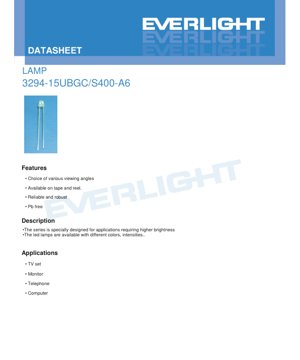
1. Product Overview
The 3294-15UBGC/S400-A6 is a high-brightness LED lamp designed for applications requiring superior luminous output. This device utilizes an InGaN/SiC chip material to produce a super blue emitted color with a water-clear lens. It is characterized by its reliability, robustness, and availability in various packaging options including tape and reel.
1.1 Core Advantages and Target Market
The primary advantage of this LED series is its enhanced brightness, making it suitable for backlighting and indicator applications where high visibility is crucial. Key target markets and applications include television sets, computer monitors, telephones, and general computing equipment where consistent and bright blue illumination is required.
2. Technical Parameter Deep Dive
This section provides a detailed, objective analysis of the device's key electrical, optical, and thermal parameters as defined in the datasheet.
2.1 Absolute Maximum Ratings
The Absolute Maximum Ratings define the stress limits beyond which permanent damage to the device may occur. Operating the LED under these conditions is not recommended. The ratings are specified at an ambient temperature (Ta) of 25°C.
- Continuous Forward Current (IF): 25 mA. This is the maximum DC current that can be continuously applied to the LED.
- Peak Forward Current (IF(Peak)): 100 mA. This rating is typically for short pulse conditions and must not be exceeded.
- Reverse Voltage (VR): 5 V. Applying a reverse voltage beyond this limit can cause junction breakdown.
- Power Dissipation (Pd): 120 mW. This is the maximum power the package can dissipate, calculated as Forward Voltage (VF) * Forward Current (IF).
- Operating Temperature (Topr): -40°C to +85°C. The ambient temperature range for reliable operation.
- Storage Temperature (Tstg): -40°C to +100°C.
- Electrostatic Discharge (ESD): 1000 V (Human Body Model). This indicates a moderate level of ESD sensitivity; proper handling procedures are necessary.
- Soldering Temperature (Tsol): 260°C for 5 seconds. This defines the reflow soldering profile tolerance.
2.2 Electro-Optical Characteristics
The Electro-Optical Characteristics are measured at a standard test current of IF=20mA and Ta=25°C, representing typical operating conditions.
- Luminous Intensity (Iv): 400 (Min.) to 800 (Typ.) mcd. This wide binning range indicates production variance; designers should account for the minimum value for worst-case brightness.
- Viewing Angle (2θ1/2): 90° (Typical). This defines the full angle at which the luminous intensity drops to half of its peak value, offering a broad emission pattern.
- Peak Wavelength (λp): 502 nm (Typical). The wavelength at which the spectral emission is strongest.
- Dominant Wavelength (λd): 505 nm (Typical). The single wavelength perceived by the human eye, defining the color as \"super blue.\"
- Spectrum Radiation Bandwidth (Δλ): 30 nm (Typical). The spectral width at half maximum intensity.
- Forward Voltage (VF): 3.5 V (Typical), 4.3 V (Maximum) at 20mA. This parameter is crucial for driver design and power supply selection.
- Reverse Current (IR): 50 μA (Maximum) at VR=5V.
Measurement Tolerances: The datasheet notes specific uncertainties: ±0.1V for VF, ±10% for Iv, and ±1.0nm for λd. These must be considered in precision applications.
3. Binning System Explanation
The product utilizes a binning system to categorize units based on key optical and electrical parameters, ensuring consistency within a batch. The label explanation defines these bins:
- CAT: Ranks of Luminous Intensity (Iv). Corresponds to the 400-800 mcd range.
- HUE: Ranks of Dominant Wavelength (λd). Groups LEDs by their specific blue color point around 505nm.
- REF: Ranks of Forward Voltage (VF). Groups LEDs by their voltage drop, important for current matching in series strings.
Designers should specify or be aware of the required bins for their application to maintain color and brightness uniformity.
4. Performance Curve Analysis
The typical characteristic curves provide insight into the device's behavior under varying conditions.
4.1 Relative Intensity vs. Wavelength
This curve shows the spectral power distribution, peaking at approximately 502nm with a bandwidth (Δλ) of 30nm, confirming the monochromatic blue emission.
4.2 Directivity Pattern
The polar plot illustrates the 90° viewing angle, showing a near-Lambertian emission pattern where intensity decreases with the cosine of the viewing angle.
4.3 Forward Current vs. Forward Voltage (I-V Curve)
The I-V curve is exponential, typical for a diode. At the test current of 20mA, the voltage is typically 3.5V. The curve is essential for thermal design, as VF has a negative temperature coefficient.
4.4 Relative Intensity vs. Forward Current (L-I Curve)
Luminous intensity increases super-linearly with current before potentially saturating at higher currents. Operating above the recommended 20mA may increase output but will reduce efficiency and lifespan due to increased heat.
4.5 Thermal Characteristics
Relative Intensity vs. Ambient Temperature: Luminous output decreases as ambient temperature rises. This derating is critical for applications in high-temperature environments.
Forward Current vs. Ambient Temperature: For a constant voltage drive, the current would increase with temperature due to the decreasing VF. This highlights the importance of constant-current drivers for stable operation.
5. Mechanical and Package Information
5.1 Package Dimension Drawing
The mechanical drawing provides critical dimensions for PCB footprint design and assembly clearance. Key notes include:
1. All dimensions are in millimeters.
2. The flange height must be less than 1.5mm (0.059\").
3. Standard tolerance is ±0.25mm unless otherwise specified.
5.2 Polarity Identification
The LED has a cathode and anode lead. Typically, the longer lead is the anode (+), and the flat side on the lens or a mark on the flange indicates the cathode (-). The PCB footprint must be designed to match this orientation.
6. Soldering and Assembly Guidelines
Proper handling is essential to maintain LED performance and reliability.
6.1 Lead Forming
- Bend leads at a point at least 3mm from the epoxy bulb base.
- Perform forming before soldering.
- Avoid stressing the package. Misaligned PCB holes causing lead stress can degrade the epoxy resin.
- Cut leads at room temperature.
6.2 Storage Conditions
- Store at ≤30°C and ≤70% RH after shipment. Shelf life is 3 months.
- For longer storage (up to 1 year), use a sealed container with nitrogen and desiccant.
- Avoid rapid temperature changes in humid environments to prevent condensation.
6.3 Soldering Process
General Rule: Maintain a minimum distance of 3mm from the solder joint to the epoxy bulb.
Hand Soldering: Iron tip temperature max 300°C (30W max), soldering time max 3 seconds.
Wave/Dip Soldering: Preheat max 100°C (60 sec max). Solder bath max 260°C for 5 seconds.
Profile: A recommended soldering temperature profile graph is provided, emphasizing a controlled ramp-up, peak, and cool-down phase.
Critical Notes:
- Avoid stress on leads during high-temperature phases.
- Do not solder (dip/hand) more than once.
- Protect the LED from shock/vibration until it cools to room temperature.
- Avoid rapid cooling from peak temperature.
- Use the lowest possible temperature that achieves a reliable solder joint.
6.4 Cleaning
- Clean only with isopropyl alcohol at room temperature for ≤1 minute.
- Avoid ultrasonic cleaning. If absolutely necessary, pre-qualify the process to ensure no damage occurs.
6.5 Heat Management
Proper thermal design is mandatory. The operating current must be derated appropriately based on the application's ambient temperature and the thermal resistance of the mounting setup. Refer to de-rating curves (implied, though not explicitly shown in the provided extract) for guidance. Inadequate heat sinking will lead to reduced light output, color shift, and accelerated degradation.
7. Packaging and Ordering Information
7.1 Packing Specification
The LEDs are packaged to prevent damage during shipping and storage:
- Primary Packing: Anti-electrostatic bag.
- Secondary Packing: Inner carton containing 4 bags.
- Tertiary Packing: Outside carton containing 10 inner cartons.
Packing Quantity: Minimum 200 to 1000 pieces per bag. A full outside carton contains 40 bags (4 bags/inner carton * 10 inner cartons).
7.2 Label Explanation
Labels on packaging contain the following information for traceability and identification: CPN (Customer Part Number), P/N (Manufacturer Part Number: 3294-15UBGC/S400-A6), QTY (Quantity), CAT/HUE/REF (Binning codes), and LOT No. (Lot Number for traceability).
8. Application Suggestions
8.1 Typical Application Scenarios
This LED is ideal for:
- Backlighting: For LCD panels in TVs, monitors, and industrial displays requiring a blue backlight or as part of an RGB white-light system.
- Status Indicators: High-brightness power, activity, or mode indicators in telecommunications and computing equipment.
- Decorative Lighting: Accent lighting where a vivid blue color is desired.
8.2 Design Considerations
- Driver Selection: Use a constant-current driver set to 20mA (or lower for reduced heat/longer life) to ensure stable luminous output and color. Account for the typical 3.5V forward voltage drop.
- Current Limiting Resistor: If using a voltage source, calculate the series resistor precisely using the maximum VF (4.3V) to ensure the current never exceeds the absolute maximum rating under worst-case conditions.
- Thermal Management: Design the PCB with adequate copper area or use a metal-core PCB (MCPCB) to dissipate heat, especially in enclosed spaces or high ambient temperatures.
- Optical Design: The 90° viewing angle is suitable for wide-area illumination. For focused light, secondary optics (lenses) may be required.
- ESD Protection: Implement ESD protection on input lines and ensure assembly personnel use proper grounding straps.
9. Technical Comparison and Differentiation
While a direct competitor comparison is not in the datasheet, this LED's key differentiators can be inferred:
- High Brightness Bin: With a typical intensity of 800mcd at 20mA, it offers high luminous efficacy for a standard 3mm or 5mm LED lamp package.
- Specific Color Point: The 505nm \"super blue\" is a distinct shade, potentially different from royal blue (~450nm) or pure blue (~470nm) LEDs.
- Robust Construction: Emphasis on reliability and Pb-free construction meets modern environmental and durability standards.
- Comprehensive Documentation: Detailed handling, soldering, and storage guidelines reduce application risk.
10. Frequently Asked Questions (Based on Technical Parameters)
Q1: Can I drive this LED at 25mA continuously?
A1: While the Absolute Maximum Rating is 25mA, the Electro-Optical Characteristics are specified at 20mA. For reliable long-term operation and to account for thermal effects, it is strongly recommended to operate at or below 20mA. Use the maximum rating only as a stress limit, not an operating point.
Q2: Why is there such a wide range in Luminous Intensity (400-800 mcd)?
A2: This is due to production variances in the semiconductor epitaxy and chip fabrication process. The devices are binned (CAT code) after production. For uniform brightness in an array, specify a tight bin or use LEDs from the same production lot.
Q3: How do I interpret the \"Typical\" values in the datasheet?
A3: \"Typical\" represents the mean or most common value from production. Design should be based on \"Minimum\" values for guaranteed performance (e.g., use 400 mcd for worst-case brightness) and \"Maximum\" values for stress calculations (e.g., use 4.3V for resistor calculation).
Q4: Is a heat sink necessary?
A4: For operation at 20mA in moderate ambient temperatures (<50°C), the internal heat dissipation (~70mW) may be managed by the leads and standard PCB copper. For higher ambient temperatures, higher currents, or enclosed fixtures, additional thermal management (e.g., more copper, MCPCB) is essential to prevent overheating and premature failure.
11. Practical Use Case Example
Scenario: Designing a status indicator panel for a rack-mounted network switch.
1. Requirement: A bright blue \"Link Active\" indicator visible from several meters away.
2. Selection: The 3294-15UBGC/S400-A6 is chosen for its high brightness (800mcd typ) and appropriate viewing angle (90°).
3. Circuit Design: The system uses a 5V rail. A series resistor is calculated: R = (V_supply - VF_max) / IF = (5V - 4.3V) / 0.020A = 35 ohms. A standard 36-ohm resistor is selected, limiting current to ~19.4mA at VF_typ, which is safe and provides sufficient brightness.
4. PCB Layout: The LED footprint is placed with a small copper pour connected to the cathode lead for minor heat dissipation. The panel design includes a light pipe to guide and diffuse the light.
5. Assembly: LEDs are hand-soldered with a temperature-controlled iron set to 280°C, with the joint made >3mm from the body, completing within 2 seconds.
12. Technology Principle Introduction
This LED is based on a semiconductor heterostructure. The active region uses Indium Gallium Nitride (InGaN) grown on a Silicon Carbide (SiC) substrate. When a forward voltage is applied, electrons and holes are injected into the active region where they recombine, releasing energy in the form of photons (light). The specific composition of the InGaN alloy determines the bandgap energy, which in turn defines the wavelength of the emitted light—in this case, approximately 505nm (blue). The water-clear epoxy lens encapsulates the chip, provides mechanical protection, and shapes the light output beam (90° viewing angle).
13. Technology Development Trends
The evolution of LED technology like this device follows several key trends:
1. Increased Efficiency: Ongoing materials science and chip design improvements aim to produce more lumens per watt (lm/W), reducing power consumption for the same light output.
2. Color Precision and Consistency: Advances in epitaxial growth and binning processes lead to tighter wavelength and intensity distributions, improving color uniformity in arrays.
3. Enhanced Reliability and Lifetime: Better packaging materials, thermal interfaces, and driver integration contribute to longer operational lifespans under harsh conditions.
4. Miniaturization and Integration: While discrete lamps remain popular, the trend is towards surface-mount device (SMD) packages and integrated modules for higher density and automated assembly.
5. Expanded Color Gamut: Development of LEDs with specific, narrow wavelength peaks (like this 505nm blue) enables wider color gamuts in display applications when combined with red and green LEDs.
LED Specification Terminology
Complete explanation of LED technical terms
Photoelectric Performance
| Term | Unit/Representation | Simple Explanation | Why Important |
|---|---|---|---|
| Luminous Efficacy | lm/W (lumens per watt) | Light output per watt of electricity, higher means more energy efficient. | Directly determines energy efficiency grade and electricity cost. |
| Luminous Flux | lm (lumens) | Total light emitted by source, commonly called "brightness". | Determines if the light is bright enough. |
| Viewing Angle | ° (degrees), e.g., 120° | Angle where light intensity drops to half, determines beam width. | Affects illumination range and uniformity. |
| CCT (Color Temperature) | K (Kelvin), e.g., 2700K/6500K | Warmth/coolness of light, lower values yellowish/warm, higher whitish/cool. | Determines lighting atmosphere and suitable scenarios. |
| CRI / Ra | Unitless, 0–100 | Ability to render object colors accurately, Ra≥80 is good. | Affects color authenticity, used in high-demand places like malls, museums. |
| SDCM | MacAdam ellipse steps, e.g., "5-step" | Color consistency metric, smaller steps mean more consistent color. | Ensures uniform color across same batch of LEDs. |
| Dominant Wavelength | nm (nanometers), e.g., 620nm (red) | Wavelength corresponding to color of colored LEDs. | Determines hue of red, yellow, green monochrome LEDs. |
| Spectral Distribution | Wavelength vs intensity curve | Shows intensity distribution across wavelengths. | Affects color rendering and quality. |
Electrical Parameters
| Term | Symbol | Simple Explanation | Design Considerations |
|---|---|---|---|
| Forward Voltage | Vf | Minimum voltage to turn on LED, like "starting threshold". | Driver voltage must be ≥Vf, voltages add up for series LEDs. |
| Forward Current | If | Current value for normal LED operation. | Usually constant current drive, current determines brightness & lifespan. |
| Max Pulse Current | Ifp | Peak current tolerable for short periods, used for dimming or flashing. | Pulse width & duty cycle must be strictly controlled to avoid damage. |
| Reverse Voltage | Vr | Max reverse voltage LED can withstand, beyond may cause breakdown. | Circuit must prevent reverse connection or voltage spikes. |
| Thermal Resistance | Rth (°C/W) | Resistance to heat transfer from chip to solder, lower is better. | High thermal resistance requires stronger heat dissipation. |
| ESD Immunity | V (HBM), e.g., 1000V | Ability to withstand electrostatic discharge, higher means less vulnerable. | Anti-static measures needed in production, especially for sensitive LEDs. |
Thermal Management & Reliability
| Term | Key Metric | Simple Explanation | Impact |
|---|---|---|---|
| Junction Temperature | Tj (°C) | Actual operating temperature inside LED chip. | Every 10°C reduction may double lifespan; too high causes light decay, color shift. |
| Lumen Depreciation | L70 / L80 (hours) | Time for brightness to drop to 70% or 80% of initial. | Directly defines LED "service life". |
| Lumen Maintenance | % (e.g., 70%) | Percentage of brightness retained after time. | Indicates brightness retention over long-term use. |
| Color Shift | Δu′v′ or MacAdam ellipse | Degree of color change during use. | Affects color consistency in lighting scenes. |
| Thermal Aging | Material degradation | Deterioration due to long-term high temperature. | May cause brightness drop, color change, or open-circuit failure. |
Packaging & Materials
| Term | Common Types | Simple Explanation | Features & Applications |
|---|---|---|---|
| Package Type | EMC, PPA, Ceramic | Housing material protecting chip, providing optical/thermal interface. | EMC: good heat resistance, low cost; Ceramic: better heat dissipation, longer life. |
| Chip Structure | Front, Flip Chip | Chip electrode arrangement. | Flip chip: better heat dissipation, higher efficacy, for high-power. |
| Phosphor Coating | YAG, Silicate, Nitride | Covers blue chip, converts some to yellow/red, mixes to white. | Different phosphors affect efficacy, CCT, and CRI. |
| Lens/Optics | Flat, Microlens, TIR | Optical structure on surface controlling light distribution. | Determines viewing angle and light distribution curve. |
Quality Control & Binning
| Term | Binning Content | Simple Explanation | Purpose |
|---|---|---|---|
| Luminous Flux Bin | Code e.g., 2G, 2H | Grouped by brightness, each group has min/max lumen values. | Ensures uniform brightness in same batch. |
| Voltage Bin | Code e.g., 6W, 6X | Grouped by forward voltage range. | Facilitates driver matching, improves system efficiency. |
| Color Bin | 5-step MacAdam ellipse | Grouped by color coordinates, ensuring tight range. | Guarantees color consistency, avoids uneven color within fixture. |
| CCT Bin | 2700K, 3000K etc. | Grouped by CCT, each has corresponding coordinate range. | Meets different scene CCT requirements. |
Testing & Certification
| Term | Standard/Test | Simple Explanation | Significance |
|---|---|---|---|
| LM-80 | Lumen maintenance test | Long-term lighting at constant temperature, recording brightness decay. | Used to estimate LED life (with TM-21). |
| TM-21 | Life estimation standard | Estimates life under actual conditions based on LM-80 data. | Provides scientific life prediction. |
| IESNA | Illuminating Engineering Society | Covers optical, electrical, thermal test methods. | Industry-recognized test basis. |
| RoHS / REACH | Environmental certification | Ensures no harmful substances (lead, mercury). | Market access requirement internationally. |
| ENERGY STAR / DLC | Energy efficiency certification | Energy efficiency and performance certification for lighting. | Used in government procurement, subsidy programs, enhances competitiveness. |