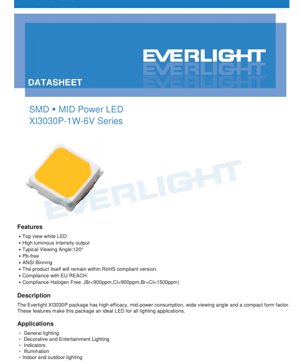
1. Product Overview
The XI3030P-1W-6V series represents a compact, high-performance mid-power surface-mount LED designed for modern lighting applications. Characterized by its 3.0mm x 3.0mm footprint, this package delivers a balanced combination of high luminous efficacy, moderate power consumption, and a wide 120-degree viewing angle. The primary emitted color is neutral white, achieved through InGaN chip technology encapsulated in a water-clear resin. Its form factor and performance make it a versatile solution suitable for a broad spectrum of illumination needs, from functional ambient lighting to decorative accents.
1.1 Core Advantages
The key advantages of this LED series include its high luminous intensity output, which enables efficient light generation. The wide viewing angle ensures uniform light distribution, reducing hotspots and glare. The product is manufactured to be lead-free (Pb-free), compliant with the European Union's REACH regulation, and adheres to strict halogen-free standards (Br<900ppm, Cl<900ppm, Br+Cl<1500ppm). Furthermore, it utilizes ANSI-standard binning for color consistency, and the product itself is designed to remain within RoHS compliant specifications.
1.2 Target Applications
The versatility of the XI3030P series allows its deployment in numerous lighting scenarios. Primary applications encompass general lighting for residential and commercial spaces. It is also well-suited for decorative and entertainment lighting, where color quality and reliability are important. The LED serves effectively as an indicator light and for various illumination tasks. Its robustness supports both indoor and outdoor lighting fixtures, provided they are designed with appropriate environmental protection.
2. Technical Parameter Analysis
2.1 Absolute Maximum Ratings
Understanding the operational limits is crucial for reliable design. The absolute maximum ratings, specified at a soldering point temperature (Tsoldering) of 25°C, define the boundaries beyond which permanent damage may occur.
- Forward Current (IF): 200 mA (continuous).
- Peak Forward Current (IFP): 600 mA, permissible under pulsed conditions with a duty cycle of 1/10 and a pulse width of 10ms.
- Power Dissipation (Pd): 1320 mW.
- Operating Temperature (Topr): -40°C to +85°C.
- Storage Temperature (Tstg): -40°C to +100°C.
- Thermal Resistance (Rth J-S): 21 °C/W (junction to soldering point).
- Junction Temperature (Tj): 125°C (maximum).
- Soldering Temperature: Reflow soldering is rated for 260°C for 10 seconds. Hand soldering should not exceed 350°C for 3 seconds.
Important Note: These LEDs are sensitive to electrostatic discharge (ESD). Proper ESD handling procedures must be followed during assembly and handling to prevent latent or catastrophic failures.
2.2 Electro-Optical Characteristics
The typical performance is measured at a forward current (IF) of 150mA and Tsoldering = 25°C. These parameters are central to circuit design and performance expectation.
- Luminous Flux (Φ): The minimum luminous flux starts at 118 lumens for base models, with higher bins available (see Section 3). The typical tolerance is ±11%.
- Forward Voltage (VF): Ranges from a minimum of 5.8V to a maximum of 6.6V at 150mA. The typical tolerance is ±0.1V. This relatively high voltage indicates the LED likely contains multiple series-connected semiconductor junctions within the package.
- Color Rendering Index (CRI or Ra): Available in two primary grades: a minimum of 70 (CRI>70) and a minimum of 80 (CRI>80). Tolerance is ±2 points. Higher CRI values indicate better color fidelity of illuminated objects.
- Viewing Angle (2θ1/2): 120 degrees, typical. This is the full angle at which luminous intensity is half of the peak intensity.
- Reverse Current (IR): Maximum of 50 µA at a reverse voltage (VR) of 5V.
3. Binning System Explanation
The product employs a detailed binning system to ensure consistency in key parameters. The order code itself encapsulates this binning information.
3.1 Product Number Explanation
The full order code, e.g., XI3030P/LK4C-H2711866Z15/2N, is structured as follows: XI3030P/ X KXC – H XX XX XX Z15 / 2 N. Critical segments include:
- CRI Index: The character after 'XI3030P/' (e.g., 'L' or 'K'). 'L' denotes CRI ≥70, 'K' denotes CRI ≥80.
- Flux Bin: The 'KXC' or 'XXC' part includes a numeric flux bin code (4,5,6,7).
- Color & Performance Code ('HXX XX XX'): This section defines Color Correlated Temperature (CCT), minimum luminous flux, and maximum forward voltage. For example, 'H2711866' breaks down as: CCT=2700K, Min. Flux=118 lm, Max. VF=6.6V.
- Current Index ('Z15'): Denotes the nominal forward current of 150mA.
3.2 Color Rendering Index (CRI) Bins
CRI is binned with specific minimum values: M (60), N (65), L (70), Q (75), K (80), P (85), H (90). The mass production lists focus on the L (≥70) and K (≥80) bins.
3.3 Luminous Flux Bins
Flux is categorized into bins labeled S31 through S71. Each bin has a defined minimum and maximum lumen output at 150mA. For instance, bin S31 covers 118 to 123 lm, while bin S71 covers 158 to 163 lm. The tolerance for luminous flux is ±11%.
3.4 Forward Voltage Bins
Forward voltage is grouped into four bins: 5866 (5.8-6.0V), 6062 (6.0-6.2V), 6264 (6.2-6.4V), and 6466 (6.4-6.6V). The tolerance is ±0.1V. Designers must ensure the driving circuit can accommodate the maximum VF of the selected bin.
4. Mass Production Lists
The datasheet provides comprehensive lists of available order codes, segregated by CRI level.
4.1 Models with CRI ≥70
This list includes variants with CCTs of 2700K, 3000K, 4000K, 5000K, 5700K, and 6500K. For each CCT, multiple flux bins are available (e.g., LK4C, LK5C, LK6C, LK7C), offering a range of minimum luminous outputs from 118 lm to 143 lm. All models share a maximum forward voltage of 6.6V and an operating current of 150mA.
4.2 Models with CRI ≥80
This parallel list offers the same range of CCTs and flux bins (KK4C to KK7C) but with the higher minimum CRI of 80. The luminous flux values for corresponding bins are identical to the CRI≥70 series. This allows designers to choose between standard and high color rendering without sacrificing light output for a given CCT and flux bin.
5. Application & Design Considerations
5.1 Thermal Management
With a thermal resistance of 21°C/W from junction to solder point, effective heat sinking is essential, especially when operating near the maximum current. The maximum junction temperature is 125°C. Exceeding this limit will accelerate lumen depreciation and reduce operational lifetime. PCB design should incorporate adequate thermal vias and copper area to dissipate heat from the solder pads.
5.2 Electrical Drive
The LED requires a constant current driver suitable for a typical forward voltage of ~6.2V at 150mA. Due to the voltage bin spread (up to 6.6V max), the driver must be capable of supplying sufficient voltage headroom. The driver should also include protection against reverse voltage and transient voltage spikes.
5.3 Optical Integration
The 120-degree viewing angle and top-view emission pattern make this LED suitable for applications requiring wide, diffuse illumination. For directional lighting, secondary optics (lenses or reflectors) will be necessary. The water-clear resin provides good light extraction efficiency.
6. Soldering and Assembly Guidelines
Adherence to soldering profiles is critical to prevent damage to the LED package or internal wire bonds.
- Reflow Soldering: A peak temperature of 260°C should not be exceeded for more than 10 seconds. A standard lead-free reflow profile is recommended.
- Hand Soldering: If necessary, the iron tip temperature should be limited to 350°C, and contact time should be less than 3 seconds per pad. Use a low-power iron and avoid applying mechanical stress.
- Storage: Store in a dry, ESD-safe environment within the specified temperature range (-40°C to +100°C).
7. Performance Analysis and Trends
7.1 Efficiency Context
The luminous efficacy of these LEDs can be estimated. For a typical part from the S31 bin (118 lm min) at 150mA and ~6.2V (0.93W), the minimum efficacy is approximately 127 lm/W. Higher flux bins offer greater efficacy. This places the XI3030P series competitively within the mid-power LED market, balancing cost, performance, and reliability.
7.2 Market Positioning and Differentiation
The key differentiators of this series are its 6V forward voltage architecture and the availability of high CRI (up to 90) options. The 6V design can simplify driver topology in certain array configurations compared to more common 3V LEDs. The comprehensive binning provides designers with predictable performance, which is crucial for consistent quality in mass-produced lighting fixtures.
7.3 Design Case Example
Consider designing a high-quality, dimmable downlight requiring 2700K color temperature and excellent color rendering (CRI>80) with a target flux of approximately 120 lumens per LED. The model XI3030P/KK4C-H2711866Z15/2N would be a suitable choice. The design must incorporate a constant-current driver capable of delivering 150mA with an output voltage compliance up to 6.6V per LED. If four LEDs are connected in series, the driver must provide at least 26.4V. Thermal management on the metal-core PCB must ensure the solder point temperature remains low enough to keep the junction temperature below 125°C under all operating conditions.
8. Frequently Asked Questions (FAQ)
Q: What is the physical size of this LED?
A: The package is a 3030 type, meaning it measures approximately 3.0mm in length and 3.0mm in width. The exact height should be confirmed from the mechanical drawing (not provided in this excerpt).
Q: Can I drive this LED at 200mA?
A: While the absolute maximum rating is 200mA, the electro-optical characteristics and binning are specified at 150mA. Operating at 200mA will generate more heat, reduce efficacy, and potentially shorten lifespan. It is recommended to design for the nominal 150mA current.
Q: How do I interpret the order code to select the right part?
A: Refer to Section 3.1 (Product Number Explanation) and the mass production lists in Sections 4.1 and 4.2. Match your requirements for CCT, minimum flux, and CRI to the corresponding code.
Q: Is a heatsink required?
A> For continuous operation at 150mA, proper thermal management via the PCB (e.g., a thermal pad with vias to an internal ground plane or an external heatsink) is strongly recommended to maintain performance and longevity. The need for a dedicated aluminum heatsink depends on the application's ambient temperature and airflow.
LED Specification Terminology
Complete explanation of LED technical terms
Photoelectric Performance
| Term | Unit/Representation | Simple Explanation | Why Important |
|---|---|---|---|
| Luminous Efficacy | lm/W (lumens per watt) | Light output per watt of electricity, higher means more energy efficient. | Directly determines energy efficiency grade and electricity cost. |
| Luminous Flux | lm (lumens) | Total light emitted by source, commonly called "brightness". | Determines if the light is bright enough. |
| Viewing Angle | ° (degrees), e.g., 120° | Angle where light intensity drops to half, determines beam width. | Affects illumination range and uniformity. |
| CCT (Color Temperature) | K (Kelvin), e.g., 2700K/6500K | Warmth/coolness of light, lower values yellowish/warm, higher whitish/cool. | Determines lighting atmosphere and suitable scenarios. |
| CRI / Ra | Unitless, 0–100 | Ability to render object colors accurately, Ra≥80 is good. | Affects color authenticity, used in high-demand places like malls, museums. |
| SDCM | MacAdam ellipse steps, e.g., "5-step" | Color consistency metric, smaller steps mean more consistent color. | Ensures uniform color across same batch of LEDs. |
| Dominant Wavelength | nm (nanometers), e.g., 620nm (red) | Wavelength corresponding to color of colored LEDs. | Determines hue of red, yellow, green monochrome LEDs. |
| Spectral Distribution | Wavelength vs intensity curve | Shows intensity distribution across wavelengths. | Affects color rendering and quality. |
Electrical Parameters
| Term | Symbol | Simple Explanation | Design Considerations |
|---|---|---|---|
| Forward Voltage | Vf | Minimum voltage to turn on LED, like "starting threshold". | Driver voltage must be ≥Vf, voltages add up for series LEDs. |
| Forward Current | If | Current value for normal LED operation. | Usually constant current drive, current determines brightness & lifespan. |
| Max Pulse Current | Ifp | Peak current tolerable for short periods, used for dimming or flashing. | Pulse width & duty cycle must be strictly controlled to avoid damage. |
| Reverse Voltage | Vr | Max reverse voltage LED can withstand, beyond may cause breakdown. | Circuit must prevent reverse connection or voltage spikes. |
| Thermal Resistance | Rth (°C/W) | Resistance to heat transfer from chip to solder, lower is better. | High thermal resistance requires stronger heat dissipation. |
| ESD Immunity | V (HBM), e.g., 1000V | Ability to withstand electrostatic discharge, higher means less vulnerable. | Anti-static measures needed in production, especially for sensitive LEDs. |
Thermal Management & Reliability
| Term | Key Metric | Simple Explanation | Impact |
|---|---|---|---|
| Junction Temperature | Tj (°C) | Actual operating temperature inside LED chip. | Every 10°C reduction may double lifespan; too high causes light decay, color shift. |
| Lumen Depreciation | L70 / L80 (hours) | Time for brightness to drop to 70% or 80% of initial. | Directly defines LED "service life". |
| Lumen Maintenance | % (e.g., 70%) | Percentage of brightness retained after time. | Indicates brightness retention over long-term use. |
| Color Shift | Δu′v′ or MacAdam ellipse | Degree of color change during use. | Affects color consistency in lighting scenes. |
| Thermal Aging | Material degradation | Deterioration due to long-term high temperature. | May cause brightness drop, color change, or open-circuit failure. |
Packaging & Materials
| Term | Common Types | Simple Explanation | Features & Applications |
|---|---|---|---|
| Package Type | EMC, PPA, Ceramic | Housing material protecting chip, providing optical/thermal interface. | EMC: good heat resistance, low cost; Ceramic: better heat dissipation, longer life. |
| Chip Structure | Front, Flip Chip | Chip electrode arrangement. | Flip chip: better heat dissipation, higher efficacy, for high-power. |
| Phosphor Coating | YAG, Silicate, Nitride | Covers blue chip, converts some to yellow/red, mixes to white. | Different phosphors affect efficacy, CCT, and CRI. |
| Lens/Optics | Flat, Microlens, TIR | Optical structure on surface controlling light distribution. | Determines viewing angle and light distribution curve. |
Quality Control & Binning
| Term | Binning Content | Simple Explanation | Purpose |
|---|---|---|---|
| Luminous Flux Bin | Code e.g., 2G, 2H | Grouped by brightness, each group has min/max lumen values. | Ensures uniform brightness in same batch. |
| Voltage Bin | Code e.g., 6W, 6X | Grouped by forward voltage range. | Facilitates driver matching, improves system efficiency. |
| Color Bin | 5-step MacAdam ellipse | Grouped by color coordinates, ensuring tight range. | Guarantees color consistency, avoids uneven color within fixture. |
| CCT Bin | 2700K, 3000K etc. | Grouped by CCT, each has corresponding coordinate range. | Meets different scene CCT requirements. |
Testing & Certification
| Term | Standard/Test | Simple Explanation | Significance |
|---|---|---|---|
| LM-80 | Lumen maintenance test | Long-term lighting at constant temperature, recording brightness decay. | Used to estimate LED life (with TM-21). |
| TM-21 | Life estimation standard | Estimates life under actual conditions based on LM-80 data. | Provides scientific life prediction. |
| IESNA | Illuminating Engineering Society | Covers optical, electrical, thermal test methods. | Industry-recognized test basis. |
| RoHS / REACH | Environmental certification | Ensures no harmful substances (lead, mercury). | Market access requirement internationally. |
| ENERGY STAR / DLC | Energy efficiency certification | Energy efficiency and performance certification for lighting. | Used in government procurement, subsidy programs, enhances competitiveness. |