Table of Contents
- 1. Product Overview
- 2. In-Depth Technical Parameter Analysis
- 2.1 Photometric and Color Characteristics
- 2.2 Electrical Parameters
- 2.3 Thermal and Reliability Parameters
- 3. Binning System Explanation
- 4. Performance Curve Analysis
- 4.1 IV Curve and Luminous Efficacy
- 4.2 Temperature Dependence
- 4.3 Spatial and Spectral Distribution
- 5. Mechanical and Packaging Information
- 6. Soldering and Assembly Guidelines
- 7. Packaging and Ordering Information
- 8. Application Recommendations
- 9. Technical Comparison and Differentiation
- 10. Frequently Asked Questions (Based on Technical Parameters)
- 11. Practical Design and Usage Examples
- 12. Operational Principle
- 13. Technology Trends and Context
1. Product Overview
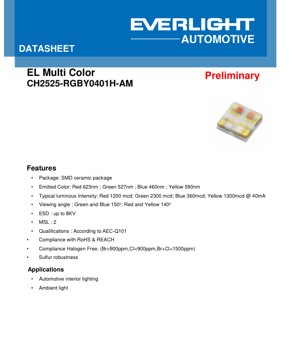
This document provides a comprehensive technical analysis of the CH2525-RGBY0401H-AM, a high-performance, multi-color Surface-Mount Device (SMD) LED. The component is engineered for reliability and performance in demanding environments, featuring a robust ceramic package and four distinct color emitters integrated into a single unit. Its primary design targets applications requiring precise color mixing, high brightness, and long-term stability.
The core advantage of this LED lies in its integration. By combining Red, Green, Blue, and Yellow (RGBY) diodes in one compact SMD package, it simplifies PCB design, reduces component count, and enables sophisticated color generation beyond the standard RGB gamut, particularly enhancing the rendition of warm white and amber tones. The device is specifically qualified according to the stringent AEC-Q101 standard for discrete semiconductors, making it a suitable choice for automotive electronics where operational reliability under harsh conditions is paramount.
The target market is primarily the automotive industry, specifically for interior lighting systems such as dashboard backlighting, switch illumination, and ambient mood lighting. Secondary applications include general decorative lighting, signage, and consumer electronics where multi-color functionality and high reliability are desired.
2. In-Depth Technical Parameter Analysis
The electrical and optical characteristics define the operational boundaries and performance expectations for the LED.
2.1 Photometric and Color Characteristics
The LED emits four distinct colors, each with defined optical properties measured at a standard test current of 40mA and a thermal pad temperature of 25°C. The luminous intensity, a measure of perceived brightness in a given direction, varies per color: Red typically outputs 1200 millicandelas (mcd), Green 2300 mcd, Blue 360 mcd, and Yellow 1300 mcd. It is crucial to note the measurement tolerance for luminous intensity is ±8%.
The viewing angle, defined as the off-axis angle where luminous intensity drops to half its peak value, is 150 degrees for the Green and Blue emitters and 140 degrees for the Red and Yellow emitters, with a tolerance of ±5 degrees. This indicates a very wide radiation pattern, suitable for area illumination.
Color is specified by both peak wavelength (λp) and dominant wavelength (λd). The typical dominant wavelengths are Red: 623 nm, Green: 527 nm, Blue: 460 nm, and Yellow: 590 nm, with a tight tolerance of ±1 nm for dominant wavelength. The spectral distribution graph shows distinct, well-separated peaks for each color, which is essential for accurate color mixing.
2.2 Electrical Parameters
The forward current (I_F) operating range is from 10 mA to 80 mA, with 40 mA being the typical test condition. Operating below 10 mA is not recommended. The forward voltage (V_F) at 40 mA differs per color due to semiconductor material properties: Red typically 2.00V, Green 2.80V, Blue 3.00V, and Yellow 2.40V, with a measurement tolerance of ±0.05V. The device is not designed for reverse bias operation.
2.3 Thermal and Reliability Parameters
Thermal management is critical for LED performance and lifetime. The thermal resistance from junction to solder point (Rth_JS) is provided in both real and electrical equivalent values. For example, the Red emitter has Rth_JS_real of 33 K/W and Rth_JS_el of 25 K/W. These values are used to calculate junction temperature rise based on power dissipation.
The absolute maximum ratings establish hard limits: power dissipation (P_d) is 220 mW for Red/Yellow and 280 mW for Green/Blue. The maximum junction temperature (T_J) is 125°C. The operating temperature range (T_opr) is from -40°C to +110°C, confirming its automotive-grade suitability. The device can withstand Electrostatic Discharge (ESD) up to 8 kV (Human Body Model).
3. Binning System Explanation
The datasheet includes a luminous intensity binning structure to categorize LEDs based on their output. Bins are labeled with alphanumeric codes (L1, L2, M1... R1) representing a range of minimum and maximum luminous intensity. For instance, bin L1 covers LEDs with intensity from 11.2 mcd to 14 mcd, while bin R1 starts at 112 mcd. This system allows designers to select components with consistent brightness levels for uniform appearance in an array or system. The provided table appears to be a generic template, and the specific bins for each color of the CH2525-RGBY0401H-AM would be defined in detailed product specifications or ordering guides.
4. Performance Curve Analysis
The characteristic graphs provide vital insights into the LED's behavior under varying conditions.
4.1 IV Curve and Luminous Efficacy
The Forward Current vs. Forward Voltage graph shows the exponential relationship typical of diodes. Each color trace has a different knee voltage. The Relative Luminous Intensity vs. Forward Current graph shows that output increases with current but may not be perfectly linear, especially at higher currents where efficiency drops due to heating.
4.2 Temperature Dependence
The Relative Luminous Intensity vs. Junction Temperature graph is critical for thermal design. It shows that luminous output decreases as junction temperature increases. The rate of decrease (thermal quenching) varies by semiconductor material; for example, Red and Yellow LEDs typically show less sensitivity to temperature than Blue and Green LEDs. The Dominant Wavelength vs. Junction Temperature graph shows a shift in color (typically towards longer wavelengths) as temperature rises, which must be considered in color-critical applications.
The Forward Current Derating Curve dictates the maximum allowable forward current based on the solder pad temperature. To ensure the junction temperature stays below 125°C, the current must be reduced as the ambient/pad temperature increases. The graph provides specific derating lines for the color groups (Red/Yellow, Green, Blue).
4.3 Spatial and Spectral Distribution
The Typical Diagram Characteristics of Radiation (polar plots) for each color visually confirm the wide viewing angles. The Relative Spectral Distribution graph plots normalized intensity against wavelength, clearly showing the primary emission peak for each color diode, which is essential for understanding the color mixing potential and filtering requirements.
5. Mechanical and Packaging Information
The LED uses a Surface-Mount Device (SMD) ceramic package. Ceramic packages offer superior thermal conductivity and mechanical robustness compared to plastic packages, which is beneficial for high-power or high-reliability applications. The specific mechanical dimensions, including length, width, height, and lead/pad spacing, are detailed in the "Mechanical Dimension" section (referenced as page 17). A recommended soldering pad layout (page 18) is provided to ensure proper solder joint formation, thermal transfer, and mechanical stability during reflow and operation. The polarity or pin assignment for the four color channels and any common cathode/anode configuration would be defined in this section.
6. Soldering and Assembly Guidelines
The device is rated for reflow soldering with a peak temperature of 260°C for up to 30 seconds, which is compatible with standard lead-free (Pb-free) solder processes. A detailed reflow soldering profile graph (page 18) should be consulted, which typically shows the temperature ramp-up, preheat, liquidous, peak, and cooling stages. Adherence to this profile is necessary to prevent thermal shock, solder defects, or damage to the LED chip or package. The Moisture Sensitivity Level (MSL) is rated at Level 2, indicating the package can be exposed to factory floor conditions for up to one year before requiring baking prior to reflow soldering. Precautions for use (page 21) likely include handling to avoid ESD, storage conditions, and cleaning recommendations.
7. Packaging and Ordering Information
Packaging information (page 19) specifies how the LEDs are supplied, typically on tape-and-reel for automated pick-and-place assembly. Details include reel dimensions, pocket spacing, and orientation. The part number "CH2525-RGBY0401H-AM" follows a likely internal coding system where "CH2525" may indicate the package type/size, "RGBY" the colors, "0401" could relate to a performance bin or version, and "AM" may denote Automotive Grade. Ordering information (page 16) would detail how to specify different bins or variants.
8. Application Recommendations
The primary stated applications are automotive interior lighting and ambient light. In automotive interiors, this LED can be used for multi-color backlighting of instrument clusters, infotainment controls, and creating customizable ambient lighting zones within the cabin. For ambient lighting, its RGBY capability allows for the generation of a wider range of colors, including more saturated and warmer whites, compared to standard RGB LEDs.
Design Considerations:
- Driver Circuit: Requires a constant-current driver capable of independently controlling four channels. The different forward voltages must be accounted for, potentially requiring separate current regulators or a sophisticated multi-channel LED driver IC.
- Thermal Management: The power dissipation, especially when multiple colors are driven simultaneously, necessitates adequate PCB copper area (thermal pad) and possibly a connection to a heatsink to maintain low junction temperature for optimal light output, color stability, and longevity.
- Optics: The wide viewing angle may require secondary optics (lenses, diffusers) to shape the light beam for specific applications.
- Color Mixing & Control: Achieving consistent and desired colors requires calibration and potentially closed-loop color feedback using sensors, as the output of each channel varies with current and temperature.
9. Technical Comparison and Differentiation
Compared to standard plastic SMD RGB LEDs, this component's key differentiators are its ceramic package (for better heat dissipation and reliability) and the addition of a dedicated Yellow emitter. The Yellow chip significantly improves the Color Rendering Index (CRI) of generated white light and allows for direct creation of amber colors without mixing Red and Green, which is often inefficient and can produce a muddy color. The AEC-Q101 qualification is a major differentiator for automotive applications, as it validates performance over temperature, humidity, and operational life tests that standard commercial-grade LEDs do not undergo.
10. Frequently Asked Questions (Based on Technical Parameters)
Q: Why is the luminous intensity of the Blue emitter (360 mcd) much lower than the Green (2300 mcd) at the same 40mA current?
A: This is primarily due to the human eye's photopic sensitivity curve (V(λ)). The eye is most sensitive to green light (~555 nm) and less sensitive to blue light (~460 nm). Therefore, for the same radiant power (optical watts), the green light will appear much brighter in terms of photometric units (lumens, candelas). The difference in internal quantum efficiency of the semiconductor materials also plays a role.
Q: Can I drive this LED with a constant voltage source?
A: It is strongly discouraged. LEDs are current-driven devices. Their forward voltage has a tolerance and varies with temperature. A constant voltage source could lead to excessive current, overheating, and rapid failure. Always use a constant-current driver or a current-limiting circuit.
Q: What is the difference between Rth_JS_real and Rth_JS_el mentioned in the thermal resistance parameters?
A: Rth_JS_real is the actual measured thermal resistance from the semiconductor junction to the solder point. Rth_JS_el is an "electrical" equivalent value often derived from the temperature-sensitive forward voltage parameter. Designers typically use Rth_JS_real for thermal modeling, while Rth_JS_el might be used for in-circuit junction temperature estimation techniques.
11. Practical Design and Usage Examples
Example 1: Automotive Ambient Lighting Controller: A module uses four of these LEDs, one in each corner of a car's footwell. A microcontroller with PWM outputs drives a four-channel constant-current driver. Firmware allows the user to select from preset colors (e.g., cool white, warm white, blue, orange) or create custom colors by adjusting the duty cycle of each channel. The ceramic package ensures reliability despite potential high ambient temperatures near the vehicle's floor.
Example 2: Architectural Color-Tunable Downlight: In a recessed downlight, an array of these LEDs is mounted on a metal-core PCB for heat sinking. An advanced driver with color calibration and temperature compensation is used. The system can dynamically shift the white point from a cool, energizing white (high Blue/Green mix) in the morning to a warm, relaxing white (high Red/Yellow mix) in the evening, all while maintaining high color rendering.
12. Operational Principle
The device operates on the principle of electroluminescence in semiconductor materials. When a forward bias voltage exceeding the diode's bandgap energy is applied, electrons and holes recombine in the active region of the semiconductor, releasing energy in the form of photons (light). The specific wavelength (color) of the emitted light is determined by the bandgap energy of the semiconductor material used for each chip: different compound semiconductors (e.g., AlInGaP for Red/Yellow, InGaN for Green/Blue) are employed to achieve the desired colors. The four chips are housed in a single ceramic package with separate electrical connections for independent control.
13. Technology Trends and Context
The integration of multiple color emitters (beyond RGB) into a single package is a growing trend, driven by demand for higher quality light and more flexible color control in automotive, professional lighting, and display applications. The inclusion of a dedicated white or amber emitter, or in this case Yellow, improves color rendering and efficiency for certain colors. There is also a continuous push towards higher power density and efficiency (more lumens per watt), which places greater emphasis on thermal management, making ceramic and other advanced packaging materials more prevalent. Furthermore, the integration of control electronics (e.g., driver ICs) directly with the LED package is an emerging trend to simplify system design.
LED Specification Terminology
Complete explanation of LED technical terms
Photoelectric Performance
| Term | Unit/Representation | Simple Explanation | Why Important |
|---|---|---|---|
| Luminous Efficacy | lm/W (lumens per watt) | Light output per watt of electricity, higher means more energy efficient. | Directly determines energy efficiency grade and electricity cost. |
| Luminous Flux | lm (lumens) | Total light emitted by source, commonly called "brightness". | Determines if the light is bright enough. |
| Viewing Angle | ° (degrees), e.g., 120° | Angle where light intensity drops to half, determines beam width. | Affects illumination range and uniformity. |
| CCT (Color Temperature) | K (Kelvin), e.g., 2700K/6500K | Warmth/coolness of light, lower values yellowish/warm, higher whitish/cool. | Determines lighting atmosphere and suitable scenarios. |
| CRI / Ra | Unitless, 0–100 | Ability to render object colors accurately, Ra≥80 is good. | Affects color authenticity, used in high-demand places like malls, museums. |
| SDCM | MacAdam ellipse steps, e.g., "5-step" | Color consistency metric, smaller steps mean more consistent color. | Ensures uniform color across same batch of LEDs. |
| Dominant Wavelength | nm (nanometers), e.g., 620nm (red) | Wavelength corresponding to color of colored LEDs. | Determines hue of red, yellow, green monochrome LEDs. |
| Spectral Distribution | Wavelength vs intensity curve | Shows intensity distribution across wavelengths. | Affects color rendering and quality. |
Electrical Parameters
| Term | Symbol | Simple Explanation | Design Considerations |
|---|---|---|---|
| Forward Voltage | Vf | Minimum voltage to turn on LED, like "starting threshold". | Driver voltage must be ≥Vf, voltages add up for series LEDs. |
| Forward Current | If | Current value for normal LED operation. | Usually constant current drive, current determines brightness & lifespan. |
| Max Pulse Current | Ifp | Peak current tolerable for short periods, used for dimming or flashing. | Pulse width & duty cycle must be strictly controlled to avoid damage. |
| Reverse Voltage | Vr | Max reverse voltage LED can withstand, beyond may cause breakdown. | Circuit must prevent reverse connection or voltage spikes. |
| Thermal Resistance | Rth (°C/W) | Resistance to heat transfer from chip to solder, lower is better. | High thermal resistance requires stronger heat dissipation. |
| ESD Immunity | V (HBM), e.g., 1000V | Ability to withstand electrostatic discharge, higher means less vulnerable. | Anti-static measures needed in production, especially for sensitive LEDs. |
Thermal Management & Reliability
| Term | Key Metric | Simple Explanation | Impact |
|---|---|---|---|
| Junction Temperature | Tj (°C) | Actual operating temperature inside LED chip. | Every 10°C reduction may double lifespan; too high causes light decay, color shift. |
| Lumen Depreciation | L70 / L80 (hours) | Time for brightness to drop to 70% or 80% of initial. | Directly defines LED "service life". |
| Lumen Maintenance | % (e.g., 70%) | Percentage of brightness retained after time. | Indicates brightness retention over long-term use. |
| Color Shift | Δu′v′ or MacAdam ellipse | Degree of color change during use. | Affects color consistency in lighting scenes. |
| Thermal Aging | Material degradation | Deterioration due to long-term high temperature. | May cause brightness drop, color change, or open-circuit failure. |
Packaging & Materials
| Term | Common Types | Simple Explanation | Features & Applications |
|---|---|---|---|
| Package Type | EMC, PPA, Ceramic | Housing material protecting chip, providing optical/thermal interface. | EMC: good heat resistance, low cost; Ceramic: better heat dissipation, longer life. |
| Chip Structure | Front, Flip Chip | Chip electrode arrangement. | Flip chip: better heat dissipation, higher efficacy, for high-power. |
| Phosphor Coating | YAG, Silicate, Nitride | Covers blue chip, converts some to yellow/red, mixes to white. | Different phosphors affect efficacy, CCT, and CRI. |
| Lens/Optics | Flat, Microlens, TIR | Optical structure on surface controlling light distribution. | Determines viewing angle and light distribution curve. |
Quality Control & Binning
| Term | Binning Content | Simple Explanation | Purpose |
|---|---|---|---|
| Luminous Flux Bin | Code e.g., 2G, 2H | Grouped by brightness, each group has min/max lumen values. | Ensures uniform brightness in same batch. |
| Voltage Bin | Code e.g., 6W, 6X | Grouped by forward voltage range. | Facilitates driver matching, improves system efficiency. |
| Color Bin | 5-step MacAdam ellipse | Grouped by color coordinates, ensuring tight range. | Guarantees color consistency, avoids uneven color within fixture. |
| CCT Bin | 2700K, 3000K etc. | Grouped by CCT, each has corresponding coordinate range. | Meets different scene CCT requirements. |
Testing & Certification
| Term | Standard/Test | Simple Explanation | Significance |
|---|---|---|---|
| LM-80 | Lumen maintenance test | Long-term lighting at constant temperature, recording brightness decay. | Used to estimate LED life (with TM-21). |
| TM-21 | Life estimation standard | Estimates life under actual conditions based on LM-80 data. | Provides scientific life prediction. |
| IESNA | Illuminating Engineering Society | Covers optical, electrical, thermal test methods. | Industry-recognized test basis. |
| RoHS / REACH | Environmental certification | Ensures no harmful substances (lead, mercury). | Market access requirement internationally. |
| ENERGY STAR / DLC | Energy efficiency certification | Energy efficiency and performance certification for lighting. | Used in government procurement, subsidy programs, enhances competitiveness. |