1. Product Overview
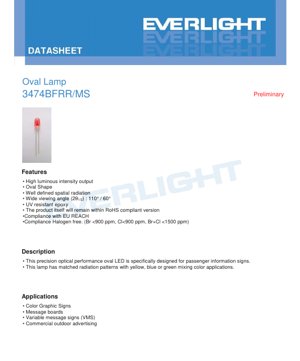
This document provides a comprehensive technical analysis of the 3474BFRR/MS oval LED lamp. This component is a precision optical device engineered primarily for use in passenger information systems and various signage applications. Its unique oval shape and defined radiation pattern are key design features that differentiate it from standard round LEDs.
The core function of this LED is to provide a high-brightness, reliable light source with a specific spatial emission profile. It is constructed using AlGaInP (Aluminum Gallium Indium Phosphide) chip technology, which is known for producing high-efficiency red and amber light. The emitted color is classified as \"Brilliant Red,\" and the lens is red diffused, which helps in achieving a uniform appearance and the specified viewing angles.
1.1 Core Advantages and Target Market
The primary advantages of this oval LED lamp stem from its application-specific design.
- Matched Radiation Patterns: The oval beam profile (110° x 60°) is intentionally designed to mix effectively with yellow, blue, or green light in color graphic applications, ensuring consistent color rendering across the sign area.
- High Luminous Intensity: With a typical output of 1605 mcd at 20mA, it provides sufficient brightness for daylight-readable signs.
- Regulatory Compliance: The product is designed to comply with key regulations including RoHS, EU REACH, and halogen-free requirements (Br <900 ppm, Cl <900 ppm, Br+Cl <1500 ppm), making it suitable for global markets.
- Durability: The use of UV-resistant epoxy resin enhances long-term reliability in outdoor environments where exposure to sunlight is a concern.
The target market is clearly defined as commercial and transportation signage:
- Color Graphic Signs
- Message Boards
- Variable Message Signs (VMS)
- Commercial Outdoor Advertising
2. In-Depth Technical Parameter Analysis
A thorough understanding of the absolute maximum ratings and electro-optical characteristics is critical for reliable circuit design and ensuring the LED's longevity.
2.1 Absolute Maximum Ratings
These ratings define the stress limits beyond which permanent damage may occur. Operating the device continuously at or near these limits is not recommended.
- Reverse Voltage (VR): 5V. Exceeding this voltage in reverse bias can cause immediate junction breakdown.
- Continuous Forward Current (IF): 30 mA. This is the maximum DC current for reliable operation.
- Peak Forward Current (IFP): 160 mA. This is permissible only under pulsed conditions (duty cycle 1/10 @ 1kHz), useful for multiplexing or short-term overdrive for extra brightness.
- Power Dissipation (Pd): 110 mW. This limit, combined with thermal resistance, dictates the maximum allowable junction temperature.
- Operating & Storage Temperature: -40°C to +85°C (operating), -40°C to +100°C (storage). The wide range ensures functionality in harsh environments.
- Soldering Temperature: 260°C for 5 seconds. This is a standard reflow profile, but care must be taken to avoid thermal shock.
2.2 Electro-Optical Characteristics
These parameters, measured at the standard test condition of 20mA forward current and 25°C ambient temperature (Ta), define the LED's performance.
- Luminous Intensity (Iv): 1205-2490 mcd. The wide range indicates a binning system is used (see Section 3). The typical value is 1605 mcd.
- Viewing Angle (2θ1/2): 110° (X-axis) / 60° (Y-axis). This oval pattern is the defining feature, providing a wider horizontal spread suitable for signage viewed from various angles.
- Peak Wavelength (λp): 632 nm (typical). This is the wavelength at which the spectral power distribution is maximum.
- Dominant Wavelength (λd): 619-629 nm. This is the single wavelength perceived by the human eye, defining the color. It is also binned (see Section 3).
- Forward Voltage (VF): 1.6V to 2.6V at 20mA. Designers must account for this variation when designing current-limiting circuits.
- Reverse Current (IR): 10 μA max at VR=5V. A low value indicates good junction quality.
3. Binning System Explanation
To ensure color and brightness consistency in an application, LEDs are sorted (binned) after production. This datasheet defines two key binning parameters.
3.1 Luminous Intensity Binning
LEDs are categorized into four bins (RA, RB, RC, RD) based on their measured luminous intensity at 20mA. The bins have contiguous ranges from 1205 mcd to 2490 mcd. A ±10% tolerance is noted within each bin. Designers should specify the required bin code to guarantee a minimum brightness level for their application.
3.2 Dominant Wavelength Binning
Color consistency is managed through two wavelength bins: R1 (619-624 nm) and R2 (624-629 nm). A tight tolerance of ±1nm is specified. Choosing a single bin (e.g., R1) for all LEDs in a sign ensures a uniform red hue, critical for graphic displays.
4. Performance Curve Analysis
The provided characteristic curves offer insights into the LED's behavior under non-standard conditions.
4.1 Spectral Distribution and Directivity
The \"Relative Intensity vs. Wavelength\" curve shows a typical AlGaInP spectrum centered around 632 nm with a narrow bandwidth (~20 nm), resulting in a saturated red color. The \"Directivity\" diagram visually confirms the oval radiation pattern with the specified 110° x 60° viewing angles.
4.2 Electrical and Thermal Characteristics
- Forward Current vs. Forward Voltage (I-V Curve): Shows the exponential relationship. The curve allows designers to estimate voltage drop at currents other than 20mA.
- Relative Intensity vs. Forward Current: Demonstrates that light output is relatively linear with current up to a point, after which efficiency may drop due to heating.
- Relative Intensity vs. Ambient Temperature: Shows the negative temperature coefficient of light output. Luminous intensity decreases as ambient temperature rises, which must be factored into designs for hot environments.
- Forward Current vs. Ambient Temperature: Likely depicts how the maximum allowable forward current derates with increasing temperature to stay within the power dissipation limit.
5. Mechanical and Package Information
The package is designed for through-hole mounting. The dimensioned drawing provides critical measurements for PCB layout and mechanical integration.
- Lead Spacing: The standard 2.54mm (0.1 inch) pitch between leads.
- Body Dimensions: The oval lens dimensions and overall package height.
- Polarity Identification: Typically indicated by a flat side on the lens or a longer anode lead. The datasheet drawing should be consulted for the exact marker.
- Notes: General tolerance is ±0.25mm unless specified. The maximum protrusion of resin under the flange is 1.5mm, which is important for clearance on the PCB.
6. Soldering and Assembly Guidelines
Proper handling is essential to prevent damage.
- Lead Forming: Must be done before soldering. Bend at a point >3mm from the epoxy bulb. Avoid stressing the package. Cut leads at room temperature.
- PCB Mounting: Holes must align perfectly with leads to avoid mounting stress, which can crack the epoxy or degrade performance.
- Soldering: The solder joint should be >3mm from the epoxy bulb. Soldering beyond the base of the tie bar is recommended. Follow the 260°C for 5 seconds profile.
- Storage: Store at ≤30°C and ≤70% RH. Shelf life is 3 months from shipment. For longer storage (up to 1 year), use a sealed container with nitrogen and desiccant. Avoid rapid temperature changes in humid environments to prevent condensation.
7. Packaging and Ordering Information
7.1 Moisture Resistant Packing
The components are supplied in moisture-resistant packaging, typically involving carrier tape and reel.
- Carrier Tape Dimensions: Detailed drawing with critical dimensions like pocket pitch (P=12.70mm), feed hole diameter, and overall tape width (W3=18.00mm).
- Label Explanation: The reel label includes fields for Customer Part Number (CPN), Product Number (P/N), Quantity (QTY), and the bin codes for Luminous Intensity (CAT), Dominant Wavelength (HUE), and Forward Voltage (REF).
7.2 Packing Quantities and Cartons
The standard packing hierarchy is: 2500 pieces per inner carton, and 10 inner cartons (25,000 pieces total) per outside carton. Diagrams for both carton types are provided.
7.3 Model Number Designation
The part number 3474BFRR/MS follows a structured format: 3474 (series/base), B (likely package code), F (likely color/intensity code), RR (Brilliant Red), MS (likely packing method). The dashes indicate where optional bin codes (e.g., for CAT, HUE) would be inserted in the full ordering code.
8. Application Suggestions and Design Considerations
Typical Application Circuits: A constant current driver is strongly recommended over a simple series resistor for optimal stability and longevity, especially in variable temperature environments. The driver should be set to deliver 20mA for nominal brightness or a lower value for extended life.
Thermal Management: While the power is low (max 110mW), ensuring adequate ventilation in enclosed sign cabinets is important. High ambient temperatures will reduce light output and may require current derating.
Optical Design: The oval beam pattern is ideal for backlighting rectangular or wide-format segments in signs. For color mixing applications, the spatial overlap with other colored LEDs must be carefully considered in the optical design of the sign diffuser or light guide.
9. Technical Comparison and Differentiation
The primary differentiation of the 3474BFRR/MS lies in its oval radiation pattern. Compared to a standard round LED with a circular viewing angle (e.g., 120°), this lamp provides a more rectangular illumination footprint. This reduces wasted light outside the desired sign area, improves efficiency, and enables better color mixing control in adjacent segments. Its specific design for passenger information signs indicates optimization for long-term reliability, UV resistance, and compliance with transportation industry standards.
10. Frequently Asked Questions (Based on Technical Parameters)
Q: Can I drive this LED at 30mA continuously?
A: Yes, 30mA is the Absolute Maximum Rating for continuous forward current. For maximum reliability and lifetime, operating at or below the typical test current of 20mA is advisable.
Q: What is the difference between Peak Wavelength (632nm) and Dominant Wavelength (621nm typical)?
A: Peak wavelength is the physical peak of the light spectrum emitted. Dominant wavelength is the perceptual \"color\" our eyes see, which for red AlGaInP LEDs is often slightly shorter than the peak due to the shape of the spectral curve and the human eye's sensitivity (photopic response). Designers should use Dominant Wavelength for color specification.
Q: How critical is the binning selection?
A: For applications where multiple LEDs are used side-by-side (like a message board), selecting a single bin for luminous intensity (CAT) and dominant wavelength (HUE) is critical to avoid visible brightness and color variations across the display.
Q: The storage conditions seem strict. What happens if they are exceeded?
A: Moisture absorption can occur if stored in high humidity. During subsequent soldering (reflow), the rapid heating can cause the trapped moisture to expand violently, leading to internal package cracking (\"popcorning\") and failure. Adhering to the storage guidelines is essential.
11. Practical Use Case Example
Scenario: Designing a single-line VMS for a bus stop.
The display uses 7-segment characters. Each segment is backlit by multiple LEDs. Using the oval 3474BFRR/MS LEDs oriented with their wide axis (110°) horizontal would efficiently fill the rectangular segment area with red light, minimizing the number of LEDs needed per segment compared to round LEDs. The designer would specify bin R1 for dominant wavelength to ensure all characters have an identical red hue, and bin RC or RD for luminous intensity to guarantee sufficient brightness for daylight readability. A constant current driver board would be designed to supply 18-20mA per LED string, with appropriate thermal design for the enclosed sign cabinet.
12. Operational Principle
This LED operates on the principle of electroluminescence in a semiconductor diode. The AlGaInP chip forms a p-n junction. When a forward voltage exceeding the junction's threshold (approx. 1.6-2.6V) is applied, electrons and holes are injected across the junction. When these charge carriers recombine, they release energy in the form of photons (light). The specific composition of the AlGaInP alloy determines the bandgap energy, which directly defines the wavelength (color) of the emitted light—in this case, in the red spectrum (~621-629 nm). The oval-shaped epoxy lens then encapsulates the chip and precisely molds the emitted light into the desired 110° x 60° radiation pattern.
13. Technology Trends
While this is a mature through-hole component, the broader LED industry trends that influence its application space include:
Increased Efficiency: Ongoing material and process improvements lead to higher luminous efficacy (more light per watt), allowing for lower power consumption or higher brightness in signage.
Enhanced Reliability: Improvements in epoxy resins, encapsulation techniques, and chip packaging continue to extend operational lifetimes, which is crucial for infrastructure applications like transportation signs.
Color Mixing and Control: There is a trend towards more sophisticated multi-color and full-color LED signs. Components with well-defined and stable radiation patterns, like this oval LED, remain essential for achieving uniform color mixing and high-quality graphical output in these advanced systems.
Miniaturization & Surface Mount: The general trend is towards surface-mount device (SMD) packages for automated assembly. However, through-hole components like the 3474 series maintain relevance in applications requiring extreme mechanical robustness, easier manual servicing, or specific optical formats not readily available in SMDs.
LED Specification Terminology
Complete explanation of LED technical terms
Photoelectric Performance
| Term | Unit/Representation | Simple Explanation | Why Important |
|---|---|---|---|
| Luminous Efficacy | lm/W (lumens per watt) | Light output per watt of electricity, higher means more energy efficient. | Directly determines energy efficiency grade and electricity cost. |
| Luminous Flux | lm (lumens) | Total light emitted by source, commonly called "brightness". | Determines if the light is bright enough. |
| Viewing Angle | ° (degrees), e.g., 120° | Angle where light intensity drops to half, determines beam width. | Affects illumination range and uniformity. |
| CCT (Color Temperature) | K (Kelvin), e.g., 2700K/6500K | Warmth/coolness of light, lower values yellowish/warm, higher whitish/cool. | Determines lighting atmosphere and suitable scenarios. |
| CRI / Ra | Unitless, 0–100 | Ability to render object colors accurately, Ra≥80 is good. | Affects color authenticity, used in high-demand places like malls, museums. |
| SDCM | MacAdam ellipse steps, e.g., "5-step" | Color consistency metric, smaller steps mean more consistent color. | Ensures uniform color across same batch of LEDs. |
| Dominant Wavelength | nm (nanometers), e.g., 620nm (red) | Wavelength corresponding to color of colored LEDs. | Determines hue of red, yellow, green monochrome LEDs. |
| Spectral Distribution | Wavelength vs intensity curve | Shows intensity distribution across wavelengths. | Affects color rendering and quality. |
Electrical Parameters
| Term | Symbol | Simple Explanation | Design Considerations |
|---|---|---|---|
| Forward Voltage | Vf | Minimum voltage to turn on LED, like "starting threshold". | Driver voltage must be ≥Vf, voltages add up for series LEDs. |
| Forward Current | If | Current value for normal LED operation. | Usually constant current drive, current determines brightness & lifespan. |
| Max Pulse Current | Ifp | Peak current tolerable for short periods, used for dimming or flashing. | Pulse width & duty cycle must be strictly controlled to avoid damage. |
| Reverse Voltage | Vr | Max reverse voltage LED can withstand, beyond may cause breakdown. | Circuit must prevent reverse connection or voltage spikes. |
| Thermal Resistance | Rth (°C/W) | Resistance to heat transfer from chip to solder, lower is better. | High thermal resistance requires stronger heat dissipation. |
| ESD Immunity | V (HBM), e.g., 1000V | Ability to withstand electrostatic discharge, higher means less vulnerable. | Anti-static measures needed in production, especially for sensitive LEDs. |
Thermal Management & Reliability
| Term | Key Metric | Simple Explanation | Impact |
|---|---|---|---|
| Junction Temperature | Tj (°C) | Actual operating temperature inside LED chip. | Every 10°C reduction may double lifespan; too high causes light decay, color shift. |
| Lumen Depreciation | L70 / L80 (hours) | Time for brightness to drop to 70% or 80% of initial. | Directly defines LED "service life". |
| Lumen Maintenance | % (e.g., 70%) | Percentage of brightness retained after time. | Indicates brightness retention over long-term use. |
| Color Shift | Δu′v′ or MacAdam ellipse | Degree of color change during use. | Affects color consistency in lighting scenes. |
| Thermal Aging | Material degradation | Deterioration due to long-term high temperature. | May cause brightness drop, color change, or open-circuit failure. |
Packaging & Materials
| Term | Common Types | Simple Explanation | Features & Applications |
|---|---|---|---|
| Package Type | EMC, PPA, Ceramic | Housing material protecting chip, providing optical/thermal interface. | EMC: good heat resistance, low cost; Ceramic: better heat dissipation, longer life. |
| Chip Structure | Front, Flip Chip | Chip electrode arrangement. | Flip chip: better heat dissipation, higher efficacy, for high-power. |
| Phosphor Coating | YAG, Silicate, Nitride | Covers blue chip, converts some to yellow/red, mixes to white. | Different phosphors affect efficacy, CCT, and CRI. |
| Lens/Optics | Flat, Microlens, TIR | Optical structure on surface controlling light distribution. | Determines viewing angle and light distribution curve. |
Quality Control & Binning
| Term | Binning Content | Simple Explanation | Purpose |
|---|---|---|---|
| Luminous Flux Bin | Code e.g., 2G, 2H | Grouped by brightness, each group has min/max lumen values. | Ensures uniform brightness in same batch. |
| Voltage Bin | Code e.g., 6W, 6X | Grouped by forward voltage range. | Facilitates driver matching, improves system efficiency. |
| Color Bin | 5-step MacAdam ellipse | Grouped by color coordinates, ensuring tight range. | Guarantees color consistency, avoids uneven color within fixture. |
| CCT Bin | 2700K, 3000K etc. | Grouped by CCT, each has corresponding coordinate range. | Meets different scene CCT requirements. |
Testing & Certification
| Term | Standard/Test | Simple Explanation | Significance |
|---|---|---|---|
| LM-80 | Lumen maintenance test | Long-term lighting at constant temperature, recording brightness decay. | Used to estimate LED life (with TM-21). |
| TM-21 | Life estimation standard | Estimates life under actual conditions based on LM-80 data. | Provides scientific life prediction. |
| IESNA | Illuminating Engineering Society | Covers optical, electrical, thermal test methods. | Industry-recognized test basis. |
| RoHS / REACH | Environmental certification | Ensures no harmful substances (lead, mercury). | Market access requirement internationally. |
| ENERGY STAR / DLC | Energy efficiency certification | Energy efficiency and performance certification for lighting. | Used in government procurement, subsidy programs, enhances competitiveness. |