1. Product Overview
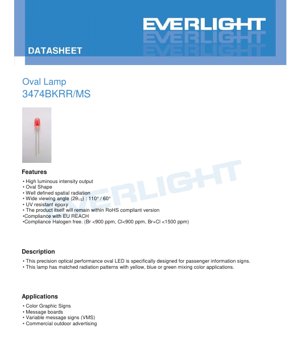
This document details the specifications for a precision optical performance oval LED lamp. The primary design intent is for use in passenger information signs and similar applications requiring clear, defined illumination over a specific area. The oval shape and matched radiation patterns are key features enabling effective color mixing in applications utilizing yellow, blue, or green alongside the primary red emission.
The device is constructed with UV-resistant epoxy material, ensuring long-term reliability in environments exposed to sunlight. It is compliant with key environmental and safety standards including the EU RoHS directive, EU REACH regulation, and is manufactured as a halogen-free component (with Bromine <900 ppm, Chlorine <900 ppm, and their sum <1500 ppm).
2. Technical Parameter Deep-Dive
2.1 Absolute Maximum Ratings
These ratings define the limits beyond which permanent damage to the device may occur. Operation under these conditions is not guaranteed.
- Reverse Voltage (VR): 5 V. Exceeding this voltage in reverse bias can cause junction breakdown.
- Forward Current (IF): 50 mA (Continuous).
- Peak Forward Current (IFP): 160 mA. This is permissible only under pulsed conditions with a duty cycle of 1/10 at 1 kHz. It allows for brief over-driving, for example, in multiplexed display applications.
- Power Dissipation (Pd): 120 mW. This is the maximum allowable power loss within the device, calculated as Forward Voltage (VF) * Forward Current (IF). Operating near this limit requires careful thermal management.
- Operating Temperature (Topr): -40 to +85 °C. The device is rated for industrial temperature ranges.
- Storage Temperature (Tstg): -40 to +100 °C.
- Soldering Temperature (Tsol): 260 °C for 5 seconds. This defines the reflow soldering profile tolerance.
2.2 Electro-Optical Characteristics (Ta=25°C)
These are the typical performance parameters measured under standard test conditions.
- Luminous Intensity (Iv): 1205-2490 mcd (Typical: 1605 mcd) at IF=20mA. This high output is suitable for daylight-readable signs.
- Viewing Angle (2θ1/2): 110° (X-axis) / 60° (Y-axis). The oval radiation pattern provides a wide horizontal spread and a more focused vertical beam, ideal for signage viewed from varying horizontal angles.
- Peak Wavelength (λp): 632 nm (Typical). The wavelength at which the emitted optical power is maximum.
- Dominant Wavelength (λd): 619-629 nm (Typical: 621 nm). This defines the perceived color of the light, which is in the brilliant red region.
- Spectrum Radiation Bandwidth (Δλ): 20 nm (Typical). A measure of the spectral purity of the emitted light.
- Forward Voltage (VF): 1.6 - 2.6 V at IF=20mA. The voltage drop across the LED when conducting. This range must be considered for driver design.
- Reverse Current (IR): 10 μA (Max) at VR=5V. A very low leakage current in the off state.
3. Binning System Explanation
To ensure color and brightness consistency in production, LEDs are sorted into bins based on key parameters.
3.1 Luminous Intensity Binning
Bins are defined with a ±10% tolerance from the nominal bin values. The bin codes (RA, RB, RC, RD) represent ascending levels of minimum luminous intensity at 20mA.
- RA: 1205 - 1445 mcd
- RB: 1445 - 1730 mcd
- RC: 1730 - 2075 mcd
- RD: 2075 - 2490 mcd
3.2 Dominant Wavelength Binning
Wavelength bins ensure a consistent perceived red color, with a tight tolerance of ±1nm. The bins help match LEDs for applications where color uniformity is critical.
- R1: 619 - 624 nm
- R2: 624 - 629 nm
4. Performance Curve Analysis
The datasheet provides several characteristic curves that are essential for understanding device behavior under different operating conditions.
4.1 Spectral Distribution
The Relative Intensity vs. Wavelength curve shows a typical narrow emission spectrum centered around 632 nm, characteristic of AlGaInP material technology, which produces high-efficiency red light.
4.2 IV Curve and Efficiency
The Forward Current vs. Forward Voltage curve exhibits the standard exponential diode relationship. The Relative Intensity vs. Forward Current curve is generally linear in the normal operating range (up to 50mA), indicating stable efficiency. Designers must ensure the driver provides stable current, not voltage, to maintain consistent light output.
4.3 Thermal Characteristics
The Relative Intensity vs. Ambient Temperature and Forward Current vs. Ambient Temperature curves are crucial for thermal management. Luminous intensity typically decreases as junction temperature rises. The forward voltage also has a negative temperature coefficient (decreases with temperature), which must be considered in constant-voltage drive scenarios to avoid thermal runaway. Adequate PCB copper area or heatsinking is recommended for high-current or high-ambient-temperature operation.
5. Mechanical & Packaging Information
5.1 Package Dimensions
The LED follows a standard surface-mount package outline. Key dimensions include the lead pitch (2.54 mm), which is a common footprint for through-hole adaptation or direct PCB mounting. The oval lens protrudes from the main body. All unspecified dimensions have a default tolerance of ±0.25 mm. The maximum resin protrusion under the flange is 1.5 mm, which is important for clearance during PCB assembly.
5.2 Polarity Identification
The cathode is typically indicated by a flat side on the lens, a notch on the package body, or a shorter lead (if leads are present in the through-hole version). The datasheet diagram should be consulted for the specific marker on this 3474BKRR/MS variant. Correct polarity is essential to prevent reverse bias damage.
6. Soldering & Assembly Guidelines
6.1 Reflow Soldering Parameters
The device can withstand a peak soldering temperature of 260°C for 5 seconds. This aligns with standard lead-free (SnAgCu) reflow profiles. The temperature should be measured at the LED lead, not in the oven air.
6.2 Critical Precautions
- Lead Forming: If bending leads, do so at least 3mm from the epoxy bulb base. Perform bending before soldering to avoid stress on the solder joint. Use proper tools to avoid stressing the package, which can crack the epoxy or damage the internal wire bonds.
- PCB Hole Alignment: PCB holes must align precisely with the LED leads. Mounting under mechanical stress can degrade the epoxy seal and LED performance over time.
- Solder Joint Location: Maintain a distance of more than 3mm from the solder joint to the epoxy bulb. Soldering beyond the base of the tie bar is recommended.
6.3 Storage Conditions
After receipt, LEDs should be stored at ≤30°C and ≤70% Relative Humidity. The recommended storage life in this state is 3 months. For longer storage (up to 1 year), the devices should be kept in a sealed container with a nitrogen atmosphere and desiccant to prevent moisture absorption, which is critical for MSL (Moisture Sensitivity Level) compliance and preventing \"popcorning\" during reflow.
7. Packaging & Ordering Information
7.1 Packaging Specifications
The device is supplied in moisture-resistant packing. The standard packing quantity is 2500 pieces per inner carton, with 10 inner cartons (25,000 pieces total) per master outside carton. The components are housed on embossed carrier tape with specific dimensions for automated pick-and-place equipment.
7.2 Label Explanation & Model Number
The reel label contains essential information for traceability and correct application: Customer Part Number (CPN), Manufacturer Part Number (P/N), Packing Quantity (QTY), and the specific Binning Codes for Luminous Intensity (CAT), Dominant Wavelength (HUE), and Forward Voltage (REF), along with the production Lot Number.
The full product designation follows the pattern: 3474 B K R R - □ □ □ □
- 3474: Package type/size.
- B: Likely indicates brightness or a specific series.
- K: May denote color (though specific to this red variant).
- R R: Indicates the color \"Brilliant Red\".
- - □ □ □ □: These placeholders represent the specific binning codes for Intensity (CAT), Wavelength (HUE), and Voltage (REF) selected for the order.
8. Application Suggestions
8.1 Typical Application Scenarios
- Passenger Information Signs (PIS): In buses, trains, and airports, where high brightness and wide horizontal viewing angle are essential.
- Message Boards & Variable Message Signs (VMS): For traffic information, advertising, and public announcements. The oval beam helps create uniform illumination across individual pixels or segments.
- Color Graphic Signs & Commercial Outdoor Advertising: Used as a red element in full-color or multi-color displays. Its matched radiation pattern facilitates color mixing with adjacent blue, green, or yellow LEDs.
8.2 Design Considerations
- Current Driving: Always use a constant current driver. The recommended operating current is 20mA for typical brightness, but it can be driven up to 50mA continuous for higher output, considering the increased power dissipation and thermal management needs.
- Series/Parallel Configuration: When connecting multiple LEDs in series, ensure the driver voltage accommodates the sum of the forward voltages (considering the max VF). For parallel connections, each LED should ideally have its own current-limiting resistor to account for VF binning variations and prevent current hogging.
- Optical Design: The 110°x60° viewing angle is inherent to the package lens. Secondary optics (diffusers, lenses) can be used to further shape the beam if required, but the primary pattern is well-suited for direct-view signage.
9. Technical Comparison & Differentiation
Compared to standard round-lens LEDs, this oval lamp offers a key advantage: an asymmetric radiation pattern (110° x 60°) that naturally fits the rectangular shape of typical signage segments or pixels. This provides more efficient light utilization, reducing wasted light spill outside the desired viewing area and potentially allowing for lower drive currents to achieve the same perceived sign brightness from the target viewing corridor. Its high luminous intensity (up to 2490 mcd) makes it competitive for outdoor and high-ambient-light applications where superior contrast is required.
10. Frequently Asked Questions (Based on Technical Parameters)
10.1 What is the difference between Peak Wavelength (632nm) and Dominant Wavelength (~621nm)?
Peak Wavelength (λp) is the physical wavelength where the optical power output is highest. Dominant Wavelength (λd) is a calculated value that corresponds to the perceived color by the human eye, based on the entire emission spectrum and the CIE color matching functions. For monochromatic LEDs like this red one, they are close but not identical. Dominant wavelength is more relevant for color specification in displays.
10.2 Can I drive this LED at 50mA continuously?
Yes, 50mA is the Absolute Maximum Continuous Forward Current. However, operating at this limit will generate more heat (Pd ≈ VF*IF). You must ensure the PCB design provides adequate thermal relief (sufficient copper area, possible thermal vias) to keep the LED junction temperature within safe limits, especially at high ambient temperatures. Derating the current (e.g., to 30-40mA) will improve long-term reliability and lumen maintenance.
10.3 Why is the storage life limited to 3 months, and what is MSL?
The epoxy package absorbs moisture from the air. When subjected to the high heat of reflow soldering, this trapped moisture can vaporize rapidly, creating internal pressure that may crack the package (\"popcorning\"). The 3-month storage guideline assumes standard factory bag conditions. For longer storage, the nitrogen-packed, desiccated container resets the moisture exposure clock. The Moisture Sensitivity Level (MSL) rating, which should be checked on the package label, defines the exact floor life after the dry bag is opened.
11. Practical Use Case Example
Scenario: Designing a single-line, red-alphanumeric VMS for a bus.
- Pixel Layout: The oval LEDs are arranged in a 5x7 dot matrix pattern for each character. Their 110° horizontal viewing angle ensures the message is readable from seats across the aisle.
- Drive Circuit: A constant-current LED driver IC is selected, configured to deliver 20mA per channel. LEDs in a column are connected in series, with the driver managing the cumulative forward voltage.
- Thermal Management: The PCB is designed with large copper pours connected to the LED cathode pads, acting as a heat spreader. The bus interior ambient temperature is considered within the -40 to +85°C range.
- Binning: To ensure uniform appearance across the display, LEDs from the same Dominant Wavelength bin (R1 or R2) and a narrow range of Luminous Intensity bins (e.g., RB and RC only) are specified in the order.
12. Technology Principle Introduction
This LED utilizes an AlGaInP (Aluminum Gallium Indium Phosphide) semiconductor chip. When a forward voltage is applied, electrons and holes recombine in the active region of the chip, releasing energy in the form of photons. The specific ratio of aluminum, gallium, and indium in the crystal lattice determines the bandgap energy, which directly corresponds to the wavelength of emitted light—in this case, red (~621-632 nm). The oval-shaped epoxy lens is precision-molded to control the radiation pattern, internally reflecting and refracting light to achieve the desired 110°x60° viewing angle.
13. Industry Trends
The trend in signage and display LEDs continues toward higher efficiency (more lumens per watt), allowing for lower power consumption and reduced thermal load. There is also a focus on improved color consistency and tighter binning tolerances to enable seamless large-format displays. Furthermore, reliability and longevity under harsh environmental conditions (UV, temperature cycling, humidity) remain critical drivers for material and packaging advancements, such as the use of more robust silicone-based encapsulants instead of traditional epoxy.
LED Specification Terminology
Complete explanation of LED technical terms
Photoelectric Performance
| Term | Unit/Representation | Simple Explanation | Why Important |
|---|---|---|---|
| Luminous Efficacy | lm/W (lumens per watt) | Light output per watt of electricity, higher means more energy efficient. | Directly determines energy efficiency grade and electricity cost. |
| Luminous Flux | lm (lumens) | Total light emitted by source, commonly called "brightness". | Determines if the light is bright enough. |
| Viewing Angle | ° (degrees), e.g., 120° | Angle where light intensity drops to half, determines beam width. | Affects illumination range and uniformity. |
| CCT (Color Temperature) | K (Kelvin), e.g., 2700K/6500K | Warmth/coolness of light, lower values yellowish/warm, higher whitish/cool. | Determines lighting atmosphere and suitable scenarios. |
| CRI / Ra | Unitless, 0–100 | Ability to render object colors accurately, Ra≥80 is good. | Affects color authenticity, used in high-demand places like malls, museums. |
| SDCM | MacAdam ellipse steps, e.g., "5-step" | Color consistency metric, smaller steps mean more consistent color. | Ensures uniform color across same batch of LEDs. |
| Dominant Wavelength | nm (nanometers), e.g., 620nm (red) | Wavelength corresponding to color of colored LEDs. | Determines hue of red, yellow, green monochrome LEDs. |
| Spectral Distribution | Wavelength vs intensity curve | Shows intensity distribution across wavelengths. | Affects color rendering and quality. |
Electrical Parameters
| Term | Symbol | Simple Explanation | Design Considerations |
|---|---|---|---|
| Forward Voltage | Vf | Minimum voltage to turn on LED, like "starting threshold". | Driver voltage must be ≥Vf, voltages add up for series LEDs. |
| Forward Current | If | Current value for normal LED operation. | Usually constant current drive, current determines brightness & lifespan. |
| Max Pulse Current | Ifp | Peak current tolerable for short periods, used for dimming or flashing. | Pulse width & duty cycle must be strictly controlled to avoid damage. |
| Reverse Voltage | Vr | Max reverse voltage LED can withstand, beyond may cause breakdown. | Circuit must prevent reverse connection or voltage spikes. |
| Thermal Resistance | Rth (°C/W) | Resistance to heat transfer from chip to solder, lower is better. | High thermal resistance requires stronger heat dissipation. |
| ESD Immunity | V (HBM), e.g., 1000V | Ability to withstand electrostatic discharge, higher means less vulnerable. | Anti-static measures needed in production, especially for sensitive LEDs. |
Thermal Management & Reliability
| Term | Key Metric | Simple Explanation | Impact |
|---|---|---|---|
| Junction Temperature | Tj (°C) | Actual operating temperature inside LED chip. | Every 10°C reduction may double lifespan; too high causes light decay, color shift. |
| Lumen Depreciation | L70 / L80 (hours) | Time for brightness to drop to 70% or 80% of initial. | Directly defines LED "service life". |
| Lumen Maintenance | % (e.g., 70%) | Percentage of brightness retained after time. | Indicates brightness retention over long-term use. |
| Color Shift | Δu′v′ or MacAdam ellipse | Degree of color change during use. | Affects color consistency in lighting scenes. |
| Thermal Aging | Material degradation | Deterioration due to long-term high temperature. | May cause brightness drop, color change, or open-circuit failure. |
Packaging & Materials
| Term | Common Types | Simple Explanation | Features & Applications |
|---|---|---|---|
| Package Type | EMC, PPA, Ceramic | Housing material protecting chip, providing optical/thermal interface. | EMC: good heat resistance, low cost; Ceramic: better heat dissipation, longer life. |
| Chip Structure | Front, Flip Chip | Chip electrode arrangement. | Flip chip: better heat dissipation, higher efficacy, for high-power. |
| Phosphor Coating | YAG, Silicate, Nitride | Covers blue chip, converts some to yellow/red, mixes to white. | Different phosphors affect efficacy, CCT, and CRI. |
| Lens/Optics | Flat, Microlens, TIR | Optical structure on surface controlling light distribution. | Determines viewing angle and light distribution curve. |
Quality Control & Binning
| Term | Binning Content | Simple Explanation | Purpose |
|---|---|---|---|
| Luminous Flux Bin | Code e.g., 2G, 2H | Grouped by brightness, each group has min/max lumen values. | Ensures uniform brightness in same batch. |
| Voltage Bin | Code e.g., 6W, 6X | Grouped by forward voltage range. | Facilitates driver matching, improves system efficiency. |
| Color Bin | 5-step MacAdam ellipse | Grouped by color coordinates, ensuring tight range. | Guarantees color consistency, avoids uneven color within fixture. |
| CCT Bin | 2700K, 3000K etc. | Grouped by CCT, each has corresponding coordinate range. | Meets different scene CCT requirements. |
Testing & Certification
| Term | Standard/Test | Simple Explanation | Significance |
|---|---|---|---|
| LM-80 | Lumen maintenance test | Long-term lighting at constant temperature, recording brightness decay. | Used to estimate LED life (with TM-21). |
| TM-21 | Life estimation standard | Estimates life under actual conditions based on LM-80 data. | Provides scientific life prediction. |
| IESNA | Illuminating Engineering Society | Covers optical, electrical, thermal test methods. | Industry-recognized test basis. |
| RoHS / REACH | Environmental certification | Ensures no harmful substances (lead, mercury). | Market access requirement internationally. |
| ENERGY STAR / DLC | Energy efficiency certification | Energy efficiency and performance certification for lighting. | Used in government procurement, subsidy programs, enhances competitiveness. |