Table of Contents
- 1. Product Overview
- 1.1 Core Features and Target Market
- 2. In-Depth Technical Parameter Analysis
- 2.1 Photometric and Electrical Characteristics
- 2.2 Absolute Maximum Ratings and Thermal Management
- 3. Binning System Explanation
- 3.1 Luminous Intensity Binning
- 3.2 Dominant Wavelength and Forward Voltage Binning
- 4. Performance Curve Analysis
- 4.1 IV Curve and Spectral Distribution
- 4.2 Temperature Dependence and Derating
- 5. Mechanical, Packaging, and Assembly Information
- 5.1 Mechanical Dimensions and Polarity
- 5.2 Soldering and Reflow Guidelines
- 5.3 Packaging and Handling Precautions
- 6. Ordering and Part Number Information
- 7. Application Design Considerations and FAQs
- 7.1 Typical Application Scenarios
- 7.2 Design and Usage FAQs
- 7.3 Practical Design Case Study
- 8. Technical Principles and Industry Context
- 8.1 Operating Principle
- 8.2 Comparison and Trends
- LED Specification Terminology
- Photoelectric Performance
- Electrical Parameters
- Thermal Management & Reliability
- Packaging & Materials
- Quality Control & Binning
- Testing & Certification
1. Product Overview
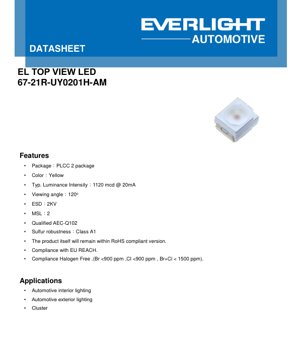
This document details the specifications for a high-performance, surface-mount yellow LED in a PLCC-2 package. The device is engineered primarily for demanding automotive lighting environments, offering reliable operation, consistent color output, and robust construction to withstand harsh conditions.
1.1 Core Features and Target Market
The LED's primary application is in the automotive sector, targeting both interior and exterior lighting systems. Key features include a typical luminous intensity of 1120 millicandelas (mcd) at a forward current of 20mA, a wide 120-degree viewing angle for excellent visibility, and qualification to the AEC-Q102 standard for automotive-grade components. It also boasts sulfur robustness (Class A1), compliance with EU REACH and RoHS directives, and is halogen-free. These attributes make it suitable for applications such as dashboard backlighting (clusters), interior ambient lighting, and various exterior signal lights where reliability and longevity are critical.
2. In-Depth Technical Parameter Analysis
The electrical and optical characteristics define the operational boundaries and typical performance of the LED.
2.1 Photometric and Electrical Characteristics
The key operating parameters are specified at a junction temperature of 25°C and a forward current (IF) of 20mA. The typical forward voltage (VF) is 2.10V, with a minimum of 1.75V and a maximum of 2.75V. The dominant wavelength (λd) falls within the yellow spectrum, ranging from 585nm to 594nm. The luminous intensity (IV) has a typical value of 1120 mcd, with a minimum of 710 mcd and a maximum of 1800 mcd. It is important to note the measurement tolerances: ±8% for luminous flux, ±0.05V for forward voltage, and ±1nm for dominant wavelength.
2.2 Absolute Maximum Ratings and Thermal Management
To ensure device reliability, these limits must not be exceeded under any conditions. The absolute maximum forward current is 50mA, with a surge current capability of 100mA for pulses ≤10μs. The maximum power dissipation is 137mW. The device can operate within an ambient temperature range of -40°C to +110°C, with a maximum junction temperature (TJ) of 125°C. The thermal resistance from the junction to the solder point is specified both electrically (Rth JS el: 100-120 K/W) and in real conditions (Rth JS real: 120-160 K/W), which is crucial for thermal design in the application. The ESD sensitivity is rated at 2kV (HBM).
3. Binning System Explanation
The LED is categorized into bins for key parameters to ensure consistency in mass production and for design flexibility.
3.1 Luminous Intensity Binning
Luminous intensity is grouped into four bins: V1 (710-900 mcd), V2 (900-1120 mcd), AA (1120-1400 mcd), and AB (1400-1800 mcd). This allows designers to select the appropriate brightness level for their specific application needs.
3.2 Dominant Wavelength and Forward Voltage Binning
The dominant wavelength is binned into three groups: 8588 (585-588 nm), 8891 (588-591 nm), and 9194 (591-594 nm), enabling precise color selection. Forward voltage is binned into four ranges: 1720 (1.75-2.00V), 2022 (2.00-2.25V), 2225 (2.25-2.50V), and 2527 (2.50-2.75V), which is important for driver circuit design and power management.
4. Performance Curve Analysis
Graphical data provides insight into the LED's behavior under varying conditions.
4.1 IV Curve and Spectral Distribution
The forward current vs. forward voltage (I-V) curve shows the exponential relationship typical of diodes. The relative spectral distribution graph confirms the emission peak in the yellow region. The radiation pattern diagram illustrates the 120-degree viewing angle, defined as the off-axis angle where intensity drops to half its peak value.
4.2 Temperature Dependence and Derating
Several graphs detail performance changes with temperature. The relative luminous intensity decreases as junction temperature rises. The dominant wavelength exhibits a shift with both increasing forward current and junction temperature. The forward current derating curve is critical: it shows the maximum allowable forward current must be reduced as the solder pad temperature increases. For example, at a pad temperature of 110°C, the maximum continuous current is limited to 34mA. A separate graph defines the permissible pulse handling capability for different duty cycles.
5. Mechanical, Packaging, and Assembly Information
5.1 Mechanical Dimensions and Polarity
The component uses a standard PLCC-2 (Plastic Leaded Chip Carrier) surface-mount package, often referred to by its footprint size as 0201. The detailed mechanical drawing specifies the exact length, width, height, and lead positions. The part number includes an \"R\" indicating reverse polarity, which must be verified against the recommended soldering pad layout during PCB design to ensure correct orientation.
5.2 Soldering and Reflow Guidelines
A recommended soldering pad layout is provided to ensure proper solder joint formation and thermal relief. The reflow soldering profile must be followed precisely. The maximum soldering temperature is 260°C for a duration not exceeding 30 seconds. Adherence to this profile is essential to prevent thermal damage to the LED package and internal die.
5.3 Packaging and Handling Precautions
The device has a Moisture Sensitivity Level (MSL) of 2. Precautions include storing in a dry environment and baking if the packaging is opened and exposed to ambient humidity beyond its floor life before soldering. General precautions warn against applying reverse voltage, exceeding absolute maximum ratings, and subjecting the device to mechanical stress.
6. Ordering and Part Number Information
The part number follows a specific structure: 67-21R-UY0201H-AM.
- 67-21: Product family.
- R: Reverse polarity.
- UY: Color (Yellow).
- 020: Test current (20mA).
- 1: Lead frame type.
- H: Brightness level (High).
- AM: Designates automotive application.
7. Application Design Considerations and FAQs
7.1 Typical Application Scenarios
This LED is ideal for:
- Automotive Interior Lighting: Dashboard instrument clusters, switch backlighting, ambient lighting strips.
- Automotive Exterior Lighting: Side marker lights, center high-mount stop lights (CHMSL), turn signal indicators (depending on local regulations and required intensity).
7.2 Design and Usage FAQs
Q: What is the recommended drive current?
A: The typical operating current is 20mA, providing a good balance of brightness and longevity. The absolute maximum is 50mA continuous, but operation near this limit requires careful thermal management as shown in the derating curve.
Q: How do I ensure color consistency in my design?
A: Specify the required dominant wavelength bin (8588, 8891, or 9194) when ordering. Using LEDs from the same production bin minimizes color variation.
Q: Is a current-limiting resistor necessary?
A: Yes. LEDs are current-driven devices. An external current-limiting resistor or a constant-current driver circuit is mandatory to prevent thermal runaway and destruction of the LED, especially given the variation in forward voltage (1.75V to 2.75V).
Q: Can it be used in non-automotive applications?
A: While qualified for automotive use, its high reliability makes it suitable for other demanding industrial, consumer, or signage applications where environmental robustness is needed.
7.3 Practical Design Case Study
Consider designing a dashboard indicator light. The design steps would involve: 1) Determining the required luminous intensity based on daylight visibility requirements (selecting an appropriate bin, e.g., AA or AB). 2) Designing the driver circuit: Calculating the series resistor value for a 12V automotive supply, considering the LED's forward voltage bin (e.g., 2022 for ~2.1V) to achieve 20mA. The formula is R = (Vsupply - VF) / IF. 3) Thermal analysis: Verifying that the PCB layout and possible ambient temperature near the dashboard do not cause the solder pad temperature to exceed the point where derating is required (referring to the derating curve). 4) Implementing reverse polarity protection on the PCB, as the LED is not designed for reverse voltage operation.
8. Technical Principles and Industry Context
8.1 Operating Principle
This LED is a semiconductor light source. When a forward voltage exceeding its threshold is applied, electrons recombine with holes within the semiconductor chip, releasing energy in the form of photons. The specific materials used in the chip's active region determine the wavelength (color) of the emitted light, in this case, yellow. The PLCC-2 package incorporates a reflector cup and a molded epoxy lens to shape the light output and achieve the specified 120-degree viewing angle.
8.2 Comparison and Trends
Compared to older through-hole LEDs, this PLCC-2 SMD device offers a smaller footprint, better suitability for automated assembly, and improved thermal performance due to its design that allows heat to dissipate through the solder pads. The trend in automotive lighting is towards higher efficiency (more lumens per watt), smaller package sizes enabling sleeker designs, and increased integration of control electronics (e.g., LED drivers) directly with the light source. Components like this, with AEC-Q102 qualification and high brightness in a compact package, align with these industry demands for advanced, reliable vehicle lighting systems.
LED Specification Terminology
Complete explanation of LED technical terms
Photoelectric Performance
| Term | Unit/Representation | Simple Explanation | Why Important |
|---|---|---|---|
| Luminous Efficacy | lm/W (lumens per watt) | Light output per watt of electricity, higher means more energy efficient. | Directly determines energy efficiency grade and electricity cost. |
| Luminous Flux | lm (lumens) | Total light emitted by source, commonly called "brightness". | Determines if the light is bright enough. |
| Viewing Angle | ° (degrees), e.g., 120° | Angle where light intensity drops to half, determines beam width. | Affects illumination range and uniformity. |
| CCT (Color Temperature) | K (Kelvin), e.g., 2700K/6500K | Warmth/coolness of light, lower values yellowish/warm, higher whitish/cool. | Determines lighting atmosphere and suitable scenarios. |
| CRI / Ra | Unitless, 0–100 | Ability to render object colors accurately, Ra≥80 is good. | Affects color authenticity, used in high-demand places like malls, museums. |
| SDCM | MacAdam ellipse steps, e.g., "5-step" | Color consistency metric, smaller steps mean more consistent color. | Ensures uniform color across same batch of LEDs. |
| Dominant Wavelength | nm (nanometers), e.g., 620nm (red) | Wavelength corresponding to color of colored LEDs. | Determines hue of red, yellow, green monochrome LEDs. |
| Spectral Distribution | Wavelength vs intensity curve | Shows intensity distribution across wavelengths. | Affects color rendering and quality. |
Electrical Parameters
| Term | Symbol | Simple Explanation | Design Considerations |
|---|---|---|---|
| Forward Voltage | Vf | Minimum voltage to turn on LED, like "starting threshold". | Driver voltage must be ≥Vf, voltages add up for series LEDs. |
| Forward Current | If | Current value for normal LED operation. | Usually constant current drive, current determines brightness & lifespan. |
| Max Pulse Current | Ifp | Peak current tolerable for short periods, used for dimming or flashing. | Pulse width & duty cycle must be strictly controlled to avoid damage. |
| Reverse Voltage | Vr | Max reverse voltage LED can withstand, beyond may cause breakdown. | Circuit must prevent reverse connection or voltage spikes. |
| Thermal Resistance | Rth (°C/W) | Resistance to heat transfer from chip to solder, lower is better. | High thermal resistance requires stronger heat dissipation. |
| ESD Immunity | V (HBM), e.g., 1000V | Ability to withstand electrostatic discharge, higher means less vulnerable. | Anti-static measures needed in production, especially for sensitive LEDs. |
Thermal Management & Reliability
| Term | Key Metric | Simple Explanation | Impact |
|---|---|---|---|
| Junction Temperature | Tj (°C) | Actual operating temperature inside LED chip. | Every 10°C reduction may double lifespan; too high causes light decay, color shift. |
| Lumen Depreciation | L70 / L80 (hours) | Time for brightness to drop to 70% or 80% of initial. | Directly defines LED "service life". |
| Lumen Maintenance | % (e.g., 70%) | Percentage of brightness retained after time. | Indicates brightness retention over long-term use. |
| Color Shift | Δu′v′ or MacAdam ellipse | Degree of color change during use. | Affects color consistency in lighting scenes. |
| Thermal Aging | Material degradation | Deterioration due to long-term high temperature. | May cause brightness drop, color change, or open-circuit failure. |
Packaging & Materials
| Term | Common Types | Simple Explanation | Features & Applications |
|---|---|---|---|
| Package Type | EMC, PPA, Ceramic | Housing material protecting chip, providing optical/thermal interface. | EMC: good heat resistance, low cost; Ceramic: better heat dissipation, longer life. |
| Chip Structure | Front, Flip Chip | Chip electrode arrangement. | Flip chip: better heat dissipation, higher efficacy, for high-power. |
| Phosphor Coating | YAG, Silicate, Nitride | Covers blue chip, converts some to yellow/red, mixes to white. | Different phosphors affect efficacy, CCT, and CRI. |
| Lens/Optics | Flat, Microlens, TIR | Optical structure on surface controlling light distribution. | Determines viewing angle and light distribution curve. |
Quality Control & Binning
| Term | Binning Content | Simple Explanation | Purpose |
|---|---|---|---|
| Luminous Flux Bin | Code e.g., 2G, 2H | Grouped by brightness, each group has min/max lumen values. | Ensures uniform brightness in same batch. |
| Voltage Bin | Code e.g., 6W, 6X | Grouped by forward voltage range. | Facilitates driver matching, improves system efficiency. |
| Color Bin | 5-step MacAdam ellipse | Grouped by color coordinates, ensuring tight range. | Guarantees color consistency, avoids uneven color within fixture. |
| CCT Bin | 2700K, 3000K etc. | Grouped by CCT, each has corresponding coordinate range. | Meets different scene CCT requirements. |
Testing & Certification
| Term | Standard/Test | Simple Explanation | Significance |
|---|---|---|---|
| LM-80 | Lumen maintenance test | Long-term lighting at constant temperature, recording brightness decay. | Used to estimate LED life (with TM-21). |
| TM-21 | Life estimation standard | Estimates life under actual conditions based on LM-80 data. | Provides scientific life prediction. |
| IESNA | Illuminating Engineering Society | Covers optical, electrical, thermal test methods. | Industry-recognized test basis. |
| RoHS / REACH | Environmental certification | Ensures no harmful substances (lead, mercury). | Market access requirement internationally. |
| ENERGY STAR / DLC | Energy efficiency certification | Energy efficiency and performance certification for lighting. | Used in government procurement, subsidy programs, enhances competitiveness. |