Table of Contents
- 1. Product Overview
- 2. Technical Parameter Deep Dive
- 2.1 Absolute Maximum Ratings
- 2.2 Electro-Optical Characteristics
- 3. Performance Curve Analysis
- 3.1 IR-LED Characteristics
- 3.2 Phototransistor Characteristics
- 3.3 Combined Sensor Characteristics
- 4. Mechanical and Package Information
- 5. Soldering and Assembly Guidelines
- 6. Packaging and Ordering Information
- 7. Application Suggestions
- 7.1 Typical Application Scenarios
- 7.2 Design Considerations
- 8. Technical Comparison
- 9. Frequently Asked Questions (FAQ)
- 10. Practical Use Case
- 11. Operating Principle
- 12. Technology Trends
- 13. Disclaimer and Important Notes
1. Product Overview
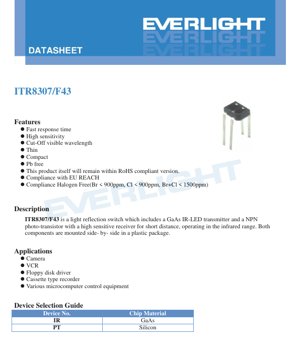
The ITR8307/F43 is a compact, surface-mount reflective optical sensor designed for short-distance object detection. It integrates an infrared light-emitting diode (IR-LED) and a high-sensitivity NPN silicon phototransistor within a single plastic package. The primary function is to detect the presence or absence of an object by emitting infrared light from the LED and measuring the amount of light reflected back to the phototransistor.
The core advantages of this device include its fast response time, high sensitivity to infrared light, and its ability to filter out visible light interference, ensuring reliable operation. Its thin and compact form factor makes it suitable for space-constrained applications in consumer electronics and microcomputer-controlled equipment.
The device is manufactured to be lead-free (Pb-free), compliant with the EU REACH regulation, and adheres to halogen-free standards (Br < 900ppm, Cl < 900ppm, Br+Cl < 1500ppm). It is also designed to remain within the specifications of the RoHS directive.
2. Technical Parameter Deep Dive
2.1 Absolute Maximum Ratings
These ratings define the limits beyond which permanent damage to the device may occur. Operation under these conditions is not guaranteed.
- Input (IR-LED) Power Dissipation (Pd): 75 mW at or below 25°C free air temperature. Exceeding this can overheat the LED junction.
- LED Reverse Voltage (VR): 5 V. Applying a higher reverse voltage can cause breakdown.
- LED Forward Current (IF): 50 mA continuous. The peak forward current (IFP) is 1 A for pulses of 100 µs width at a 10 ms period.
- Output (Phototransistor) Collector Power Dissipation (PC): 75 mW.
- Collector Current (IC): 50 mA maximum.
- Collector-Emitter Voltage (VCEO): 30 V. This is the maximum voltage that can be applied between collector and emitter with the base open.
- Operating Temperature (Topr): -25°C to +85°C. The device is functional within this ambient temperature range.
- Storage Temperature (Tstg): -30°C to +100°C.
- Lead Soldering Temperature (Tsol): 260°C for a maximum of 5 seconds. This is critical for wave or reflow soldering processes.
2.2 Electro-Optical Characteristics
These parameters are measured at Ta=25°C and define the typical performance of the device.
- LED Forward Voltage (VF): Typically 1.2 V, with a maximum of 1.6 V at a forward current (IF) of 20 mA. This is important for designing the current-limiting driver circuit.
- LED Peak Wavelength (λP): 940 nm. This is the wavelength at which the IR-LED emits the most optical power, matching the peak sensitivity of the silicon phototransistor.
- Phototransistor Dark Current (ICEO): Maximum 100 nA at VCE=10V with no illumination (Ee=0). This is the leakage current when the sensor is 'off' and should be minimized for good signal-to-noise ratio.
- Collector Current (IC(ON)): Minimum 0.1 mA under the test condition of VCE=5V and IF=20mA. This is the photocurrent generated when the LED is active and an object is within the detection range.
- Rise/Fall Time (tr, tf): Typically 20 µs each. This defines the switching speed of the phototransistor, crucial for detecting fast-moving objects or for high-speed data transmission in some applications.
3. Performance Curve Analysis
The datasheet includes several characteristic curves that provide a deeper understanding of device behavior under varying conditions. While the specific graphs are not reproduced here, their typical implications are explained.
3.1 IR-LED Characteristics
Curves for the infrared emitter typically show the relationship between forward voltage and forward current (I-V curve), which is non-linear. They also illustrate the relative radiant intensity versus forward current, showing how optical output increases with drive current, and the effect of ambient temperature on this output, which generally decreases as temperature rises.
3.2 Phototransistor Characteristics
Curves for the receiver typically depict collector current versus collector-emitter voltage for different levels of irradiance (optical input power). This family of curves is similar to a bipolar transistor's output characteristics, with irradiance acting like base current. Other curves may show collector current versus distance to a reflective surface or versus the LED drive current, defining the sensor's transfer function.
3.3 Combined Sensor Characteristics
These curves represent the performance of the complete sensor assembly. A key graph is the collector current versus the distance to a standard reflective surface (often a white card) for a fixed LED current. This curve defines the effective sensing range and the nonlinear response over distance, which is critical for threshold detection design.
4. Mechanical and Package Information
The device comes in a compact, surface-mount package. The exact dimensions are provided in the datasheet's package drawing. Key notes from the drawing specify that all dimensions are in millimeters and the general tolerance is ±0.15 mm unless otherwise stated. The side-by-side placement of the IR-LED and phototransistor is optimized for reflective sensing. The package includes polarity markings to ensure correct orientation during PCB assembly.
5. Soldering and Assembly Guidelines
The absolute maximum rating for lead soldering temperature is 260°C for 5 seconds. This parameter must be strictly adhered to during reflow or wave soldering processes to prevent damage to the plastic package or the internal wire bonds. Standard IPC/JEDEC J-STD-020 profiles for lead-free soldering are generally applicable, but the peak temperature and time above liquidus must be controlled. Prolonged exposure to high humidity before soldering should be avoided, and standard moisture sensitivity level (MSL) handling procedures are recommended, though the specific MSL classification is not stated in the provided content.
6. Packaging and Ordering Information
The standard packaging is as follows:
- 160 pieces per tube.
- 18 tubes per inner carton.
- 12 inner cartons per master (outside) carton.
The label on the packaging includes fields for Customer's Production Number (CPN), Production Number (P/N), Packing Quantity (QTY), Ranks (CAT), Peak Wavelength (HUE), Reference (REF), Lot Number (LOT No.), and Production Place.
7. Application Suggestions
7.1 Typical Application Scenarios
The datasheet lists several classic applications: cameras (e.g., for detecting film or tape presence), VCRs, floppy disk drives, cassette tape recorders, and various microcomputer control equipment. Modern applications include paper detection in printers, coin detection in vending machines, edge sensing, object counting, and proximity sensing in consumer devices where non-contact detection is required.
7.2 Design Considerations
- Current Limiting: A series resistor must be used with the IR-LED to limit the forward current (IF) to a safe value, typically 20 mA for standard operation, calculated using the supply voltage and the LED's forward voltage (VF).
- Load Resistor: The phototransistor output requires a pull-up or load resistor (RL) connected between the collector and the positive supply. Its value determines the output voltage swing and the speed of response. A smaller resistor provides faster response but lower sensitivity (smaller voltage change).
- Ambient Light Immunity: While the device cuts off visible light, strong ambient infrared sources (sunlight, incandescent bulbs) can affect performance. Mechanical shielding, optical filters, or modulation/demodulation techniques (pulsing the LED and synchronously reading the output) can improve reliability.
- Reflectivity: The detection range and signal strength are highly dependent on the reflectivity, color, and surface texture of the target object. Calibration or adjustable thresholds may be necessary.
8. Technical Comparison
The ITR8307/F43 offers a specific set of features. Compared to simpler phototransistors or photodiodes, it provides an integrated, aligned solution for reflective sensing. Compared to modern digital output sensors with built-in logic, it is an analog component requiring external circuitry for signal conditioning, offering greater design flexibility but more complexity. Its key differentiators are its compact size, fast response time (20 µs), and compliance with environmental regulations (RoHS, REACH, Halogen-Free).
9. Frequently Asked Questions (FAQ)
Q: What is the typical sensing distance?
A: The datasheet does not specify a maximum distance as it depends heavily on the reflectivity of the target and the LED drive current. The test condition for IC(ON) uses a 1mm gap, indicating it is optimized for very short-range detection. Practical ranges are usually a few millimeters to a couple of centimeters.
Q: Can I drive the LED with a voltage source directly?
A: No. The LED must be driven with a current-limited source, almost always implemented with a series resistor, to prevent thermal runaway and destruction from overcurrent.
Q: How do I interface the output to a microcontroller?
A: The phototransistor collector output is an analog voltage that varies with reflected light. It can be connected to a microcontroller's analog-to-digital converter (ADC) pin for precise measurement, or through a comparator circuit to create a digital on/off signal for a GPIO pin.
Q: What is the purpose of the 'Cut-Off visible wavelength' feature?
A> The phototransistor is designed to be sensitive primarily to the 940 nm infrared light from its paired LED and less sensitive to visible light. This reduces false triggering from changes in ambient room lighting.
10. Practical Use Case
Case: Paper-End Detection in a Desktop Printer
The sensor is mounted inside the printer, facing the paper path. A reflective flag or the paper itself acts as the target. When paper is present, infrared light reflects back to the phototransistor, generating a high collector current and a low output voltage (if using a pull-up resistor). When the paper runs out, the reflection ceases, the phototransistor turns off, and the output voltage goes high. This voltage transition is detected by the printer's control logic, triggering a "paper out" alert to the user. The fast response time ensures detection even at high paper feed speeds.
11. Operating Principle
The ITR8307/F43 operates on the principle of modulated light reflection. The internal GaAs infrared LED converts electrical current into infrared light (940 nm). This light is emitted towards a target area. If an object is present within the detection field, a portion of this light is reflected back. The integrated NPN silicon phototransistor acts as the receiver. When photons from the reflected infrared light strike the base-collector junction of the phototransistor, they generate electron-hole pairs. This photogenerated current acts as a base current, which is then amplified by the transistor's gain, resulting in a much larger collector current (IC). The magnitude of this collector current is proportional to the intensity of the reflected infrared light, which in turn depends on the distance and reflectivity of the object. By measuring this output current (or the voltage across a load resistor), the presence, absence, or even approximate distance of an object can be determined.
12. Technology Trends
Reflective optical sensors like the ITR8307/F43 represent a mature and reliable technology. Current trends in the field include further miniaturization of packages, integration of the sensor with analog front-end circuitry (amplifiers, ADCs) and digital logic (I2C/SPI interfaces) into single-chip solutions, reducing external component count. There is also a focus on lower power consumption for battery-operated devices and enhanced algorithms for background light cancellation and distance measurement. The demand for environmentally compliant (green) components, which this device addresses, continues to be a strong driver in the electronics industry.
13. Disclaimer and Important Notes
Based on the datasheet content, the following disclaimers and notes are critical for users:
- The manufacturer reserves the right to adjust product material mix.
- The product meets its published specification for 12 months from the date of shipment.
- Graphs and typical values are for reference only and do not represent guaranteed minimum or maximum limits.
- The user is responsible for operating the device within its Absolute Maximum Ratings. The manufacturer assumes no liability for damage resulting from misuse.
- The datasheet content is copyrighted; reproduction requires prior consent.
- Critical Warning: This product is not intended for use in safety-critical applications including military, aircraft, automotive, medical, life-sustaining, or life-saving equipment. For such applications, explicit authorization must be obtained.
LED Specification Terminology
Complete explanation of LED technical terms
Photoelectric Performance
| Term | Unit/Representation | Simple Explanation | Why Important |
|---|---|---|---|
| Luminous Efficacy | lm/W (lumens per watt) | Light output per watt of electricity, higher means more energy efficient. | Directly determines energy efficiency grade and electricity cost. |
| Luminous Flux | lm (lumens) | Total light emitted by source, commonly called "brightness". | Determines if the light is bright enough. |
| Viewing Angle | ° (degrees), e.g., 120° | Angle where light intensity drops to half, determines beam width. | Affects illumination range and uniformity. |
| CCT (Color Temperature) | K (Kelvin), e.g., 2700K/6500K | Warmth/coolness of light, lower values yellowish/warm, higher whitish/cool. | Determines lighting atmosphere and suitable scenarios. |
| CRI / Ra | Unitless, 0–100 | Ability to render object colors accurately, Ra≥80 is good. | Affects color authenticity, used in high-demand places like malls, museums. |
| SDCM | MacAdam ellipse steps, e.g., "5-step" | Color consistency metric, smaller steps mean more consistent color. | Ensures uniform color across same batch of LEDs. |
| Dominant Wavelength | nm (nanometers), e.g., 620nm (red) | Wavelength corresponding to color of colored LEDs. | Determines hue of red, yellow, green monochrome LEDs. |
| Spectral Distribution | Wavelength vs intensity curve | Shows intensity distribution across wavelengths. | Affects color rendering and quality. |
Electrical Parameters
| Term | Symbol | Simple Explanation | Design Considerations |
|---|---|---|---|
| Forward Voltage | Vf | Minimum voltage to turn on LED, like "starting threshold". | Driver voltage must be ≥Vf, voltages add up for series LEDs. |
| Forward Current | If | Current value for normal LED operation. | Usually constant current drive, current determines brightness & lifespan. |
| Max Pulse Current | Ifp | Peak current tolerable for short periods, used for dimming or flashing. | Pulse width & duty cycle must be strictly controlled to avoid damage. |
| Reverse Voltage | Vr | Max reverse voltage LED can withstand, beyond may cause breakdown. | Circuit must prevent reverse connection or voltage spikes. |
| Thermal Resistance | Rth (°C/W) | Resistance to heat transfer from chip to solder, lower is better. | High thermal resistance requires stronger heat dissipation. |
| ESD Immunity | V (HBM), e.g., 1000V | Ability to withstand electrostatic discharge, higher means less vulnerable. | Anti-static measures needed in production, especially for sensitive LEDs. |
Thermal Management & Reliability
| Term | Key Metric | Simple Explanation | Impact |
|---|---|---|---|
| Junction Temperature | Tj (°C) | Actual operating temperature inside LED chip. | Every 10°C reduction may double lifespan; too high causes light decay, color shift. |
| Lumen Depreciation | L70 / L80 (hours) | Time for brightness to drop to 70% or 80% of initial. | Directly defines LED "service life". |
| Lumen Maintenance | % (e.g., 70%) | Percentage of brightness retained after time. | Indicates brightness retention over long-term use. |
| Color Shift | Δu′v′ or MacAdam ellipse | Degree of color change during use. | Affects color consistency in lighting scenes. |
| Thermal Aging | Material degradation | Deterioration due to long-term high temperature. | May cause brightness drop, color change, or open-circuit failure. |
Packaging & Materials
| Term | Common Types | Simple Explanation | Features & Applications |
|---|---|---|---|
| Package Type | EMC, PPA, Ceramic | Housing material protecting chip, providing optical/thermal interface. | EMC: good heat resistance, low cost; Ceramic: better heat dissipation, longer life. |
| Chip Structure | Front, Flip Chip | Chip electrode arrangement. | Flip chip: better heat dissipation, higher efficacy, for high-power. |
| Phosphor Coating | YAG, Silicate, Nitride | Covers blue chip, converts some to yellow/red, mixes to white. | Different phosphors affect efficacy, CCT, and CRI. |
| Lens/Optics | Flat, Microlens, TIR | Optical structure on surface controlling light distribution. | Determines viewing angle and light distribution curve. |
Quality Control & Binning
| Term | Binning Content | Simple Explanation | Purpose |
|---|---|---|---|
| Luminous Flux Bin | Code e.g., 2G, 2H | Grouped by brightness, each group has min/max lumen values. | Ensures uniform brightness in same batch. |
| Voltage Bin | Code e.g., 6W, 6X | Grouped by forward voltage range. | Facilitates driver matching, improves system efficiency. |
| Color Bin | 5-step MacAdam ellipse | Grouped by color coordinates, ensuring tight range. | Guarantees color consistency, avoids uneven color within fixture. |
| CCT Bin | 2700K, 3000K etc. | Grouped by CCT, each has corresponding coordinate range. | Meets different scene CCT requirements. |
Testing & Certification
| Term | Standard/Test | Simple Explanation | Significance |
|---|---|---|---|
| LM-80 | Lumen maintenance test | Long-term lighting at constant temperature, recording brightness decay. | Used to estimate LED life (with TM-21). |
| TM-21 | Life estimation standard | Estimates life under actual conditions based on LM-80 data. | Provides scientific life prediction. |
| IESNA | Illuminating Engineering Society | Covers optical, electrical, thermal test methods. | Industry-recognized test basis. |
| RoHS / REACH | Environmental certification | Ensures no harmful substances (lead, mercury). | Market access requirement internationally. |
| ENERGY STAR / DLC | Energy efficiency certification | Energy efficiency and performance certification for lighting. | Used in government procurement, subsidy programs, enhances competitiveness. |