Table of Contents
- 1. Product Overview
- 2. Technical Parameter Deep Dive
- 2.1 Absolute Maximum Ratings
- 2.2 Electro-Optical Characteristics
- 4. Performance Curve Analysis
- 4.1 Spectrum Distribution
- 4.2 Forward Current vs. Forward Voltage (I-V Curve)
- 4.3 Forward Current Derating Curve
- 5. Mechanical and Package Information
- 5.1 Package Dimensions
- 5.2 Pinout and Polarity Identification
- 6. Soldering and Assembly Guidelines
- 7. Packaging and Ordering Information
- 8. Application Suggestions
- 8.1 Typical Application Scenarios
- 8.2 Design Considerations
- 9. Technical Comparison and Differentiation
- 10. Frequently Asked Questions (Based on Technical Parameters)
- 11. Practical Design and Usage Case
- 12. Operating Principle Introduction
- 13. Technology Trends and Developments
- LED Specification Terminology
- Photoelectric Performance
- Electrical Parameters
- Thermal Management & Reliability
- Packaging & Materials
- Quality Control & Binning
- Testing & Certification
1. Product Overview
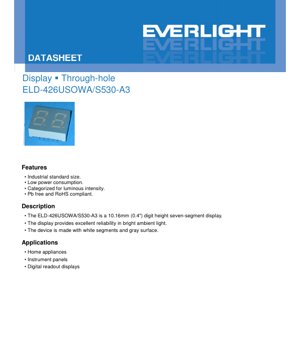
The ELD-426USOWA/S530-A3 is a through-hole mounted, seven-segment alphanumeric display designed for clear digital readouts in various electronic applications. It features a standard industrial footprint, making it compatible with existing PCB layouts and sockets designed for similar displays. The primary design goal is to provide reliable, legible numeric and limited alphanumeric information in environments with varying ambient light conditions.
The core advantage of this display lies in its combination of standard physical dimensions and categorized optical performance. The segments are constructed with white diffusion resin and a gray surface, which enhances contrast and readability. The device is built using AlGaInP (Aluminum Gallium Indium Phosphide) semiconductor technology, which is known for its efficiency in producing high-brightness red and reddish-orange light. This makes the display suitable for applications where power consumption is a concern but visibility is paramount.
The target market for this component includes designers and manufacturers of consumer electronics, industrial control panels, home appliances, and test and measurement equipment. Its through-hole design ensures robust mechanical connections, ideal for applications subject to vibration or where long-term reliability is critical.
2. Technical Parameter Deep Dive
2.1 Absolute Maximum Ratings
These ratings define the stress limits beyond which permanent damage to the device may occur. Operation under or at these limits is not guaranteed and should be avoided in normal use.
- Reverse Voltage (VR): 5V. Exceeding this voltage in reverse bias can cause junction breakdown.
- Forward Current (IF): 25 mA DC. This is the maximum continuous current allowed through a single segment.
- Peak Forward Current (IFP): 60 mA. This is permissible only under pulsed conditions with a duty cycle of 1/10 and a frequency of 1 kHz. It allows for brief periods of higher brightness, for example, in multiplexed displays.
- Power Dissipation (Pd): 60 mW. This is the maximum power that can be safely dissipated as heat by the device.
- Operating Temperature (Topr): -40°C to +85°C. The device is rated for industrial temperature ranges.
- Storage Temperature (Tstg): -40°C to +100°C.
- Soldering Temperature (Tsol): 260°C for a maximum of 5 seconds. This is critical for wave or hand soldering processes.
2.2 Electro-Optical Characteristics
These parameters are measured at a standard junction temperature of 25°C and define the device's performance under normal operating conditions.
- Luminous Intensity (Iv): Typical value is 24 mcd at a forward current (IF) of 10 mA. The minimum specified is 11 mcd. The intensity is an average value measured per individual 7-segment. A tolerance of ±10% applies.
- Peak Wavelength (λp): Typically 621 nm. This is the wavelength at which the emitted optical power is maximum. It defines the perceived color, which in this case is in the reddish-orange spectrum.
- Dominant Wavelength (λd): Typically 615 nm. This is the single wavelength that would produce a color sensation matching that of the LED's output, crucial for color-critical applications.
- Spectral Radiation Bandwidth (Δλ): Typically 18 nm. This indicates the range of wavelengths emitted, centered around the peak wavelength. A narrower bandwidth indicates a more spectrally pure color.
- Forward Voltage (VF): Typically 2.0V, with a maximum of 2.4V at IF=20 mA. The tolerance is ±0.1V. This parameter is essential for designing the current-limiting circuitry.
- Reverse Current (IR): Maximum 100 µA at VR=5V. This is the leakage current when the device is reverse-biased.
3. Binning System Explanation
The datasheet indicates that the devices are "Categorized for luminous intensity." This refers to a binning or sorting process.
- Luminous Intensity Binning: The luminous intensity (Iv) is measured and sorted into specific ranges or "bins." This ensures consistency in brightness across multiple units used in the same product, preventing noticeable variations in segment brightness on a display. The label on the packaging includes a "CAT" field which denotes this Luminous Intensity Rank.
- Color/Wavelength Consistency: While not explicitly stated as binned, the typical values for peak (621 nm) and dominant (615 nm) wavelength suggest tight control over the semiconductor epitaxy and manufacturing process to ensure consistent color output, which is characteristic of AlGaInP technology.
- Forward Voltage: The specified tolerance of ±0.1V indicates a controlled production process, minimizing variations in the electrical characteristics that could affect driver circuit design.
4. Performance Curve Analysis
The datasheet provides typical characteristic curves which are invaluable for understanding device behavior under non-standard conditions.
4.1 Spectrum Distribution
The spectral distribution curve shows the relative intensity of light emitted across different wavelengths. For the ELD-426USOWA/S530-A3, this curve would be centered around 621 nm (reddish-orange) with a typical full width at half maximum (FWHM) of 18 nm. This curve is important for applications where the display's light might interact with optical filters or where specific color perception is required.
4.2 Forward Current vs. Forward Voltage (I-V Curve)
This curve illustrates the non-linear relationship between the voltage applied across the LED and the resulting current. It shows the "turn-on" voltage (around 1.8-2.0V for this device) and how the voltage increases slightly with current. Designers use this to calculate the necessary series resistor value for a given supply voltage to achieve the desired operating current (e.g., 10 mA or 20 mA).
4.3 Forward Current Derating Curve
This is a critical graph for reliability. It shows how the maximum allowable continuous forward current (IF) must be reduced as the ambient temperature increases above 25°C. As temperature rises, the LED's ability to dissipate heat decreases. To prevent overheating and accelerated degradation, the operating current must be lowered. For example, at an ambient temperature of 85°C, the maximum permissible continuous current will be significantly less than the 25 mA absolute maximum rating specified at 25°C.
5. Mechanical and Package Information
5.1 Package Dimensions
The display conforms to an industrial standard size for a 10.16mm (0.4 inch) digit height, single-digit, seven-segment package. The dimensional drawing provides all critical measurements including overall height, width, digit size, segment dimensions, and pin spacing. The pin spacing is typically on a 0.1-inch (2.54 mm) grid, compatible with standard perforated prototyping boards and PCB layouts. All unspecified tolerances are ±0.25 mm.
5.2 Pinout and Polarity Identification
The internal circuit diagram shows the common-anode configuration of the display. In a common-anode display, the anodes of all LED segments are connected together to a common pin (or multiple pins for current handling). Each segment's cathode has its own dedicated pin. To illuminate a segment, the common anode pin is connected to the positive supply voltage (through a current-limiting resistor), and the corresponding cathode pin is pulled low (grounded). The pinout diagram clearly identifies pin 1, the common anode pins, and the cathode pins for segments a through g and the decimal point (if present). Proper polarity identification is crucial to prevent incorrect connections that could damage the display.
6. Soldering and Assembly Guidelines
- Soldering Process: The device can withstand a maximum soldering temperature of 260°C for up to 5 seconds. This is suitable for wave soldering or hand soldering with a temperature-controlled iron. Prolonged exposure to high heat can damage the internal wire bonds or the epoxy resin.
- ESD (Electrostatic Discharge) Precautions: The LED dice are sensitive to static electricity. Recommended handling precautions include using grounded wrist straps, ESD-safe workstations with conductive mats, and proper grounding of all equipment. The work environment should maintain adequate humidity to minimize static charge generation. Ionizers can be used to neutralize charges on insulating materials.
- Storage Conditions: Devices should be stored within the specified temperature range of -40°C to +100°C in a dry, ESD-safe environment. The original packaging (tubes) provides mechanical protection and should be used until the components are ready for assembly.
7. Packaging and Ordering Information
- Packaging Specification: The devices are packed 25 pieces per tube. For bulk handling, 64 tubes are packed into one box, and 4 boxes are packed into one master carton. This totals 6,400 pieces per carton (25 x 64 x 4).
- Label Explanation: The packaging label contains several key fields:
- CPN: Customer's Part Number (for customer reference).
- P/N: The manufacturer's part number (ELD-426USOWA/S530-A3).
- QTY: The quantity of devices in that specific package.
- CAT: The Luminous Intensity Rank or bin code.
- LOT No: The manufacturing lot number for traceability.
8. Application Suggestions
8.1 Typical Application Scenarios
- Home Appliances: Timers on ovens, microwaves, and washing machines; temperature displays on refrigerators or air conditioners.
- Instrument Panels: Readouts for voltage, current, frequency, or RPM in test equipment, power supplies, and automotive dashboards (for aftermarket or non-critical functions).
- Digital Readout Displays: Standalone counters, clocks, thermometers, hygrometers, and simple control interfaces.
8.2 Design Considerations
- Current Limiting: Always use a series resistor for each segment or the common anode to limit current to the desired value (e.g., 10-20 mA). Calculate the resistor value using R = (Vsupply - VF) / IF.
- Multiplexing: For multi-digit displays, a multiplexing technique is commonly used. This involves rapidly cycling power through each digit's segments one digit at a time. The peak current (IFP rating of 60 mA) allows for higher instantaneous current during the short multiplexing pulse to achieve an average brightness equivalent to a lower continuous current. The duty cycle must be managed correctly.
- Viewing Angle and Contrast: The gray surface and white diffused segments are designed for good contrast. Consider the intended viewing angle when mounting the display. The through-hole design allows for precise vertical alignment on the PCB.
- Thermal Management: In high ambient temperature applications or when driving near maximum ratings, ensure adequate ventilation around the display. Adhere to the current derating curve.
9. Technical Comparison and Differentiation
Compared to older technologies or smaller displays, the ELD-426USOWA/S530-A3 offers specific advantages:
- vs. Smaller Displays (e.g., 5mm or 3mm): The 10.16mm digit height provides superior visibility from a greater distance, making it suitable for panel-mounted equipment.
- vs. Incandescent or VFD Displays: LED technology offers significantly lower power consumption, longer lifetime (typically tens of thousands of hours), higher shock and vibration resistance, and faster response time. It also operates at lower voltages.
- vs. Generic Red LEDs: The use of AlGaInP material typically offers higher luminous efficiency and better color stability over temperature and lifetime compared to older GaAsP (Gallium Arsenide Phosphide) red LEDs. The industrial standard footprint ensures easy replacement and design compatibility.
- Differentiation within its class: The key differentiators are the specific luminous intensity binning (ensuring brightness uniformity), the Pb-free and RoHS compliant construction, and the robust through-hole package designed for reliability in demanding environments.
10. Frequently Asked Questions (Based on Technical Parameters)
- Q: What resistor value should I use for a 5V supply to drive a segment at 10 mA?
A: Using the typical VF of 2.0V: R = (5V - 2.0V) / 0.01A = 300 Ω. A standard 300 Ω or 330 Ω resistor would be appropriate. Always use the maximum VF (2.4V) for a conservative design: R = (5V - 2.4V) / 0.01A = 260 Ω. - Q: Can I drive this display directly from a microcontroller pin?
A: No. A typical MCU pin cannot source or sink 10-20 mA continuously per segment without risk of damage. You must use the MCU pin to control a transistor (BJT or MOSFET) or a dedicated driver IC (like a 74HC595 shift register with current-limiting resistors or a constant-current LED driver) that handles the higher segment current. - Q: Why is the peak forward current (60 mA) higher than the continuous current (25 mA)?
A> This accounts for pulsed operation methods like multiplexing. The LED can handle higher current for very short pulses because the heat generated does not have time to raise the junction temperature to a dangerous level. The 1/10 duty cycle at 1 kHz means the pulse is on for 0.1 ms and off for 0.9 ms. - Q: What does "Pb free and RoHS compliant" mean?
A: The device is manufactured without the use of lead (Pb) and complies with the European Union's Restriction of Hazardous Substances (RoHS) directive. This makes it suitable for use in products sold in markets with strict environmental regulations.
11. Practical Design and Usage Case
Case: Designing a 4-Digit Multiplexed Panel Meter
A designer is creating a benchtop DC voltage meter that displays values from 0.000 to 19.99V. They choose four ELD-426USOWA/S530-A3 displays.
- Circuit Design: A microcontroller with an ADC reads the voltage. The MCU's I/O pins are connected to the segment cathodes (a-g, dp) via current-limiting resistors (e.g., 150 Ω for ~20 mA pulse current). Four additional MCU pins, each driving a PNP transistor, control the common anodes of each digit.
- Multiplexing Routine: The firmware activates one digit's transistor at a time, while outputting the segment pattern for that digit on the cathode lines. It cycles through all four digits rapidly (e.g., at 200 Hz, giving a 50 Hz refresh rate per digit). This persistence of vision makes all digits appear continuously lit.
- Current Calculation: With a 5V supply, a typical VF of 2.0V, and a desired peak segment current of 20 mA during its active time slot, the resistor is R = (5V - 2.0V) / 0.02A = 150 Ω. The average current per segment is 20 mA / 4 digits = 5 mA, well within the 25 mA continuous rating. The peak current of 20 mA is within the 60 mA pulsed rating.
- Benefits Realized: The design uses only 12 MCU pins (7 segments + 4 digits + 1 decimal point) instead of 32 (8 segments x 4 digits), saving I/O resources. The standard footprint simplifies PCB layout. The categorized luminous intensity ensures uniform brightness across all four displays.
12. Operating Principle Introduction
A Light Emitting Diode (LED) is a semiconductor p-n junction diode. When forward-biased (positive voltage applied to the p-side relative to the n-side), electrons from the n-region and holes from the p-region are injected into the junction region. When these charge carriers recombine, they release energy. In an LED, this energy is released in the form of photons (light). The specific wavelength (color) of the emitted light is determined by the bandgap energy of the semiconductor material used.
The ELD-426USOWA/S530-A3 uses an AlGaInP (Aluminum Gallium Indium Phosphide) compound semiconductor. By precisely controlling the ratios of these elements during crystal growth, the bandgap energy is tuned to emit light in the reddish-orange portion of the spectrum (around 615-621 nm). The seven-segment display is simply a collection of these individual LED junctions, shaped into standard segments (a through g) and arranged in a figure-eight pattern, with a common electrical connection (common anode) for simplified driving.
13. Technology Trends and Developments
While through-hole, discrete seven-segment displays like the ELD-426USOWA/S530-A3 remain highly relevant for their robustness and simplicity, several trends are observable in display technology:
- Integration: There is a move towards integrated display modules that include the LED digits, driver ICs, and sometimes even a microcontroller on a single PCB. These modules communicate via serial interfaces (I2C, SPI) and greatly simplify the host system design.
- Surface-Mount Technology (SMT): For high-volume automated assembly, SMT seven-segment displays are becoming more common. They save board space and allow for faster, lower-cost assembly processes compared to through-hole components.
- Alternative Technologies: For applications requiring higher resolution, more complex characters, or graphics, dot-matrix LED displays, OLEDs (Organic LEDs), and LCDs are often chosen. However, for simple, high-brightness, low-cost numeric readouts, the classic seven-segment LED display remains a dominant and reliable solution, especially in industrial and appliance contexts where long-term availability and durability are key.
- Efficiency Improvements: Ongoing research in semiconductor materials, including new phosphor-converted LEDs and micro-LEDs, continues to push the boundaries of luminous efficacy (lumens per watt), color gamut, and miniaturization, which may eventually influence even this mature product segment.
LED Specification Terminology
Complete explanation of LED technical terms
Photoelectric Performance
| Term | Unit/Representation | Simple Explanation | Why Important |
|---|---|---|---|
| Luminous Efficacy | lm/W (lumens per watt) | Light output per watt of electricity, higher means more energy efficient. | Directly determines energy efficiency grade and electricity cost. |
| Luminous Flux | lm (lumens) | Total light emitted by source, commonly called "brightness". | Determines if the light is bright enough. |
| Viewing Angle | ° (degrees), e.g., 120° | Angle where light intensity drops to half, determines beam width. | Affects illumination range and uniformity. |
| CCT (Color Temperature) | K (Kelvin), e.g., 2700K/6500K | Warmth/coolness of light, lower values yellowish/warm, higher whitish/cool. | Determines lighting atmosphere and suitable scenarios. |
| CRI / Ra | Unitless, 0–100 | Ability to render object colors accurately, Ra≥80 is good. | Affects color authenticity, used in high-demand places like malls, museums. |
| SDCM | MacAdam ellipse steps, e.g., "5-step" | Color consistency metric, smaller steps mean more consistent color. | Ensures uniform color across same batch of LEDs. |
| Dominant Wavelength | nm (nanometers), e.g., 620nm (red) | Wavelength corresponding to color of colored LEDs. | Determines hue of red, yellow, green monochrome LEDs. |
| Spectral Distribution | Wavelength vs intensity curve | Shows intensity distribution across wavelengths. | Affects color rendering and quality. |
Electrical Parameters
| Term | Symbol | Simple Explanation | Design Considerations |
|---|---|---|---|
| Forward Voltage | Vf | Minimum voltage to turn on LED, like "starting threshold". | Driver voltage must be ≥Vf, voltages add up for series LEDs. |
| Forward Current | If | Current value for normal LED operation. | Usually constant current drive, current determines brightness & lifespan. |
| Max Pulse Current | Ifp | Peak current tolerable for short periods, used for dimming or flashing. | Pulse width & duty cycle must be strictly controlled to avoid damage. |
| Reverse Voltage | Vr | Max reverse voltage LED can withstand, beyond may cause breakdown. | Circuit must prevent reverse connection or voltage spikes. |
| Thermal Resistance | Rth (°C/W) | Resistance to heat transfer from chip to solder, lower is better. | High thermal resistance requires stronger heat dissipation. |
| ESD Immunity | V (HBM), e.g., 1000V | Ability to withstand electrostatic discharge, higher means less vulnerable. | Anti-static measures needed in production, especially for sensitive LEDs. |
Thermal Management & Reliability
| Term | Key Metric | Simple Explanation | Impact |
|---|---|---|---|
| Junction Temperature | Tj (°C) | Actual operating temperature inside LED chip. | Every 10°C reduction may double lifespan; too high causes light decay, color shift. |
| Lumen Depreciation | L70 / L80 (hours) | Time for brightness to drop to 70% or 80% of initial. | Directly defines LED "service life". |
| Lumen Maintenance | % (e.g., 70%) | Percentage of brightness retained after time. | Indicates brightness retention over long-term use. |
| Color Shift | Δu′v′ or MacAdam ellipse | Degree of color change during use. | Affects color consistency in lighting scenes. |
| Thermal Aging | Material degradation | Deterioration due to long-term high temperature. | May cause brightness drop, color change, or open-circuit failure. |
Packaging & Materials
| Term | Common Types | Simple Explanation | Features & Applications |
|---|---|---|---|
| Package Type | EMC, PPA, Ceramic | Housing material protecting chip, providing optical/thermal interface. | EMC: good heat resistance, low cost; Ceramic: better heat dissipation, longer life. |
| Chip Structure | Front, Flip Chip | Chip electrode arrangement. | Flip chip: better heat dissipation, higher efficacy, for high-power. |
| Phosphor Coating | YAG, Silicate, Nitride | Covers blue chip, converts some to yellow/red, mixes to white. | Different phosphors affect efficacy, CCT, and CRI. |
| Lens/Optics | Flat, Microlens, TIR | Optical structure on surface controlling light distribution. | Determines viewing angle and light distribution curve. |
Quality Control & Binning
| Term | Binning Content | Simple Explanation | Purpose |
|---|---|---|---|
| Luminous Flux Bin | Code e.g., 2G, 2H | Grouped by brightness, each group has min/max lumen values. | Ensures uniform brightness in same batch. |
| Voltage Bin | Code e.g., 6W, 6X | Grouped by forward voltage range. | Facilitates driver matching, improves system efficiency. |
| Color Bin | 5-step MacAdam ellipse | Grouped by color coordinates, ensuring tight range. | Guarantees color consistency, avoids uneven color within fixture. |
| CCT Bin | 2700K, 3000K etc. | Grouped by CCT, each has corresponding coordinate range. | Meets different scene CCT requirements. |
Testing & Certification
| Term | Standard/Test | Simple Explanation | Significance |
|---|---|---|---|
| LM-80 | Lumen maintenance test | Long-term lighting at constant temperature, recording brightness decay. | Used to estimate LED life (with TM-21). |
| TM-21 | Life estimation standard | Estimates life under actual conditions based on LM-80 data. | Provides scientific life prediction. |
| IESNA | Illuminating Engineering Society | Covers optical, electrical, thermal test methods. | Industry-recognized test basis. |
| RoHS / REACH | Environmental certification | Ensures no harmful substances (lead, mercury). | Market access requirement internationally. |
| ENERGY STAR / DLC | Energy efficiency certification | Energy efficiency and performance certification for lighting. | Used in government procurement, subsidy programs, enhances competitiveness. |