Table of Contents
- 1. Product Overview
- 1.1 Core Features and Advantages
- 1.2 Target Applications
- 2. Technical Parameter Analysis
- 2.1 Absolute Maximum Ratings
- 2.2 Electro-Optical Characteristics
- 3. Performance Curve Analysis
- 3.1 Spectrum Distribution
- 3.2 Forward Current vs. Forward Voltage (I-V Curve)
- 3.3 Forward Current Derating Curve
- 4. Mechanical and Packaging Information
- 4.1 Package Dimensions
- 4.2 Internal Circuit Diagram and Polarity
- 5. Soldering and Assembly Guidelines
- 6. Packaging and Ordering Information
- 6.1 Packing Specifications
- 6.2 Label Explanation
- 7. Application Design Considerations
- 7.1 Driving Circuit Design
- 7.2 Multiplexing Considerations
- 7.3 ESD (Electrostatic Discharge) Precautions
- 8. Technical Comparison and Differentiation
- 9. Frequently Asked Questions (FAQ)
- 9.1 What is the purpose of the luminous intensity categorization (CAT)?
- 9.2 Can I drive this display directly from a 3.3V microcontroller pin?
- 9.3 Does this display have a decimal point?
- 10. Practical Design Example
- LED Specification Terminology
- Photoelectric Performance
- Electrical Parameters
- Thermal Management & Reliability
- Packaging & Materials
- Quality Control & Binning
- Testing & Certification
1. Product Overview
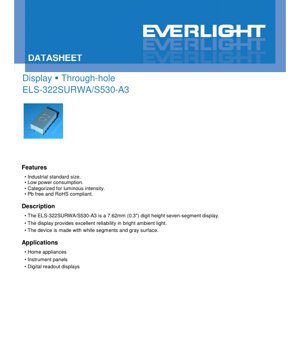
The ELS-322SURWA/S530-A3 is a single-digit, seven-segment alphanumeric display designed for through-hole mounting. It features a standard industrial size with a digit height of 7.62mm (0.3 inches). The device is constructed with brilliant red AlGaInP LED chips, housed within a white diffusion resin package that presents a gray surface appearance. This combination is engineered to deliver high reliability and excellent readability even in bright ambient lighting conditions, making it suitable for a variety of indicator and readout applications.
1.1 Core Features and Advantages
- Standard Footprint: Conforms to common industrial dimensions for easy integration into existing panel designs and PCB layouts.
- Low Power Consumption: Operates efficiently with standard drive currents, contributing to energy-saving designs.
- Intensity Categorization: Devices are binned for luminous intensity, ensuring consistent brightness levels across production batches and simplifying design for uniform appearance.
- Environmental Compliance: The product is manufactured to be lead-free (Pb-free) and is compliant with the RoHS (Restriction of Hazardous Substances) directive.
- High Contrast: The white segments against a gray background provide a high-contrast display for clear visibility.
1.2 Target Applications
This display is versatile and finds use in numerous electronic devices requiring numeric or limited alphanumeric readouts. Primary application areas include:
- Home Appliances (e.g., ovens, microwaves, washing machines)
- Instrumentation Panels for industrial equipment
- Digital Readout Displays in test and measurement devices
- Consumer Electronics
- Automotive Aftermarket Accessories
2. Technical Parameter Analysis
2.1 Absolute Maximum Ratings
These ratings define the limits beyond which permanent damage to the device may occur. Operation under or at these extremes is not guaranteed.
- Reverse Voltage (VR): 5 V - The maximum voltage that can be applied in the reverse direction across the LED.
- Continuous Forward Current (IF): 25 mA - The maximum recommended continuous DC current for reliable long-term operation.
- Peak Forward Current (IFP): 60 mA - The maximum allowable pulsed forward current, specified at a duty cycle of 1/10 and a frequency of 1 kHz. This is relevant for multiplexed driving schemes.
- Power Dissipation (Pd): 60 mW - The maximum power the device can dissipate.
- Operating Temperature (Topr): -40°C to +85°C - The ambient temperature range over which the device is designed to function.
- Storage Temperature (Tstg): -40°C to +100°C.
- Soldering Temperature (Tsol): 260°C for a maximum duration of 5 seconds, which is compatible with standard wave or reflow soldering processes.
2.2 Electro-Optical Characteristics
These parameters are measured at an ambient temperature (Ta) of 25°C and define the typical performance of the device.
- Luminous Intensity (Iv): The typical value is 11.0 mcd per segment at a forward current (IF) of 10 mA, with a minimum of 5.6 mcd. The average value is measured on a single segment. A tolerance of ±10% applies.
- Peak Wavelength (λp): Typically 632 nm at IF=20mA, defining the wavelength at which the emitted light intensity is highest.
- Dominant Wavelength (λd): Typically 624 nm at IF=20mA. This is the single wavelength perceived by the human eye that matches the color of the emitted light.
- Spectral Bandwidth (Δλ): Typically 20 nm at IF=20mA, indicating the range of wavelengths emitted around the peak.
- Forward Voltage (VF): Typically 2.0 V, with a maximum of 2.4 V at IF=20mA. Tolerance is ±0.1V. This is a critical parameter for designing the current-limiting circuitry.
- Reverse Current (IR): Maximum of 100 µA when a reverse voltage (VR) of 5V is applied.
3. Performance Curve Analysis
3.1 Spectrum Distribution
The spectral output curve (relative intensity vs. wavelength) centers around the typical peak wavelength of 632 nm with a bandwidth of approximately 20 nm. This confirms the brilliant red color emission characteristic of the AlGaInP semiconductor material used in the LED chips.
3.2 Forward Current vs. Forward Voltage (I-V Curve)
The I-V characteristic curve shows the exponential relationship typical of diodes. At the recommended operating current of 10-20 mA, the forward voltage typically falls between 1.9V and 2.1V. Designers must use this curve to ensure the driving circuit provides adequate voltage to achieve the desired current, incorporating a series current-limiting resistor as standard practice for LED driving.
3.3 Forward Current Derating Curve
This graph illustrates the maximum allowable continuous forward current as a function of the ambient temperature. As temperature increases, the maximum permissible current decreases linearly to prevent overheating and ensure long-term reliability. For example, at the maximum operating temperature of 85°C, the allowable continuous current is significantly lower than the 25 mA rating at 25°C. This is crucial for designs operating in elevated temperature environments.
4. Mechanical and Packaging Information
4.1 Package Dimensions
The display has a standard through-hole DIP (Dual In-line Package) footprint. Key dimensions include the overall height, digit size, and pin spacing. The pin spacing is on a standard 0.1-inch (2.54mm) grid. The drawing specifies all critical lengths, widths, and diameters with a standard tolerance of ±0.25mm unless otherwise noted. Engineers must refer to this drawing for accurate PCB hole placement and clearance requirements.
4.2 Internal Circuit Diagram and Polarity
The internal schematic shows the common-anode configuration of the seven segments and the decimal point (if present). All segment cathodes are separate, while the anodes for all segments are connected internally to a common pin. Correct identification of the common anode pin and the individual cathode pins is essential for proper circuit connection. The datasheet provides a pinout diagram correlating physical pin numbers to segment labels (A, B, C, D, E, F, G, DP).
5. Soldering and Assembly Guidelines
The device is rated for a maximum soldering temperature of 260°C for up to 5 seconds. This is compatible with standard wave soldering processes. For manual soldering, a temperature-controlled iron should be used, and contact time per pin should be minimized to prevent thermal damage to the plastic housing and the internal wire bonds. The device should be stored in its original anti-static packaging in a dry environment prior to use.
6. Packaging and Ordering Information
6.1 Packing Specifications
The standard packing flow is: 26 pieces per tube, 88 tubes per box, and 4 boxes per carton. This totals 9,152 pieces per master carton.
6.2 Label Explanation
The product label contains several codes: CPN (Customer's Part Number), P/N (Manufacturer's Part Number: ELS-322SURWA/S530-A3), QTY (Quantity), CAT (Luminous Intensity Rank or category), and LOT No. (Traceable production lot number). Understanding the CAT code is important for selecting displays with matched brightness.
7. Application Design Considerations
7.1 Driving Circuit Design
As a common-anode display, it is typically driven by connecting the common anode to the positive supply voltage (VCC) through a current-limiting resistor. Each segment cathode is then connected to a current sink, usually a microcontroller I/O pin or a dedicated driver IC (like a 74HC595 shift register or a MAX7219 display driver). The value of the current-limiting resistor is calculated using the formula: R = (VCC - VF) / IF, where VF is the forward voltage of the segment (typically 2.0V) and IF is the desired forward current (e.g., 10-20 mA). For a 5V supply and a 15mA target current: R = (5V - 2.0V) / 0.015A = 200 Ω. A standard 220 Ω resistor would be a suitable choice.
7.2 Multiplexing Considerations
For multi-digit displays, multiplexing is used to control many segments with fewer I/O pins. In this scheme, digits are illuminated one at a time in rapid succession. The peak forward current rating (60mA at 1/10 duty cycle) becomes relevant here. When multiplexing, the instantaneous current per segment during its brief on-time can be higher than the continuous DC rating, as long as the average current over time remains within safe limits. This allows for brighter perceived intensity.
7.3 ESD (Electrostatic Discharge) Precautions
The LED display is sensitive to electrostatic discharge. Proper ESD handling procedures must be followed during assembly and handling to prevent latent damage or immediate failure. Recommended measures include using grounded wrist straps, ESD-safe workstations with conductive mats, and ionizers in areas with insulating materials. All equipment used in assembly should be properly grounded.
8. Technical Comparison and Differentiation
Compared to older technologies or smaller displays, the ELS-322SURWA/S530-A3 offers a balance of size, brightness, and efficiency. The use of AlGaInP material provides a high-efficiency red emission. The 0.3-inch digit height is a common size offering a good compromise between readability and PCB space consumption. Its through-hole design makes it robust and suitable for applications where vibration or manual insertion is a factor, compared to surface-mount alternatives.
9. Frequently Asked Questions (FAQ)
9.1 What is the purpose of the luminous intensity categorization (CAT)?
The CAT code groups displays based on their measured luminous output. This allows designers to select parts from the same intensity bin to ensure uniform brightness across all digits in a multi-digit display, avoiding noticeable variations in segment brightness.
9.2 Can I drive this display directly from a 3.3V microcontroller pin?
Possibly, but careful calculation is needed. With a typical VF of 2.0V, the voltage headroom (3.3V - 2.0V = 1.3V) is sufficient to drive a current-limited segment. Using the formula R = 1.3V / IF, for a 10mA current you would need a 130 Ω resistor. However, ensure the microcontroller pin can sink the required current (e.g., 10-20mA per segment). For multiple segments on one pin, a driver IC is strongly recommended.
9.3 Does this display have a decimal point?
The part number ELS-322SURWA/S530-A3 and the internal circuit diagram should be consulted. The \"A3\" suffix and the presence of a \"DP\" (Decimal Point) pin in the diagram indicate that this specific variant includes a decimal point LED.
10. Practical Design Example
Scenario: Designing a simple 3-digit voltmeter readout using a microcontroller.
Implementation: Three ELS-322SURWA/S530-A3 displays would be used. The common anode pins of each digit would be connected to three separate microcontroller pins configured as outputs (to enable digit multiplexing). All segment cathode pins (A-G, DP) for all three digits would be connected together and then connected to eight microcontroller pins (or a shift register) configured as current sinks. Software would sequentially turn on one digit's anode at a time, while setting the pattern for its segments via the cathode lines. The persistence of vision creates the illusion of a stable 3-digit number. The current-limiting resistors can be placed on either the common anode lines (one per digit) or on each individual cathode line (eight resistors). Placing them on the cathodes is often preferred for more uniform current sharing.
LED Specification Terminology
Complete explanation of LED technical terms
Photoelectric Performance
| Term | Unit/Representation | Simple Explanation | Why Important |
|---|---|---|---|
| Luminous Efficacy | lm/W (lumens per watt) | Light output per watt of electricity, higher means more energy efficient. | Directly determines energy efficiency grade and electricity cost. |
| Luminous Flux | lm (lumens) | Total light emitted by source, commonly called "brightness". | Determines if the light is bright enough. |
| Viewing Angle | ° (degrees), e.g., 120° | Angle where light intensity drops to half, determines beam width. | Affects illumination range and uniformity. |
| CCT (Color Temperature) | K (Kelvin), e.g., 2700K/6500K | Warmth/coolness of light, lower values yellowish/warm, higher whitish/cool. | Determines lighting atmosphere and suitable scenarios. |
| CRI / Ra | Unitless, 0–100 | Ability to render object colors accurately, Ra≥80 is good. | Affects color authenticity, used in high-demand places like malls, museums. |
| SDCM | MacAdam ellipse steps, e.g., "5-step" | Color consistency metric, smaller steps mean more consistent color. | Ensures uniform color across same batch of LEDs. |
| Dominant Wavelength | nm (nanometers), e.g., 620nm (red) | Wavelength corresponding to color of colored LEDs. | Determines hue of red, yellow, green monochrome LEDs. |
| Spectral Distribution | Wavelength vs intensity curve | Shows intensity distribution across wavelengths. | Affects color rendering and quality. |
Electrical Parameters
| Term | Symbol | Simple Explanation | Design Considerations |
|---|---|---|---|
| Forward Voltage | Vf | Minimum voltage to turn on LED, like "starting threshold". | Driver voltage must be ≥Vf, voltages add up for series LEDs. |
| Forward Current | If | Current value for normal LED operation. | Usually constant current drive, current determines brightness & lifespan. |
| Max Pulse Current | Ifp | Peak current tolerable for short periods, used for dimming or flashing. | Pulse width & duty cycle must be strictly controlled to avoid damage. |
| Reverse Voltage | Vr | Max reverse voltage LED can withstand, beyond may cause breakdown. | Circuit must prevent reverse connection or voltage spikes. |
| Thermal Resistance | Rth (°C/W) | Resistance to heat transfer from chip to solder, lower is better. | High thermal resistance requires stronger heat dissipation. |
| ESD Immunity | V (HBM), e.g., 1000V | Ability to withstand electrostatic discharge, higher means less vulnerable. | Anti-static measures needed in production, especially for sensitive LEDs. |
Thermal Management & Reliability
| Term | Key Metric | Simple Explanation | Impact |
|---|---|---|---|
| Junction Temperature | Tj (°C) | Actual operating temperature inside LED chip. | Every 10°C reduction may double lifespan; too high causes light decay, color shift. |
| Lumen Depreciation | L70 / L80 (hours) | Time for brightness to drop to 70% or 80% of initial. | Directly defines LED "service life". |
| Lumen Maintenance | % (e.g., 70%) | Percentage of brightness retained after time. | Indicates brightness retention over long-term use. |
| Color Shift | Δu′v′ or MacAdam ellipse | Degree of color change during use. | Affects color consistency in lighting scenes. |
| Thermal Aging | Material degradation | Deterioration due to long-term high temperature. | May cause brightness drop, color change, or open-circuit failure. |
Packaging & Materials
| Term | Common Types | Simple Explanation | Features & Applications |
|---|---|---|---|
| Package Type | EMC, PPA, Ceramic | Housing material protecting chip, providing optical/thermal interface. | EMC: good heat resistance, low cost; Ceramic: better heat dissipation, longer life. |
| Chip Structure | Front, Flip Chip | Chip electrode arrangement. | Flip chip: better heat dissipation, higher efficacy, for high-power. |
| Phosphor Coating | YAG, Silicate, Nitride | Covers blue chip, converts some to yellow/red, mixes to white. | Different phosphors affect efficacy, CCT, and CRI. |
| Lens/Optics | Flat, Microlens, TIR | Optical structure on surface controlling light distribution. | Determines viewing angle and light distribution curve. |
Quality Control & Binning
| Term | Binning Content | Simple Explanation | Purpose |
|---|---|---|---|
| Luminous Flux Bin | Code e.g., 2G, 2H | Grouped by brightness, each group has min/max lumen values. | Ensures uniform brightness in same batch. |
| Voltage Bin | Code e.g., 6W, 6X | Grouped by forward voltage range. | Facilitates driver matching, improves system efficiency. |
| Color Bin | 5-step MacAdam ellipse | Grouped by color coordinates, ensuring tight range. | Guarantees color consistency, avoids uneven color within fixture. |
| CCT Bin | 2700K, 3000K etc. | Grouped by CCT, each has corresponding coordinate range. | Meets different scene CCT requirements. |
Testing & Certification
| Term | Standard/Test | Simple Explanation | Significance |
|---|---|---|---|
| LM-80 | Lumen maintenance test | Long-term lighting at constant temperature, recording brightness decay. | Used to estimate LED life (with TM-21). |
| TM-21 | Life estimation standard | Estimates life under actual conditions based on LM-80 data. | Provides scientific life prediction. |
| IESNA | Illuminating Engineering Society | Covers optical, electrical, thermal test methods. | Industry-recognized test basis. |
| RoHS / REACH | Environmental certification | Ensures no harmful substances (lead, mercury). | Market access requirement internationally. |
| ENERGY STAR / DLC | Energy efficiency certification | Energy efficiency and performance certification for lighting. | Used in government procurement, subsidy programs, enhances competitiveness. |