Table of Contents
- 1. Product Overview
- 2. Technical Parameters and Specifications
- 2.1 Absolute Maximum Ratings
- 2.2 Electro-Optical Characteristics
- 3. Performance Curve Analysis
- 3.1 Spectrum Distribution
- 3.2 Forward Current vs. Forward Voltage (I-V Curve)
- 3.3 Forward Current Derating Curve
- 4. Mechanical and Package Information
- 4.1 Package Dimensions
- 4.2 Pinout and Internal Circuit Diagram
- 5. Assembly and Handling Guidelines
- 5.1 Soldering Instructions
- 5.2 Electrostatic Discharge (ESD) Protection
- 6. Packaging and Ordering Information
- 6.1 Packing Specifications
- 6.2 Label Explanation
- 7. Application Notes and Design Considerations
- 7.1 Typical Applications
- 7.2 Driving Circuit Design
- 7.3 Brightness Matching and Binning
- 8. Technical Comparison and Differentiation
- 9. Frequently Asked Questions (FAQ)
- 9.1 What is the purpose of the gray surface?
- 9.2 Can I drive this display directly from a microcontroller pin?
- 9.3 How do I determine the common anode/cathode configuration?
- 10. Reliability and Long-Term Performance
- LED Specification Terminology
- Photoelectric Performance
- Electrical Parameters
- Thermal Management & Reliability
- Packaging & Materials
- Quality Control & Binning
- Testing & Certification
1. Product Overview
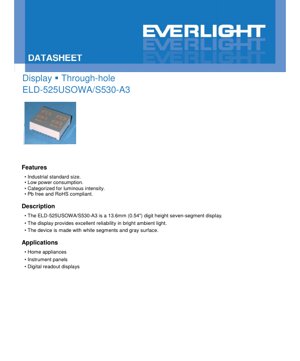
The ELD-525USOWA/S530-A3 is a single-digit, seven-segment alphanumeric display designed for through-hole mounting. It features a standard industrial size with a digit height of 13.6 millimeters (0.54 inches). The display utilizes white segments against a gray background surface, which provides enhanced contrast and readability, particularly in bright ambient lighting conditions. This design choice contributes to excellent reliability for various applications requiring clear numeric or limited alphanumeric readouts.
The device is constructed using AlGaInP (Aluminum Gallium Indium Phosphide) semiconductor material, which emits a reddish-orange light. The encapsulation resin is a white diffusion type, helping to distribute the light evenly across each segment. A key feature is the categorization of devices based on luminous intensity, allowing for consistent brightness matching in multi-digit applications. The product is compliant with Pb-free and RoHS environmental directives.
2. Technical Parameters and Specifications
2.1 Absolute Maximum Ratings
The device must not be operated beyond these limits to prevent permanent damage. All ratings are specified at an ambient temperature (Ta) of 25°C.
- Reverse Voltage (VR): 5 V
- Forward Current (IF): 25 mA (Continuous)
- Peak Forward Current (IFP): 60 mA (Duty cycle 1/10, 1 kHz)
- Power Dissipation (Pd): 60 mW
- Operating Temperature (Topr): -40°C to +85°C
- Storage Temperature (Tstg): -40°C to +100°C
- Soldering Temperature (Tsol): 260°C (for a duration not exceeding 5 seconds)
2.2 Electro-Optical Characteristics
The following parameters define the optical and electrical performance under typical operating conditions (Ta=25°C).
- Luminous Intensity (Iv): The typical value is 12.5 mcd per segment at a forward current of 10 mA. The minimum specified value is 5.6 mcd. Devices are categorized (binned) for luminous intensity, and the tolerance is ±10%.
- Peak Wavelength (λp): Typically 621 nm (measured at IF=20mA).
- Dominant Wavelength (λd): Typically 615 nm (measured at IF=20mA).
- Spectral Radiation Bandwidth (Δλ): Typically 18 nm (measured at IF=20mA).
- Forward Voltage (VF): Typically 2.0 V, with a maximum of 2.4 V at a forward current of 20 mA. The tolerance is ±0.1V.
- Reverse Current (IR): Maximum 100 μA at a reverse voltage of 5 V.
3. Performance Curve Analysis
The datasheet provides several characteristic curves essential for circuit design and thermal management.
3.1 Spectrum Distribution
The spectral output curve shows the relative luminous intensity as a function of wavelength. The peak is centered around 621 nm, confirming the reddish-orange color emission. The narrow bandwidth of approximately 18 nm indicates good color purity, which is typical for AlGaInP-based LEDs.
3.2 Forward Current vs. Forward Voltage (I-V Curve)
This graph illustrates the relationship between the applied forward voltage and the resulting current through the LED. It is a non-linear curve, characteristic of a diode. The typical operating point for testing (VF=2.0V at IF=20mA) can be identified on this curve. Designers use this to calculate the necessary current-limiting resistor value for a given supply voltage.
3.3 Forward Current Derating Curve
This is a critical graph for reliability. It shows the maximum allowable continuous forward current as a function of the ambient temperature. As the ambient temperature increases, the maximum permissible current decreases linearly to prevent overheating and ensure long-term reliability. This curve must be consulted when designing for high-temperature environments to avoid exceeding the device's power dissipation limits.
4. Mechanical and Package Information
4.1 Package Dimensions
The display follows a standard through-hole DIP (Dual In-line Package) footprint. The overall dimensions, pin spacing, segment size, and placement are provided in a detailed mechanical drawing. Key dimensions include the digit height (13.6mm), character width, and the center-to-center distance between pins. All unspecified tolerances are ±0.25 mm. The package is designed for easy insertion into standard PCB holes and is suitable for wave soldering processes.
4.2 Pinout and Internal Circuit Diagram
The datasheet includes a diagram showing the internal electrical connection of the 10 pins. A standard seven-segment display has connections for segments A through G and a decimal point (DP). The diagram clarifies which pin corresponds to each segment and the common anode or cathode configuration (this specific model's diagram would define it). This information is essential for correctly designing the driving circuitry and PCB layout.
5. Assembly and Handling Guidelines
5.1 Soldering Instructions
The device can withstand a soldering temperature of 260°C for a maximum of 5 seconds. This parameter is crucial for both hand soldering and wave soldering processes. Exceeding this time or temperature may damage the internal wire bonds or the LED chip. Proper thermal management during soldering is recommended.
5.2 Electrostatic Discharge (ESD) Protection
The LED display is sensitive to electrostatic discharge. ESD can cause immediate failure or latent damage that reduces long-term reliability. The following precautions are strongly recommended during handling and assembly:
- Use grounded wrist straps and ESD footwear.
- Work on grounded ESD mats and use grounded equipment.
- Ensure all tools and machinery are properly grounded.
- Consider using ionizers in areas with insulating materials to neutralize static charge.
- Implement surge protection in the final product design.
6. Packaging and Ordering Information
6.1 Packing Specifications
The units are packaged in a multi-tier system for protection and logistics:
- Tube: 20 pieces per tube.
- Box: 36 tubes per box.
- Carton: 4 boxes per carton.
This packaging method protects the leads from bending and the display face from scratches during transportation.
6.2 Label Explanation
Labels on the packaging contain key information for traceability and identification:
- CPN: Customer's Product Number.
- P/N: Manufacturer's Product Number (e.g., ELD-525USOWA/S530-A3).
- QTY: Quantity of pieces in the package.
- CAT: Luminous Intensity Rank (bin code).
- LOT No: Manufacturing lot number for traceability.
7. Application Notes and Design Considerations
7.1 Typical Applications
This display is suitable for a wide range of applications requiring a simple, reliable numeric readout, including:
- Home Appliances: Timers on microwaves, ovens, washing machines, and air conditioners.
- Instrument Panels: Readouts for test equipment, industrial controls, and automotive aftermarket gauges.
- Digital Readout Displays: Basic counters, clocks, and measurement displays.
7.2 Driving Circuit Design
To operate the display, a current-limiting resistor must be connected in series with each segment (or the common pin, depending on the configuration). The resistor value (R) is calculated using Ohm's Law: R = (Vsupply - VF) / IF. For example, with a 5V supply, a VF of 2.0V, and a desired IF of 10mA, the resistor value would be (5V - 2.0V) / 0.01A = 300 Ω. A driver IC (like a 7-segment decoder/driver or a microcontroller with sufficient current sourcing/sinking capability) is typically used to control which segments are illuminated.
7.3 Brightness Matching and Binning
The "categorized for luminous intensity" feature means devices are tested and sorted into brightness bins. For multi-digit displays, it is advisable to use devices from the same bin to ensure uniform brightness across all digits. Designers should specify the required bin code when ordering for consistency in production.
8. Technical Comparison and Differentiation
Compared to smaller SMD (Surface Mount Device) seven-segment displays, this through-hole version offers easier prototyping and repair, higher mechanical robustness in certain applications, and often better viewing angles and brightness due to its larger size. Its primary advantage over incandescent or VFD (Vacuum Fluorescent Display) alternatives is significantly lower power consumption, longer lifetime, and higher resistance to shock and vibration. The specific reddish-orange color and gray background provide a classic, high-contrast appearance favored in many industrial and consumer contexts.
9. Frequently Asked Questions (FAQ)
9.1 What is the purpose of the gray surface?
The gray surface around the white segments serves to absorb ambient light, reducing reflections and glare. This significantly improves the contrast ratio between the illuminated segments and the background, making the display much easier to read in brightly lit environments, both indoors and outdoors.
9.2 Can I drive this display directly from a microcontroller pin?
It depends on the microcontroller's specifications. A typical MCU GPIO pin can source or sink around 20-25mA, which is within the continuous forward current rating of a single segment. However, driving multiple segments simultaneously through one pin would exceed this limit. Furthermore, MCU pins have a total package current limit. Therefore, it is standard practice to use a dedicated driver IC or transistor array to handle the higher cumulative current required for the display, protecting the microcontroller.
9.3 How do I determine the common anode/cathode configuration?
The internal circuit diagram in the datasheet's package dimension section definitively shows the configuration. By tracing the connections, you can see if all segment anodes are tied together (common anode) or all segment cathodes are tied together (common cathode). This determines whether you need to source current to the common pin (common cathode) or sink current from it (common anode).
10. Reliability and Long-Term Performance
The operating temperature range of -40°C to +85°C indicates a robust design suitable for harsh environments. Adherence to the absolute maximum ratings, especially the current derating curve relative to ambient temperature, is paramount for ensuring the stated lifetime. The use of AlGaInP technology provides stable wavelength and intensity over time and temperature compared to older technologies. Proper handling to avoid ESD and mechanical stress on the leads will further ensure reliability in the field.
LED Specification Terminology
Complete explanation of LED technical terms
Photoelectric Performance
| Term | Unit/Representation | Simple Explanation | Why Important |
|---|---|---|---|
| Luminous Efficacy | lm/W (lumens per watt) | Light output per watt of electricity, higher means more energy efficient. | Directly determines energy efficiency grade and electricity cost. |
| Luminous Flux | lm (lumens) | Total light emitted by source, commonly called "brightness". | Determines if the light is bright enough. |
| Viewing Angle | ° (degrees), e.g., 120° | Angle where light intensity drops to half, determines beam width. | Affects illumination range and uniformity. |
| CCT (Color Temperature) | K (Kelvin), e.g., 2700K/6500K | Warmth/coolness of light, lower values yellowish/warm, higher whitish/cool. | Determines lighting atmosphere and suitable scenarios. |
| CRI / Ra | Unitless, 0–100 | Ability to render object colors accurately, Ra≥80 is good. | Affects color authenticity, used in high-demand places like malls, museums. |
| SDCM | MacAdam ellipse steps, e.g., "5-step" | Color consistency metric, smaller steps mean more consistent color. | Ensures uniform color across same batch of LEDs. |
| Dominant Wavelength | nm (nanometers), e.g., 620nm (red) | Wavelength corresponding to color of colored LEDs. | Determines hue of red, yellow, green monochrome LEDs. |
| Spectral Distribution | Wavelength vs intensity curve | Shows intensity distribution across wavelengths. | Affects color rendering and quality. |
Electrical Parameters
| Term | Symbol | Simple Explanation | Design Considerations |
|---|---|---|---|
| Forward Voltage | Vf | Minimum voltage to turn on LED, like "starting threshold". | Driver voltage must be ≥Vf, voltages add up for series LEDs. |
| Forward Current | If | Current value for normal LED operation. | Usually constant current drive, current determines brightness & lifespan. |
| Max Pulse Current | Ifp | Peak current tolerable for short periods, used for dimming or flashing. | Pulse width & duty cycle must be strictly controlled to avoid damage. |
| Reverse Voltage | Vr | Max reverse voltage LED can withstand, beyond may cause breakdown. | Circuit must prevent reverse connection or voltage spikes. |
| Thermal Resistance | Rth (°C/W) | Resistance to heat transfer from chip to solder, lower is better. | High thermal resistance requires stronger heat dissipation. |
| ESD Immunity | V (HBM), e.g., 1000V | Ability to withstand electrostatic discharge, higher means less vulnerable. | Anti-static measures needed in production, especially for sensitive LEDs. |
Thermal Management & Reliability
| Term | Key Metric | Simple Explanation | Impact |
|---|---|---|---|
| Junction Temperature | Tj (°C) | Actual operating temperature inside LED chip. | Every 10°C reduction may double lifespan; too high causes light decay, color shift. |
| Lumen Depreciation | L70 / L80 (hours) | Time for brightness to drop to 70% or 80% of initial. | Directly defines LED "service life". |
| Lumen Maintenance | % (e.g., 70%) | Percentage of brightness retained after time. | Indicates brightness retention over long-term use. |
| Color Shift | Δu′v′ or MacAdam ellipse | Degree of color change during use. | Affects color consistency in lighting scenes. |
| Thermal Aging | Material degradation | Deterioration due to long-term high temperature. | May cause brightness drop, color change, or open-circuit failure. |
Packaging & Materials
| Term | Common Types | Simple Explanation | Features & Applications |
|---|---|---|---|
| Package Type | EMC, PPA, Ceramic | Housing material protecting chip, providing optical/thermal interface. | EMC: good heat resistance, low cost; Ceramic: better heat dissipation, longer life. |
| Chip Structure | Front, Flip Chip | Chip electrode arrangement. | Flip chip: better heat dissipation, higher efficacy, for high-power. |
| Phosphor Coating | YAG, Silicate, Nitride | Covers blue chip, converts some to yellow/red, mixes to white. | Different phosphors affect efficacy, CCT, and CRI. |
| Lens/Optics | Flat, Microlens, TIR | Optical structure on surface controlling light distribution. | Determines viewing angle and light distribution curve. |
Quality Control & Binning
| Term | Binning Content | Simple Explanation | Purpose |
|---|---|---|---|
| Luminous Flux Bin | Code e.g., 2G, 2H | Grouped by brightness, each group has min/max lumen values. | Ensures uniform brightness in same batch. |
| Voltage Bin | Code e.g., 6W, 6X | Grouped by forward voltage range. | Facilitates driver matching, improves system efficiency. |
| Color Bin | 5-step MacAdam ellipse | Grouped by color coordinates, ensuring tight range. | Guarantees color consistency, avoids uneven color within fixture. |
| CCT Bin | 2700K, 3000K etc. | Grouped by CCT, each has corresponding coordinate range. | Meets different scene CCT requirements. |
Testing & Certification
| Term | Standard/Test | Simple Explanation | Significance |
|---|---|---|---|
| LM-80 | Lumen maintenance test | Long-term lighting at constant temperature, recording brightness decay. | Used to estimate LED life (with TM-21). |
| TM-21 | Life estimation standard | Estimates life under actual conditions based on LM-80 data. | Provides scientific life prediction. |
| IESNA | Illuminating Engineering Society | Covers optical, electrical, thermal test methods. | Industry-recognized test basis. |
| RoHS / REACH | Environmental certification | Ensures no harmful substances (lead, mercury). | Market access requirement internationally. |
| ENERGY STAR / DLC | Energy efficiency certification | Energy efficiency and performance certification for lighting. | Used in government procurement, subsidy programs, enhances competitiveness. |