1. Product Overview
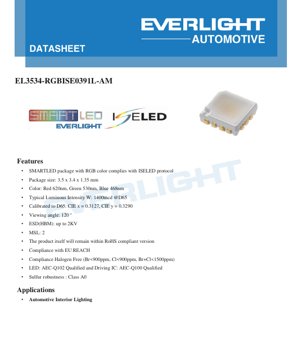
The EL3534-RGBISE0391L-AM is a highly integrated, intelligent LED component designed for modern automotive interior lighting systems. It combines red, green, and blue (RGB) LED chips within a single SMARTLED package, featuring an integrated driver IC that communicates via the ISELED protocol. This integration simplifies system design by reducing external component count and enabling precise digital color control and calibration directly from the microcontroller.
The core advantage of this product lies in its compliance with stringent automotive standards, including AEC-Q102 qualification for the LED and AEC-Q100 for the driver IC. It is calibrated to the D65 white point standard (CIE x=0.3127, y=0.3290), ensuring consistent and accurate color output across production batches, which is critical for aesthetic lighting applications. The primary target market is automotive OEMs and tier-1 suppliers developing ambient lighting, dashboard illumination, and other interior lighting features that require dynamic color changing and high reliability.
2. In-Depth Technical Parameter Analysis
2.1 Photometric and Color Characteristics
The device's photometric performance is characterized under specific test conditions, typically at a thermal pad temperature of 25°C. The typical luminous intensities are 410 mcd for Red (dominant wavelength 620nm), 880 mcd for Green (530nm), and 110 mcd for Blue (468nm). When all three colors are driven simultaneously to produce white light, the typical combined luminous intensity is 1400 mcd. A tolerance of ±8% applies to these luminous intensity measurements. The dominant wavelength tolerance is ±1nm, and the chromaticity coordinate tolerance is ±0.01, ensuring tight color binning.
The device offers a wide viewing angle of 120 degrees, providing uniform illumination over a broad area. This is suitable for applications like light guides or direct illumination where even light distribution is required.
2.2 Electrical and Interface Characteristics
The device operates from a 5V nominal supply (VCC), with a recommended operating range of 4.5V to 5.5V. The absolute maximum rating for the supply voltage is 5.5V. The serial communication interface supports the ISELED protocol. The upstream connection to the host microcontroller can operate in a single-ended mode for easy connection, with a data rate (SIO1_P) ranging from 1.4 to 2.6 MHz (typical 2 MHz). The downstream connection to other devices in a daisy chain uses a differential mode. The device automatically detects the communication mode (single-ended or differential) on both upstream and downstream links during power-up.
The typical forward currents for each color at full brightness are 12.5 mA for Red, 9.5 mA for Green, and 7 mA for Blue, resulting in a total typical current of 26 mA for white light. The driver itself has a standby current of 1.2 mA (typical). Power-on reset (POR) occurs at a typical VCC of 4.2V, while undervoltage lockout (UVLO) activates at a typical VCC of 3.3V, protecting the device during unstable power conditions.
2.3 Thermal and Reliability Ratings
The device is rated for an operating junction temperature (Tj) of up to 125°C. The recommended operating ambient/solder point temperature (Topr/Ts) range is from -40°C to +110°C, which is standard for automotive-grade components. The thermal resistance from the junction to the solder point (Rth JS el) is specified with a maximum of 120 K/W. This parameter is crucial for thermal management design to ensure the LED junction temperature remains within safe limits during operation.
For reliability, the device is rated for ESD protection up to 2 kV (Human Body Model). It is compliant with RoHS, REACH, and is halogen-free (Br<900ppm, Cl<900ppm, Br+Cl<1500ppm). It also features sulfur robustness classified as A0, which is important for longevity in automotive environments where sulfur-containing gases can corrode components. The moisture sensitivity level (MSL) is 2.
3. Mechanical and Package Information
The device comes in a compact surface-mount package measuring 3.5 mm in length, 3.4 mm in width, and 1.35 mm in height. The pad layout consists of 11 pins. Key functional pins include: Pin 1 (PRG5) for programming voltage (normally connected to GND), Pins 2 & 3 (SIO1_N, SIO1_P) for the upstream serial interface, Pins 6 & 7 (SIO2_P, SIO2_N) for the downstream serial interface, Pin 8 (VCC) for the 5V supply, and Pins 4 & 5 (GND) for ground. Pins 9, 10, and 11 are connected to the cathodes of the Green, Red, and Blue LEDs respectively. A notable feature is that these LED cathode pins can be used to light up the LEDs independently without using the integrated driver IC, by applying an appropriate current path, providing flexibility for testing or simple applications.
4. Soldering and Assembly Guidelines
The device can withstand a reflow soldering temperature of 260°C for up to 30 seconds, which is compatible with standard lead-free (Pb-free) soldering processes. Designers should follow the typical application layout provided in the datasheet to ensure optimal electrical and thermal performance. This includes proper routing of the differential serial lines and adequate thermal relief for the ground pad. It is recommended to allow an idle time of 150 μs after power-up before sending initialization commands to the device.
5. Application Suggestions and Design Considerations
5.1 Typical Application Scenarios
The primary application is automotive interior lighting. This includes ambient lighting strips in door panels, footwells, and the center console; backlighting for switches and controls; and decorative accent lighting. The ISELED protocol enables daisy-chaining of multiple devices, allowing a single microcontroller to control a long string of LEDs with individual addressability, simplifying wiring harness design.
5.2 Design Considerations
- Power Supply: Ensure a stable 5V supply with low noise, as the device includes sensitive analog and digital circuitry. Consider the inrush current during power-up for a chain of devices.
- Thermal Management: Calculate the maximum power dissipation (P = Vf * If) for the intended use case and ensure the PCB design provides a low thermal resistance path to dissipate heat, keeping the junction temperature below 125°C. The thermal pad should be properly soldered to a copper pour on the PCB.
- Signal Integrity: For longer daisy chains or in noisy automotive environments, follow best practices for routing differential pairs (SIO2_P/N) to maintain signal integrity.
- Software: The host microcontroller must implement the ISELED protocol stack to correctly initialize, address, and send color data to the LED chain.
6. Technical Comparison and Differentiation
Compared to traditional discrete RGB LEDs with separate driver ICs, the EL3534-RGBISE0391L-AM offers significant integration. The key differentiator is the built-in ISELED-compliant driver, which handles color calibration, gamma correction, and communication, offloading these tasks from the main system microcontroller. This leads to several advantages: reduced system bill of materials (BOM), simplified PCB layout, guaranteed color consistency without manual binning, and easier scalability in daisy-chain configurations. The integrated calibration data stored in each device ensures that the commanded color is accurately reproduced, regardless of LED manufacturing variances.
7. Frequently Asked Questions (Based on Technical Parameters)
Q: Can I use this LED with a standard 3.3V microcontroller GPIO?
A: The serial interface logic levels are defined relative to its 5V supply (VCC). For the single-ended upstream mode, VIH is 1.20V min and VIL is 1.14V max. A 3.3V CMOS output (typically ~3.3V for high) should be compatible, but it's essential to verify the actual voltage levels meet the datasheet specifications under all conditions.
Q: How do I create other colors besides Red, Green, Blue, and White?
A: All colors are generated by digitally controlling the pulse-width modulation (PWM) duty cycle of each Red, Green, and Blue channel via the ISELED protocol. By sending different RGB values (e.g., 255, 150, 0 for orange), the integrated driver mixes the light output to produce the desired color.
Q: What is the purpose of the PRG5 pin?
A> The PRG5 pin is used for programming or factory calibration of the internal driver IC. For normal operation, it must be connected to ground (GND). Leaving it floating or connecting it incorrectly may cause unpredictable behavior.
Q: How many of these LEDs can be connected in a daisy chain?
A> The datasheet does not specify a maximum number. The limit is typically determined by the total data refresh rate requirement (latency increases with chain length), the power supply's current capability, and the ability of the first device's driver to correctly transmit data through the entire chain without signal degradation.
8. Practical Use Case Example
Consider designing an ambient lighting system for a car door panel. A single wire pair (for differential data) and power/ground wires can be routed along the door. Up to 20 EL3534 devices can be daisy-chained and physically placed behind a light guide. The host microcontroller, located in the door module or body controller, sends a single data stream. Each LED in the chain reads its assigned color data from the stream. This allows for dynamic effects like a color wave moving along the door, or all LEDs displaying the same selected color, with minimal wiring complexity. The integrated calibration ensures the red color on the driver's door matches exactly with the red on the passenger door, even if the LEDs are from different production lots.
9. Principle of Operation Introduction
The device operates on a digital command principle. The host microcontroller sends data frames according to the ISELED protocol. These frames contain addressing information and color data (RGB values). The integrated Communication Unit in each device receives the frame from the upstream side. If the address matches, the Main Unit processes the command, which typically involves updating the PWM generators for the three LED channels. The PWM drivers then regulate the current to the respective Red, Green, and Blue LED chips, controlling their brightness. The device can also pass data through to the downstream device, enabling the daisy-chain topology. The automatic line mode detection allows the system to self-configure, identifying the first and last device in the chain.
10. Technology Trends and Context
The EL3534-RGBISE0391L-AM represents the trend in automotive lighting towards greater integration and intelligence. The move from simple on/off lighting to dynamic, personalized ambient lighting requires components that are digitally controllable, consistent, and reliable. Protocols like ISELED are developed specifically for automotive environments to ensure robust communication. Future developments may include even higher levels of integration, such as incorporating light sensors for adaptive brightness control within the same package, or supporting more advanced color spaces. The focus remains on meeting automotive-grade reliability (AEC-Q), reducing system complexity, and enabling new design possibilities for vehicle interiors.
LED Specification Terminology
Complete explanation of LED technical terms
Photoelectric Performance
| Term | Unit/Representation | Simple Explanation | Why Important |
|---|---|---|---|
| Luminous Efficacy | lm/W (lumens per watt) | Light output per watt of electricity, higher means more energy efficient. | Directly determines energy efficiency grade and electricity cost. |
| Luminous Flux | lm (lumens) | Total light emitted by source, commonly called "brightness". | Determines if the light is bright enough. |
| Viewing Angle | ° (degrees), e.g., 120° | Angle where light intensity drops to half, determines beam width. | Affects illumination range and uniformity. |
| CCT (Color Temperature) | K (Kelvin), e.g., 2700K/6500K | Warmth/coolness of light, lower values yellowish/warm, higher whitish/cool. | Determines lighting atmosphere and suitable scenarios. |
| CRI / Ra | Unitless, 0–100 | Ability to render object colors accurately, Ra≥80 is good. | Affects color authenticity, used in high-demand places like malls, museums. |
| SDCM | MacAdam ellipse steps, e.g., "5-step" | Color consistency metric, smaller steps mean more consistent color. | Ensures uniform color across same batch of LEDs. |
| Dominant Wavelength | nm (nanometers), e.g., 620nm (red) | Wavelength corresponding to color of colored LEDs. | Determines hue of red, yellow, green monochrome LEDs. |
| Spectral Distribution | Wavelength vs intensity curve | Shows intensity distribution across wavelengths. | Affects color rendering and quality. |
Electrical Parameters
| Term | Symbol | Simple Explanation | Design Considerations |
|---|---|---|---|
| Forward Voltage | Vf | Minimum voltage to turn on LED, like "starting threshold". | Driver voltage must be ≥Vf, voltages add up for series LEDs. |
| Forward Current | If | Current value for normal LED operation. | Usually constant current drive, current determines brightness & lifespan. |
| Max Pulse Current | Ifp | Peak current tolerable for short periods, used for dimming or flashing. | Pulse width & duty cycle must be strictly controlled to avoid damage. |
| Reverse Voltage | Vr | Max reverse voltage LED can withstand, beyond may cause breakdown. | Circuit must prevent reverse connection or voltage spikes. |
| Thermal Resistance | Rth (°C/W) | Resistance to heat transfer from chip to solder, lower is better. | High thermal resistance requires stronger heat dissipation. |
| ESD Immunity | V (HBM), e.g., 1000V | Ability to withstand electrostatic discharge, higher means less vulnerable. | Anti-static measures needed in production, especially for sensitive LEDs. |
Thermal Management & Reliability
| Term | Key Metric | Simple Explanation | Impact |
|---|---|---|---|
| Junction Temperature | Tj (°C) | Actual operating temperature inside LED chip. | Every 10°C reduction may double lifespan; too high causes light decay, color shift. |
| Lumen Depreciation | L70 / L80 (hours) | Time for brightness to drop to 70% or 80% of initial. | Directly defines LED "service life". |
| Lumen Maintenance | % (e.g., 70%) | Percentage of brightness retained after time. | Indicates brightness retention over long-term use. |
| Color Shift | Δu′v′ or MacAdam ellipse | Degree of color change during use. | Affects color consistency in lighting scenes. |
| Thermal Aging | Material degradation | Deterioration due to long-term high temperature. | May cause brightness drop, color change, or open-circuit failure. |
Packaging & Materials
| Term | Common Types | Simple Explanation | Features & Applications |
|---|---|---|---|
| Package Type | EMC, PPA, Ceramic | Housing material protecting chip, providing optical/thermal interface. | EMC: good heat resistance, low cost; Ceramic: better heat dissipation, longer life. |
| Chip Structure | Front, Flip Chip | Chip electrode arrangement. | Flip chip: better heat dissipation, higher efficacy, for high-power. |
| Phosphor Coating | YAG, Silicate, Nitride | Covers blue chip, converts some to yellow/red, mixes to white. | Different phosphors affect efficacy, CCT, and CRI. |
| Lens/Optics | Flat, Microlens, TIR | Optical structure on surface controlling light distribution. | Determines viewing angle and light distribution curve. |
Quality Control & Binning
| Term | Binning Content | Simple Explanation | Purpose |
|---|---|---|---|
| Luminous Flux Bin | Code e.g., 2G, 2H | Grouped by brightness, each group has min/max lumen values. | Ensures uniform brightness in same batch. |
| Voltage Bin | Code e.g., 6W, 6X | Grouped by forward voltage range. | Facilitates driver matching, improves system efficiency. |
| Color Bin | 5-step MacAdam ellipse | Grouped by color coordinates, ensuring tight range. | Guarantees color consistency, avoids uneven color within fixture. |
| CCT Bin | 2700K, 3000K etc. | Grouped by CCT, each has corresponding coordinate range. | Meets different scene CCT requirements. |
Testing & Certification
| Term | Standard/Test | Simple Explanation | Significance |
|---|---|---|---|
| LM-80 | Lumen maintenance test | Long-term lighting at constant temperature, recording brightness decay. | Used to estimate LED life (with TM-21). |
| TM-21 | Life estimation standard | Estimates life under actual conditions based on LM-80 data. | Provides scientific life prediction. |
| IESNA | Illuminating Engineering Society | Covers optical, electrical, thermal test methods. | Industry-recognized test basis. |
| RoHS / REACH | Environmental certification | Ensures no harmful substances (lead, mercury). | Market access requirement internationally. |
| ENERGY STAR / DLC | Energy efficiency certification | Energy efficiency and performance certification for lighting. | Used in government procurement, subsidy programs, enhances competitiveness. |