Table of Contents
- 1. Product Overview
- 2. Technical Specifications Deep Dive
- 2.1 Absolute Maximum Ratings
- 2.2 Electro-Optical Characteristics (Ta=25°C)
- 3. Binning System Explanation
- 3.1 Luminous Intensity Binning
- 3.2 Dominant Wavelength Binning
- 4. Mechanical and Packaging Information
- 4.1 Physical Dimensions
- 4.2 Polarity Identification
- 4.3 Packaging Specifications
- 5. Soldering and Assembly Guidelines
- 5.1 Reflow Soldering Profile
- 5.2 Hand Soldering
- 5.3 Storage and Handling
- 6. Application Notes and Design Considerations
- 6.1 Typical Applications
- 6.2 Circuit Design
- 6.3 Thermal Management
- 6.4 Application Restrictions
- 7. Technical Comparison and Positioning
- 8. Frequently Asked Questions (FAQ)
- 8.1 Why is a current-limiting resistor mandatory?
- 8.2 Can I drive this LED directly from a microcontroller GPIO pin?
- 8.3 What does "water clear" resin mean?
- 8.4 How do I interpret the bin codes on the reel label?
- 9. Practical Design Case Study
- 10. Operating Principle and Technology
- 11. Industry Trends
1. Product Overview
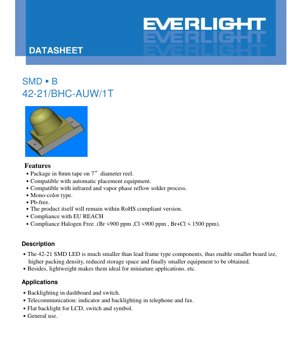
The 42-21/BHC-AUW/1T is a compact, surface-mount LED designed for modern electronic applications requiring reliable, low-power indicator or backlighting solutions. This blue LED utilizes InGaN chip technology, encapsulated in a water-clear resin, to deliver consistent performance in a miniature footprint. Its primary advantages include significant space savings on PCBs, high packing density, and suitability for automated assembly processes, making it ideal for high-volume manufacturing.
The component is fully compliant with RoHS, EU REACH, and halogen-free standards, ensuring environmental responsibility and broad market acceptance. Its lightweight construction and small size enable the design of smaller, more portable equipment.
2. Technical Specifications Deep Dive
2.1 Absolute Maximum Ratings
The device's operational limits are defined to ensure long-term reliability. Exceeding these ratings may cause permanent damage.
- Reverse Voltage (VR): 5V. A protective circuit is recommended if reverse voltage conditions are possible.
- Continuous Forward Current (IF): 25mA. The typical operating condition is 20mA.
- Peak Forward Current (IFP): 100mA (Duty 1/10 @1KHz). Suitable for pulsed operation but not for DC.
- Power Dissipation (Pd): 95mW. This limit considers both electrical and thermal constraints.
- Operating & Storage Temperature: -40°C to +85°C / -40°C to +90°C. This wide range supports industrial applications.
- Electrostatic Discharge (ESD): 150V (HBM). Standard ESD precautions during handling are necessary.
- Soldering Temperature: Reflow: 260°C for 10 sec; Hand: 350°C for 3 sec. Adherence is critical to prevent thermal damage.
2.2 Electro-Optical Characteristics (Ta=25°C)
These parameters define the LED's performance under standard test conditions (IF=20mA).
- Luminous Intensity (Iv): 450 to 1800 mcd (millicandela). The wide range is managed through a binning system.
- Viewing Angle (2θ1/2): 30 degrees (typical). This defines the angular spread of emitted light.
- Peak Wavelength (λp): 468 nm (typical). The wavelength at which the spectral power is maximum.
- Dominant Wavelength (λd): 464.5 to 476.5 nm. This is the perceived color of the light, with a tolerance of ±1nm.
- Spectral Bandwidth (Δλ): 25 nm (typical). The width of the emitted spectrum at half the maximum intensity.
- Forward Voltage (VF): 2.7V to 3.7V, with a typical value of 3.3V at 20mA.
- Reverse Current (IR): Maximum 50 µA at VR=5V.
Critical Design Note: The forward voltage has a range. A current-limiting resistor is absolutely mandatory to prevent thermal runaway and burnout from minor supply voltage fluctuations. The resistor value must be calculated based on the actual supply voltage and the maximum expected VF to ensure IF does not exceed 25mA.
3. Binning System Explanation
To ensure color and brightness consistency in production, LEDs are sorted into bins. The 42-21 uses two independent binning systems.
3.1 Luminous Intensity Binning
LEDs are categorized by their measured light output at IF=20mA. The bin code is marked for identification.
- Bin U: 450 – 715 mcd
- Bin V: 715 – 1120 mcd
- Bin W: 1120 – 1800 mcd
Tolerance: ±11%
3.2 Dominant Wavelength Binning
LEDs are also sorted by their precise shade of blue to maintain color uniformity in an array.
- Group A, Bin A9: 464.5 – 467.5 nm
- Group A, Bin A10: 467.5 – 470.5 nm
- Group A, Bin A11: 470.5 – 473.5 nm
- Group A, Bin A12: 473.5 – 476.5 nm
Tolerance: ±1nm
Design Implication: For applications requiring matched brightness or color (e.g., multi-LED backlights, status bars), specifying a single bin or requesting tight binning from the supplier is crucial.
4. Mechanical and Packaging Information
4.1 Physical Dimensions
The LED has a compact SMD package. Key dimensions (tolerance ±0.1mm unless noted):
- Package Size: Approximately 2.1mm x 2.1mm.
- Height: Approximately 1.2mm.
- The cathode is identified by a specific marking on the package body.
4.2 Polarity Identification
Correct polarity is essential. The cathode terminal is clearly indicated on the component's body. The recommended PCB land pattern (footprint) should mirror this design to ensure proper alignment during reflow soldering.
4.3 Packaging Specifications
The LEDs are supplied in industry-standard packaging for automated assembly:
- Carrier Tape: 8mm width, on 7-inch diameter reels.
- Quantity per Reel: 1000 pieces.
- Moisture Sensitivity: Packed in a moisture-resistant aluminum bag with desiccant to prevent moisture absorption, which can cause "popcorn" cracking during reflow.
The reel label contains critical information: Product Number (P/N), quantity (QTY), luminous intensity bin (CAT), dominant wavelength bin (HUE), forward voltage rank (REF), and lot number (LOT No).
5. Soldering and Assembly Guidelines
5.1 Reflow Soldering Profile
The component is compatible with infrared and vapor phase reflow processes. A lead-free (Pb-free) soldering profile is required:
- Peak Temperature: 260°C maximum.
- Time Above Liquidus: Recommended 30-60 seconds.
- Preheat: Gradual ramp-up to activate flux and minimize thermal shock.
Critical: Reflow soldering should not be performed more than two times on the same LED assembly.
5.2 Hand Soldering
If manual repair is unavoidable, extreme care must be taken:
- Iron Temperature: Less than 350°C.
- Contact Time: 3 seconds or less per terminal.
- Iron Power: Less than 25W.
- Method: Use a double-head soldering iron to heat both terminals simultaneously and avoid mechanical stress on the solder joints. Confirm LED functionality after any repair.
5.3 Storage and Handling
- Before Opening Bag: Store at ≤30°C and ≤90% RH.
- After Opening Bag (Floor Life): 1 year at ≤30°C and ≤60% RH. Unused parts must be resealed in a moisture-proof bag with fresh desiccant.
- Baking: If the bag is opened beyond the floor life or desiccant is saturated, bake at 60±5°C for 24 hours before reflow to drive out moisture.
- Do not bend or warp the PCB after soldering, as this can stress the LED solder joints and cause failure.
6. Application Notes and Design Considerations
6.1 Typical Applications
- Instrument Panel Backlighting: Illumination for dashboard indicators and switches.
- Telecommunication Devices: Status indicators and keypad backlighting in phones and fax machines.
- LCD Backlighting: Edge or direct backlighting for small monochrome or color LCDs.
- General Indication: Power status, mode indicators, and other user interface elements.
6.2 Circuit Design
The most critical aspect of the drive circuit is the series current-limiting resistor. Its value (Rs) can be calculated using Ohm's Law: Rs = (Vsupply - VF) / IF.
Example: For a 5V supply and using the maximum VF of 3.7V to ensure safe current under all conditions at IF=20mA:
Rs = (5V - 3.7V) / 0.020A = 65 Ohms.
The nearest standard value (e.g., 68 Ohms) would be selected, and the resistor's power rating should be checked: P = I2R = (0.02)2 * 68 = 0.0272W. A standard 1/10W (0.1W) resistor is more than sufficient.
6.3 Thermal Management
While the power dissipation is low (95mW max), proper PCB layout aids longevity. Ensure adequate copper area around the LED pads to act as a heat sink, especially if operating at high ambient temperatures or near the maximum current.
6.4 Application Restrictions
This standard commercial-grade LED is not specifically designed or qualified for high-reliability applications where failure could lead to safety risks or significant property damage. This includes, but is not limited to:
- Military, aerospace, or aviation safety systems.
- Automotive safety-critical systems (e.g., brake lights, airbag indicators).
- Medical life-support or diagnostic equipment.
For such applications, components with appropriate automotive, military, or medical qualifications must be sourced. The performance is guaranteed only within the specifications outlined in this document.
7. Technical Comparison and Positioning
The 42-21 package represents a balance between size, performance, and manufacturability. Compared to larger lead-frame LEDs (e.g., 3mm or 5mm through-hole types), it offers a drastic reduction in board space and weight, enabling modern miniaturized designs. Compared to smaller chip-scale packages (CSP), it offers easier handling with standard SMT equipment and provides a molded lens for controlled light distribution (30-degree viewing angle). Its 20mA drive current and 3.3V typical VF make it directly compatible with common 3.3V and 5V logic supplies with a simple resistor.
8. Frequently Asked Questions (FAQ)
8.1 Why is a current-limiting resistor mandatory?
LEDs are current-driven devices. Their V-I characteristic is exponential. A small increase in voltage beyond the nominal VF causes a large, potentially destructive increase in current. A series resistor provides a linear, predictable relationship between supply voltage and LED current, ensuring stable and safe operation.
8.2 Can I drive this LED directly from a microcontroller GPIO pin?
Possibly, but with caution. Many GPIO pins can source or sink only 10-25mA. You must check your microcontroller's datasheet. Even if within limits, you still need a series resistor. It is often safer to use the GPIO to control a transistor (BJT or MOSFET) which then drives the LED, isolating the MCU from the LED current load.
8.3 What does "water clear" resin mean?
It means the encapsulating plastic lens is transparent, not diffused or tinted. This allows the true color of the blue InGaN chip to be seen, providing the highest possible light output and a well-defined, narrow viewing angle.
8.4 How do I interpret the bin codes on the reel label?
The "CAT" code (U, V, W) tells you the brightness range. The "HUE" code (e.g., A10) tells you the dominant wavelength range. For consistent appearance in a product, order LEDs from the same CAT and HUE bin. The "REF" code indicates the forward voltage ranking, which can be useful for precise current regulation designs.
9. Practical Design Case Study
Scenario: Designing a compact USB-powered device with four blue status LEDs.
- Power Source: USB provides 5V.
- LED Selection: 42-21/BHC-AUW/1T, Bin V for medium brightness, Bin A11 for consistent blue hue.
- Current Calculation: Target IF = 18mA (slightly below max for margin). Use max VF = 3.7V for worst-case.
Rs = (5V - 3.7V) / 0.018A ≈ 72.2Ω. Use 75Ω standard resistor. - Power per LED: PLED = 3.3V(typ) * 0.018A ≈ 59.4mW. Well within 95mW limit.
- Total Current: 4 LEDs * 18mA = 72mA. Well within a standard USB port's 500mA capability.
- PCB Layout: Place LEDs with correct polarity. Use a small ground pour under and around the LED pads for heat dissipation. Ensure the reflow profile matches the recommended 260°C peak.
- Result: A reliable, consistently bright indicator system with minimal board space and power consumption.
10. Operating Principle and Technology
This LED is based on a semiconductor heterostructure made of Indium Gallium Nitride (InGaN). When a forward voltage is applied across the p-n junction, electrons and holes are injected into the active region. Their recombination releases energy in the form of photons (light). The specific composition of the InGaN alloy determines the bandgap energy, which directly defines the wavelength (color) of the emitted light—in this case, blue (~468 nm). The water-clear epoxy resin encapsulant protects the semiconductor chip, acts as a lens to shape the light output beam (30-degree viewing angle), and provides mechanical stability.
11. Industry Trends
The market for SMD LEDs like the 42-21 continues to be driven by the miniaturization of all electronic devices. There is a constant trend toward higher efficiency (more lumens per watt), which allows for either brighter output at the same current or the same brightness at lower power, extending battery life in portable devices. Additionally, demand for tighter color and brightness binning is increasing as applications like full-color displays and ambient lighting require exceptional uniformity. The underlying InGaN technology for blue LEDs is mature but continues to see incremental improvements in efficiency and reliability. The packaging technology is also evolving, with trends toward even thinner profiles and improved thermal management materials to handle higher power densities in compact spaces.
LED Specification Terminology
Complete explanation of LED technical terms
Photoelectric Performance
| Term | Unit/Representation | Simple Explanation | Why Important |
|---|---|---|---|
| Luminous Efficacy | lm/W (lumens per watt) | Light output per watt of electricity, higher means more energy efficient. | Directly determines energy efficiency grade and electricity cost. |
| Luminous Flux | lm (lumens) | Total light emitted by source, commonly called "brightness". | Determines if the light is bright enough. |
| Viewing Angle | ° (degrees), e.g., 120° | Angle where light intensity drops to half, determines beam width. | Affects illumination range and uniformity. |
| CCT (Color Temperature) | K (Kelvin), e.g., 2700K/6500K | Warmth/coolness of light, lower values yellowish/warm, higher whitish/cool. | Determines lighting atmosphere and suitable scenarios. |
| CRI / Ra | Unitless, 0–100 | Ability to render object colors accurately, Ra≥80 is good. | Affects color authenticity, used in high-demand places like malls, museums. |
| SDCM | MacAdam ellipse steps, e.g., "5-step" | Color consistency metric, smaller steps mean more consistent color. | Ensures uniform color across same batch of LEDs. |
| Dominant Wavelength | nm (nanometers), e.g., 620nm (red) | Wavelength corresponding to color of colored LEDs. | Determines hue of red, yellow, green monochrome LEDs. |
| Spectral Distribution | Wavelength vs intensity curve | Shows intensity distribution across wavelengths. | Affects color rendering and quality. |
Electrical Parameters
| Term | Symbol | Simple Explanation | Design Considerations |
|---|---|---|---|
| Forward Voltage | Vf | Minimum voltage to turn on LED, like "starting threshold". | Driver voltage must be ≥Vf, voltages add up for series LEDs. |
| Forward Current | If | Current value for normal LED operation. | Usually constant current drive, current determines brightness & lifespan. |
| Max Pulse Current | Ifp | Peak current tolerable for short periods, used for dimming or flashing. | Pulse width & duty cycle must be strictly controlled to avoid damage. |
| Reverse Voltage | Vr | Max reverse voltage LED can withstand, beyond may cause breakdown. | Circuit must prevent reverse connection or voltage spikes. |
| Thermal Resistance | Rth (°C/W) | Resistance to heat transfer from chip to solder, lower is better. | High thermal resistance requires stronger heat dissipation. |
| ESD Immunity | V (HBM), e.g., 1000V | Ability to withstand electrostatic discharge, higher means less vulnerable. | Anti-static measures needed in production, especially for sensitive LEDs. |
Thermal Management & Reliability
| Term | Key Metric | Simple Explanation | Impact |
|---|---|---|---|
| Junction Temperature | Tj (°C) | Actual operating temperature inside LED chip. | Every 10°C reduction may double lifespan; too high causes light decay, color shift. |
| Lumen Depreciation | L70 / L80 (hours) | Time for brightness to drop to 70% or 80% of initial. | Directly defines LED "service life". |
| Lumen Maintenance | % (e.g., 70%) | Percentage of brightness retained after time. | Indicates brightness retention over long-term use. |
| Color Shift | Δu′v′ or MacAdam ellipse | Degree of color change during use. | Affects color consistency in lighting scenes. |
| Thermal Aging | Material degradation | Deterioration due to long-term high temperature. | May cause brightness drop, color change, or open-circuit failure. |
Packaging & Materials
| Term | Common Types | Simple Explanation | Features & Applications |
|---|---|---|---|
| Package Type | EMC, PPA, Ceramic | Housing material protecting chip, providing optical/thermal interface. | EMC: good heat resistance, low cost; Ceramic: better heat dissipation, longer life. |
| Chip Structure | Front, Flip Chip | Chip electrode arrangement. | Flip chip: better heat dissipation, higher efficacy, for high-power. |
| Phosphor Coating | YAG, Silicate, Nitride | Covers blue chip, converts some to yellow/red, mixes to white. | Different phosphors affect efficacy, CCT, and CRI. |
| Lens/Optics | Flat, Microlens, TIR | Optical structure on surface controlling light distribution. | Determines viewing angle and light distribution curve. |
Quality Control & Binning
| Term | Binning Content | Simple Explanation | Purpose |
|---|---|---|---|
| Luminous Flux Bin | Code e.g., 2G, 2H | Grouped by brightness, each group has min/max lumen values. | Ensures uniform brightness in same batch. |
| Voltage Bin | Code e.g., 6W, 6X | Grouped by forward voltage range. | Facilitates driver matching, improves system efficiency. |
| Color Bin | 5-step MacAdam ellipse | Grouped by color coordinates, ensuring tight range. | Guarantees color consistency, avoids uneven color within fixture. |
| CCT Bin | 2700K, 3000K etc. | Grouped by CCT, each has corresponding coordinate range. | Meets different scene CCT requirements. |
Testing & Certification
| Term | Standard/Test | Simple Explanation | Significance |
|---|---|---|---|
| LM-80 | Lumen maintenance test | Long-term lighting at constant temperature, recording brightness decay. | Used to estimate LED life (with TM-21). |
| TM-21 | Life estimation standard | Estimates life under actual conditions based on LM-80 data. | Provides scientific life prediction. |
| IESNA | Illuminating Engineering Society | Covers optical, electrical, thermal test methods. | Industry-recognized test basis. |
| RoHS / REACH | Environmental certification | Ensures no harmful substances (lead, mercury). | Market access requirement internationally. |
| ENERGY STAR / DLC | Energy efficiency certification | Energy efficiency and performance certification for lighting. | Used in government procurement, subsidy programs, enhances competitiveness. |