Table of Contents
- 1. Product Overview
- 1.1 Core Advantages and Target Market
- 2. Technical Parameter Deep Dive
- 2.1 Electrical and Thermal Parameters
- 2.2 Electro-Optical Characteristics
- 3. Binning System Explanation
- 3.1 Luminous Intensity Binning
- 3.2 Dominant Wavelength Binning
- 3.3 Forward Voltage Binning
- 4. Performance Curve Analysis
- 4.1 Forward Current vs. Forward Voltage (IV Curve)
- 4.2 Relative Luminous Intensity vs. Ambient Temperature
- 4.3 Relative Luminous Intensity vs. Forward Current
- 4.4 Spectrum Distribution and Radiation Pattern
- 5. Mechanical and Package Information
- 5.1 Package Dimensions and Tolerances
- 5.2 Polarity Identification and Pad Design
- 6. Soldering and Assembly Guidelines
- 6.1 Reflow Soldering Parameters
- 6.2 Hand Soldering and Repair
- 6.3 Storage and Moisture Sensitivity
- 7. Packaging and Ordering Information
- 7.1 Reel and Tape Specifications
- 7.2 Label Explanation and Moisture-Resistant Packaging
- 8. Application Suggestions and Design Considerations
- 8.1 Typical Application Scenarios
- 8.2 Critical Design Considerations
- 9. Technical Comparison and Differentiation
- 10. Frequently Asked Questions (Based on Technical Parameters)
- 11. Practical Design and Usage Case Study
- 12. Technology Principle Introduction
- 13. Technology Trends and Developments
- LED Specification Terminology
- Photoelectric Performance
- Electrical Parameters
- Thermal Management & Reliability
- Packaging & Materials
- Quality Control & Binning
- Testing & Certification
1. Product Overview
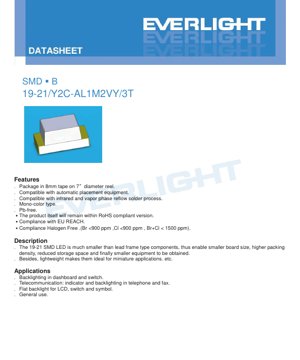
The 19-21 SMD LED is a compact, surface-mount device designed for applications requiring a brilliant yellow indicator or backlight. Utilizing AlGaInP chip technology, it delivers high luminous intensity in a miniature footprint. Its primary advantages include significant space savings on PCBs, compatibility with automated assembly processes, and compliance with modern environmental and safety standards such as RoHS, REACH, and halogen-free requirements.
1.1 Core Advantages and Target Market
The key advantage of this component is its extremely small size (2.0mm x 1.25mm x 1.1mm), which enables higher packing density and allows for the design of smaller, more compact electronic equipment. Its lightweight nature makes it ideal for miniature and portable applications. The device is packaged on 8mm tape on a 7-inch diameter reel, making it fully compatible with high-speed automatic pick-and-place equipment. The target markets include automotive electronics (e.g., dashboard and switch backlighting), telecommunications (e.g., indicator lights in phones and fax machines), consumer electronics for LCD backlighting, and general-purpose indicator applications.
2. Technical Parameter Deep Dive
This section provides a detailed, objective analysis of the device's key technical parameters as defined in the Absolute Maximum Ratings and Electro-Optical Characteristics tables.
2.1 Electrical and Thermal Parameters
The Absolute Maximum Ratings define the operational boundaries beyond which permanent damage may occur. The device has a maximum reverse voltage (VR) of 5V, emphasizing that it is not designed for reverse-bias operation. The continuous forward current (IF) is rated at 25mA, with a peak forward current (IFP) of 60mA permissible under pulsed conditions (duty cycle 1/10 at 1kHz). The maximum power dissipation (Pd) is 60mW. The operating temperature range is specified from -40°C to +85°C, with a slightly wider storage temperature range of -40°C to +90°C. The device can withstand standard lead-free reflow soldering profiles with a peak temperature of 260°C for up to 10 seconds.
2.2 Electro-Optical Characteristics
The core performance is defined under typical conditions (Ta=25°C, IF=5mA). The luminous intensity (Iv) has a typical range from 11.5 mcd to 28.5 mcd, depending on the specific bin. The viewing angle (2θ1/2) is a wide 100 degrees, providing broad, even illumination. The dominant wavelength (λd) falls within the yellow spectrum, specifically between 585.5 nm and 594.5 nm, with a typical peak wavelength (λp) around 591 nm. The spectral bandwidth (Δλ) is approximately 15 nm. The forward voltage (VF) is relatively low, ranging from 1.70V to 2.20V at 5mA. The reverse current (IR) is guaranteed to be below 10 μA at the maximum reverse voltage of 5V.
3. Binning System Explanation
To ensure consistency in production and application design, the LEDs are sorted into bins based on three key parameters: Luminous Intensity, Dominant Wavelength, and Forward Voltage.
3.1 Luminous Intensity Binning
Luminous intensity is categorized into four bins: L1 (11.5-14.5 mcd), L2 (14.5-18.0 mcd), M1 (18.0-22.5 mcd), and M2 (22.5-28.5 mcd). This allows designers to select a brightness level appropriate for their application, ensuring visual consistency across multiple units in a product.
3.2 Dominant Wavelength Binning
The color (hue) is controlled through dominant wavelength bins: D3 (585.5-588.5 nm), D4 (588.5-591.5 nm), and D5 (591.5-594.5 nm). This tight control, with a tolerance of ±1nm, is crucial for applications where color consistency is important, such as in multi-LED backlight arrays or status indicators that must match a specific brand color.
3.3 Forward Voltage Binning
Forward voltage is binned in 0.1V steps from 1.70V to 2.20V, with codes 19 through 23. Knowing the specific voltage bin is essential for designing the current-limiting resistor network, as it directly impacts the current flowing through the LED and thus its brightness and power consumption. The tolerance on VF is ±0.05V within a bin.
4. Performance Curve Analysis
The datasheet provides several characteristic curves that illustrate the device's behavior under varying conditions, which are critical for robust circuit design.
4.1 Forward Current vs. Forward Voltage (IV Curve)
The IV curve shows the non-linear relationship between forward current and forward voltage. For this LED, the voltage rises sharply once the turn-on threshold is passed. At the typical operating current of 5mA, the voltage is between 1.7V and 2.2V. Designers must use this curve to ensure the driving circuit provides stable current, not voltage, to achieve consistent brightness.
4.2 Relative Luminous Intensity vs. Ambient Temperature
This curve demonstrates the temperature dependence of light output. Luminous intensity decreases as the ambient temperature increases. The output remains relatively stable from -40°C to around 25°C but shows a noticeable decline as temperature approaches the maximum operating limit of +85°C. This characteristic must be factored into designs for high-temperature environments, potentially requiring de-rating or thermal management.
4.3 Relative Luminous Intensity vs. Forward Current
This curve shows that light output increases with forward current, but not in a perfectly linear fashion, especially at higher currents. It also highlights the importance of the Absolute Maximum Rating for continuous current (25mA). Operating near or above this limit can lead to accelerated degradation, reduced lifetime, and potential failure.
4.4 Spectrum Distribution and Radiation Pattern
The spectrum distribution plot confirms the monochromatic yellow output with a central peak around 591 nm. The radiation diagram illustrates the spatial distribution of light, showing the 100-degree viewing angle where the intensity drops to half of its peak value. This pattern is important for understanding how the light will be perceived from different angles in the final application.
5. Mechanical and Package Information
5.1 Package Dimensions and Tolerances
The LED is housed in a standard 19-21 SMD package. The key dimensions are: length 2.0mm, width 1.25mm, and height 1.1mm. The lead (terminal) dimensions and spacing are designed for reliable soldering. All unspecified tolerances are ±0.1mm. A cathode mark is clearly indicated on the package for correct polarity orientation during assembly.
5.2 Polarity Identification and Pad Design
Correct polarity is essential for device operation. The package features a distinct cathode mark. The recommended PCB land pattern (footprint) should match the package leads with appropriate solder mask relief to ensure a reliable solder fillet forms during reflow, providing both electrical connection and mechanical strength.
6. Soldering and Assembly Guidelines
Proper handling and soldering are critical to maintaining device reliability and performance.
6.1 Reflow Soldering Parameters
The device is compatible with infrared and vapor phase reflow processes. For lead-free soldering, a specific temperature profile is recommended: pre-heating between 150-200°C for 60-120 seconds, time above liquidus (217°C) for 60-150 seconds, with a peak temperature not exceeding 260°C for a maximum of 10 seconds. The maximum heating and cooling rates should be 6°C/sec and 3°C/sec, respectively. Reflow should not be performed more than two times.
6.2 Hand Soldering and Repair
If hand soldering is necessary, extreme care must be taken. The soldering iron tip temperature should be below 350°C, applied to each terminal for no more than 3 seconds. The iron's power rating should be 25W or less. A cooling interval of at least 2 seconds should be observed between soldering each terminal. Repair after initial soldering is strongly discouraged. If unavoidable, a specialized double-head soldering iron must be used to simultaneously heat both terminals and avoid mechanical stress on the package.
6.3 Storage and Moisture Sensitivity
The LEDs are packaged in a moisture-resistant barrier bag with desiccant. The bag must not be opened until the components are ready for use. After opening, unused LEDs should be stored at ≤30°C and ≤60% Relative Humidity and used within 168 hours (7 days). If this window is exceeded or the desiccant indicator shows saturation, the components must be baked at 60±5°C for 24 hours before use to remove absorbed moisture and prevent "popcorning" during reflow.
7. Packaging and Ordering Information
7.1 Reel and Tape Specifications
The components are supplied on embossed carrier tape with a width of 8mm, wound onto a standard 7-inch (178mm) diameter reel. Each reel contains 3000 pieces. Detailed dimensions for the reel, carrier tape, and cover tape are provided to ensure compatibility with automated assembly equipment feeders.
7.2 Label Explanation and Moisture-Resistant Packaging
The reel label contains critical information for traceability and correct application: Product Number (P/N), Packing Quantity (QTY), Luminous Intensity Rank (CAT), Dominant Wavelength Rank (HUE), and Forward Voltage Rank (REF). The moisture-proof packaging consists of an aluminum laminate bag containing the reel and a desiccant pack, with an external humidity indicator label.
8. Application Suggestions and Design Considerations
8.1 Typical Application Scenarios
This LED is well-suited for a variety of low-power indicator and backlighting roles. Primary applications include backlighting for automotive dashboards and switches, status indicators in telecommunication equipment (phones, fax machines), flat backlighting for small LCD panels and membrane switches, and general-purpose indicator lights in consumer and industrial electronics.
8.2 Critical Design Considerations
Current Limiting: An external current-limiting resistor is mandatory. The forward voltage has a negative temperature coefficient, meaning it decreases as temperature rises. A constant voltage source without a series resistor would lead to thermal runaway and rapid failure. The resistor value must be calculated based on the supply voltage, the forward voltage bin of the LED, and the desired operating current (which should not exceed 25mA continuous).
Thermal Management: While the device has a low power dissipation, PCB layout should still consider heat dissipation, especially in high-density arrays or high ambient temperature environments. Ensure adequate copper area around the solder pads to act as a heat sink.
ESD Protection: The device has an ESD rating of 2000V (Human Body Model). Standard ESD precautions should be observed during handling and assembly to prevent latent damage.
9. Technical Comparison and Differentiation
Compared to traditional through-hole LED packages, the 19-21 SMD format offers significant advantages: a drastically reduced footprint and profile, suitability for fully automated assembly leading to lower manufacturing costs, and improved reliability due to the absence of bent leads. Within the SMD yellow LED category, this specific part differentiates itself with its brilliant yellow color from the AlGaInP material system (often brighter and more saturated than older technologies), a wide 100-degree viewing angle, and comprehensive environmental compliance (RoHS, REACH, Halogen-Free). Its detailed binning structure allows for high-precision selection for color- and brightness-critical applications.
10. Frequently Asked Questions (Based on Technical Parameters)
Q: Can I drive this LED directly from a 3.3V or 5V logic supply?
A: No. You must always use a series current-limiting resistor. For example, with a 5V supply and an LED from the VF=2.0V bin targeting 20mA: R = (5V - 2.0V) / 0.020A = 150 Ohms. A resistor is non-negotiable for reliable operation.
Q: How do I interpret the bin codes on the label (e.g., CAT: M1, HUE: D4, REF: 20)?
A: This specifies the exact performance subset. CAT:M1 means luminous intensity between 18.0-22.5 mcd. HUE:D4 means dominant wavelength between 588.5-591.5 nm. REF:20 means forward voltage between 1.80-1.90V.
Q: The datasheet shows a reverse voltage rating of 5V. Can I use it in an AC circuit or with reverse polarity protection?
A: The 5V rating is for testing reverse current (IR) only. The device is not designed for operation in reverse bias. It should only be used in forward-bias DC circuits. For AC or bipolar applications, an external rectifier or protection diode is required.
Q: What happens if I exceed the 7-day floor life after opening the moisture barrier bag?
A: The components absorb moisture from the air. If soldered without baking, this moisture can vaporize rapidly during reflow, causing internal delamination or cracking ("popcorning"). You must bake the components at 60°C for 24 hours before use to drive out the moisture.
11. Practical Design and Usage Case Study
Scenario: Designing a multi-LED status panel for a piece of industrial equipment. The panel requires 10 uniform yellow indicators. To ensure visual consistency, the designer specifies LEDs from the same luminous intensity bin (e.g., M1) and the same dominant wavelength bin (e.g., D4). From the forward voltage bin (e.g., 20), the designer calculates a precise series resistor value for a 12V supply rail to achieve the desired brightness at 15mA, well below the 25mA maximum. The PCB layout places the LEDs with adequate spacing for heat dissipation and uses a solder mask-defined pad to control solder fillet size. The assembler follows the moisture handling procedures, uses the recommended reflow profile, and performs automated optical inspection to verify correct placement and polarity.
12. Technology Principle Introduction
This LED is based on AlGaInP (Aluminum Gallium Indium Phosphide) semiconductor material grown on a substrate. When a forward voltage is applied across the p-n junction, electrons and holes are injected into the active region where they recombine. In AlGaInP, this recombination primarily releases energy in the form of photons in the yellow/orange/red part of the visible spectrum, depending on the exact alloy composition. The "water clear" resin lens is not phosphor-converted; the yellow light is emitted directly from the semiconductor chip itself, resulting in high color purity and efficiency. The package structure protects the delicate semiconductor die and includes a molded epoxy lens that shapes the light output into the specified radiation pattern.
13. Technology Trends and Developments
The general trend in SMD LEDs like the 19-21 package is towards ever-higher luminous efficacy (more light output per watt of electrical input), achieved through improvements in chip design, epitaxial growth, and light extraction from the package. There is also a continuous drive for improved color consistency and tighter binning tolerances to meet the demands of high-end display and automotive applications. Packaging technology is evolving to enhance reliability under higher temperature and humidity conditions. Furthermore, the industry-wide shift to lead-free, halogen-free, and REACH-compliant materials, as seen in this device, reflects the growing importance of environmental sustainability and regulatory compliance in electronic component manufacturing.
LED Specification Terminology
Complete explanation of LED technical terms
Photoelectric Performance
| Term | Unit/Representation | Simple Explanation | Why Important |
|---|---|---|---|
| Luminous Efficacy | lm/W (lumens per watt) | Light output per watt of electricity, higher means more energy efficient. | Directly determines energy efficiency grade and electricity cost. |
| Luminous Flux | lm (lumens) | Total light emitted by source, commonly called "brightness". | Determines if the light is bright enough. |
| Viewing Angle | ° (degrees), e.g., 120° | Angle where light intensity drops to half, determines beam width. | Affects illumination range and uniformity. |
| CCT (Color Temperature) | K (Kelvin), e.g., 2700K/6500K | Warmth/coolness of light, lower values yellowish/warm, higher whitish/cool. | Determines lighting atmosphere and suitable scenarios. |
| CRI / Ra | Unitless, 0–100 | Ability to render object colors accurately, Ra≥80 is good. | Affects color authenticity, used in high-demand places like malls, museums. |
| SDCM | MacAdam ellipse steps, e.g., "5-step" | Color consistency metric, smaller steps mean more consistent color. | Ensures uniform color across same batch of LEDs. |
| Dominant Wavelength | nm (nanometers), e.g., 620nm (red) | Wavelength corresponding to color of colored LEDs. | Determines hue of red, yellow, green monochrome LEDs. |
| Spectral Distribution | Wavelength vs intensity curve | Shows intensity distribution across wavelengths. | Affects color rendering and quality. |
Electrical Parameters
| Term | Symbol | Simple Explanation | Design Considerations |
|---|---|---|---|
| Forward Voltage | Vf | Minimum voltage to turn on LED, like "starting threshold". | Driver voltage must be ≥Vf, voltages add up for series LEDs. |
| Forward Current | If | Current value for normal LED operation. | Usually constant current drive, current determines brightness & lifespan. |
| Max Pulse Current | Ifp | Peak current tolerable for short periods, used for dimming or flashing. | Pulse width & duty cycle must be strictly controlled to avoid damage. |
| Reverse Voltage | Vr | Max reverse voltage LED can withstand, beyond may cause breakdown. | Circuit must prevent reverse connection or voltage spikes. |
| Thermal Resistance | Rth (°C/W) | Resistance to heat transfer from chip to solder, lower is better. | High thermal resistance requires stronger heat dissipation. |
| ESD Immunity | V (HBM), e.g., 1000V | Ability to withstand electrostatic discharge, higher means less vulnerable. | Anti-static measures needed in production, especially for sensitive LEDs. |
Thermal Management & Reliability
| Term | Key Metric | Simple Explanation | Impact |
|---|---|---|---|
| Junction Temperature | Tj (°C) | Actual operating temperature inside LED chip. | Every 10°C reduction may double lifespan; too high causes light decay, color shift. |
| Lumen Depreciation | L70 / L80 (hours) | Time for brightness to drop to 70% or 80% of initial. | Directly defines LED "service life". |
| Lumen Maintenance | % (e.g., 70%) | Percentage of brightness retained after time. | Indicates brightness retention over long-term use. |
| Color Shift | Δu′v′ or MacAdam ellipse | Degree of color change during use. | Affects color consistency in lighting scenes. |
| Thermal Aging | Material degradation | Deterioration due to long-term high temperature. | May cause brightness drop, color change, or open-circuit failure. |
Packaging & Materials
| Term | Common Types | Simple Explanation | Features & Applications |
|---|---|---|---|
| Package Type | EMC, PPA, Ceramic | Housing material protecting chip, providing optical/thermal interface. | EMC: good heat resistance, low cost; Ceramic: better heat dissipation, longer life. |
| Chip Structure | Front, Flip Chip | Chip electrode arrangement. | Flip chip: better heat dissipation, higher efficacy, for high-power. |
| Phosphor Coating | YAG, Silicate, Nitride | Covers blue chip, converts some to yellow/red, mixes to white. | Different phosphors affect efficacy, CCT, and CRI. |
| Lens/Optics | Flat, Microlens, TIR | Optical structure on surface controlling light distribution. | Determines viewing angle and light distribution curve. |
Quality Control & Binning
| Term | Binning Content | Simple Explanation | Purpose |
|---|---|---|---|
| Luminous Flux Bin | Code e.g., 2G, 2H | Grouped by brightness, each group has min/max lumen values. | Ensures uniform brightness in same batch. |
| Voltage Bin | Code e.g., 6W, 6X | Grouped by forward voltage range. | Facilitates driver matching, improves system efficiency. |
| Color Bin | 5-step MacAdam ellipse | Grouped by color coordinates, ensuring tight range. | Guarantees color consistency, avoids uneven color within fixture. |
| CCT Bin | 2700K, 3000K etc. | Grouped by CCT, each has corresponding coordinate range. | Meets different scene CCT requirements. |
Testing & Certification
| Term | Standard/Test | Simple Explanation | Significance |
|---|---|---|---|
| LM-80 | Lumen maintenance test | Long-term lighting at constant temperature, recording brightness decay. | Used to estimate LED life (with TM-21). |
| TM-21 | Life estimation standard | Estimates life under actual conditions based on LM-80 data. | Provides scientific life prediction. |
| IESNA | Illuminating Engineering Society | Covers optical, electrical, thermal test methods. | Industry-recognized test basis. |
| RoHS / REACH | Environmental certification | Ensures no harmful substances (lead, mercury). | Market access requirement internationally. |
| ENERGY STAR / DLC | Energy efficiency certification | Energy efficiency and performance certification for lighting. | Used in government procurement, subsidy programs, enhances competitiveness. |