1. Product Overview
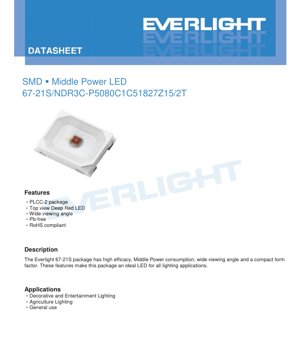
This document details the specifications for a Surface-Mount Device (SMD) Middle Power LED in a PLCC-2 package, emitting deep red light. The device is constructed using AlGaInP chip technology encapsulated in water-clear resin. It is designed for applications requiring high efficacy, a wide viewing angle, and a compact form factor within a middle power consumption range. The component is lead-free and compliant with RoHS directives.
1.1 Core Advantages and Target Market
The primary advantages of this LED include its high luminous efficacy, which translates to efficient light output for the electrical power consumed. The wide 120-degree viewing angle ensures uniform light distribution, making it suitable for applications where broad illumination is critical. Its compact PLCC-2 package allows for high-density PCB layouts. These features collectively make it an ideal choice for decorative and entertainment lighting, agriculture lighting (e.g., plant growth supplementation), and general illumination purposes where a deep red spectral output is desired.
2. Technical Parameter Deep-Dive
2.1 Absolute Maximum Ratings
These ratings define the limits beyond which permanent damage to the device may occur. Operation should be maintained within these boundaries.
- Forward Current (IF): 150 mA (Continuous).
- Peak Forward Current (IFP): 300 mA (Pulsed, duty cycle 1/10, pulse width 10ms).
- Power Dissipation (Pd): 405 mW. This is the maximum allowable power loss at the junction.
- Operating Temperature (Topr): -40°C to +85°C.
- Storage Temperature (Tstg): -40°C to +100°C.
- Thermal Resistance (Rth J-S): 50 °C/W (Junction to Soldering point). This parameter is crucial for thermal management design.
- Junction Temperature (Tj): 115 °C (Maximum).
- Soldering Temperature: Reflow: 260°C for 10 seconds max. Hand soldering: 350°C for 3 seconds max. The device is sensitive to electrostatic discharge (ESD).
2.2 Electro-Optical Characteristics
Measured at a soldering point temperature (Tsoldering) of 25°C. Typical values are provided for reference; min/max values define the guaranteed performance spread.
- Radiometric Power (Φe): 80 mW (Min), 180 mW (Max) at IF=150mA. This is the total optical power output, measured in milliwatts. Tolerance is ±11%.
- Forward Voltage (VF): 1.8V (Min), 2.7V (Max) at IF=150mA. The typical value falls within this range. Tolerance is ±0.1V from the binned value.
- Viewing Angle (2θ1/2): 120 degrees (Typical) at IF=150mA. This is the full angle at which luminous intensity is half the peak value.
- Reverse Current (IR): 50 µA (Max) at a reverse voltage (VR) of 5V.
3. Binning System Explanation
The LED is classified into bins for key parameters to ensure consistency in application design. The specific bin codes are part of the product ordering number.
3.1 Radiometric Power Bins
Binned at IF=150mA. Codes C1 through C5 represent increasing output power ranges.
- C1: 80 - 100 mW
- C2: 100 - 120 mW
- C3: 120 - 140 mW
- C4: 140 - 160 mW
- C5: 160 - 180 mW
3.2 Forward Voltage Bins
Binned at IF=150mA. Codes 25 through 33 represent increasing forward voltage ranges.
- 25: 1.8 - 1.9 V
- 26: 1.9 - 2.0 V
- ... up to 33: 2.6 - 2.7 V
3.3 Peak Wavelength Bins
Binned at IF=150mA. Defines the spectral peak of the deep red emission.
- DA2: 650 - 660 nm
- DA3: 660 - 670 nm
- DA4: 670 - 680 nm
Dominant/Peak wavelength measurement tolerance is ±1nm.
4. Performance Curve Analysis
4.1 Spectrum Distribution
The provided spectrum curve shows a narrow, well-defined peak in the deep red region (approximately 650-680nm depending on bin), characteristic of AlGaInP semiconductors. There is minimal emission in other spectral bands, making it suitable for applications requiring pure red light.
4.2 Forward Voltage vs. Junction Temperature
Figure 1 illustrates that the forward voltage (VF) has a negative temperature coefficient. As the junction temperature (Tj) increases from 25°C to 115°C, VF decreases linearly by approximately 0.25V. This is a critical consideration for constant-current driver design to ensure stable operation over temperature.
4.3 Relative Radiometric Power vs. Forward Current
Figure 2 shows a sub-linear relationship. Radiometric power increases with current but begins to saturate at higher currents (above ~100mA) due to increased thermal effects and efficiency droop. Operating at the maximum rated current (150mA) may not yield proportionally higher output compared to a slightly lower current.
4.4 Relative Luminous Intensity vs. Junction Temperature
Figure 3 demonstrates the thermal quenching effect. As Tj rises, the optical output decreases. The intensity at 115°C is roughly 70-80% of its value at 25°C. Effective heat sinking is essential to maintain light output.
4.5 Forward Current vs. Forward Voltage (IV Curve)
Figure 4 presents the classic diode IV characteristic at 25°C. The curve shows the exponential relationship in the low-current region and a more linear, resistive behavior at the operating current of 150mA, where the dynamic resistance can be inferred.
4.6 Maximum Driving Current vs. Soldering Temperature
Figure 5 is a de-rating curve. It indicates that the maximum allowable continuous forward current must be reduced if the temperature at the soldering point (TS) exceeds approximately 70°C. For example, at TS=90°C, the maximum IF is derated to about 110mA. This graph is vital for reliability in high ambient temperature environments.
4.7 Radiation Pattern
Figure 6 (Radiation Diagram) confirms the near-Lambertian emission pattern with a 120° viewing angle. The intensity is nearly uniform across a wide central region, dropping to 50% at ±60 degrees from the mechanical axis.
5. Mechanical and Package Information
5.1 Package Dimensions
The PLCC-2 package has a standard footprint. Key dimensions (in mm, tolerance ±0.1mm unless noted) include the overall length, width, and height, as well as the pad spacing and size. The cathode is typically identified by a marker on the package or a chamfered corner. The exact dimensional drawing should be referenced for PCB land pattern design.
5.2 Polarity Identification
Proper orientation is required for correct operation. The datasheet's package drawing clearly indicates the anode and cathode pads. Incorrect polarity connection during soldering will prevent the LED from illuminating and may subject it to reverse bias.
6. Soldering and Assembly Guidelines
6.1 Reflow Soldering Profile
The maximum withstand condition is 260°C for 10 seconds. A standard lead-free reflow profile with a peak temperature below 260°C and time above liquidus (TAL) controlled is recommended. Thermal mass differences on the PCB should be considered to ensure all LEDs experience similar thermal exposure.
6.2 Hand Soldering
If hand soldering is necessary, the iron tip temperature should not exceed 350°C, and contact time with the LED terminal should be limited to 3 seconds or less per pad. Use a low-thermal-mass technique.
6.3 Storage Conditions
Devices are packaged in moisture-resistant barrier bags with desiccant. Once the sealed bag is opened, the components are sensitive to moisture absorption (MSL rating). They should be used within the specified floor life or baked according to IPC/JEDEC standards before reflow if exceeded. Long-term storage should be in a dry environment at temperatures between -40°C and 100°C.
7. Packaging and Ordering Information
7.1 Reel and Tape Specifications
The LEDs are supplied on embossed carrier tapes wound onto reels. Standard reel dimensions and tape widths are provided. Common quantities per reel include 250, 500, 1000, 2000, 3000, and 4000 pieces, facilitating automated pick-and-place assembly.
7.2 Label Explanation
The reel label contains critical information: Product Number (P/N), which encodes the specific bin selections for Radiometric Power (CAT), Wavelength (HUE), and Forward Voltage (REF); Packing Quantity (QTY); and Lot Number (LOT No) for traceability.
8. Application Suggestions
8.1 Typical Application Scenarios
- Decorative and Entertainment Lighting: Architectural accent lighting, stage lighting, and signage where deep red color is required.
- Agriculture Lighting: Supplemental lighting in horticulture, particularly for photomorphogenic responses in plants (e.g., influencing flowering, stem elongation) that are sensitive to red and far-red light.
- General Use: Indicator lights, backlighting, and any application needing a reliable, efficient red light source.
8.2 Design Considerations
- Thermal Management: With an Rth J-S of 50°C/W, the PCB must act as an effective heat sink. Use adequate copper area under and around the thermal pad, and consider thermal vias to inner layers or a metal core PCB for high-power or high-ambient-temperature applications.
- Current Driving:** Always use a constant-current driver, not a constant-voltage source. The driver should be designed to accommodate the VF bin range and its negative temperature coefficient. Consider dimming capabilities if required.
- Optical Design: The wide viewing angle may require secondary optics (lenses, reflectors) if beam shaping or focusing is needed. The water-clear resin allows for good light extraction.
9. Reliability and Testing
The datasheet outlines a comprehensive reliability test plan conducted with a 90% confidence level and 10% Lot Tolerance Percent Defective (LTPD). Tests include:
- Reflow Soldering Resistance
- Thermal Shock (-10°C to +100°C)
- Temperature Cycling (-40°C to +100°C)
- High Temperature/Humidity Storage (85°C/85% RH)
- High/Low Temperature Storage and Operation Life Tests under various current and temperature conditions.
These tests validate the LED's robustness under typical manufacturing and operational stresses, ensuring long-term performance.
10. Technical Comparison and Differentiation
As a Middle Power Deep Red LED in a PLCC-2 package, its key differentiators lie in its balance of performance and size. Compared to low-power LEDs, it offers significantly higher radiant flux. Compared to high-power LEDs, it typically has a lower thermal resistance to the board and can be driven at lower currents, simplifying driver design. The use of AlGaInP technology provides high efficiency in the red spectrum compared to other technologies like phosphor-converted reds. The specific combination of 150mA drive current, 405mW power dissipation, and 120° angle in this compact form factor targets a specific niche in the lighting market.
11. Frequently Asked Questions (Based on Technical Parameters)
11.1 What driver current should I use?
For full specified output, use 150mA constant current. However, for improved longevity or lower thermal load, driving at a lower current (e.g., 100-120mA) is possible, with output referenced to the Relative Radiometric Power vs. Current curve (Fig. 2). Never exceed 150mA continuous.
11.2 How do I interpret the bin codes in the part number?
The part number (e.g., NDR3C-P5080C1C51827Z15/2T) encodes the specific bins. You must cross-reference the alphanumeric codes with the bin tables in sections 3.1, 3.2, and 3.3 to determine the guaranteed minimum and maximum values for Radiometric Power, Forward Voltage, and Peak Wavelength for that specific orderable item.
11.3 Why does the light output decrease when the LED gets hot?
This is due to the inherent property of semiconductor materials known as thermal quenching or efficiency droop, as shown in Figure 3. As temperature rises, non-radiative recombination increases, reducing the internal quantum efficiency. Proper heat sinking minimizes the junction temperature rise, maintaining higher light output.
11.4 Can I connect multiple LEDs in series or parallel?
Series connection is generally preferred when using a constant-current driver, as the same current flows through all LEDs. However, the forward voltage tolerances (bins) add up, requiring a driver with sufficient compliance voltage. Parallel connection is not recommended without individual current-limiting resistors or dedicated channels due to VF mismatch, which can cause current hogging and uneven brightness or failure.
12. Practical Design Case Study
Scenario: Designing a horticulture light bar for supplemental red light in a greenhouse with an ambient temperature of up to 40°C.
Design Steps:
- Selection: Choose this deep red LED for its targeted spectrum (e.g., bin DA3: 660-670nm, relevant for phytochrome activation).
- Thermal Analysis: Target a maximum junction temperature (Tj) of 85°C for good longevity. Given Tambient=40°C, Rth J-S=50°C/W, and Pd ≈ VF*IF (e.g., 2.2V * 0.15A = 0.33W). Temperature rise from solder point to junction: ΔT = Pd * Rth J-S = 0.33W * 50°C/W = 16.5°C. Therefore, the solder point temperature (TS) must be kept below Tj - ΔT = 85°C - 16.5°C = 68.5°C.
- PCB Design: Design the PCB with a large, continuous copper pad connected to the LED's thermal pad. Use multiple thermal vias to inner ground planes or a dedicated thermal layer to keep TS below 68.5°C when Tambient=40°C. Refer to Figure 5 to ensure the driving current is acceptable for the calculated TS.
- Driver Design: Select a constant-current driver capable of delivering 150mA per string. For 10 LEDs in series, the driver's output voltage compliance must cover the sum of the maximum VF in the chosen bin (e.g., 10 * 2.3V = 23V) plus some headroom.
- Optical Layout: Space the LEDs appropriately on the bar to achieve the desired light intensity uniformity across the plant canopy, considering the 120° viewing angle.
13. Operating Principle
This LED is a semiconductor p-n junction diode based on Aluminium Gallium Indium Phosphide (AlGaInP) material. When a forward voltage exceeding the diode's turn-on threshold is applied, electrons from the n-type region and holes from the p-type region are injected into the active region. These charge carriers recombine radiatively, releasing energy in the form of photons. The specific bandgap energy of the AlGaInP alloy determines the wavelength of the emitted light, which in this case is in the deep red spectrum (650-680 nm). The water-clear epoxy resin encapsulant protects the semiconductor chip, provides mechanical stability, and shapes the light output pattern.
14. Technology Trends
Middle-power LEDs like this one represent a significant trend in solid-state lighting, bridging the gap between low-power indicator LEDs and high-power illumination LEDs. Key industry trends influencing this segment include:
- Increased Efficacy: Ongoing material and packaging research aims to deliver higher radiometric power (mW) per unit of electrical input (mA), reducing energy consumption for the same light output.
- Improved Thermal Management: Advancements in package design (e.g., enhanced thermal pads) and PCB materials (e.g., insulated metal substrates, thermal clad boards) allow for better heat dissipation, enabling higher drive currents or improved reliability at standard currents.
- Narrower Spectral Peaks & New Wavelengths: In horticulture, there is demand for LEDs with very specific, narrow emission peaks matching plant photoreceptors (e.g., 660nm, 730nm). Development continues to optimize efficiency at these targeted wavelengths.
- Miniaturization and Integration: The drive for smaller, denser lighting arrays continues, pushing for packages with a smaller footprint while maintaining or improving optical and thermal performance.
LED Specification Terminology
Complete explanation of LED technical terms
Photoelectric Performance
| Term | Unit/Representation | Simple Explanation | Why Important |
|---|---|---|---|
| Luminous Efficacy | lm/W (lumens per watt) | Light output per watt of electricity, higher means more energy efficient. | Directly determines energy efficiency grade and electricity cost. |
| Luminous Flux | lm (lumens) | Total light emitted by source, commonly called "brightness". | Determines if the light is bright enough. |
| Viewing Angle | ° (degrees), e.g., 120° | Angle where light intensity drops to half, determines beam width. | Affects illumination range and uniformity. |
| CCT (Color Temperature) | K (Kelvin), e.g., 2700K/6500K | Warmth/coolness of light, lower values yellowish/warm, higher whitish/cool. | Determines lighting atmosphere and suitable scenarios. |
| CRI / Ra | Unitless, 0–100 | Ability to render object colors accurately, Ra≥80 is good. | Affects color authenticity, used in high-demand places like malls, museums. |
| SDCM | MacAdam ellipse steps, e.g., "5-step" | Color consistency metric, smaller steps mean more consistent color. | Ensures uniform color across same batch of LEDs. |
| Dominant Wavelength | nm (nanometers), e.g., 620nm (red) | Wavelength corresponding to color of colored LEDs. | Determines hue of red, yellow, green monochrome LEDs. |
| Spectral Distribution | Wavelength vs intensity curve | Shows intensity distribution across wavelengths. | Affects color rendering and quality. |
Electrical Parameters
| Term | Symbol | Simple Explanation | Design Considerations |
|---|---|---|---|
| Forward Voltage | Vf | Minimum voltage to turn on LED, like "starting threshold". | Driver voltage must be ≥Vf, voltages add up for series LEDs. |
| Forward Current | If | Current value for normal LED operation. | Usually constant current drive, current determines brightness & lifespan. |
| Max Pulse Current | Ifp | Peak current tolerable for short periods, used for dimming or flashing. | Pulse width & duty cycle must be strictly controlled to avoid damage. |
| Reverse Voltage | Vr | Max reverse voltage LED can withstand, beyond may cause breakdown. | Circuit must prevent reverse connection or voltage spikes. |
| Thermal Resistance | Rth (°C/W) | Resistance to heat transfer from chip to solder, lower is better. | High thermal resistance requires stronger heat dissipation. |
| ESD Immunity | V (HBM), e.g., 1000V | Ability to withstand electrostatic discharge, higher means less vulnerable. | Anti-static measures needed in production, especially for sensitive LEDs. |
Thermal Management & Reliability
| Term | Key Metric | Simple Explanation | Impact |
|---|---|---|---|
| Junction Temperature | Tj (°C) | Actual operating temperature inside LED chip. | Every 10°C reduction may double lifespan; too high causes light decay, color shift. |
| Lumen Depreciation | L70 / L80 (hours) | Time for brightness to drop to 70% or 80% of initial. | Directly defines LED "service life". |
| Lumen Maintenance | % (e.g., 70%) | Percentage of brightness retained after time. | Indicates brightness retention over long-term use. |
| Color Shift | Δu′v′ or MacAdam ellipse | Degree of color change during use. | Affects color consistency in lighting scenes. |
| Thermal Aging | Material degradation | Deterioration due to long-term high temperature. | May cause brightness drop, color change, or open-circuit failure. |
Packaging & Materials
| Term | Common Types | Simple Explanation | Features & Applications |
|---|---|---|---|
| Package Type | EMC, PPA, Ceramic | Housing material protecting chip, providing optical/thermal interface. | EMC: good heat resistance, low cost; Ceramic: better heat dissipation, longer life. |
| Chip Structure | Front, Flip Chip | Chip electrode arrangement. | Flip chip: better heat dissipation, higher efficacy, for high-power. |
| Phosphor Coating | YAG, Silicate, Nitride | Covers blue chip, converts some to yellow/red, mixes to white. | Different phosphors affect efficacy, CCT, and CRI. |
| Lens/Optics | Flat, Microlens, TIR | Optical structure on surface controlling light distribution. | Determines viewing angle and light distribution curve. |
Quality Control & Binning
| Term | Binning Content | Simple Explanation | Purpose |
|---|---|---|---|
| Luminous Flux Bin | Code e.g., 2G, 2H | Grouped by brightness, each group has min/max lumen values. | Ensures uniform brightness in same batch. |
| Voltage Bin | Code e.g., 6W, 6X | Grouped by forward voltage range. | Facilitates driver matching, improves system efficiency. |
| Color Bin | 5-step MacAdam ellipse | Grouped by color coordinates, ensuring tight range. | Guarantees color consistency, avoids uneven color within fixture. |
| CCT Bin | 2700K, 3000K etc. | Grouped by CCT, each has corresponding coordinate range. | Meets different scene CCT requirements. |
Testing & Certification
| Term | Standard/Test | Simple Explanation | Significance |
|---|---|---|---|
| LM-80 | Lumen maintenance test | Long-term lighting at constant temperature, recording brightness decay. | Used to estimate LED life (with TM-21). |
| TM-21 | Life estimation standard | Estimates life under actual conditions based on LM-80 data. | Provides scientific life prediction. |
| IESNA | Illuminating Engineering Society | Covers optical, electrical, thermal test methods. | Industry-recognized test basis. |
| RoHS / REACH | Environmental certification | Ensures no harmful substances (lead, mercury). | Market access requirement internationally. |
| ENERGY STAR / DLC | Energy efficiency certification | Energy efficiency and performance certification for lighting. | Used in government procurement, subsidy programs, enhances competitiveness. |