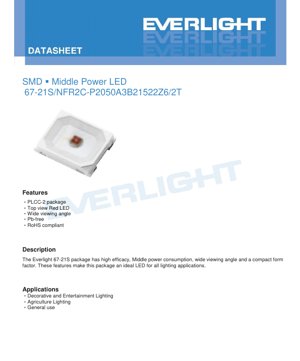
1. Product Overview
This document details the specifications for a surface-mount device (SMD) middle power LED in a PLCC-2 package. The device utilizes an AIGaInP chip to emit light in the Far Red spectrum, making it suitable for specialized lighting applications beyond general illumination. Its compact form factor, wide viewing angle, and compliance with environmental standards (Pb-free, RoHS) are key features.
1.1 Core Advantages and Target Market
The primary advantages of this LED include high efficacy for its power class and a wide 120-degree viewing angle, ensuring broad and uniform light distribution. The compact PLCC-2 package facilitates design integration into various lighting fixtures. The target markets are highly specialized, focusing on applications where specific light spectra are required, such as decorative lighting to create atmospheric effects, entertainment lighting for stage and studio, and increasingly, agriculture lighting where Far Red wavelengths are known to influence plant physiology, photomorphogenesis, and flowering responses.
2. Technical Parameter Deep-Dive
2.1 Absolute Maximum Ratings
These ratings define the operational limits beyond which permanent damage may occur. The device is rated for a continuous forward current (IF) of 60 mA, with a peak forward current (IFP) of 120 mA permissible under pulsed conditions (duty cycle 1/10, pulse width 10ms). The maximum power dissipation (Pd) is 135 mW. The operating temperature range is from -40°C to +85°C, with a slightly wider storage temperature range of -40°C to +100°C. The thermal resistance from the junction to the soldering point (Rth J-S) is specified as 50 °C/W, which is critical for thermal management design. The maximum allowable junction temperature (Tj) is 115°C. Soldering guidelines are provided: reflow soldering at 260°C for 10 seconds or hand soldering at 350°C for 3 seconds. A critical note emphasizes the device's sensitivity to electrostatic discharge (ESD), requiring proper handling procedures.
2.2 Electro-Optical Characteristics
These parameters are measured under standard test conditions (soldering point temperature = 25°C, IF = 60mA). The key performance metric is the Radiometric Power (Iv), which ranges from a minimum of 15 mW to a maximum of 50 mW, with a typical value implied within this range and a tolerance of ±11%. The forward voltage (VF) ranges from 1.5V to 2.2V with a tolerance of ±0.1V. The viewing angle (2θ1/2) is typically 120 degrees. The reverse current (IR) is specified with a maximum of 1.5 µA at a reverse voltage (VR) of 5V.
3. Binning System Explanation
To ensure consistency and allow for precise selection, the LEDs are sorted into bins based on key parameters.
3.1 Radiometric Power Bins
Radiometric output is categorized into bins labeled A3 through B2. Bin A3 covers 15-20 mW, A4 covers 20-25 mW, A5 covers 25-30 mW, B1 covers 30-40 mW, and B2 covers 40-50 mW, all measured at IF=60mA.
3.2 Forward Voltage Bins
The forward voltage is binned in 0.1V steps. Bin codes 22 through 28 correspond to voltage ranges from 1.5-1.6V up to 2.1-2.2V, respectively (at IF=60mA).
3.3 Peak Wavelength Bins
This is a critical bin for spectral applications. The Far Red emission is binned by peak wavelength: FA3 (720-730 nm), FA4 (730-740 nm), and FA5 (740-750 nm). The measurement tolerance for dominant/peak wavelength is ±1nm.
4. Performance Curve Analysis
The datasheet provides several graphs illustrating device behavior under varying conditions.
4.1 Spectrum Distribution
A spectral graph shows the relative luminous intensity across wavelengths from approximately 645nm to 795nm, with a pronounced peak in the Far Red region (720-750nm), confirming the AIGaInP chip's emission characteristics.
4.2 Thermal and Electrical Characteristics
Figure 1: Forward Voltage Shift vs. Junction Temperature shows that VF decreases linearly as the junction temperature (Tj) increases from 25°C to 115°C, a typical behavior for semiconductor junctions.
Figure 2: Relative Radiometric Power vs. Forward Current demonstrates the sub-linear relationship between drive current and light output, indicating efficiency roll-off at higher currents.
Figure 3: Relative Luminous Intensity vs. Junction Temperature plots the normalized light output against Tj, showing a decrease in efficacy as temperature rises, highlighting the importance of thermal management.
Figure 4: Forward Current vs. Forward Voltage (I-V Curve) depicts the fundamental diode characteristic at 25°C.
Figure 5: Max. Driving Forward Current vs. Soldering Temperature is a derating curve, indicating the maximum safe operating current must be reduced as the ambient/soldering point temperature increases, based on the given Rth j-s of 50°C/W.
Figure 6: Radiation Diagram is a polar plot illustrating the spatial intensity distribution, confirming the wide, Lambertian-like emission pattern.
5. Mechanical and Package Information
5.1 Package Dimensions
A detailed dimensioned drawing of the PLCC-2 package is provided. Key dimensions include the overall length and width, the size and position of the LED chip cavity, and the anode/cathode pad locations. The drawing specifies a standard tolerance of ±0.1 mm unless otherwise noted. The package uses a water-clear resin.
6. Soldering and Assembly Guidelines
The absolute maximum ratings specify the soldering conditions: 260°C for 10 seconds for reflow or 350°C for 3 seconds for hand soldering. The \"Precautions for Use\" section strongly advises using current-limiting resistors in series with the LED, as the diode's exponential I-V characteristic means a small voltage change can cause a large, potentially destructive current surge. For storage, it is critical not to open the moisture-proof barrier bag until the components are ready for use in a production line to prevent moisture absorption, which can cause \"popcorning\" during reflow soldering.
7. Packaging and Ordering Information
7.1 Packaging Specifications
The LEDs are supplied on moisture-resistant tape and reel. The carrier tape dimensions are specified, holding 4000 pieces per reel. Detailed drawings for the reel and carrier tape are included, with standard tolerances of ±0.1mm. The packing process involves placing the reel in an aluminum moisture-proof bag with desiccant and an explanatory label.
7.2 Label Explanation
The reel label includes fields for: Customer's Product Number (CPN), Product Number (P/N), Packing Quantity (QTY), Luminous Intensity Rank (CAT), Dominant Wavelength Rank (HUE), Forward Voltage Rank (REF), and Lot Number (LOT No).
8. Application Suggestions
8.1 Typical Application Scenarios
- Decorative and Entertainment Lighting: Used to create deep red ambient lighting, architectural accents, or special effects in stage and studio setups.
- Agriculture Lighting: This is a key application. Far Red light (700-750nm) interacts with the plant photoreceptor phytochrome, influencing seed germination, shade avoidance, and flowering. It is often used in combination with red and blue LEDs in horticultural lighting systems to optimize plant growth and development.
- General Use: While termed \"general,\" this likely refers to indicator lights or status lights where a specific red color is desired, though the Far Red spectrum is less common for standard indicators.
8.2 Design Considerations
Designers must implement proper constant-current driving or use a series resistor to prevent over-current. Thermal management is crucial; the 50 °C/W thermal resistance necessitates an effective thermal path from the soldering pads to a heatsink or PCB copper pour to maintain low junction temperature and ensure long-term reliability and stable light output. The wide viewing angle must be considered for optical design to achieve the desired beam pattern.
9. Reliability and Testing
A comprehensive reliability test plan is outlined, conducted with a 90% confidence level and 10% Lot Tolerance Percent Defective (LTPD). Tests include: Resistance to Solder Heat, Temperature Cycling (-40°C to +100°C), High Temperature/Humidity Life (85°C/85% RH), Low Temperature Life (-40°C), High Temperature Life (60°C and 85°C), Pulse ON/OFF cycling, Thermal Shock, and Power Temperature Cycling. Each test has specific conditions, durations (up to 3000 hours), sample sizes (8 pieces), and acceptance criteria (0 failures allowed, 1 failure rejects the lot).
10. Technical Comparison and Differentiation
Compared to standard mid-power LEDs in the same PLCC-2 package (often used for white light), this device's primary differentiation is its specialized AIGaInP semiconductor material emitting in the Far Red spectrum. While standard LEDs might use InGaN for blue/green or AlGaInP for standard red/amber, this specific wavelength target (720-750nm) caters to niche biological and aesthetic applications. Its performance parameters (efficacy, voltage) are optimized for this spectral region.
11. Frequently Asked Questions (Based on Technical Parameters)
Q: Why is a current-limiting resistor mandatory?
A: The LED's forward voltage has a negative temperature coefficient and a manufacturing tolerance. Without a resistor, a slight increase in supply voltage or decrease in VF due to heating can cause current to rise exponentially, exceeding the absolute maximum rating and destroying the device.
Q: How do I interpret the bin codes in the part number?
A: The part number likely encodes the specific bins for Radiometric Power (e.g., A3, B2), Forward Voltage (e.g., 22, 28), and Peak Wavelength (e.g., FA4) that the particular ordered lot fulfills, ensuring you receive LEDs with tightly grouped characteristics.
Q: Can I drive this LED at its peak current (120mA) continuously?
A: No. The peak forward current rating is for pulsed operation only (1/10 duty cycle, 10ms pulse width). Continuous operation must not exceed the 60mA forward current rating, considering the derating required by Figure 5 at elevated temperatures.
12. Practical Use Case Example
Scenario: Designing a supplemental lighting module for a vertical farming rack growing photoperiod-sensitive flowers.
The design goal is to provide a short burst of Far Red light at the end of the daily light period to promote flowering. A array of these LEDs would be laid out on a metal-core PCB (MCPCB) for optimal heat dissipation. A constant-current LED driver set to 60mA per string would be used. The wide 120-degree viewing angle ensures good canopy penetration without complex secondary optics. The specific wavelength bin (e.g., FA4 for 730-740nm) would be selected based on the target plant species' phytochrome response. The module would be programmed to turn on for 15 minutes after the main white lights turn off.
13. Operational Principle
This LED is a semiconductor photodiode operated in forward bias. When a voltage exceeding its forward voltage (1.5-2.2V) is applied, electrons and holes are injected into the active region from the n-type and p-type semiconductor layers, respectively. Within the active region made of AIGaInP (Aluminum Gallium Indium Phosphide), these charge carriers recombine. A significant portion of this recombination event releases energy in the form of photons (light) through a process called electroluminescence. The specific bandgap energy of the AIGaInP alloy determines the wavelength of the emitted photons, which in this case is in the Far Red portion of the spectrum (720-750 nm).
14. Technology Trends
The use of narrow-band, wavelength-specific LEDs like this Far Red device is a growing trend in non-general lighting fields. In horticulture, research is driving towards \"light recipes\" using precise combinations of blue, red, far-red, and sometimes green or UV wavelengths to optimize different plant traits (growth rate, morphology, nutrient content, flowering). This increases demand for efficient, reliable LEDs across these specific spectral bands. Furthermore, advancements in semiconductor epitaxy allow for tighter wavelength binning and higher efficacies at these longer wavelengths, which historically have been more challenging. The integration of such LEDs with smart sensors and controls for adaptive lighting systems represents a key development direction.
LED Specification Terminology
Complete explanation of LED technical terms
Photoelectric Performance
| Term | Unit/Representation | Simple Explanation | Why Important |
|---|---|---|---|
| Luminous Efficacy | lm/W (lumens per watt) | Light output per watt of electricity, higher means more energy efficient. | Directly determines energy efficiency grade and electricity cost. |
| Luminous Flux | lm (lumens) | Total light emitted by source, commonly called "brightness". | Determines if the light is bright enough. |
| Viewing Angle | ° (degrees), e.g., 120° | Angle where light intensity drops to half, determines beam width. | Affects illumination range and uniformity. |
| CCT (Color Temperature) | K (Kelvin), e.g., 2700K/6500K | Warmth/coolness of light, lower values yellowish/warm, higher whitish/cool. | Determines lighting atmosphere and suitable scenarios. |
| CRI / Ra | Unitless, 0–100 | Ability to render object colors accurately, Ra≥80 is good. | Affects color authenticity, used in high-demand places like malls, museums. |
| SDCM | MacAdam ellipse steps, e.g., "5-step" | Color consistency metric, smaller steps mean more consistent color. | Ensures uniform color across same batch of LEDs. |
| Dominant Wavelength | nm (nanometers), e.g., 620nm (red) | Wavelength corresponding to color of colored LEDs. | Determines hue of red, yellow, green monochrome LEDs. |
| Spectral Distribution | Wavelength vs intensity curve | Shows intensity distribution across wavelengths. | Affects color rendering and quality. |
Electrical Parameters
| Term | Symbol | Simple Explanation | Design Considerations |
|---|---|---|---|
| Forward Voltage | Vf | Minimum voltage to turn on LED, like "starting threshold". | Driver voltage must be ≥Vf, voltages add up for series LEDs. |
| Forward Current | If | Current value for normal LED operation. | Usually constant current drive, current determines brightness & lifespan. |
| Max Pulse Current | Ifp | Peak current tolerable for short periods, used for dimming or flashing. | Pulse width & duty cycle must be strictly controlled to avoid damage. |
| Reverse Voltage | Vr | Max reverse voltage LED can withstand, beyond may cause breakdown. | Circuit must prevent reverse connection or voltage spikes. |
| Thermal Resistance | Rth (°C/W) | Resistance to heat transfer from chip to solder, lower is better. | High thermal resistance requires stronger heat dissipation. |
| ESD Immunity | V (HBM), e.g., 1000V | Ability to withstand electrostatic discharge, higher means less vulnerable. | Anti-static measures needed in production, especially for sensitive LEDs. |
Thermal Management & Reliability
| Term | Key Metric | Simple Explanation | Impact |
|---|---|---|---|
| Junction Temperature | Tj (°C) | Actual operating temperature inside LED chip. | Every 10°C reduction may double lifespan; too high causes light decay, color shift. |
| Lumen Depreciation | L70 / L80 (hours) | Time for brightness to drop to 70% or 80% of initial. | Directly defines LED "service life". |
| Lumen Maintenance | % (e.g., 70%) | Percentage of brightness retained after time. | Indicates brightness retention over long-term use. |
| Color Shift | Δu′v′ or MacAdam ellipse | Degree of color change during use. | Affects color consistency in lighting scenes. |
| Thermal Aging | Material degradation | Deterioration due to long-term high temperature. | May cause brightness drop, color change, or open-circuit failure. |
Packaging & Materials
| Term | Common Types | Simple Explanation | Features & Applications |
|---|---|---|---|
| Package Type | EMC, PPA, Ceramic | Housing material protecting chip, providing optical/thermal interface. | EMC: good heat resistance, low cost; Ceramic: better heat dissipation, longer life. |
| Chip Structure | Front, Flip Chip | Chip electrode arrangement. | Flip chip: better heat dissipation, higher efficacy, for high-power. |
| Phosphor Coating | YAG, Silicate, Nitride | Covers blue chip, converts some to yellow/red, mixes to white. | Different phosphors affect efficacy, CCT, and CRI. |
| Lens/Optics | Flat, Microlens, TIR | Optical structure on surface controlling light distribution. | Determines viewing angle and light distribution curve. |
Quality Control & Binning
| Term | Binning Content | Simple Explanation | Purpose |
|---|---|---|---|
| Luminous Flux Bin | Code e.g., 2G, 2H | Grouped by brightness, each group has min/max lumen values. | Ensures uniform brightness in same batch. |
| Voltage Bin | Code e.g., 6W, 6X | Grouped by forward voltage range. | Facilitates driver matching, improves system efficiency. |
| Color Bin | 5-step MacAdam ellipse | Grouped by color coordinates, ensuring tight range. | Guarantees color consistency, avoids uneven color within fixture. |
| CCT Bin | 2700K, 3000K etc. | Grouped by CCT, each has corresponding coordinate range. | Meets different scene CCT requirements. |
Testing & Certification
| Term | Standard/Test | Simple Explanation | Significance |
|---|---|---|---|
| LM-80 | Lumen maintenance test | Long-term lighting at constant temperature, recording brightness decay. | Used to estimate LED life (with TM-21). |
| TM-21 | Life estimation standard | Estimates life under actual conditions based on LM-80 data. | Provides scientific life prediction. |
| IESNA | Illuminating Engineering Society | Covers optical, electrical, thermal test methods. | Industry-recognized test basis. |
| RoHS / REACH | Environmental certification | Ensures no harmful substances (lead, mercury). | Market access requirement internationally. |
| ENERGY STAR / DLC | Energy efficiency certification | Energy efficiency and performance certification for lighting. | Used in government procurement, subsidy programs, enhances competitiveness. |