Table of Contents
- 1. Product Overview
- 2. Technical Parameter Deep-Dive
- 2.1 Absolute Maximum Ratings
- 2.2 Electro-Optical Characteristics
- 3. Binning System Explanation
- 3.1 Radiometric Power (Luminous Flux) Bins
- 3.2 Forward Voltage Bins
- 3.3 Dominant Wavelength Bins
- 4. Performance Curve Analysis
- 4.1 Spectral Distribution
- 4.2 Forward Voltage vs. Junction Temperature
- 4.3 Relative Radiometric Power vs. Forward Current
- 4.4 Relative Luminous Flux vs. Junction Temperature
- 4.5 Forward Current vs. Forward Voltage & Thermal Derating
- 4.6 Radiation Pattern
- 5. Mechanical & Package Information
- 5.1 Package Dimensions
- 5.2 Polarity Identification
- 6. Soldering & Assembly Guidelines
- 6.1 Reflow Soldering Parameters
- 6.2 Storage Conditions
- 6.3 Precautions for Use
- 7. Packaging & Ordering Information
- 7.1 Tape and Reel Specifications
- 7.2 Moisture-Resistant Packing
- 7.3 Label Explanation
- 8. Application Suggestions
- 8.1 Typical Application Scenarios
- 8.2 Design Considerations
- 9. Reliability & Quality Assurance
- 10. Technical Comparison & Positioning
- 11. Frequently Asked Questions (Based on Technical Parameters)
- 12. Design-in Case Study Example
- 13. Operating Principle
- 14. Technology Trends
1. Product Overview
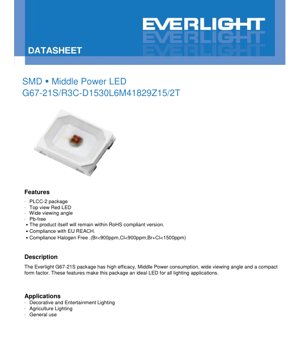
This document details the technical specifications for a surface-mount device (SMD) middle-power LED utilizing a PLCC-2 (Plastic Leaded Chip Carrier) package. The device is engineered with an AlGaInP semiconductor chip to emit red light, encapsulated in a water-clear resin. It is characterized by a compact form factor, high efficacy suitable for its power class, and a wide viewing angle, making it a versatile component for various illumination applications. The product adheres to stringent environmental standards, being lead-free (Pb-free), compliant with the EU REACH regulation, and classified as halogen-free, with bromine and chlorine content kept below specified limits.
2. Technical Parameter Deep-Dive
2.1 Absolute Maximum Ratings
The device's operational limits are defined under a baseline soldering temperature of 25°C. The maximum continuous forward current (IF) is rated at 150 mA, with a peak forward current (IFP) of 300 mA permissible under pulsed conditions (duty cycle 1/10, pulse width 10ms). The maximum power dissipation (Pd) is 435 mW. The junction-to-soldering point thermal resistance (Rth J-S) is 50 °C/W, which is critical for thermal management design. The maximum allowable junction temperature (Tj) is 115°C. The operating temperature range spans from -40°C to +85°C, with a storage temperature range of -40°C to +100°C. The device has an electrostatic discharge (ESD) withstand capability of 2000V (Human Body Model), though handling with appropriate ESD precautions is mandatory. Soldering parameters are specified for both reflow (260°C for 10 seconds) and hand soldering (350°C for 3 seconds) processes.
2.2 Electro-Optical Characteristics
Measured at Tsoldering = 25°C and IF = 150 mA, the key performance parameters are defined. The luminous flux (Φv) has a typical range of 15.0 to 24.0 lumens, with a stated tolerance of ±11%. The forward voltage (VF) ranges from 1.8V to 2.9V, with a tighter manufacturing tolerance of ±0.1V. The device offers a wide viewing angle (2θ1/2) of 120 degrees. The maximum reverse current (IR) is 50 µA when a reverse voltage (VR) of 5V is applied.
3. Binning System Explanation
The product is classified into bins to ensure consistency in key parameters, allowing for precise design and color matching.
3.1 Radiometric Power (Luminous Flux) Bins
Luminous flux output is categorized into bins denoted by codes such as L6, L7, L8, L9, M3, and M4. Each bin defines a minimum and maximum flux value at IF=150mA, for example, bin L6 covers 15-16 lm, while bin M4 covers 21-24 lm. The ±11% tolerance applies within each bin.
3.2 Forward Voltage Bins
Forward voltage is binned using two-digit codes from 25 to 35. Each code represents a 0.1V step, for instance, bin 25 covers 1.8-1.9V, bin 26 covers 1.9-2.0V, and so on up to bin 35 covering 2.8-2.9V. The manufacturing tolerance is ±0.1V per bin.
3.3 Dominant Wavelength Bins
The color point is controlled through dominant wavelength bins. The available bins are O54 (615-620 nm), R51 (620-625 nm), and R52 (625-630 nm), defining the specific shade of red emitted. The measurement tolerance for dominant/peak wavelength is ±1 nm.
4. Performance Curve Analysis
The datasheet provides several characteristic curves that illustrate device behavior under varying conditions.
4.1 Spectral Distribution
A graph shows the relative luminous intensity versus wavelength, typical for a red AlGaInP LED, with a peak in the 620-660 nm range and a defined spectral width.
4.2 Forward Voltage vs. Junction Temperature
Figure 1 plots the shift in forward voltage against junction temperature. The curve typically shows a negative coefficient, meaning VF decreases as Tj increases, which is a critical factor for constant-current driver design.
4.3 Relative Radiometric Power vs. Forward Current
Figure 2 demonstrates the sub-linear relationship between light output (relative radiometric power) and forward current. The output increases with current but with diminishing returns at higher currents due to efficiency droop and thermal effects.
4.4 Relative Luminous Flux vs. Junction Temperature
Figure 3 shows how light output decreases as the junction temperature rises. This thermal derating is essential for predicting performance in real-world applications where heatsinking may be limited.
4.5 Forward Current vs. Forward Voltage & Thermal Derating
Figure 4 depicts the standard I-V curve. Figure 5 is crucial for reliability, showing the maximum allowable driving forward current as a function of the soldering temperature, ensuring the device is not overstressed during operation after assembly.
4.6 Radiation Pattern
Figure 6 presents a polar radiation diagram, confirming the 120° viewing angle (where intensity drops to 50% of the axial value) and the symmetrical Lambertian-like emission pattern typical of top-view PLCC packages.
5. Mechanical & Package Information
5.1 Package Dimensions
The PLCC-2 package has nominal dimensions of 3.0 mm in length, 2.8 mm in width, and a height of 1.9 mm. A detailed dimensioned drawing specifies pad locations, overall tolerances (±0.1 mm unless noted), and the lens structure. The top-view design indicates the light is emitted perpendicular to the mounting plane.
5.2 Polarity Identification
The cathode is typically identified by a visual marker on the package, such as a notch, a dot, or a cut corner on the lens or body, as indicated in the dimension drawing. Correct polarity orientation is essential during assembly.
6. Soldering & Assembly Guidelines
6.1 Reflow Soldering Parameters
The recommended reflow soldering profile peaks at 260°C for a duration of 10 seconds. This is a standard lead-free (SnAgCu) process requirement. Hand soldering, if necessary, should be limited to 350°C for no more than 3 seconds per lead, using a grounded iron.
6.2 Storage Conditions
The components are packaged in moisture-sensitive barrier bags with desiccant. Before the bag is opened, LEDs must be stored at 30°C or less and 90% relative humidity or less. Once opened, components should be used within a specified timeframe or baked according to MSL (Moisture Sensitivity Level) procedures to prevent popcorning during reflow.
6.3 Precautions for Use
Over-current Protection: LEDs are current-driven devices. An external current-limiting resistor or constant-current driver is mandatory. A small increase in forward voltage can cause a large, potentially destructive increase in current due to the diode's exponential I-V characteristic.
ESD Precautions: The device is sensitive to electrostatic discharge. Use ESD-safe workstations, wrist straps, and packaging during handling and assembly.
7. Packaging & Ordering Information
7.1 Tape and Reel Specifications
The LEDs are supplied on embossed carrier tape for automated pick-and-place assembly. The tape width, pocket dimensions, and sprocket hole pitch are specified. Each reel contains 4000 pieces. Reel dimensions (diameter, width, hub size) are provided for compatibility with automated equipment.
7.2 Moisture-Resistant Packing
The full packing process involves placing the reeled components into an aluminum laminate moisture-proof bag along with desiccant and a humidity indicator card. The bag is then sealed.
7.3 Label Explanation
Reel labels include several codes: P/N (Product Number), QTY (Packing Quantity), CAT (Luminous Intensity Rank/bin), HUE (Dominant Wavelength Rank/bin), REF (Forward Voltage Rank/bin), and LOT No (Traceable Lot Number).
8. Application Suggestions
8.1 Typical Application Scenarios
The combination of medium power, good efficiency, wide angle, and compact size makes this LED suitable for:
• Decorative and Entertainment Lighting: Architectural accent lighting, signage, stage lighting effects where red color is required.
• Agriculture Lighting: Supplemental lighting in horticulture, potentially influencing plant photomorphogenesis in the red spectrum.
• General Lighting: Indicator lights, status lights, backlighting for panels or switches, and other applications requiring a reliable red indicator.
8.2 Design Considerations
• Thermal Management: With an Rth J-S of 50 °C/W, effective thermal path design on the PCB (using thermal vias, copper pours) is important to maintain low junction temperature, ensuring long-term reliability and stable light output.
• Current Drive: Always use a constant current source or a voltage source with a series resistor calculated based on the maximum VF from the binning table and the target operating current.
• Optical Design: The 120° viewing angle and Lambertian pattern simplify secondary optics design for beam shaping if required.
9. Reliability & Quality Assurance
A comprehensive set of reliability tests is performed with a 90% confidence level and an LTPD (Lot Tolerance Percent Defective) of 10%. The test matrix includes:
• Reflow Soldering Resistance
• Thermal Shock (-10°C to +100°C)
• Temperature Cycling (-40°C to +100°C)
• High Temperature/Humidity Storage (85°C/85% RH)
• High/Low Temperature Operation and Storage Life tests at various conditions and currents (e.g., 90mA, 180mA).
Each test uses a sample size of 22 pieces with an accept/reject criterion of 0/1, indicating high reliability standards.
10. Technical Comparison & Positioning
This middle-power PLCC-2 LED occupies a specific niche. Compared to low-power SMD LEDs (e.g., 0603, 0805), it offers significantly higher luminous flux, making it suitable for illumination rather than just indication. Compared to high-power LEDs, it requires less complex thermal management and driving circuitry while still delivering useful light output for many applications. The AlGaInP technology provides high efficiency in the red/orange/amber spectrum compared to phosphor-converted white LEDs of similar size. The wide 120° viewing angle is a key differentiator from LEDs with narrower, more focused beams.
11. Frequently Asked Questions (Based on Technical Parameters)
Q: What driver current should I use?
A: The absolute maximum continuous current is 150 mA. For optimal balance of efficiency, lifetime, and light output, operating between 60-120 mA is typical, but always refer to the derating curves (Fig. 5) based on your board's thermal performance.
Q: How do I interpret the binning codes in my order?
A: The label codes CAT, HUE, and REF correspond directly to the Luminous Flux, Dominant Wavelength, and Forward Voltage bin tables in sections 3.1, 3.2, and 3.3. This allows you to know the precise performance range of the LEDs you received.
Q: Can I drive this LED directly from a 3.3V or 5V logic supply?
A: No. You must use a series current-limiting resistor. Calculate the resistor value as R = (Vsupply - VF) / IF. Use the maximum VF from your voltage bin to ensure enough voltage drop across the resistor at all times.
Q: What is the impact of junction temperature on performance?
A: As shown in Fig. 3, light output decreases as Tj increases. Furthermore, higher temperatures accelerate lumen depreciation and can reduce device lifetime. Maintaining a low Tj through good heatsinking is critical for consistent, long-term performance.
12. Design-in Case Study Example
Scenario: Designing a low-cost, battery-powered red safety beacon.
Requirements: Visible from all angles, low power consumption, simple drive circuit, compact.
Design Choices:
1. LED Selection: This PLCC-2 red LED is chosen for its 120° viewing angle (good omnidirectionality), medium power (good brightness vs. battery life), and SMD package (small, easy assembly).
2. Drive Circuit: A simple circuit using a 3V coin cell battery, a MOSFET for switching, and a series resistor. The resistor value is calculated for IF = 100 mA using R = (3.0V - 2.5Vtyp) / 0.1A = 5Ω. A 5.1Ω, 1/4W resistor is selected.
3. Thermal & PCB Design: The beacon operates in short pulses (10% duty cycle), reducing average power and thermal load. The PCB uses a simple two-layer design with the LED pad connected to a small copper pour on the bottom layer for slight heatsinking.
4. Result: A functional, reliable beacon meeting size, cost, and performance targets, leveraging the LED's specified characteristics.
13. Operating Principle
This is a semiconductor photonic device based on an AlGaInP (Aluminum Gallium Indium Phosphide) heterostructure. When a forward voltage exceeding the diode's turn-on voltage is applied, electrons and holes are injected into the active region from the n-type and p-type layers, respectively. These charge carriers recombine radiatively within the quantum wells of the active region, releasing energy in the form of photons. The specific composition of the AlGaInP alloy determines the bandgap energy, which directly defines the wavelength (color) of the emitted light—in this case, in the red spectrum (615-630 nm). The water-clear epoxy resin encapsulant protects the semiconductor chip, provides mechanical stability, and shapes the light output beam.
14. Technology Trends
Middle-power SMD LEDs like this PLCC-2 type continue to evolve. General industry trends include:
• Increased Efficacy: Ongoing improvements in internal quantum efficiency, light extraction, and package design lead to higher lumens per watt (lm/W), reducing energy consumption for the same light output.
• Improved Color Consistency: Tighter binning tolerances for wavelength and flux, enabled by advanced manufacturing process control, allow for better color matching in multi-LED arrays without manual sorting.
• Enhanced Reliability: Development of more robust package materials (mold compounds, leadframes) and improved chip-level reliability lead to longer operational lifetimes (L70, L90 metrics) under higher drive currents and temperatures.
• Miniaturization with Performance: The drive for smaller, denser LED arrays pushes package sizes down while maintaining or increasing light output, though this intensifies thermal management challenges.
• Smart & Integrated Solutions: The broader market sees growth in LEDs with integrated drivers, controllers, or sensors, though this is more prevalent in high-power or specialty segments.
LED Specification Terminology
Complete explanation of LED technical terms
Photoelectric Performance
| Term | Unit/Representation | Simple Explanation | Why Important |
|---|---|---|---|
| Luminous Efficacy | lm/W (lumens per watt) | Light output per watt of electricity, higher means more energy efficient. | Directly determines energy efficiency grade and electricity cost. |
| Luminous Flux | lm (lumens) | Total light emitted by source, commonly called "brightness". | Determines if the light is bright enough. |
| Viewing Angle | ° (degrees), e.g., 120° | Angle where light intensity drops to half, determines beam width. | Affects illumination range and uniformity. |
| CCT (Color Temperature) | K (Kelvin), e.g., 2700K/6500K | Warmth/coolness of light, lower values yellowish/warm, higher whitish/cool. | Determines lighting atmosphere and suitable scenarios. |
| CRI / Ra | Unitless, 0–100 | Ability to render object colors accurately, Ra≥80 is good. | Affects color authenticity, used in high-demand places like malls, museums. |
| SDCM | MacAdam ellipse steps, e.g., "5-step" | Color consistency metric, smaller steps mean more consistent color. | Ensures uniform color across same batch of LEDs. |
| Dominant Wavelength | nm (nanometers), e.g., 620nm (red) | Wavelength corresponding to color of colored LEDs. | Determines hue of red, yellow, green monochrome LEDs. |
| Spectral Distribution | Wavelength vs intensity curve | Shows intensity distribution across wavelengths. | Affects color rendering and quality. |
Electrical Parameters
| Term | Symbol | Simple Explanation | Design Considerations |
|---|---|---|---|
| Forward Voltage | Vf | Minimum voltage to turn on LED, like "starting threshold". | Driver voltage must be ≥Vf, voltages add up for series LEDs. |
| Forward Current | If | Current value for normal LED operation. | Usually constant current drive, current determines brightness & lifespan. |
| Max Pulse Current | Ifp | Peak current tolerable for short periods, used for dimming or flashing. | Pulse width & duty cycle must be strictly controlled to avoid damage. |
| Reverse Voltage | Vr | Max reverse voltage LED can withstand, beyond may cause breakdown. | Circuit must prevent reverse connection or voltage spikes. |
| Thermal Resistance | Rth (°C/W) | Resistance to heat transfer from chip to solder, lower is better. | High thermal resistance requires stronger heat dissipation. |
| ESD Immunity | V (HBM), e.g., 1000V | Ability to withstand electrostatic discharge, higher means less vulnerable. | Anti-static measures needed in production, especially for sensitive LEDs. |
Thermal Management & Reliability
| Term | Key Metric | Simple Explanation | Impact |
|---|---|---|---|
| Junction Temperature | Tj (°C) | Actual operating temperature inside LED chip. | Every 10°C reduction may double lifespan; too high causes light decay, color shift. |
| Lumen Depreciation | L70 / L80 (hours) | Time for brightness to drop to 70% or 80% of initial. | Directly defines LED "service life". |
| Lumen Maintenance | % (e.g., 70%) | Percentage of brightness retained after time. | Indicates brightness retention over long-term use. |
| Color Shift | Δu′v′ or MacAdam ellipse | Degree of color change during use. | Affects color consistency in lighting scenes. |
| Thermal Aging | Material degradation | Deterioration due to long-term high temperature. | May cause brightness drop, color change, or open-circuit failure. |
Packaging & Materials
| Term | Common Types | Simple Explanation | Features & Applications |
|---|---|---|---|
| Package Type | EMC, PPA, Ceramic | Housing material protecting chip, providing optical/thermal interface. | EMC: good heat resistance, low cost; Ceramic: better heat dissipation, longer life. |
| Chip Structure | Front, Flip Chip | Chip electrode arrangement. | Flip chip: better heat dissipation, higher efficacy, for high-power. |
| Phosphor Coating | YAG, Silicate, Nitride | Covers blue chip, converts some to yellow/red, mixes to white. | Different phosphors affect efficacy, CCT, and CRI. |
| Lens/Optics | Flat, Microlens, TIR | Optical structure on surface controlling light distribution. | Determines viewing angle and light distribution curve. |
Quality Control & Binning
| Term | Binning Content | Simple Explanation | Purpose |
|---|---|---|---|
| Luminous Flux Bin | Code e.g., 2G, 2H | Grouped by brightness, each group has min/max lumen values. | Ensures uniform brightness in same batch. |
| Voltage Bin | Code e.g., 6W, 6X | Grouped by forward voltage range. | Facilitates driver matching, improves system efficiency. |
| Color Bin | 5-step MacAdam ellipse | Grouped by color coordinates, ensuring tight range. | Guarantees color consistency, avoids uneven color within fixture. |
| CCT Bin | 2700K, 3000K etc. | Grouped by CCT, each has corresponding coordinate range. | Meets different scene CCT requirements. |
Testing & Certification
| Term | Standard/Test | Simple Explanation | Significance |
|---|---|---|---|
| LM-80 | Lumen maintenance test | Long-term lighting at constant temperature, recording brightness decay. | Used to estimate LED life (with TM-21). |
| TM-21 | Life estimation standard | Estimates life under actual conditions based on LM-80 data. | Provides scientific life prediction. |
| IESNA | Illuminating Engineering Society | Covers optical, electrical, thermal test methods. | Industry-recognized test basis. |
| RoHS / REACH | Environmental certification | Ensures no harmful substances (lead, mercury). | Market access requirement internationally. |
| ENERGY STAR / DLC | Energy efficiency certification | Energy efficiency and performance certification for lighting. | Used in government procurement, subsidy programs, enhances competitiveness. |