Table of Contents
- 1. Product Overview
- 1.1 Core Features and Advantages
- 1.2 Target Applications
- 2. Technical Specifications and In-Depth Analysis
- 2.1 Absolute Maximum Ratings and Operating Conditions
- 2.2 DC Electrical Characteristics
- 2.3 Timing and Data Communication Protocol
- 3. Electro-Optical Characteristics and Binning System
- 3.1 Optical Performance
- 3.2 Binning System Explanation
- 4. Mechanical, Packaging, and Assembly Information
- 4.1 Package Dimensions and Pinout
- 4.2 Soldering and Assembly Guidelines
- 4.3 Moisture Sensitivity and Storage
- 4.4 Packaging Specifications
- 5. Application Design Considerations and FAQs
- 5.1 Typical Application Circuit
- 5.2 Design Considerations
- 5.3 Frequently Asked Questions (Based on Technical Parameters)
- 6. Technical Comparison and Trends
- 6.1 Differentiation from Basic LEDs
- 6.2 Principle of Operation
- 6.3 Industry Trends
1. Product Overview
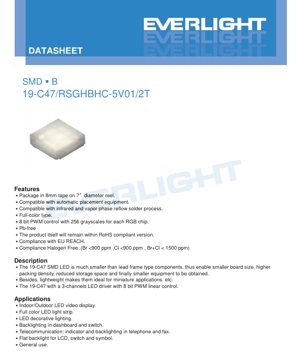
The 19-C47 is a compact, surface-mount device (SMD) integrating three individual LED chips (Red, Green, Blue) with a dedicated 3-channel constant current driver IC. This integration enables precise color mixing and control, making it a key component for applications requiring vibrant, programmable full-color output. Its primary advantage lies in the combination of a miniature footprint, simplified external circuitry due to the built-in driver, and sophisticated 8-bit pulse-width modulation (PWM) control for each color channel.
1.1 Core Features and Advantages
- Integrated Driver: Contains a 3-channel LED driver with linear 8-bit PWM control, eliminating the need for external PWM controllers for basic color mixing.
- High Color Depth: Each RGB chip can be controlled with 256 grayscale levels (8-bit), allowing for over 16 million possible colors (256^3).
- Compact SMD Package: Significantly smaller than traditional lead-frame LEDs, enabling higher board density, reduced end-product size, and suitability for automated pick-and-place assembly.
- Compliance: The product is Pb-free, compliant with RoHS, EU REACH, and halogen-free standards (Br <900ppm, Cl <900ppm, Br+Cl <1500ppm).
- Process Compatibility: Designed for compatibility with standard infrared and vapor phase reflow soldering processes.
1.2 Target Applications
This component is designed for applications demanding dynamic, full-color lighting and display.
- Indoor and outdoor full-color LED video displays and signage.
- Decorative LED lighting strips and architectural lighting.
- Backlighting for instrument panels, switches, and symbols.
- Status indicators and backlighting in telecommunication equipment.
- General full-color lighting applications.
2. Technical Specifications and In-Depth Analysis
2.1 Absolute Maximum Ratings and Operating Conditions
These parameters define the limits beyond which permanent damage to the device may occur. Operating within the recommended conditions ensures reliable performance.
- Supply Voltage (VDD): Absolute maximum range is +4.2V to +5.5V. The recommended typical operating voltage is 5.0V. Exceeding 5.5V can damage the internal driver IC.
- Input Voltage (VIN): The logic input pins (DIN) must be kept between -0.5V and VDD+0.5V. For reliable logic high recognition, a voltage of 3.3V is typical, while logic low should be below 0.3*VDD (typically 1.5V at 5V VDD).
- ESD Protection: Rated for 2000V Human Body Model (HBM). While this offers basic handling protection, proper ESD precautions during assembly are still necessary.
- Temperature Ranges: Operating temperature is -20°C to +70°C. Storage temperature extends from -40°C to +90°C. The soldering profile is critical: reflow soldering peak temperature should not exceed 260°C for 10 seconds, or 350°C for 3 seconds during hand soldering.
2.2 DC Electrical Characteristics
Measured at Ta=25°C, VDD=5V, these characteristics define the device's electrical behavior under static conditions.
- Supply Current (IDD): The typical current consumption of the driver IC itself is 2.5 mA when all LED outputs are off (PWM duty cycle 0%). This is the quiescent current.
- Logic Level Thresholds: Confirms the input voltage levels: VIH (High) is typically 3.3V, and VIL (Low) is a maximum of 0.3*VDD.
2.3 Timing and Data Communication Protocol
The device uses a serial communication protocol to receive 24-bit data (8 bits for each Red, Green, and Blue channel). The timing is crucial for error-free data transmission.
- High-Speed Mode Timing:
- T0H (0 code, high time): 300ns ±80ns.
- T0L (0 code, low time): 900ns ±80ns.
- T1H (1 code, high time): 900ns ±80ns.
- T1L (1 code, low time): 300ns ±80ns.
- RES (Reset time): Must be greater than 50µs of low signal to latch the data.
- Data Format: 24 bits of data are sent sequentially for a single device: typically G7-G0, R7-R0, B7-B0 (order may vary, check protocol details).
- Cascading: Multiple devices can be daisy-chained. The DOUT pin of one device feeds the DIN pin of the next. After receiving its 24 bits, the device automatically forwards subsequent bits to DOUT.
- Design Notes:
- An RC filter and a pull-up/pull-down resistor (R1, suggested 10kΩ to 100kΩ) on the data line are recommended to improve signal integrity.
- A 0.1µF bypass capacitor must be placed close to the VDD pin for stable power supply and noise immunity.
3. Electro-Optical Characteristics and Binning System
These parameters define the light output and color properties of the LED chips, measured at a forward current (IF) of 5mA and Ta=25°C.
3.1 Optical Performance
- Luminous Intensity (Iv): The typical light output varies by color chip:
- Red (RS): 70 mcd (min 28.5, max 180).
- Green (GH): 180 mcd (min 140, max 360).
- Blue (BH): 40 mcd (min 28.5, max 72).
- Viewing Angle (2θ1/2): A wide 120-degree viewing angle, suitable for applications requiring broad light distribution.
- Wavelength:
- Peak Wavelength (λp): Red ~632nm, Green ~518nm, Blue ~468nm.
- Dominant Wavelength (λd): Red 617.5-629.5nm, Green 525-540nm, Blue 465-475nm.
- Spectral Bandwidth (Δλ): Red ~20nm, Green ~35nm, Blue ~25nm.
3.2 Binning System Explanation
To ensure color consistency in production, LEDs are sorted into bins based on luminous intensity. Designers should specify the required bin codes for uniform appearance in an array.
- Red (RS) Bins: N (28.5-45 mcd), P (45-72 mcd), Q (72-112 mcd), R (112-180 mcd).
- Green (GH) Bins: R2 (140-180 mcd), S1 (180-225 mcd), S2 (225-285 mcd), T1 (285-360 mcd).
- Blue (BH) Bins: N (28.5-45 mcd), P (45-72 mcd).
Tolerances: Luminous intensity has a ±11% tolerance, and dominant wavelength has a ±1nm tolerance within a bin.
4. Mechanical, Packaging, and Assembly Information
4.1 Package Dimensions and Pinout
The device comes in a compact SMD package. The suggested pad layout is a starting point and should be optimized for specific manufacturing processes.
- Pin Functions:
- DOUT: Data output for cascading to the next device's DIN.
- VDD: Power supply input (+5V). Requires a local 0.1µF bypass capacitor.
- DIN: Serial data input for PWM control data.
- GND: Common ground for power and data.
4.2 Soldering and Assembly Guidelines
- Reflow Profile: Compatible with standard profiles with a peak temperature not exceeding 260°C for 10 seconds.
- Current Limiting: Critical: The integrated driver provides constant current control for the LEDs based on the PWM input. However, the external supply voltage (VDD) must be regulated. A slight over-voltage can cause a large current increase through the driver and LEDs, leading to immediate burnout. Proper voltage regulation is essential.
4.3 Moisture Sensitivity and Storage
This is a moisture-sensitive device (MSD).
- Before Opening: Store the sealed moisture-proof bag at ≤30°C and ≤90% RH.
- After Opening: The "floor life" is 168 hours (7 days) at ≤30°C and ≤60% RH. If not used within this time, unused parts must be re-bagged with desiccant.
- Baking: If the floor life is exceeded or the humidity indicator card shows moisture ingress, baking is required before soldering to prevent "popcorn" damage during reflow.
4.4 Packaging Specifications
- Tape and Reel: Packaged in 8mm wide tape on 7-inch diameter reels. Each reel contains 2000 pieces.
- Label Information: Reel labels include Product Number (P/N), quantity (QTY), and critical binning codes for Luminous Intensity Rank (CAT), Chromaticity/Wavelength Rank (HUE), and Forward Voltage Rank (REF).
5. Application Design Considerations and FAQs
5.1 Typical Application Circuit
A basic application involves a 5V regulated power supply, a microcontroller (MCU) with a digital I/O pin capable of generating the precise serial protocol, and the LED. The MCU's I/O pin connects to the DIN of the first LED. For multiple LEDs, they are daisy-chained. A 0.1µF ceramic capacitor is placed between VDD and GND at each device. A series resistor (e.g., 100Ω to 470Ω) may be placed in series with the data line near the MCU to dampen ringing, though the datasheet suggests an RC filter.
5.2 Design Considerations
- Power Supply: Use a well-regulated 5V supply. Ripple and noise can affect color consistency and data integrity.
- Data Line Integrity: For long cables or many devices in a chain, signal degradation can occur. Consider using buffer chips or differential drivers for robust communication.
- Thermal Management: While the driver handles current, the LEDs generate heat. For high-duty-cycle operation or high ambient temperatures, ensure adequate PCB copper or heatsinking to maintain junction temperature within limits.
- Color Calibration: Due to binning variations, for professional display applications, a color calibration step using the 8-bit PWM control may be necessary to achieve uniform white point and color gamut across all pixels.
5.3 Frequently Asked Questions (Based on Technical Parameters)
- Q: What is the maximum current per LED channel? A: The datasheet does not specify a fixed forward current (IF) for the LEDs when driven by the internal driver. The light output is specified at IF=5mA, which is likely the driver's set current for each channel. The driver's constant-current design protects the LEDs, but the absolute maximum VDD rating must not be exceeded.
- Q: Can I drive this LED with a 3.3V microcontroller? A: Yes. The logic high input voltage (VIH) is typically 3.3V, which is compatible with 3.3V logic. However, ensure the VDD supply remains at 5V for the LED driver to function correctly.
- Q: How many LEDs can I daisy-chain? A: The limit is determined by the data refresh rate and signal integrity. Each device adds a small propagation delay. For a 24-bit data stream per device and a target refresh rate (e.g., 60Hz), you can calculate the maximum number. With a 800kbps clock, hundreds of devices can be chained for static lighting, but for video, the number is lower due to the need for high refresh rates.
- Q: Why is a bypass capacitor mandatory? A: The driver IC switches current to the LEDs at high frequencies (PWM). This causes sudden current spikes on the VDD line. The local 0.1µF capacitor provides this high-frequency current locally, preventing voltage droops that could reset the IC or cause flicker, and reducing electromagnetic interference (EMI).
6. Technical Comparison and Trends
6.1 Differentiation from Basic LEDs
The key differentiator of the 19-C47 is its integrated driver. Compared to a discrete RGB LED which requires three external current-limiting resistors and an external PWM controller (e.g., from an MCU with three PWM pins), this device simplifies design. It requires only a single data line and power, drastically reducing MCU pin count and software complexity for large arrays. The trade-off is a slightly higher component cost and the need to manage the serial protocol.
6.2 Principle of Operation
The device operates on a serial-in, parallel-out shift register principle for the PWM data. The 24-bit data word is clocked into an internal register. This register controls separate 8-bit PWM generators for each color. The PWM generators modulate the constant current sources driving the respective LED chips. The human eye integrates the rapid on/off pulses, perceiving a specific brightness level for each primary color, which mixes to form the final color.
6.3 Industry Trends
The trend in addressable LEDs is towards higher integration, higher data rates, and improved color performance. Successors to 8-bit PWM (like this device) often feature 16-bit or higher PWM for smoother dimming and better color accuracy (eliminating low-brightness flicker or color shift). Protocols are becoming faster and more robust (e.g., using Manchester coding or differential signaling). There is also a move towards including global brightness control and temperature compensation within the driver IC. The 19-C47 represents a mature, cost-effective solution for many mainstream full-color lighting and display applications.
LED Specification Terminology
Complete explanation of LED technical terms
Photoelectric Performance
| Term | Unit/Representation | Simple Explanation | Why Important |
|---|---|---|---|
| Luminous Efficacy | lm/W (lumens per watt) | Light output per watt of electricity, higher means more energy efficient. | Directly determines energy efficiency grade and electricity cost. |
| Luminous Flux | lm (lumens) | Total light emitted by source, commonly called "brightness". | Determines if the light is bright enough. |
| Viewing Angle | ° (degrees), e.g., 120° | Angle where light intensity drops to half, determines beam width. | Affects illumination range and uniformity. |
| CCT (Color Temperature) | K (Kelvin), e.g., 2700K/6500K | Warmth/coolness of light, lower values yellowish/warm, higher whitish/cool. | Determines lighting atmosphere and suitable scenarios. |
| CRI / Ra | Unitless, 0–100 | Ability to render object colors accurately, Ra≥80 is good. | Affects color authenticity, used in high-demand places like malls, museums. |
| SDCM | MacAdam ellipse steps, e.g., "5-step" | Color consistency metric, smaller steps mean more consistent color. | Ensures uniform color across same batch of LEDs. |
| Dominant Wavelength | nm (nanometers), e.g., 620nm (red) | Wavelength corresponding to color of colored LEDs. | Determines hue of red, yellow, green monochrome LEDs. |
| Spectral Distribution | Wavelength vs intensity curve | Shows intensity distribution across wavelengths. | Affects color rendering and quality. |
Electrical Parameters
| Term | Symbol | Simple Explanation | Design Considerations |
|---|---|---|---|
| Forward Voltage | Vf | Minimum voltage to turn on LED, like "starting threshold". | Driver voltage must be ≥Vf, voltages add up for series LEDs. |
| Forward Current | If | Current value for normal LED operation. | Usually constant current drive, current determines brightness & lifespan. |
| Max Pulse Current | Ifp | Peak current tolerable for short periods, used for dimming or flashing. | Pulse width & duty cycle must be strictly controlled to avoid damage. |
| Reverse Voltage | Vr | Max reverse voltage LED can withstand, beyond may cause breakdown. | Circuit must prevent reverse connection or voltage spikes. |
| Thermal Resistance | Rth (°C/W) | Resistance to heat transfer from chip to solder, lower is better. | High thermal resistance requires stronger heat dissipation. |
| ESD Immunity | V (HBM), e.g., 1000V | Ability to withstand electrostatic discharge, higher means less vulnerable. | Anti-static measures needed in production, especially for sensitive LEDs. |
Thermal Management & Reliability
| Term | Key Metric | Simple Explanation | Impact |
|---|---|---|---|
| Junction Temperature | Tj (°C) | Actual operating temperature inside LED chip. | Every 10°C reduction may double lifespan; too high causes light decay, color shift. |
| Lumen Depreciation | L70 / L80 (hours) | Time for brightness to drop to 70% or 80% of initial. | Directly defines LED "service life". |
| Lumen Maintenance | % (e.g., 70%) | Percentage of brightness retained after time. | Indicates brightness retention over long-term use. |
| Color Shift | Δu′v′ or MacAdam ellipse | Degree of color change during use. | Affects color consistency in lighting scenes. |
| Thermal Aging | Material degradation | Deterioration due to long-term high temperature. | May cause brightness drop, color change, or open-circuit failure. |
Packaging & Materials
| Term | Common Types | Simple Explanation | Features & Applications |
|---|---|---|---|
| Package Type | EMC, PPA, Ceramic | Housing material protecting chip, providing optical/thermal interface. | EMC: good heat resistance, low cost; Ceramic: better heat dissipation, longer life. |
| Chip Structure | Front, Flip Chip | Chip electrode arrangement. | Flip chip: better heat dissipation, higher efficacy, for high-power. |
| Phosphor Coating | YAG, Silicate, Nitride | Covers blue chip, converts some to yellow/red, mixes to white. | Different phosphors affect efficacy, CCT, and CRI. |
| Lens/Optics | Flat, Microlens, TIR | Optical structure on surface controlling light distribution. | Determines viewing angle and light distribution curve. |
Quality Control & Binning
| Term | Binning Content | Simple Explanation | Purpose |
|---|---|---|---|
| Luminous Flux Bin | Code e.g., 2G, 2H | Grouped by brightness, each group has min/max lumen values. | Ensures uniform brightness in same batch. |
| Voltage Bin | Code e.g., 6W, 6X | Grouped by forward voltage range. | Facilitates driver matching, improves system efficiency. |
| Color Bin | 5-step MacAdam ellipse | Grouped by color coordinates, ensuring tight range. | Guarantees color consistency, avoids uneven color within fixture. |
| CCT Bin | 2700K, 3000K etc. | Grouped by CCT, each has corresponding coordinate range. | Meets different scene CCT requirements. |
Testing & Certification
| Term | Standard/Test | Simple Explanation | Significance |
|---|---|---|---|
| LM-80 | Lumen maintenance test | Long-term lighting at constant temperature, recording brightness decay. | Used to estimate LED life (with TM-21). |
| TM-21 | Life estimation standard | Estimates life under actual conditions based on LM-80 data. | Provides scientific life prediction. |
| IESNA | Illuminating Engineering Society | Covers optical, electrical, thermal test methods. | Industry-recognized test basis. |
| RoHS / REACH | Environmental certification | Ensures no harmful substances (lead, mercury). | Market access requirement internationally. |
| ENERGY STAR / DLC | Energy efficiency certification | Energy efficiency and performance certification for lighting. | Used in government procurement, subsidy programs, enhances competitiveness. |