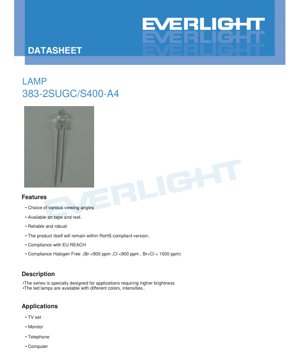
1. Product Overview
The 383-2SUGC/S 400-A4 is a high-brightness LED lamp designed for applications requiring superior luminous output. It utilizes AlGaInP chip technology to produce a Super Green emitted color with a water-clear resin encapsulation. This component is part of a series offering various viewing angles and is available in tape and reel packaging for automated assembly processes.
The product is engineered to be reliable and robust, ensuring consistent performance. It complies with key environmental and safety standards, including RoHS, EU REACH, and is classified as Halogen Free, with Bromine (Br) and Chlorine (Cl) content maintained below specified limits (Br <900 ppm, Cl <900 ppm, Br+Cl < 1500 ppm).
1.1 Core Advantages
- High Luminous Intensity: Delivers typical luminous intensity of 4000 millicandelas (mcd) at a standard forward current of 20mA.
- Narrow Viewing Angle: Features a typical 20-degree half-intensity viewing angle (2θ1/2), suitable for focused illumination.
- Environmental Compliance: Adheres to RoHS, REACH, and Halogen-Free requirements, making it suitable for modern electronic products with strict environmental mandates.
- Robust Construction: Designed for reliability in various application environments.
1.2 Target Market & Applications
This LED is primarily targeted at backlighting and indicator applications in consumer and professional electronics. Its high brightness and specific color make it ideal for:
- Television Sets (TV)
- Computer Monitors
- Telephones
- General Computer Peripherals
2. Technical Parameter Deep Dive
2.1 Absolute Maximum Ratings
These ratings define the limits beyond which permanent damage to the device may occur. Operation under these conditions is not guaranteed.
- Continuous Forward Current (IF): 30 mA
- Peak Forward Current (IFP): 100 mA (at 1/10 duty cycle, 1 kHz)
- Reverse Voltage (VR): 5 V
- Electrostatic Discharge (ESD) Human Body Model: 150 V
- Power Dissipation (Pd): 120 mW
- Operating Temperature Range (Topr): -40°C to +85°C
- Storage Temperature Range (Tstg): -40°C to +100°C
- Soldering Temperature (Tsol): 260°C for a maximum of 5 seconds.
2.2 Electro-Optical Characteristics (Ta=25°C)
These parameters are measured under standard test conditions (Forward Current, IF = 20mA) and represent the device's typical performance.
- Luminous Intensity (Iv): Minimum 2500 mcd, Typical 4000 mcd.
- Viewing Angle (2θ1/2): Typical 20 degrees.
- Peak Wavelength (λp): Typical 525 nm.
- Dominant Wavelength (λd): Typical 530 nm.
- Spectrum Radiation Bandwidth (Δλ): Typical 35 nm.
- Forward Voltage (VF): Typical 3.4 V, Maximum 4.0 V.
- Reverse Current (IR): Maximum 50 μA at VR=5V.
Measurement Tolerances: Luminous Intensity (±10%), Dominant Wavelength (±1.0nm), Forward Voltage (±0.1V).
3. Binning System Explanation
The datasheet indicates a binning system for key parameters to ensure consistency in production batches. The label explanation specifies codes for ranking:
- CAT: Ranks of Luminous Intensity. This groups LEDs based on their measured light output (e.g., 4000mcd typical would fall into a specific bin).
- HUE: Ranks of Dominant Wavelength. This categorizes LEDs according to their specific shade of green (around the typical 530nm).
- REF: Ranks of Forward Voltage. This sorts LEDs based on their voltage drop at the test current.
This system allows designers to select components with tightly controlled characteristics for applications where color or brightness uniformity is critical, such as in display backlighting arrays.
4. Performance Curve Analysis
The datasheet provides several characteristic curves that illustrate device behavior under varying conditions.
4.1 Relative Intensity vs. Wavelength
This curve shows the spectral power distribution of the emitted Super Green light, centered around the peak wavelength of 525nm with a bandwidth (FWHM) of 35nm. The narrow bandwidth contributes to a saturated green color.
4.2 Directivity Pattern
This plot visualizes the 20-degree viewing angle, showing how the luminous intensity decreases as the observation angle moves away from the central axis (0 degrees).
4.3 Forward Current vs. Forward Voltage (IV Curve)
This graph depicts the non-linear relationship between the current flowing through the LED and the voltage across it. The typical forward voltage is 3.4V at 20mA. The curve is essential for designing the current-limiting driver circuit.
4.4 Relative Intensity vs. Forward Current
This curve demonstrates that light output (relative intensity) increases with forward current. However, operation must remain within the Absolute Maximum Ratings (30mA continuous) to prevent overheating and accelerated degradation.
4.5 Thermal Characteristics
Two key curves relate performance to ambient temperature (Ta):
Relative Intensity vs. Ambient Temp: Shows the decrease in light output as temperature rises, a common characteristic of LEDs due to efficiency droop and other physical mechanisms.
Forward Current vs. Ambient Temp: Illustrates how the forward voltage of the LED changes with temperature, which is important for constant-current driver stability.
5. Mechanical & Package Information
5.1 Package Dimensions
The LED is provided in a standard lamp-style package. The dimensional drawing specifies all critical measurements in millimeters. Key notes include:
- All dimensions are in millimeters (mm).
- The flange height must be less than 1.5mm (0.059\").
- Standard tolerance for unspecified dimensions is ±0.25mm.
The physical design includes two leads (anode and cathode) for through-hole mounting on a Printed Circuit Board (PCB).
5.2 Polarity Identification & Lead Forming
Polarity is typically indicated by lead length or a flat spot on the package flange (the longer lead is usually the anode). The datasheet provides crucial guidelines for lead forming prior to soldering:
- Bending must occur at least 3mm from the base of the epoxy bulb (the dome).
- Forming must be done before the soldering process.
- Stress on the package during bending must be avoided to prevent internal damage or breakage.
- Lead cutting should be performed at room temperature.
- PCB holes must align perfectly with LED leads to avoid mounting stress.
6. Soldering & Assembly Guidelines
6.1 Storage Conditions
- Recommended storage after receipt: ≤30°C and ≤70% Relative Humidity (RH).
- Shelf life under these conditions: 3 months.
- For longer storage (up to 1 year): Use a sealed container with a nitrogen atmosphere and desiccant.
- Avoid rapid temperature changes in humid environments to prevent condensation.
6.2 Soldering Process Parameters
Detailed soldering instructions are provided to ensure reliability:
Hand Soldering:
• Iron Tip Temperature: Maximum 300°C (for a 30W max iron).
• Soldering Time per lead: Maximum 3 seconds.
• Minimum Distance from solder joint to epoxy bulb: 3mm.
Wave (DIP) Soldering:
• Preheat Temperature: Maximum 100°C (for max 60 seconds).
• Solder Bath Temperature & Time: Maximum 260°C for 5 seconds.
• Minimum Distance from solder joint to epoxy bulb: 3mm.
General Rules:
• Avoid stress on leads during high-temperature operations.
• Do not solder (dip or hand) the same LED more than once.
• Protect the LED from mechanical shock/vibration while cooling to room temperature after soldering.
• Use the lowest possible temperature that achieves a reliable solder joint.
• A recommended soldering temperature profile graph is provided, showing a gradual ramp-up, a stable peak at 260°C, and a controlled cool-down phase.
6.3 Cleaning
- If cleaning is necessary, use isopropyl alcohol at room temperature for no more than one minute.
- Dry at room temperature before use.
- Ultrasonic cleaning is not recommended. If absolutely required, extensive pre-qualification is necessary to determine safe power levels and conditions, as it can damage the LED structure.
7. Packaging & Ordering Information
7.1 Packing Specification
The LEDs are packaged to prevent damage during shipping and handling:
- Primary Packing: Anti-electrostatic bags.
- Secondary Packing: Inner cartons.
- Tertiary Packing: Outside cartons.
Packing Quantities:
1. 200 to 500 pieces per anti-static bag.
2. 6 bags per inner carton.
3. 10 inner cartons per outside carton.
7.2 Label Explanation
The packaging label contains several codes for traceability and specification:
• CPN: Customer's Production Number.
• P/N: Manufacturer's Production Number (e.g., 383-2SUGC/S 400-A4).
• QTY: Quantity of pieces in the bag/carton.
• CAT/HUE/REF: Binning codes for Luminous Intensity, Dominant Wavelength, and Forward Voltage, respectively.
• LOT No: Manufacturing lot number for traceability.
8. Application Suggestions & Design Considerations
8.1 Thermal Management
The datasheet explicitly states that \"Heat management of LEDs must be taken into consideration during the design stage.\" While not providing a thermal resistance (Rθ) value, it implies that:
• The maximum power dissipation is 120mW.
• Operating at high ambient temperatures or high currents will generate heat that must be conducted away from the LED junction via the leads and PCB.
• Proper PCB layout with adequate copper area connected to the LED leads is essential for heat sinking, especially when operating near maximum ratings or in high-temperature environments.
8.2 Circuit Design
- Current Limiting: An external current-limiting resistor or constant-current driver is mandatory. The forward voltage has a range (Typ. 3.4V, Max. 4.0V), so designing for the maximum VF ensures the current limit is never exceeded.
- Reverse Voltage Protection: The maximum reverse voltage is only 5V. Circuits should be designed to prevent any reverse bias across the LED, such as when connecting in parallel or in complex backlight arrays. A protection diode in parallel (cathode to anode) may be necessary in some configurations.
- ESD Precautions: With an ESD rating of 150V (HBM), standard ESD handling precautions are required during assembly and handling.
9. Technical Comparison & Differentiation
While a direct comparison to other part numbers is not in this single datasheet, the 383-2SUGC/S 400-A4 can be evaluated based on its stated parameters:
- High Brightness Focus: Its 4000mcd typical intensity at 20mA is a key differentiator for applications needing high luminous output from a single discrete LED.
- Narrow Viewing Angle: The 20-degree beam is narrower than many standard LEDs (which are often 30-60 degrees), making it suitable for directed light or backlighting waveguides where light needs to be coupled efficiently.
- AlGaInP Technology: This material system is known for high efficiency in the red, orange, yellow, and green spectrum. This LED leverages that for its Super Green color.
- Comprehensive Compliance: Meeting RoHS, REACH, and Halogen-Free standards simultaneously makes it a future-proof choice for global markets.
10. Frequently Asked Questions (Based on Technical Parameters)
Q1: Can I drive this LED at 30mA continuously?
A1: Yes, 30mA is the Absolute Maximum Continuous Forward Current. However, for long-term reliability and to manage heat, operating at or below the test condition of 20mA is recommended. At 30mA, ensure excellent thermal management.
Q2: What is the difference between Peak Wavelength (525nm) and Dominant Wavelength (530nm)?
A2: Peak Wavelength (λp) is the wavelength at which the emission spectrum has its maximum intensity. Dominant Wavelength (λd) is the single wavelength of monochromatic light that matches the perceived color of the LED. The small difference is normal and λd is more relevant for color specification.
Q3: Why is the storage shelf life only 3 months?
A3: This is a precaution primarily related to moisture absorption by the plastic package. After prolonged exposure to ambient humidity, the rapid heating during soldering can cause internal steam pressure and cracking (\"popcorning\"). The nitrogen storage method mitigates this.
Q4: How do I interpret the CAT/HUE/REF bin codes on the label?
A4: These are internal manufacturer codes. To select a specific bin for your application (e.g., a tight wavelength range), you would need to consult the manufacturer's detailed binning specification document or work directly with their sales/support team to request parts from a specific bin.
11. Practical Use Case Example
Scenario: Designing a status indicator for a networking device.
• Requirement: A bright, unmistakable \"system active\" green light visible in office lighting.
• Selection Rationale: The 4000mcd output ensures high visibility. The 20-degree viewing angle provides a bright \"hot spot\" when viewed head-on, which is ideal for a panel indicator.
• Circuit Design: Assuming a 5V system supply (Vcc). The typical VF is 3.4V at 20mA. Using Ohm's Law: R = (Vcc - VF) / IF = (5V - 3.4V) / 0.020A = 80 Ohms. To account for VF variation, design for the worst case: R_min = (5V - 4.0V) / 0.020A = 50 Ohms. Choosing a 68 Ohm resistor provides a safe current between 14.7mA (VF=4.0V) and 23.5mA (VF=3.4V), well within limits.
• Layout: Use PCB pads connected to a small copper pour to aid heat dissipation from the LED leads.
12. Operating Principle
This is a semiconductor photonic device. When a forward voltage exceeding its characteristic forward voltage (VF) is applied, electrons and holes are injected into the active region of the AlGaInP semiconductor chip. These charge carriers recombine, releasing energy in the form of photons (light). The specific composition of the AlGaInP layers determines the bandgap energy, which dictates the wavelength (color) of the emitted photons—in this case, green light centered around 530nm. The water-clear epoxy resin dome acts as a lens, shaping the emitted light into the specified 20-degree viewing angle.
13. Technology Trends
The LED industry continues to evolve. While this is a mature through-hole component, trends influencing this product segment include:
• Increased Efficiency: Ongoing material and process improvements lead to higher luminous efficacy (more light output per electrical watt), potentially allowing similar brightness at lower currents for reduced power consumption and heat.
• Miniaturization & SMD Transition: The broader market trend is towards Surface-Mount Device (SMD) packages for automated assembly. Through-hole lamps like this one remain vital for applications requiring higher individual brightness, easier manual prototyping, or specific mechanical mounting.
• Tighter Color & Intensity Binning: Demand for color consistency in displays and signage drives manufacturers to offer more narrowly defined bins (CAT, HUE), allowing for better uniformity in multi-LED arrays.
• Enhanced Reliability Specifications: Datasheets are increasingly including lifetime ratings (e.g., L70, L50) under specific operating conditions, providing more predictable data for long-term design planning.
LED Specification Terminology
Complete explanation of LED technical terms
Photoelectric Performance
| Term | Unit/Representation | Simple Explanation | Why Important |
|---|---|---|---|
| Luminous Efficacy | lm/W (lumens per watt) | Light output per watt of electricity, higher means more energy efficient. | Directly determines energy efficiency grade and electricity cost. |
| Luminous Flux | lm (lumens) | Total light emitted by source, commonly called "brightness". | Determines if the light is bright enough. |
| Viewing Angle | ° (degrees), e.g., 120° | Angle where light intensity drops to half, determines beam width. | Affects illumination range and uniformity. |
| CCT (Color Temperature) | K (Kelvin), e.g., 2700K/6500K | Warmth/coolness of light, lower values yellowish/warm, higher whitish/cool. | Determines lighting atmosphere and suitable scenarios. |
| CRI / Ra | Unitless, 0–100 | Ability to render object colors accurately, Ra≥80 is good. | Affects color authenticity, used in high-demand places like malls, museums. |
| SDCM | MacAdam ellipse steps, e.g., "5-step" | Color consistency metric, smaller steps mean more consistent color. | Ensures uniform color across same batch of LEDs. |
| Dominant Wavelength | nm (nanometers), e.g., 620nm (red) | Wavelength corresponding to color of colored LEDs. | Determines hue of red, yellow, green monochrome LEDs. |
| Spectral Distribution | Wavelength vs intensity curve | Shows intensity distribution across wavelengths. | Affects color rendering and quality. |
Electrical Parameters
| Term | Symbol | Simple Explanation | Design Considerations |
|---|---|---|---|
| Forward Voltage | Vf | Minimum voltage to turn on LED, like "starting threshold". | Driver voltage must be ≥Vf, voltages add up for series LEDs. |
| Forward Current | If | Current value for normal LED operation. | Usually constant current drive, current determines brightness & lifespan. |
| Max Pulse Current | Ifp | Peak current tolerable for short periods, used for dimming or flashing. | Pulse width & duty cycle must be strictly controlled to avoid damage. |
| Reverse Voltage | Vr | Max reverse voltage LED can withstand, beyond may cause breakdown. | Circuit must prevent reverse connection or voltage spikes. |
| Thermal Resistance | Rth (°C/W) | Resistance to heat transfer from chip to solder, lower is better. | High thermal resistance requires stronger heat dissipation. |
| ESD Immunity | V (HBM), e.g., 1000V | Ability to withstand electrostatic discharge, higher means less vulnerable. | Anti-static measures needed in production, especially for sensitive LEDs. |
Thermal Management & Reliability
| Term | Key Metric | Simple Explanation | Impact |
|---|---|---|---|
| Junction Temperature | Tj (°C) | Actual operating temperature inside LED chip. | Every 10°C reduction may double lifespan; too high causes light decay, color shift. |
| Lumen Depreciation | L70 / L80 (hours) | Time for brightness to drop to 70% or 80% of initial. | Directly defines LED "service life". |
| Lumen Maintenance | % (e.g., 70%) | Percentage of brightness retained after time. | Indicates brightness retention over long-term use. |
| Color Shift | Δu′v′ or MacAdam ellipse | Degree of color change during use. | Affects color consistency in lighting scenes. |
| Thermal Aging | Material degradation | Deterioration due to long-term high temperature. | May cause brightness drop, color change, or open-circuit failure. |
Packaging & Materials
| Term | Common Types | Simple Explanation | Features & Applications |
|---|---|---|---|
| Package Type | EMC, PPA, Ceramic | Housing material protecting chip, providing optical/thermal interface. | EMC: good heat resistance, low cost; Ceramic: better heat dissipation, longer life. |
| Chip Structure | Front, Flip Chip | Chip electrode arrangement. | Flip chip: better heat dissipation, higher efficacy, for high-power. |
| Phosphor Coating | YAG, Silicate, Nitride | Covers blue chip, converts some to yellow/red, mixes to white. | Different phosphors affect efficacy, CCT, and CRI. |
| Lens/Optics | Flat, Microlens, TIR | Optical structure on surface controlling light distribution. | Determines viewing angle and light distribution curve. |
Quality Control & Binning
| Term | Binning Content | Simple Explanation | Purpose |
|---|---|---|---|
| Luminous Flux Bin | Code e.g., 2G, 2H | Grouped by brightness, each group has min/max lumen values. | Ensures uniform brightness in same batch. |
| Voltage Bin | Code e.g., 6W, 6X | Grouped by forward voltage range. | Facilitates driver matching, improves system efficiency. |
| Color Bin | 5-step MacAdam ellipse | Grouped by color coordinates, ensuring tight range. | Guarantees color consistency, avoids uneven color within fixture. |
| CCT Bin | 2700K, 3000K etc. | Grouped by CCT, each has corresponding coordinate range. | Meets different scene CCT requirements. |
Testing & Certification
| Term | Standard/Test | Simple Explanation | Significance |
|---|---|---|---|
| LM-80 | Lumen maintenance test | Long-term lighting at constant temperature, recording brightness decay. | Used to estimate LED life (with TM-21). |
| TM-21 | Life estimation standard | Estimates life under actual conditions based on LM-80 data. | Provides scientific life prediction. |
| IESNA | Illuminating Engineering Society | Covers optical, electrical, thermal test methods. | Industry-recognized test basis. |
| RoHS / REACH | Environmental certification | Ensures no harmful substances (lead, mercury). | Market access requirement internationally. |
| ENERGY STAR / DLC | Energy efficiency certification | Energy efficiency and performance certification for lighting. | Used in government procurement, subsidy programs, enhances competitiveness. |