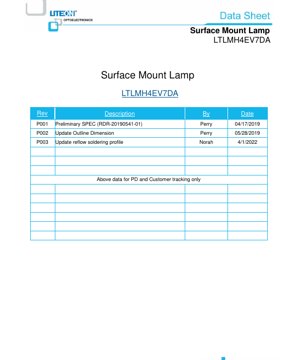
1. Product Overview
The LTLMH4 EV7DA is a high-brightness surface mount LED lamp designed for demanding illumination applications. It utilizes advanced packaging technology to deliver superior optical performance in a compact, industry-standard SMD form factor. The device is engineered for compatibility with automated surface mount assembly lines and standard lead-free reflow soldering processes.
This LED features a specialized lens package, available in round and oval configurations, which provides a controlled radiation pattern. This design is particularly advantageous for sign board applications, as it achieves a narrow viewing angle without the need for additional external optical lenses, offering a cost and space advantage compared to standard SMD or PLCC packages. The encapsulation employs advanced epoxy materials that provide excellent resistance to moisture and offer UV protection, ensuring long-term reliability in both indoor and outdoor environments.
1.1 Core Features and Advantages
- High Luminous Intensity Output: Delivers typical luminous intensity of 4200 mcd at 20mA, enabling bright and visible displays.
- Energy Efficiency: Features low power consumption with high luminous efficacy.
- Environmental Robustness: Superior moisture resistance and UV-protected package enhance durability.
- Environmental Compliance: Fully compliant with RoHS directives, and is lead-free and halogen-free.
- Optical Design: Red AlInGaP chip with a diffused package, emitting at a dominant wavelength of 624nm. The integrated lens provides a typical viewing angle of 70/45 degrees (as defined in the characteristic curves).
- Manufacturing Readiness: Rated MSL3 (Moisture Sensitivity Level 3), suitable for standard SMT handling with appropriate precautions.
1.2 Target Applications and Market
This component is specifically targeted at applications requiring high visibility and reliability in information display systems. Its primary use cases include:
- Video Message Signs: For large-format indoor and outdoor displays.
- Traffic Signs: Suitable for variable message signs and traffic control indicators.
- General Message Signs: Including advertising boards, information panels, and wayfinding systems.
2. In-Depth Technical Parameter Analysis
2.1 Absolute Maximum Ratings
These ratings define the stress limits beyond which permanent damage to the device may occur. Operation under or at these limits is not guaranteed.
- Power Dissipation (Pd): 120 mW maximum.
- Peak Forward Current (IF(PEAK)): 120 mA, permissible only under pulsed conditions (duty cycle ≤ 1/10, pulse width ≤ 10ms).
- DC Forward Current (IF): 50 mA continuous.
- Derating: The DC forward current must be linearly derated by 0.75 mA/°C for ambient temperatures (TA) above 45°C.
- Operating Temperature Range: -40°C to +85°C.
- Storage Temperature Range: -40°C to +100°C.
- Reflow Soldering Condition: Withstands a peak temperature of 260°C for a maximum of 10 seconds, as per the specified profile.
2.2 Electrical and Optical Characteristics
These parameters are specified at an ambient temperature (TA) of 25°C and define the typical performance of the device.
- Luminous Intensity (IV): 2000-5700 mcd, with a typical value of 4200 mcd at IF = 20mA. Measurement follows the CIE eye-response curve, and a ±15% testing tolerance is included in the guarantee.
- Viewing Angle (2θ1/2): 70/45 degrees (typical). This is the full angle at which luminous intensity drops to half its axial value, measured with a ±2-degree tolerance.
- Peak Emission Wavelength (λP): 634 nm (typical).
- Dominant Wavelength (λd): 618-630 nm, with a typical value of 624 nm. This is the single wavelength defining the perceived color, derived from the CIE chromaticity diagram.
- Spectral Line Half-Width (Δλ): 15 nm (typical), indicating the spectral purity of the red emission.
- Forward Voltage (VF): 1.8-2.4 V, with a typical value of 2.2 V at IF = 20mA.
- Reverse Current (IR): 10 μA maximum at a reverse voltage (VR) of 5V. Important Note: The device is not designed for operation under reverse bias; this test condition is for leakage characterization only.
2.3 Thermal Characteristics
Effective thermal management is crucial for LED performance and lifetime. The derating specification of 0.75 mA/°C above 45°C highlights the need for adequate PCB thermal design, especially when operating at or near the maximum DC current. The third pad (P3/Anode) in the footprint is specifically recommended for connection to a thermal pad or heat sink to facilitate heat dissipation during operation.
3. Binning System Specification
To ensure color and brightness consistency in production applications, LEDs are sorted into bins. The LTLMH4 EV7DA uses two independent binning systems.
3.1 Luminous Intensity Binning
LEDs are classified based on their luminous intensity measured at 20mA. The bin code is marked on the packing bag.
- ES Bin: 2000 - 2600 mcd
- ET Bin: 2600 - 3400 mcd
- EU Bin: 3400 - 4400 mcd
- EV Bin: 4400 - 5700 mcd
Note: A tolerance of ±15% applies to the limits of each bin.
3.2 Forward Voltage Binning
LEDs are also sorted by their forward voltage drop at 20mA to aid in circuit design for current matching.
- 1A Bin: 1.8 - 2.0 V
- 2A Bin: 2.0 - 2.2 V
- 3A Bin: 2.2 - 2.4 V
Note: A tolerance of ±0.1V applies to the limits of each bin.
4. Performance Curve Analysis
The datasheet references typical characteristic curves which are essential for design engineers. While the specific graphs are not reproduced in text, they typically include the following relationships, all measured at 25°C unless noted:
- Relative Luminous Intensity vs. Forward Current (I-V Curve): Shows how light output increases with current, typically in a sub-linear fashion at higher currents due to thermal effects and efficiency droop.
- Forward Voltage vs. Forward Current: Displays the diode's V-I characteristic.
- Relative Luminous Intensity vs. Ambient Temperature: Demonstrates the decrease in light output as junction temperature rises, a critical factor for thermal design.
- Viewing Angle Pattern (Fig.6 reference): Illustrates the spatial radiation pattern, confirming the 70/45 degree typical viewing angle where intensity falls to 50% of the peak.
- Spectral Distribution (Fig.1 reference): Shows the emission spectrum, centering around the 634 nm peak wavelength with the specified 15 nm half-width.
These curves allow designers to predict performance under non-standard operating conditions (different currents, temperatures) and are vital for optimizing drive circuits and thermal management.
5. Mechanical and Package Information
5.1 Outline Dimensions
The package has a compact footprint suitable for high-density PCB layouts.
- Package Body Size: 4.2mm ±0.2mm (L) x 4.2mm ±0.2mm (W).
- Total Height: 6.2mm ±0.5mm maximum.
- Standoff Height: 0.45mm nominal from PCB surface to bottom of flange.
- Lead Spacing: 2.0mm ±0.5mm (measured where leads emerge from package).
- Protruded Resin: A maximum of 1.0mm of resin may protrude beneath the package flange.
- General Tolerances: ±0.25mm unless otherwise specified on the drawing.
5.2 Polarity Identification and Pad Design
The device has three electrical pads:
- P1: Anode.
- P2: Cathode.
- P3: Anode (duplicate).
The recommended soldering pad pattern includes a rounded pad (R0.5) for P3. Critical Design Note: Pad P3 is explicitly recommended to be connected to a heat sink or cooling mechanism on the PCB. Its primary function is to distribute heat away from the LED junction during operation, thereby improving performance and longevity. This pad should be incorporated into the PCB's thermal management strategy.
6. Soldering and Assembly Guidelines
6.1 Moisture Sensitivity and Storage
This component is classified as Moisture Sensitivity Level 3 (MSL3) per JEDEC J-STD-020.
- Storage in Sealed Bag: LEDs in the original moisture barrier bag can be stored for up to 12 months at <30°C and 90% RH.
- Floor Life: After opening the bag, components must be soldered within 168 hours (7 days) while kept under conditions of <30°C and 60% RH.
- Baking Requirements: Baking at 60°C ±5°C for 20 hours is required if: the humidity indicator card shows >10% RH; the floor life exceeds 168 hours; or components are exposed to >30°C and 60% RH. Baking should be performed only once.
- Handling: Unused LEDs should be stored with desiccant in a resealed moisture barrier bag. Prolonged exposure can oxidize the silver-plated leads, affecting solderability.
6.2 Reflow Soldering Profile
The recommended lead-free reflow profile is critical for reliable assembly without damaging the LED.
- Preheat/Soak: Temperature from 150°C (min) to 200°C (max) for up to 120 seconds maximum.
- Liquidous Time (tL): Time above 217°C should be 60-150 seconds.
- Peak Temperature (TP): 260°C maximum.
- Time at Classification Temperature (tP): Time within 5°C of the specified classification temperature (255°C) should not exceed 30 seconds.
- Total Ramp Time: Time from 25°C to peak temperature should be 5 minutes maximum.
Important Restrictions:
- Reflow soldering must not be performed more than two times.
- The device is designed for reflow soldering and is not suitable for dip soldering.
- Avoid applying external mechanical stress to the LED during soldering while it is at high temperature.
- Avoid rapid cooling from the peak temperature to prevent thermal shock.
6.3 Cleaning
If cleaning is necessary after soldering, use alcohol-based solvents such as isopropyl alcohol. Avoid harsh or aggressive chemical cleaners that may damage the epoxy lens or package.
7. Packaging and Ordering Information
7.1 Packing Specification
The LEDs are supplied in industry-standard embossed carrier tape for automated pick-and-place assembly.
- Carrier Tape Width (W): 16.0mm ±0.3mm.
- Pocket Pitch (P): 8.0mm ±0.1mm.
- Reel Dimensions: The tape is wound on a 330mm ±2mm diameter reel.
- Quantity per Reel: 1,000 pieces.
- Labeling: Reels are marked with electrostatic discharge (ESD) warning labels, as these are Electrostatic Sensitive Devices requiring safe handling procedures.
8. Application and Design Recommendations
8.1 Drive Circuit Design
LEDs are current-operated devices. To ensure uniform brightness when driving multiple LEDs, especially in parallel configurations, it is strongly recommended to use a current-limiting resistor in series with each LED (Circuit Model A). Driving LEDs directly from a voltage source without current regulation (Circuit Model B) is not recommended, as it can lead to significant brightness variation and potential overcurrent damage due to the natural variance in forward voltage (VF) from device to device, even within the same bin.
The resistor value (R) can be calculated using Ohm's Law: R = (VSupply - VF) / IF, where IF is the desired operating current (e.g., 20mA) and VF should be chosen conservatively, often using the maximum value from the datasheet (2.4V) to ensure the current does not exceed limits under all conditions.
8.2 Thermal Management in Application
For optimal performance and lifetime:
- Utilize Thermal Pad (P3): Always connect the recommended third pad (P3, Anode) to a copper pour or dedicated thermal via pattern on the PCB to act as a heat sink.
- Observe Current Derating: Adhere to the 0.75 mA/°C derating rule for ambient temperatures above 45°C. For example, at 65°C ambient, the maximum continuous current is reduced to: 50 mA - [0.75 mA/°C * (65°C - 45°C)] = 35 mA.
- PCB Layout: Use adequate copper thickness and area around the LED pads to conduct heat away from the device.
8.3 Optical Integration
The integrated lens providing a 70/45 degree viewing angle eliminates the need for secondary optics in many sign applications, simplifying mechanical design. For applications requiring different beam patterns, the typical viewing angle data and radiation pattern curve should be consulted to model the final optical output.
9. Technical Comparison and Differentiation
Compared to standard SMD LEDs (e.g., 3528, 5050 packages) or PLCC (Plastic Leaded Chip Carrier) LEDs, the LTLMH4 EV7DA offers distinct advantages for signage:
- Superior Optical Control: The dedicated lens package provides a narrower and more controlled viewing angle (70/45°) without add-on lenses, reducing system cost and complexity.
- Higher Luminous Intensity: Typical intensity of 4200 mcd is significantly higher than that of general-purpose indicator SMD LEDs, making it suitable for high-ambient-light or long-viewing-distance applications.
- Robust Package: The use of advanced moisture and UV-resistant epoxy offers better environmental protection than standard packages, which is critical for outdoor signage.
- Thermal Pad: The inclusion of a dedicated thermal pad (P3) is a design feature aimed at better thermal performance than many standard SMD LEDs, supporting higher drive currents and improved longevity.
10. Frequently Asked Questions (Based on Technical Parameters)
Q1: What is the difference between Peak Wavelength (634nm) and Dominant Wavelength (624nm)?
A1: Peak wavelength is the single wavelength at the highest point of the emission spectrum. Dominant wavelength is derived from color science (CIE diagram) and represents the perceived color as a single wavelength. For this red LED, the dominant wavelength of 624nm is the key parameter for color specification in applications.
Q2: Can I drive this LED at 50mA continuously?
A2: Yes, but only if the ambient temperature is 45°C or lower. At higher ambient temperatures, the current must be derated according to the 0.75 mA/°C rule to prevent overheating and accelerated degradation.
Q3: Why is a series resistor mandatory even for a constant voltage drive?
A3: The forward voltage (VF) of an LED has a tolerance range (1.8-2.4V). Connecting multiple LEDs in parallel directly to a voltage source will cause the LEDs with lower VF to draw disproportionately more current, leading to brightness mismatch and potential failure. The series resistor provides negative feedback, stabilizing the current through each individual LED.
Q4: How many times can I rework a board with this LED?
A4: The LED can withstand a maximum of two reflow soldering cycles. Hand soldering/rework with an iron (at ≤315°C for ≤3 seconds) should be performed no more than once. Exceeding these limits risks damaging the internal wire bonds or the epoxy package.
11. Design and Usage Case Study
Scenario: Designing a High-Visibility Outdoor Traffic Message Sign.
Requirements: The sign must be clearly visible in direct sunlight at a distance of 100 meters. It will use a dense array of red pixels. The operating environment ranges from -20°C to +60°C. The design must ensure uniform brightness and long-term reliability.
Design Choices with LTLMH4 EV7DA:
- Component Selection: The high typical luminous intensity (4200 mcd) meets the sunlight readability requirement. The moisture/UV-resistant package is essential for outdoor use.
- Drive Circuit: LEDs are arranged in a matrix. Each column is driven by a constant current source. Within a column, LEDs are connected in series to ensure identical current, avoiding the need for individual resistors per LED and improving efficiency. The supply voltage is sized to accommodate the sum of VF drops plus headroom for the current regulator.
- Thermal Management: Given the high ambient temperature possibility (up to 60°C), the drive current is derated. Using the max rating of 50mA at 45°C and derating 0.75mA/°C, the max current at 60°C is 38.75mA. A conservative design sets the operating current at 30mA. The PCB is designed with a large thermal ground plane connected to all LED P3 pads. Thermal vias under this plane transfer heat to the rear of the board, which is attached to the sign's aluminum chassis acting as a heat sink.
- Binning for Consistency: To ensure a uniform appearance, LEDs from a single luminous intensity bin (e.g., EU or EV) and a single forward voltage bin (e.g., 2A) are specified for the entire production run, minimizing pixel-to-pixel variation.
- Manufacturing Process: The MSL3 rating is communicated to the contract manufacturer. They follow the prescribed baking procedures if floor life is exceeded and adhere strictly to the 260°C peak reflow profile to prevent package damage.
This case demonstrates how the detailed parameters in the datasheet directly inform critical design decisions for a reliable and high-performance end product.
LED Specification Terminology
Complete explanation of LED technical terms
Photoelectric Performance
| Term | Unit/Representation | Simple Explanation | Why Important |
|---|---|---|---|
| Luminous Efficacy | lm/W (lumens per watt) | Light output per watt of electricity, higher means more energy efficient. | Directly determines energy efficiency grade and electricity cost. |
| Luminous Flux | lm (lumens) | Total light emitted by source, commonly called "brightness". | Determines if the light is bright enough. |
| Viewing Angle | ° (degrees), e.g., 120° | Angle where light intensity drops to half, determines beam width. | Affects illumination range and uniformity. |
| CCT (Color Temperature) | K (Kelvin), e.g., 2700K/6500K | Warmth/coolness of light, lower values yellowish/warm, higher whitish/cool. | Determines lighting atmosphere and suitable scenarios. |
| CRI / Ra | Unitless, 0–100 | Ability to render object colors accurately, Ra≥80 is good. | Affects color authenticity, used in high-demand places like malls, museums. |
| SDCM | MacAdam ellipse steps, e.g., "5-step" | Color consistency metric, smaller steps mean more consistent color. | Ensures uniform color across same batch of LEDs. |
| Dominant Wavelength | nm (nanometers), e.g., 620nm (red) | Wavelength corresponding to color of colored LEDs. | Determines hue of red, yellow, green monochrome LEDs. |
| Spectral Distribution | Wavelength vs intensity curve | Shows intensity distribution across wavelengths. | Affects color rendering and quality. |
Electrical Parameters
| Term | Symbol | Simple Explanation | Design Considerations |
|---|---|---|---|
| Forward Voltage | Vf | Minimum voltage to turn on LED, like "starting threshold". | Driver voltage must be ≥Vf, voltages add up for series LEDs. |
| Forward Current | If | Current value for normal LED operation. | Usually constant current drive, current determines brightness & lifespan. |
| Max Pulse Current | Ifp | Peak current tolerable for short periods, used for dimming or flashing. | Pulse width & duty cycle must be strictly controlled to avoid damage. |
| Reverse Voltage | Vr | Max reverse voltage LED can withstand, beyond may cause breakdown. | Circuit must prevent reverse connection or voltage spikes. |
| Thermal Resistance | Rth (°C/W) | Resistance to heat transfer from chip to solder, lower is better. | High thermal resistance requires stronger heat dissipation. |
| ESD Immunity | V (HBM), e.g., 1000V | Ability to withstand electrostatic discharge, higher means less vulnerable. | Anti-static measures needed in production, especially for sensitive LEDs. |
Thermal Management & Reliability
| Term | Key Metric | Simple Explanation | Impact |
|---|---|---|---|
| Junction Temperature | Tj (°C) | Actual operating temperature inside LED chip. | Every 10°C reduction may double lifespan; too high causes light decay, color shift. |
| Lumen Depreciation | L70 / L80 (hours) | Time for brightness to drop to 70% or 80% of initial. | Directly defines LED "service life". |
| Lumen Maintenance | % (e.g., 70%) | Percentage of brightness retained after time. | Indicates brightness retention over long-term use. |
| Color Shift | Δu′v′ or MacAdam ellipse | Degree of color change during use. | Affects color consistency in lighting scenes. |
| Thermal Aging | Material degradation | Deterioration due to long-term high temperature. | May cause brightness drop, color change, or open-circuit failure. |
Packaging & Materials
| Term | Common Types | Simple Explanation | Features & Applications |
|---|---|---|---|
| Package Type | EMC, PPA, Ceramic | Housing material protecting chip, providing optical/thermal interface. | EMC: good heat resistance, low cost; Ceramic: better heat dissipation, longer life. |
| Chip Structure | Front, Flip Chip | Chip electrode arrangement. | Flip chip: better heat dissipation, higher efficacy, for high-power. |
| Phosphor Coating | YAG, Silicate, Nitride | Covers blue chip, converts some to yellow/red, mixes to white. | Different phosphors affect efficacy, CCT, and CRI. |
| Lens/Optics | Flat, Microlens, TIR | Optical structure on surface controlling light distribution. | Determines viewing angle and light distribution curve. |
Quality Control & Binning
| Term | Binning Content | Simple Explanation | Purpose |
|---|---|---|---|
| Luminous Flux Bin | Code e.g., 2G, 2H | Grouped by brightness, each group has min/max lumen values. | Ensures uniform brightness in same batch. |
| Voltage Bin | Code e.g., 6W, 6X | Grouped by forward voltage range. | Facilitates driver matching, improves system efficiency. |
| Color Bin | 5-step MacAdam ellipse | Grouped by color coordinates, ensuring tight range. | Guarantees color consistency, avoids uneven color within fixture. |
| CCT Bin | 2700K, 3000K etc. | Grouped by CCT, each has corresponding coordinate range. | Meets different scene CCT requirements. |
Testing & Certification
| Term | Standard/Test | Simple Explanation | Significance |
|---|---|---|---|
| LM-80 | Lumen maintenance test | Long-term lighting at constant temperature, recording brightness decay. | Used to estimate LED life (with TM-21). |
| TM-21 | Life estimation standard | Estimates life under actual conditions based on LM-80 data. | Provides scientific life prediction. |
| IESNA | Illuminating Engineering Society | Covers optical, electrical, thermal test methods. | Industry-recognized test basis. |
| RoHS / REACH | Environmental certification | Ensures no harmful substances (lead, mercury). | Market access requirement internationally. |
| ENERGY STAR / DLC | Energy efficiency certification | Energy efficiency and performance certification for lighting. | Used in government procurement, subsidy programs, enhances competitiveness. |