Table of Contents
- 1. Product Overview
- 1.1 Core Advantages and Target Market
- 2. Technical Parameters: In-Depth Objective Analysis
- 2.1 Photometric and Electrical Characteristics
- 2.2 Absolute Maximum Ratings and Thermal Characteristics
- 3. Binning System Explanation
- 3.1 Wavelength and Radiant Flux Binning
- 3.2 Forward Voltage Binning
- 4. Performance Curve Analysis
- 4.1 IV Curve and Relative Power
- 4.2 Temperature Dependence and Spectral Distribution
- 4.3 Radiation Pattern
- 5. Mechanical and Package Information
- 5.1 Dimensions and Tolerances
- 5.2 Pad Design and Polarity
- 6. Soldering and Assembly Guidelines
- 6.1 General Handling Precautions
- 6.2 Storage Conditions
- 7. Packaging and Ordering Information
- 7.1 Packaging Specification
- 7.2 Model Numbering Rule
- 8. Application Recommendations
- 8.1 Typical Application Scenarios
- 8.2 Design Considerations
- 9. Technical Comparison and Differentiation
- 10. Frequently Asked Questions (Based on Technical Parameters)
- 10.1 How do I select the right wavelength?
- 10.2 Why is thermal management so important?
- 10.3 Can I drive this module with a constant voltage supply?
- 11. Practical Design and Usage Case
- 12. Principle Introduction
- 13. Development Trends
- LED Specification Terminology
- Photoelectric Performance
- Electrical Parameters
- Thermal Management & Reliability
- Packaging & Materials
- Quality Control & Binning
- Testing & Certification
1. Product Overview
This document details the specifications for a high-power UV (Ultraviolet) LED module utilizing a Chip-on-Board (COB) configuration. The module is designed for industrial-grade applications requiring intense ultraviolet radiation. Its core construction features a copper substrate for superior thermal management and a quartz glass package for durability and optical performance, making it suitable for demanding environments.
1.1 Core Advantages and Target Market
The primary advantages of this module stem from its robust design. The copper substrate ensures efficient heat dissipation, which is critical for maintaining LED performance and longevity at high drive currents. The quartz glass package offers excellent UV transmission and protects the semiconductor chips from environmental factors. The module is targeted at industrial markets, specifically for processes like UV curing of inks, adhesives, and resins, as well as for ultraviolet disinfection systems in air and water purification. Its general-use designation also allows for integration into various other UV-based inspection or analytical equipment.
2. Technical Parameters: In-Depth Objective Analysis
The performance of the module is defined by a comprehensive set of electrical, optical, and thermal parameters. Understanding these is crucial for proper system design.
2.1 Photometric and Electrical Characteristics
The module's output is characterized by its total radiant flux, measured in Watts (W), which indicates the total optical power emitted across the UV spectrum. This parameter is binned into different codes (e.g., 1A13, 1A14, 1A15, 1A16) corresponding to minimum output levels at a standard test current of 5.5A. The specific radiant flux value depends on the peak wavelength of the module variant (365-370nm, 380-390nm, 390-400nm, 400-410nm). The forward voltage (Vf) typically ranges from 30V to 50V at 5.5A, reflecting the series-parallel arrangement of the individual LED chips (10S10P). The viewing angle is specified as 60 degrees (full width at half maximum), defining the beam spread.
2.2 Absolute Maximum Ratings and Thermal Characteristics
Operating the device beyond its Absolute Maximum Ratings can cause permanent damage. Key limits include a maximum power dissipation of 260W, a peak forward current of 7A (under pulsed conditions), and a maximum junction temperature (Tj) of 115°C. The thermal resistance from junction to solder point (Rth j-s) is specified as 0.4 °C/W, a critical figure for heatsink design. A lower thermal resistance indicates more efficient heat transfer away from the LED chips, which is essential for maintaining performance and reliability.
3. Binning System Explanation
The product utilizes a binning system to categorize units based on key performance metrics, ensuring consistency for the end-user.
3.1 Wavelength and Radiant Flux Binning
The module is offered in four primary wavelength bands: 365-370nm, 380-390nm, 390-400nm, and 400-410nm. Within each wavelength band, the radiant flux is further sorted into bins denoted by codes like 1A13, 1A14, etc. Each code corresponds to a guaranteed minimum radiant output (e.g., 12W min for 1A13 in the 365-370nm variant). This allows designers to select a module with the precise optical power required for their application.
3.2 Forward Voltage Binning
The forward voltage is also binned, indicated by codes C02 (30-40V) and C03 (40-50V). This is important for driver selection, as the power supply must be capable of delivering the required current within this voltage range to ensure stable operation.
4. Performance Curve Analysis
Graphical data provides deeper insight into the module's behavior under varying conditions.
4.1 IV Curve and Relative Power
The Forward Voltage vs. Forward Current (IV) curve shows the relationship between drive current and the voltage drop across the module. It is non-linear, typical of semiconductor devices. The Forward Current vs. Relative Power curve demonstrates how optical output increases with current but may saturate or decrease at very high currents due to thermal effects, highlighting the importance of thermal management.
4.2 Temperature Dependence and Spectral Distribution
The Solder Temperature vs. Relative Power curve illustrates the negative impact of rising temperature on light output. As the solder point temperature (Ts) increases, the radiant output decreases. The Spectral Distribution curve plots the relative intensity of emitted light against wavelength, showing the characteristic peak and spectral width (typically ± 2nm tolerance) of the UV LED.
4.3 Radiation Pattern
The Radiation Diagram is a polar plot showing the angular distribution of light intensity, confirming the 60-degree viewing angle. The intensity is typically highest at 0 degrees (perpendicular to the emitting surface) and decreases towards the edges of the viewing angle.
5. Mechanical and Package Information
5.1 Dimensions and Tolerances
The module has an outline size of 25.0mm in width, 50.0mm in length, and 5.9mm in height (excluding solder pads). All dimensional tolerances are ±0.2mm unless otherwise specified. Detailed top and side views are provided in the specification, including pad locations and critical radii.
5.2 Pad Design and Polarity
The mechanical drawing indicates the positions of the anode (+) and cathode (-) solder pads. Correct polarity must be observed during installation to prevent damage to the device. The pad design is intended for surface-mount soldering processes.
6. Soldering and Assembly Guidelines
6.1 General Handling Precautions
Due to the glass package and sensitivity to electrostatic discharge (ESD), careful handling is required. ESD protection measures (e.g., grounded workstations, wrist straps) should be employed during all handling and assembly operations. The module should be stored in its original protective packaging until ready for use.
6.2 Storage Conditions
The module should be stored in an environment with a temperature range of -40°C to +100°C and low humidity to prevent moisture absorption and potential damage during reflow soldering.
7. Packaging and Ordering Information
7.1 Packaging Specification
The module is packaged individually (1 piece per bag) to prevent physical damage and contamination. The packaging likely includes anti-static properties to protect against ESD.
7.2 Model Numbering Rule
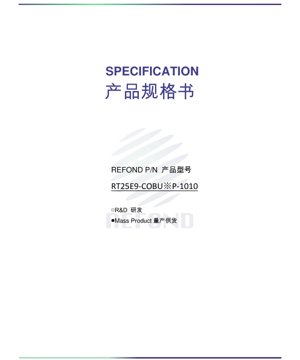
The model number (e.g., RT25E9-COBU※P-1010) encodes key attributes. "RT25E9" likely indicates the series and size. "COBU" signifies a UV COB product. The following code (e.g., ※P-1010) specifies the wavelength bin and radiant flux bin. The "1010" may refer to the 10S10P chip arrangement. The exact decoding should be confirmed with the full product datasheet or manufacturer.
8. Application Recommendations
8.1 Typical Application Scenarios
- UV Curing: For instantly curing inks, coatings, adhesives, and resins in printing, electronics assembly, and wood finishing.
- Disinfection: For germicidal applications in air purifiers, water sterilizers, and surface sanitization equipment, primarily using the 365-370nm or 380-390nm variants.
- Inspection & Analysis: For fluorescence excitation in forensic, medical, or industrial inspection systems.
8.2 Design Considerations
- Thermal Management: The most critical aspect. A heatsink with sufficient thermal mass and surface area must be used to keep the solder point temperature (Ts) and, consequently, the junction temperature (Tj) well below the 115°C maximum. The 0.4 °C/W thermal resistance guides heatsink specification.
- Drive Current: Operate at or below the recommended 5.5A continuous current. Use a constant current LED driver compatible with the module's voltage range (30-50V).
- Optics: The 60-degree viewing angle may be suitable for many applications without secondary optics. For beam shaping (collimating or focusing), UV-transmissive lenses or reflectors must be used.
- Eye and Skin Safety: UV radiation is hazardous. Appropriate shielding, interlocks, and personal protective equipment (PPE) must be incorporated into the final product design.
9. Technical Comparison and Differentiation
Compared to traditional UV lamps (mercury vapor), this LED module offers significant advantages: instant on/off, longer lifetime, no hazardous materials (mercury), narrower spectral output, and greater design flexibility due to its compact size. Within the UV LED market, its key differentiators are the high power output (up to 25.5W radiant flux), the use of a copper substrate for excellent thermal performance, and the robust quartz glass package which is more durable than silicone or plastic alternatives for high-power UV.
10. Frequently Asked Questions (Based on Technical Parameters)
10.1 How do I select the right wavelength?
Choose based on your application's photoinitiator or absorption spectrum. For most curing applications, 365nm, 385nm, 395nm, or 405nm are common. For germicidal efficacy, wavelengths around 265nm are most effective, but UVA (315-400nm) is used for surface disinfection and can be effective for certain pathogens.
10.2 Why is thermal management so important?
High junction temperature accelerates the degradation of the LED, causing a permanent drop in light output (lumen depreciation) and can lead to catastrophic failure. It also causes a temporary reduction in output while hot (see temperature curves). Effective cooling is non-negotiable for reliability.
10.3 Can I drive this module with a constant voltage supply?
It is strongly discouraged. LEDs are current-driven devices. A constant voltage supply could lead to thermal runaway if the forward voltage drops as temperature rises, causing current to increase uncontrollably. Always use a constant current driver.
11. Practical Design and Usage Case
Case: Designing a UV Curing Station for PCB Soldermask. A designer needs to cure a soldermask ink that reacts optimally at 395nm. They would select the RT25E9-COBUHP-1010 variant in the 1A16 flux bin for maximum intensity. They design an aluminum heatsink with a thermal resistance low enough to keep Tj below 100°C when driven at 5.5A in their enclosure. A constant current driver rated for 5.5A and up to 50V is selected. Multiple modules are arranged in an array to cover the desired curing area. Safety interlocks cut power when the station door is opened. This system provides fast, efficient, and reliable curing compared to older thermal methods.
12. Principle Introduction
A UV LED is a semiconductor device that emits ultraviolet light when an electric current passes through it. This occurs through electroluminescence: electrons recombine with electron holes within the device's active region, releasing energy in the form of photons. The specific wavelength (color) of the light is determined by the energy band gap of the semiconductor materials used (e.g., AlGaN, InGaN). A COB (Chip-on-Board) module integrates multiple LED chips directly onto a common substrate, which in this case is copper for thermal conduction, and encapsulates them under a single primary lens (quartz glass), creating a high-power, compact light source.
13. Development Trends
The UV LED market is driven by the global phase-out of mercury lamps. Key trends include: increasing wall-plug efficiency (optical power out / electrical power in), leading to higher radiant flux from smaller packages; improvements in lifetime and reliability, especially for deep-UV (UVC) LEDs used in disinfection; reduction in cost per radiant watt; and the development of LEDs at shorter, more germicidally effective wavelengths (e.g., 265-280nm). There is also a trend towards smarter modules with integrated sensors for temperature and output monitoring.
LED Specification Terminology
Complete explanation of LED technical terms
Photoelectric Performance
| Term | Unit/Representation | Simple Explanation | Why Important |
|---|---|---|---|
| Luminous Efficacy | lm/W (lumens per watt) | Light output per watt of electricity, higher means more energy efficient. | Directly determines energy efficiency grade and electricity cost. |
| Luminous Flux | lm (lumens) | Total light emitted by source, commonly called "brightness". | Determines if the light is bright enough. |
| Viewing Angle | ° (degrees), e.g., 120° | Angle where light intensity drops to half, determines beam width. | Affects illumination range and uniformity. |
| CCT (Color Temperature) | K (Kelvin), e.g., 2700K/6500K | Warmth/coolness of light, lower values yellowish/warm, higher whitish/cool. | Determines lighting atmosphere and suitable scenarios. |
| CRI / Ra | Unitless, 0–100 | Ability to render object colors accurately, Ra≥80 is good. | Affects color authenticity, used in high-demand places like malls, museums. |
| SDCM | MacAdam ellipse steps, e.g., "5-step" | Color consistency metric, smaller steps mean more consistent color. | Ensures uniform color across same batch of LEDs. |
| Dominant Wavelength | nm (nanometers), e.g., 620nm (red) | Wavelength corresponding to color of colored LEDs. | Determines hue of red, yellow, green monochrome LEDs. |
| Spectral Distribution | Wavelength vs intensity curve | Shows intensity distribution across wavelengths. | Affects color rendering and quality. |
Electrical Parameters
| Term | Symbol | Simple Explanation | Design Considerations |
|---|---|---|---|
| Forward Voltage | Vf | Minimum voltage to turn on LED, like "starting threshold". | Driver voltage must be ≥Vf, voltages add up for series LEDs. |
| Forward Current | If | Current value for normal LED operation. | Usually constant current drive, current determines brightness & lifespan. |
| Max Pulse Current | Ifp | Peak current tolerable for short periods, used for dimming or flashing. | Pulse width & duty cycle must be strictly controlled to avoid damage. |
| Reverse Voltage | Vr | Max reverse voltage LED can withstand, beyond may cause breakdown. | Circuit must prevent reverse connection or voltage spikes. |
| Thermal Resistance | Rth (°C/W) | Resistance to heat transfer from chip to solder, lower is better. | High thermal resistance requires stronger heat dissipation. |
| ESD Immunity | V (HBM), e.g., 1000V | Ability to withstand electrostatic discharge, higher means less vulnerable. | Anti-static measures needed in production, especially for sensitive LEDs. |
Thermal Management & Reliability
| Term | Key Metric | Simple Explanation | Impact |
|---|---|---|---|
| Junction Temperature | Tj (°C) | Actual operating temperature inside LED chip. | Every 10°C reduction may double lifespan; too high causes light decay, color shift. |
| Lumen Depreciation | L70 / L80 (hours) | Time for brightness to drop to 70% or 80% of initial. | Directly defines LED "service life". |
| Lumen Maintenance | % (e.g., 70%) | Percentage of brightness retained after time. | Indicates brightness retention over long-term use. |
| Color Shift | Δu′v′ or MacAdam ellipse | Degree of color change during use. | Affects color consistency in lighting scenes. |
| Thermal Aging | Material degradation | Deterioration due to long-term high temperature. | May cause brightness drop, color change, or open-circuit failure. |
Packaging & Materials
| Term | Common Types | Simple Explanation | Features & Applications |
|---|---|---|---|
| Package Type | EMC, PPA, Ceramic | Housing material protecting chip, providing optical/thermal interface. | EMC: good heat resistance, low cost; Ceramic: better heat dissipation, longer life. |
| Chip Structure | Front, Flip Chip | Chip electrode arrangement. | Flip chip: better heat dissipation, higher efficacy, for high-power. |
| Phosphor Coating | YAG, Silicate, Nitride | Covers blue chip, converts some to yellow/red, mixes to white. | Different phosphors affect efficacy, CCT, and CRI. |
| Lens/Optics | Flat, Microlens, TIR | Optical structure on surface controlling light distribution. | Determines viewing angle and light distribution curve. |
Quality Control & Binning
| Term | Binning Content | Simple Explanation | Purpose |
|---|---|---|---|
| Luminous Flux Bin | Code e.g., 2G, 2H | Grouped by brightness, each group has min/max lumen values. | Ensures uniform brightness in same batch. |
| Voltage Bin | Code e.g., 6W, 6X | Grouped by forward voltage range. | Facilitates driver matching, improves system efficiency. |
| Color Bin | 5-step MacAdam ellipse | Grouped by color coordinates, ensuring tight range. | Guarantees color consistency, avoids uneven color within fixture. |
| CCT Bin | 2700K, 3000K etc. | Grouped by CCT, each has corresponding coordinate range. | Meets different scene CCT requirements. |
Testing & Certification
| Term | Standard/Test | Simple Explanation | Significance |
|---|---|---|---|
| LM-80 | Lumen maintenance test | Long-term lighting at constant temperature, recording brightness decay. | Used to estimate LED life (with TM-21). |
| TM-21 | Life estimation standard | Estimates life under actual conditions based on LM-80 data. | Provides scientific life prediction. |
| IESNA | Illuminating Engineering Society | Covers optical, electrical, thermal test methods. | Industry-recognized test basis. |
| RoHS / REACH | Environmental certification | Ensures no harmful substances (lead, mercury). | Market access requirement internationally. |
| ENERGY STAR / DLC | Energy efficiency certification | Energy efficiency and performance certification for lighting. | Used in government procurement, subsidy programs, enhances competitiveness. |