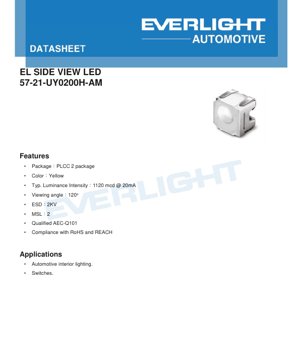
1. Product Overview
This document details the specifications for a high-performance, surface-mount yellow LED in a PLCC-2 (Plastic Leaded Chip Carrier) package. The device is engineered for reliability and performance in demanding environments, featuring a wide 120-degree viewing angle and a typical luminous intensity of 1120 millicandelas (mcd) at a standard drive current of 20mA. Its primary design target is automotive interior lighting applications, such as dashboard illumination, switch backlighting, and general indicator functions, where consistent color output, long-term stability, and compliance with automotive-grade standards are critical.
The LED's core advantages include its qualification to the AEC-Q101 standard, which validates its reliability for automotive use, and compliance with RoHS (Restriction of Hazardous Substances) and REACH (Registration, Evaluation, Authorisation and Restriction of Chemicals) environmental directives. It also features a Moisture Sensitivity Level (MSL) of 2 and an Electrostatic Discharge (ESD) sensitivity rating of 2kV (Human Body Model), making it suitable for standard assembly processes.
2. In-Depth Technical Parameter Analysis
2.1 Optoelectrical Characteristics
The key performance metrics are defined under standard test conditions (Ts = 25°C). The forward current (IF) has an operating range from 5mA to 50mA, with a typical value of 20mA. At this typical current, the luminous intensity (IV) ranges from a minimum of 710mcd to a maximum of 1400mcd, with a typical value of 1120mcd. The forward voltage (VF) at 20mA is specified between 1.75V and 2.75V, with a typical value of 2.00V. The dominant wavelength (λd), which defines the perceived yellow color, is between 585nm and 594nm, typically 592nm. The viewing angle (φ), where luminous intensity drops to half of its peak value, is 120 degrees.
2.2 Absolute Maximum Ratings
These ratings define the stress limits beyond which permanent damage may occur. The absolute maximum power dissipation (Pd) is 137mW. The maximum continuous forward current is 50mA, while a surge current (IFM) of 100mA is permissible for pulses ≤ 10μs with a very low duty cycle (D=0.005). The device is not designed for reverse bias operation. The maximum junction temperature (TJ) is 125°C, with operating and storage temperature ranges from -40°C to +110°C. The maximum soldering temperature for reflow is 260°C for 30 seconds.
2.3 Thermal Characteristics
Thermal management is crucial for LED performance and longevity. The datasheet specifies two thermal resistance values from the junction to the solder point: a real thermal resistance (Rth JS real) of 160 K/W and an electrical thermal resistance (Rth JS el) of 120 K/W, both measured at IF=20mA. The lower electrical value is typically used for design calculations related to forward voltage temperature dependence.
3. Binning System Explanation
To ensure color and brightness consistency in production, LEDs are sorted into bins.
3.1 Luminous Intensity Binning
The luminous output is categorized into multiple bins, each representing a specific range of minimum and maximum luminous intensity in millicandelas (mcd). The bins follow an alphanumeric code (e.g., L1, L2, M1... up to GA). For this specific part number, the possible output bins are highlighted, with the typical part falling into the \"AA\" bin (1120 to 1400 mcd). The luminous flux measurement has a tolerance of ±8%.
3.2 Dominant Wavelength Binning
The yellow color is controlled by binning the dominant wavelength. The bins are defined by numerical codes representing a wavelength range in nanometers (nm). The tolerance for dominant wavelength is ±1nm. The specific bin for this product ensures the yellow color is within the specified 585-594nm range, typically around 592nm.
4. Performance Curve Analysis
The datasheet provides several graphs illustrating the device's behavior under varying conditions.
4.1 Spectral Distribution and Radiation Pattern
The Relative Spectral Distribution graph shows a peak in the yellow region (~592nm) with minimal emission in other parts of the spectrum, confirming a pure yellow color. The Radiation Pattern graph is a polar plot demonstrating the 120-degree viewing angle, with light intensity distribution typical of a PLCC package with a built-in lens.
4.2 Forward Current vs. Forward Voltage (IV Curve)
This graph shows the exponential relationship between forward voltage and current. It is essential for designing the current-limiting circuitry. The curve allows designers to estimate the VF at any given current within the operating range.
4.3 Temperature Dependence
Multiple graphs detail performance changes with junction temperature:
- Relative Luminous Intensity vs. Junction Temperature: Shows that light output decreases as temperature increases, a characteristic of all LEDs. This must be accounted for in thermal design.
- Relative Forward Voltage vs. Junction Temperature: Demonstrates that VF has a negative temperature coefficient, decreasing linearly as temperature rises. This can be used for indirect temperature sensing.
- Relative Wavelength vs. Junction Temperature: Indicates a slight shift in dominant wavelength (typically a few nanometers) with temperature, which is important for color-critical applications.
- Dominant Wavelength vs. Forward Current: Shows minimal variation in color with changing drive current.
4.4 Derating and Pulse Handling
The Forward Current Derating Curve is critical for reliability. It plots the maximum allowable continuous forward current against the solder pad temperature. For example, at a solder point temperature (TS) of 110°C, the maximum current is derated to approximately 34mA. The curve explicitly states not to use currents below 5mA. The Permissible Pulse Handling Capability graph defines the safe operating area for pulsed currents at various duty cycles, allowing for brief over-current driving in multiplexed or strobe applications.
5. Mechanical and Package Information
The LED uses a standard PLCC-2 surface-mount package. The mechanical drawing (implied by section 7) would provide precise dimensions including length, width, height, and lead spacing. The package features a molded plastic body with a built-in lens that shapes the 120-degree viewing angle. Polarity is indicated by the package shape and/or marking, with the cathode typically identified.
6. Soldering and Assembly Guidelines
6.1 Recommended Solder Pad Layout
A recommended footprint (land pattern) is provided to ensure proper soldering, mechanical stability, and optimal thermal transfer from the LED to the printed circuit board (PCB).
6.2 Reflow Soldering Profile
The datasheet specifies a reflow profile with a peak temperature of 260°C for a maximum of 30 seconds. This is a standard lead-free (Pb-free) soldering profile. Adherence to this profile is necessary to prevent thermal damage to the plastic package and the internal die and wire bonds.
6.3 Precautions for Use
General handling precautions include using appropriate ESD protection during assembly, avoiding mechanical stress on the lens, and ensuring the device is stored in a dry environment per its MSL-2 rating before use.
7. Packaging and Ordering Information
The packaging information (section 10) details how the LEDs are supplied, typically on tape-and-reel for automated pick-and-place assembly. The part number structure (57-21-UY0200H-AM) encodes key attributes such as package type, color, brightness bin, and other variant codes. The ordering information section explains how to specify the desired bins for luminous intensity and wavelength when placing an order.
8. Application Recommendations
8.1 Typical Application Scenarios
The primary application is automotive interior lighting, including:
- Instrument cluster and dashboard backlighting.
- Backlighting for buttons, switches, and control panels.
- General status and indicator lights.
- Ambient lighting accents.
8.2 Design Considerations
Current Drive: A constant current driver is strongly recommended over a constant voltage source with a series resistor for better stability and longevity. The design should reference the IV curve and absolute maximum ratings. Thermal Management: The derating curve and thermal resistance values must be used to calculate the maximum junction temperature in the application. Adequate PCB copper area (thermal pad) and possible airflow are needed to keep the solder point temperature low, especially when driving at or near the maximum current. Optical Design: The 120-degree viewing angle provides wide illumination. For focused light, secondary optics may be required. The variation in luminous intensity and wavelength across bins should be considered for applications requiring uniform appearance across multiple LEDs.
9. Technical Comparison and Differentiation
Compared to generic non-automotive PLCC-2 LEDs, this device's key differentiators are its AEC-Q101 qualification and extended operating temperature range (-40°C to +110°C), which are mandatory for automotive electronics. The typical luminous intensity of 1120mcd is relatively high for a standard PLCC-2 yellow LED, offering good brightness efficiency. The comprehensive binning structure provides manufacturers with tighter control over color and brightness consistency in their final products.
10. Frequently Asked Questions (Based on Technical Parameters)
Q: Can I drive this LED directly from a 5V or 12V automotive rail? A: No. You must use a current-limiting circuit. A simple series resistor (calculated using Ohm's Law: R = (Vsupply - VF) / IF) or, preferably, a dedicated constant-current LED driver IC is required to set the current to the desired level (e.g., 20mA).
Q: Why is there a minimum current specification (5mA)? A: Driving an LED at extremely low currents can lead to unstable light output and color shift. The 5mA minimum ensures reliable and consistent operation.
Q: How do I interpret the two different thermal resistance values? A: The electrical thermal resistance (120 K/W) is derived from the change in forward voltage with temperature and is used for electrical modeling. The real thermal resistance (160 K/W) is a more direct measure of heat flow from the junction to the solder point and should be used for primary thermal design calculations to estimate junction temperature rise (ΔTJ = Pd × Rth JS real).
Q: What does MSL 2 mean for storage? A: Moisture Sensitivity Level 2 means the package can be stored in a dry environment (
11. Practical Design Case Study
Scenario: Designing a dashboard switch backlight requiring 4 yellow LEDs. Target: consistent medium brightness, long life in a hot environment (max PCB ambient ~85°C). Design Steps: 1. Current Selection: Choose 15mA (below the 20mA typical) to reduce heat generation and increase lifetime, while still providing sufficient light. 2. Driver Circuit: Use a single constant-current driver IC capable of sourcing 60mA (4x15mA) to ensure identical current through all LEDs for uniform brightness. 3. Thermal Analysis: Calculate power dissipation per LED: Pd ≈ VF × IF = 2.0V × 0.015A = 30mW. Junction temperature rise: ΔTJ = 0.03W × 160 K/W = 4.8K. With Tambient = 85°C at the solder point, TJ ≈ 90°C, which is well below the 125°C maximum. 4. Binning: Specify a tight luminous intensity bin (e.g., R1 or R2) and a specific dominant wavelength bin when ordering to guarantee visual consistency across all four switches.
12. Operating Principle
This is a semiconductor light-emitting diode (LED). When a forward voltage exceeding its bandgap voltage is applied, electrons and holes recombine in the active region of the semiconductor chip, releasing energy in the form of photons (light). The specific material composition of the semiconductor (typically based on AlInGaP for yellow light) determines the wavelength, and thus the color, of the emitted light. The built-in epoxy lens of the PLCC package encapsulates the chip, provides mechanical protection, and shapes the light output beam.
13. Technology Trends
The general trend in such components is towards higher luminous efficacy (more light output per watt of electrical input), improved color consistency and saturation, and enhanced reliability metrics. Packaging is evolving to allow for higher power density and better thermal management. Furthermore, integration with onboard control circuitry (like I2C addressable LEDs) is becoming more common, though this particular device is a standard, discrete component. The demand for AEC-Q101 qualified components continues to grow as automotive lighting becomes more sophisticated and widespread.
LED Specification Terminology
Complete explanation of LED technical terms
Photoelectric Performance
| Term | Unit/Representation | Simple Explanation | Why Important |
|---|---|---|---|
| Luminous Efficacy | lm/W (lumens per watt) | Light output per watt of electricity, higher means more energy efficient. | Directly determines energy efficiency grade and electricity cost. |
| Luminous Flux | lm (lumens) | Total light emitted by source, commonly called "brightness". | Determines if the light is bright enough. |
| Viewing Angle | ° (degrees), e.g., 120° | Angle where light intensity drops to half, determines beam width. | Affects illumination range and uniformity. |
| CCT (Color Temperature) | K (Kelvin), e.g., 2700K/6500K | Warmth/coolness of light, lower values yellowish/warm, higher whitish/cool. | Determines lighting atmosphere and suitable scenarios. |
| CRI / Ra | Unitless, 0–100 | Ability to render object colors accurately, Ra≥80 is good. | Affects color authenticity, used in high-demand places like malls, museums. |
| SDCM | MacAdam ellipse steps, e.g., "5-step" | Color consistency metric, smaller steps mean more consistent color. | Ensures uniform color across same batch of LEDs. |
| Dominant Wavelength | nm (nanometers), e.g., 620nm (red) | Wavelength corresponding to color of colored LEDs. | Determines hue of red, yellow, green monochrome LEDs. |
| Spectral Distribution | Wavelength vs intensity curve | Shows intensity distribution across wavelengths. | Affects color rendering and quality. |
Electrical Parameters
| Term | Symbol | Simple Explanation | Design Considerations |
|---|---|---|---|
| Forward Voltage | Vf | Minimum voltage to turn on LED, like "starting threshold". | Driver voltage must be ≥Vf, voltages add up for series LEDs. |
| Forward Current | If | Current value for normal LED operation. | Usually constant current drive, current determines brightness & lifespan. |
| Max Pulse Current | Ifp | Peak current tolerable for short periods, used for dimming or flashing. | Pulse width & duty cycle must be strictly controlled to avoid damage. |
| Reverse Voltage | Vr | Max reverse voltage LED can withstand, beyond may cause breakdown. | Circuit must prevent reverse connection or voltage spikes. |
| Thermal Resistance | Rth (°C/W) | Resistance to heat transfer from chip to solder, lower is better. | High thermal resistance requires stronger heat dissipation. |
| ESD Immunity | V (HBM), e.g., 1000V | Ability to withstand electrostatic discharge, higher means less vulnerable. | Anti-static measures needed in production, especially for sensitive LEDs. |
Thermal Management & Reliability
| Term | Key Metric | Simple Explanation | Impact |
|---|---|---|---|
| Junction Temperature | Tj (°C) | Actual operating temperature inside LED chip. | Every 10°C reduction may double lifespan; too high causes light decay, color shift. |
| Lumen Depreciation | L70 / L80 (hours) | Time for brightness to drop to 70% or 80% of initial. | Directly defines LED "service life". |
| Lumen Maintenance | % (e.g., 70%) | Percentage of brightness retained after time. | Indicates brightness retention over long-term use. |
| Color Shift | Δu′v′ or MacAdam ellipse | Degree of color change during use. | Affects color consistency in lighting scenes. |
| Thermal Aging | Material degradation | Deterioration due to long-term high temperature. | May cause brightness drop, color change, or open-circuit failure. |
Packaging & Materials
| Term | Common Types | Simple Explanation | Features & Applications |
|---|---|---|---|
| Package Type | EMC, PPA, Ceramic | Housing material protecting chip, providing optical/thermal interface. | EMC: good heat resistance, low cost; Ceramic: better heat dissipation, longer life. |
| Chip Structure | Front, Flip Chip | Chip electrode arrangement. | Flip chip: better heat dissipation, higher efficacy, for high-power. |
| Phosphor Coating | YAG, Silicate, Nitride | Covers blue chip, converts some to yellow/red, mixes to white. | Different phosphors affect efficacy, CCT, and CRI. |
| Lens/Optics | Flat, Microlens, TIR | Optical structure on surface controlling light distribution. | Determines viewing angle and light distribution curve. |
Quality Control & Binning
| Term | Binning Content | Simple Explanation | Purpose |
|---|---|---|---|
| Luminous Flux Bin | Code e.g., 2G, 2H | Grouped by brightness, each group has min/max lumen values. | Ensures uniform brightness in same batch. |
| Voltage Bin | Code e.g., 6W, 6X | Grouped by forward voltage range. | Facilitates driver matching, improves system efficiency. |
| Color Bin | 5-step MacAdam ellipse | Grouped by color coordinates, ensuring tight range. | Guarantees color consistency, avoids uneven color within fixture. |
| CCT Bin | 2700K, 3000K etc. | Grouped by CCT, each has corresponding coordinate range. | Meets different scene CCT requirements. |
Testing & Certification
| Term | Standard/Test | Simple Explanation | Significance |
|---|---|---|---|
| LM-80 | Lumen maintenance test | Long-term lighting at constant temperature, recording brightness decay. | Used to estimate LED life (with TM-21). |
| TM-21 | Life estimation standard | Estimates life under actual conditions based on LM-80 data. | Provides scientific life prediction. |
| IESNA | Illuminating Engineering Society | Covers optical, electrical, thermal test methods. | Industry-recognized test basis. |
| RoHS / REACH | Environmental certification | Ensures no harmful substances (lead, mercury). | Market access requirement internationally. |
| ENERGY STAR / DLC | Energy efficiency certification | Energy efficiency and performance certification for lighting. | Used in government procurement, subsidy programs, enhances competitiveness. |