1. Introduction & Overview
RainbowSight represents a significant advancement in the field of camera-based tactile sensing for robotics. Developed at MIT, this sensor family addresses a critical bottleneck: providing high-resolution, local geometric feedback from curved and omnidirectional sensing surfaces, which are more biomimetic and practical for complex manipulation than traditional flat sensors. The core innovation is a novel rainbow illumination scheme using addressable RGB LEDs, which simplifies the optical design, enhances manufacturability, and enables accurate photometric stereo for 3D shape reconstruction on curved surfaces.
The motivation stems from the limitations of prior systems like GelSight, which, while providing excellent data, often featured bulky, flat designs that were difficult to adapt to varied end-effector geometries. RainbowSight's design philosophy prioritizes customizability, ease of fabrication, and minimal optical tuning, making sophisticated tactile sensing more accessible to roboticists.
2. Core Technology & Design
RainbowSight's architecture is built around three key components: the illumination system, the curved sensing body, and the calibration pipeline.
2.1 The Rainbow Illumination Scheme
The sensor employs a ring of addressable RGB LEDs at its base. Unlike methods using discrete colored lights (e.g., red, green, blue from different directions), the LEDs are programmed to emit a continuous, spatially varying rainbow spectrum. This creates a smooth color gradient across the internally reflective, curved sensing surface coated with a semi-specular layer. When an object deforms the soft elastomer surface, the camera captures the altered color pattern. This single, blended gradient image contains sufficient information from multiple effective "lighting directions" encoded in color, enabling the application of photometric stereo techniques with a single camera shot, simplifying hardware compared to multi-camera or multi-flash systems.
2.2 Sensor Hardware Design
The sensor is compact and features a curved, often hemispherical or finger-like, transparent core. The design is scalable, with prototypes ranging from dime-sized (~20 mm) to larger gripper-mounted fingers. A key advantage is the reduced need for precise optical alignment. The rainbow gradient is inherently forgiving, as the color encoding provides the directional cues, reducing dependence on perfectly positioned point light sources common in earlier curved tactile sensors.
2.3 Calibration & Depth Reconstruction
The system requires a calibration step to map the observed color at each pixel to a corresponding surface normal vector. This involves capturing reference images of the undeformed sensor under the rainbow illumination to build a mapping between (R, G, B) color space and (Nx, Ny, Nz) normal space. During operation, the difference between the current image and the reference image is computed. The color changes are decoded into surface normal estimates using the pre-calibrated mapping. The depth map (a 2.5D height field) is then reconstructed by integrating the normal field. The paper notes improvements in this calibration process over previous methods, leading to more accurate depth maps.
The relationship can be summarized by the photometric stereo equation, where the observed intensity $I$ at a pixel is a function of the surface normal $\mathbf{n}$, the albedo $\rho$, and the lighting vector $\mathbf{l}$: $I = \rho \, \mathbf{n} \cdot \mathbf{l}$. In RainbowSight, the lighting vector $\mathbf{l}$ is effectively encoded in the color channel.
3. Experimental Results & Performance
The paper presents compelling evidence of RainbowSight's capabilities through qualitative and quantitative experiments.
3.1 Shape Reconstruction Accuracy
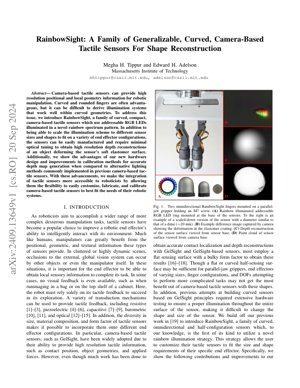
Experiments demonstrate the sensor's ability to reconstruct detailed geometry of objects pressing into its elastomer surface. Examples include screws, gears, and other small parts with complex topography. The resulting depth maps and 3D point clouds (as shown in Fig. 1 C & D of the PDF) clearly show ridges, threads, and contours. The high spatial resolution allows for discerning fine features critical for object recognition and manipulation feedback.
3.2 Comparison with Alternative Methods
The authors compare the rainbow illumination against other common lighting strategies for camera-based tactile sensors, such as using separate monochromatic LEDs. The key advantages demonstrated are:
- Superior Illumination Uniformity: The rainbow gradient provides more consistent coverage across the highly curved surface, avoiding dark spots or saturated regions.
- Simplified Calibration: The single, continuous gradient simplifies the photometric calibration model compared to stitching together data from multiple discrete light sources.
- Robustness to Manufacturing Tolerances: Minor variations in LED placement or sensor shape have less impact on reconstruction quality due to the blended nature of the illumination.
These comparisons underscore RainbowSight's practical benefits for real-world deployment.
4. Technical Analysis & Framework
4.1 Photometric Stereo Principles
RainbowSight's core algorithm relies on Photometric Stereo. Traditional photometric stereo uses multiple images of a static scene taken under different known lighting directions to solve for per-pixel surface normals. RainbowSight's innovation is performing a form of "color-coded photometric stereo" with a single image. The spatially varying rainbow illumination simulates having multiple light sources from different directions, all active simultaneously but distinguished by their spectral signature (color). The surface normal at a point influences the mixture of colors reflected to the camera. By calibrating the system, this color mixture is decoded back into a normal vector.
The mathematical formulation involves solving for the normal $\mathbf{n}$ that best explains the observed color vector $\mathbf{I} = [I_R, I_G, I_B]^T$ under a lighting matrix $\mathbf{L}$ which encodes the direction and spectral power of the effective lights: $\mathbf{I} = \rho \, \mathbf{L} \mathbf{n}$. Here, $\rho$ is the surface albedo, assumed constant for the coated elastomer.
4.2 Analysis Framework Example
Case Study: Evaluating Tactile Sensor Design Choices
When integrating a tactile sensor like RainbowSight into a robotic system, a structured analysis framework is crucial. Consider the following non-code decision matrix:
- Task Requirements Analysis: Define the needed tactile data (e.g., binary contact, 2D force map, high-res 3D geometry). RainbowSight excels at 3D geometry.
- Form Factor & Integration: Assess the end-effector geometry. Can it accommodate a curved sensor? Is omnidirectional sensing needed? RainbowSight offers customization here.
- Illumination Robustness Check: Evaluate the operational environment. Will ambient light interfere? RainbowSight's internal, controlled illumination is a strength.
- Manufacturing & Calibration Overhead: Compare the complexity of sensor fabrication and the calibration pipeline. RainbowSight reduces optical tuning but requires color-to-normal calibration.
- Data Processing Pipeline: Map the sensor output to downstream perception/control algorithms. Ensure the latency of computing depth maps from color images meets system requirements.
This framework helps roboticists move beyond simply adopting a novel sensor to strategically deploying it where its specific advantages—customizable curved shape and robust rainbow-based photometric stereo—provide maximum return on integration effort.
5. Industry Analyst's Perspective
Let's cut through the academic presentation and assess RainbowSight's real-world impact and viability.
5.1 Core Insight
RainbowSight isn't just another tactile sensor; it's a pragmatic engineering hack that elegantly sidesteps the optical nightmare of curved photometric stereo. The MIT team has identified that the quest for perfect, discrete multi-light setups in confined curved spaces is a losing battle for mass adoption. Their solution? Smear the light into a rainbow gradient and let a calibration map sort it out. This is less about a fundamental physics breakthrough and more about a clever repackaging of known principles (photometric stereo, color encoding) for drastically improved manufacturability and design flexibility. The real value proposition is accessibility.
5.2 Logical Flow
The logic chain is compelling: 1) Dexterous manipulation needs rich tactile feedback. 2) Rich feedback comes from high-resolution 3D shape sensing. 3) Shape sensing on useful (curved) gripper geometries is optically hard. 4) Previous solutions (complex multi-LED arrays) are finicky and hard to scale/adapt. 5) RainbowSight's innovation: Replace complex spatial light positioning with complex spectral encoding. 6) Result: A sensor that is easier to build in different shapes, easier to calibrate reliably, and thus more likely to be used outside a lab. The flow pivots from "how to make the physics work" to "how to make the system buildable."
5.3 Strengths & Flaws
Strengths:
- Design Democratization: This could be the "Arduino" of high-res tactile sensing—lowering the barrier to entry significantly.
- Form Factor Freedom: The decoupling of illumination complexity from surface curvature is a game-changer for custom end-effectors.
- Inherent Data Density: The camera-based approach captures a massive amount of information per frame, future-proofing for learning-based methods.
Flaws & Open Questions:
- Color Calibration Drift: How robust is the color-to-normal map over time, with elastomer aging, LED degradation, or temperature changes? This is a potential maintenance headache.
- Spectrum Ambiguity: Can two different surface orientations ever produce the same blended color? The paper hints at calibration solving this, but theoretical ambiguities could limit accuracy at extreme curvatures.
- The Processing Bottleneck: They've simplified the hardware but shifted complexity to calibration and real-time image processing. The computational cost of per-pixel color decoding and normal integration is non-trivial for embedded systems.
- Material Dependency: The entire method hinges on a specific semi-specular coating with consistent albedo. This limits the mechanical properties (e.g., durability, friction) of the contact surface.
5.4 Actionable Insights
For researchers and companies in robotics:
- Focus on the Calibration Stack: The rainbow method's success lives or dies by its calibration. Invest in developing ultra-robust, possibly self-correcting or online calibration routines to mitigate drift. Look to computer vision literature on photometric calibration for inspiration.
- Benchmark Against the True Alternative—Simulation: Before building a physical RainbowSight, teams should ask if sim-to-real with a generic depth camera or cheaper sensors, combined with a powerful world model (like trends from DeepMind or OpenAI), could achieve similar task performance at lower cost and complexity.
- Explore Hybrid Sensing: Pair RainbowSight's detailed geometry with a simple, robust force/torque sensor at the finger base. The combination of local high-res shape and global force data is likely more powerful than either alone.
- Target Niche Applications First: Don't try to replace all tactile sensing. Deploy RainbowSight in applications where its unique selling point is critical: tasks requiring identification of small, complex geometric features by touch alone (e.g., assembly verification, surgical tool manipulation, sorting recyclables).
RainbowSight is a brilliant step towards practical high-fidelity touch. The field should now pressure-test its robustness and find the killer app that justifies its elegance.
6. Future Applications & Directions
The flexibility and high-resolution output of RainbowSight open several promising avenues:
- Advanced Robotic Manipulation: Enabling robots to perform delicate tasks like cable routing, connector mating, or micro-assembly where feeling the exact shape and alignment is crucial.
- Minimally Invasive Surgery (MIS): Scaling down the sensor for integration on surgical robotic tools to provide surgeons with tactile feedback of tissue texture and morphology, compensating for the loss of direct touch.
- Prosthetics and Haptics: Developing more dexterous prosthetic hands that can provide users with detailed sensory feedback about grip and object shape, or creating high-fidelity haptic rendering devices for virtual reality.
- Industrial Inspection: Using sensor-equipped robots to tactilely inspect surfaces for defects (cracks, burrs, coating consistency) in visually occluded or low-light environments.
- Research Direction - Learning-Based Reconstruction: Future work could leverage deep learning models (e.g., Convolutional Neural Networks) to directly map the rainbow pattern images to 3D geometry or even material properties, potentially simplifying or surpassing the model-based photometric stereo pipeline, similar to how CycleGAN (Zhu et al., 2017) learned to translate between image domains without paired examples, a model could learn the complex mapping from rainbow deformation to shape.
- Research Direction - Multi-Modal Fusion: Integrating the dense geometric data from RainbowSight with other sensing modalities, such as vibration sensing for texture or thermal sensing for material identification, to create a comprehensive "tactile perception" suite.
7. References
- Tippur, M. H., & Adelson, E. H. (2024). RainbowSight: A Family of Generalizable, Curved, Camera-Based Tactile Sensors For Shape Reconstruction. arXiv preprint arXiv:2409.13649.
- Yuan, W., Dong, S., & Adelson, E. H. (2017). GelSight: High-Resolution Robot Tactile Sensors for Estimating Geometry and Force. Sensors, 17(12), 2762.
- Zhu, J.-Y., Park, T., Isola, P., & Efros, A. A. (2017). Unpaired Image-to-Image Translation using Cycle-Consistent Adversarial Networks. Proceedings of the IEEE International Conference on Computer Vision (ICCV).
- Kappassov, Z., Corrales, J. A., & Perdereau, V. (2015). Tactile sensing in dexterous robot hands—Review. Robotics and Autonomous Systems, 74, 195-220.
- MIT Computer Science and Artificial Intelligence Laboratory (CSAIL). (n.d.). Robotics and Perception Research. Retrieved from https://www.csail.mit.edu
- Woodham, R. J. (1980). Photometric method for determining surface orientation from multiple images. Optical Engineering, 19(1), 191139.