Table of Contents
1. Introduction
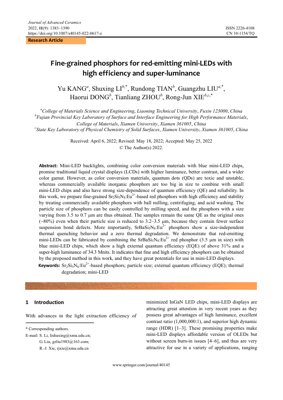
Mini-LED technology is revolutionizing display backlighting by offering superior luminance, contrast, and color gamut compared to traditional LCDs. A critical bottleneck, however, lies in the color conversion materials. While quantum dots (QDs) offer excellent color purity, their toxicity, instability, and cost are significant drawbacks. Conventional inorganic phosphors, though stable, are typically too large (>10 µm) for integration with miniaturized LED chips, and their quantum efficiency (QE) often degrades with reduced particle size. This work addresses this gap by developing a method to produce fine-grained, high-efficiency Sr2Si5N8:Eu2+-based red phosphors specifically tailored for mini-LED applications.
2. Methodology
2.1 Phosphor Synthesis and Processing
The researchers employed a top-down approach to refine commercially available Sr2Si5N8:Eu2+-based phosphors. The process involved sequential steps of ball milling, centrifuging, and acid washing. The ball milling speed was identified as the key parameter for precise control over the final particle size, enabling the production of phosphors with sizes ranging from 3.5 µm down to 0.7 µm.
2.2 Characterization Techniques
A comprehensive suite of characterization tools was used: Particle size analysis (likely via laser diffraction or SEM), photoluminescence (PL) spectroscopy to measure emission spectra and intensity, quantum yield measurements to determine internal and external quantum efficiency (IQE/EQE), and temperature-dependent PL to assess thermal quenching behavior and reliability.
3. Results and Discussion
3.1 Particle Size Control and Morphology
The study successfully demonstrated a linear correlation between milling speed and resultant particle size. Phosphors with a tightly controlled size distribution around 3.5 µm were achieved, which is significantly smaller than the >10 µm typical of commercial products. The acid washing step was crucial for removing surface defects and amorphous phases introduced during milling, which is a common challenge in top-down processing as noted in materials science literature on nanoparticle synthesis.
3.2 Optical Properties and Quantum Efficiency
A critical finding was that the quantum efficiency (QE) remained remarkably high (~80%) even when the particle size was reduced to 3.2–3.5 µm. This is attributed to the effective removal of surface suspension bond defects via the acid washing process. The external quantum efficiency (EQE) of the fabricated mini-LED device exceeded 31%, a competitive figure for red-emitting components.
3.3 Thermal Stability and Quenching Behavior
The SrBaSi5N8:Eu2+ variant exhibited exceptional thermal properties. It showed size-independent thermal quenching behavior and, notably, zero thermal degradation under operational conditions. This addresses a major reliability concern for high-brightness displays where local heating can be significant.
3.4 Mini-LED Device Performance
The integration of the 3.5 µm SrBaSi5N8:Eu2+ phosphor with blue mini-LED chips yielded a prototype device with a super-high luminance of 34.3 Mnits. This performance metric underscores the material's suitability for next-generation, high-dynamic-range (HDR) displays.
Key Performance Metric
>31%
External Quantum Efficiency (EQE)
Particle Size Achieved
3.5 µm
(vs. >10 µm commercial)
Luminance Output
34.3 Mnits
Super-High Luminance
4. Key Insights & Analyst Perspective
Core Insight: This paper isn't just about making smaller phosphors; it's a masterclass in defect engineering. The real breakthrough is preserving ~80% quantum efficiency at sub-4µm scales—a feat that typically sees catastrophic drops due to surface states. The authors cracked this by treating surface defects as a solvable contamination issue, not an intrinsic size penalty.
Logical Flow: The research follows a clean, industrial-relevant pipeline: 1) Identify the mini-LED integration bottleneck (large phosphor size), 2) Develop a scalable top-down process (milling + washing), 3) Systematically correlate process parameters (speed) with key outcomes (size, QE), and 4) Validate in a real device (34.3 Mnits). This is translational materials science done right.
Strengths & Flaws: The strength is undeniable—they delivered a working material with specs that directly answer industry pain points (size, efficiency, thermal stability). The flaw, common in academic reports, is the silent question of scalability and cost. Ball milling and acid washing on an industrial tonnage scale is a different beast than lab grams. How does yield look? What's the cost-per-gram compared to QDs? The thermal "zero degradation" claim also needs longer-term, industry-standard LM-80 testing to be fully credible.
Actionable Insights: For display manufacturers, this phosphor is a viable, drop-in alternative to toxic and unstable QDs for red conversion. The immediate action is to secure samples and run internal reliability tests. For competitors, the playbook is clear: defect mitigation is key. The acid wash step is the secret sauce—similar surface passivation strategies could be applied to other phosphor families (e.g., greens like β-SiAlon:Eu²⁺). The race is now on to replicate this success across the color spectrum.
5. Technical Details and Mathematical Formulations
The quantum efficiency (QE) is a central figure of merit. The external quantum efficiency (EQE) of an LED device is defined as the ratio of the number of photons emitted from the device to the number of electrons injected:
$EQE = \eta_{inj} \times \eta_{rad} \times \eta_{extr}$
where $\eta_{inj}$ is the carrier injection efficiency, $\eta_{rad}$ is the radiative recombination efficiency (closely related to the phosphor's internal quantum efficiency, IQE), and $\eta_{extr}$ is the light extraction efficiency. The paper's achievement of >31% EQE indicates excellent performance in all three factors. The internal quantum efficiency (IQE) of the phosphor itself, stated as ~80%, is given by:
$IQE = \frac{\text{Number of emitted photons}}{\text{Number of absorbed photons}}$
The preservation of high IQE at small particle sizes suggests the process successfully minimized non-radiative recombination centers, often modeled by a rate equation including radiative ($k_r$) and non-radiative ($k_{nr}$) decay rates: $IQE = k_r / (k_r + k_{nr})$.
6. Experimental Results and Diagram Descriptions
Figure 1 (Implied): Particle Size Distribution. Likely a graph showing particle diameter (µm) on the x-axis against frequency or volume percentage on the y-axis for different milling speeds. It would demonstrate a shift towards smaller sizes and a narrowing distribution with optimized processing, highlighting the 3.5 µm target population.
Figure 2 (Implied): Photoluminescence Spectra. A plot with wavelength (nm) on the x-axis and normalized intensity (a.u.) on the y-axis. It would show the characteristic broad red emission band of Eu²⁺ in the nitride host (peaking ~620-650 nm) for both the original and processed phosphors, confirming the crystal structure and activator environment are maintained post-processing.
Figure 3 (Implied): Quantum Efficiency vs. Particle Size. A crucial plot with particle size (µm) on the x-axis and QE (%) on the y-axis. It would show a relatively flat, high QE plateau down to ~3.2 µm, followed by a potential drop for smaller sizes, visually justifying the chosen operational size.
Figure 4 (Implied): Thermal Quenching Behavior. A plot with temperature (°C) on the x-axis and normalized PL intensity or EQE (%) on the y-axis. It would compare the SrBaSi5N8:Eu2+ phosphor with a reference, showing superior retention of emission intensity at elevated temperatures (e.g., up to 150°C), supporting the "size-independent" and "zero degradation" claims.
7. Analysis Framework: A Case Study
Scenario: A display panel manufacturer is evaluating color conversion materials for a new line of premium mini-LED TVs. They must choose between Cadmium-based QDs, Perovskite QDs, and traditional/inorganic phosphors.
Framework Application:
- Define Criteria: Establish weighted criteria: Efficiency (EQE, 25%), Reliability/Thermal Stability (25%), Cost (20%), Environmental/Safety Compliance (15%), Color Gamut Coverage (10%), and Scalability (5%).
- Benchmark & Score:
- Cd-QDs: High efficiency (~90% EQE) and color purity. Score: 10/10 for Efficiency and Color. Very low scores for Safety (toxicity) and Environmental Compliance. Overall Moderate-Low.
- Perovskite QDs: Excellent color and good efficiency but poor thermal/moisture stability. Low Reliability score. Overall Moderate.
- Traditional Large Phosphors: Excellent reliability and cost. Very low score for Scalability/integration with mini-LEDs. Overall Low for this application.
- This Work's Fine Phosphor: High Efficiency (8/10), Excellent projected Reliability (9/10), Good Safety (8/10), Good Scalability potential (7/10). Color gamut may be slightly less than QDs (7/10). Overall High.
- Decision: For a product prioritizing longevity, brightness, and regulatory ease over absolute maximum color gamut, this fine phosphor emerges as the balanced, low-risk champion. The framework highlights it as the most viable solution for the mass-market, high-performance segment the manufacturer targets.
8. Future Applications and Development Directions
- Micro-LED Displays: The natural progression is towards even smaller (<1 µm) phosphors for direct integration into micro-LED pixels, moving beyond backlights to self-emissive displays. The developed processing knowledge is directly applicable.
- Augmented/Virtual Reality (AR/VR): These devices require extremely high pixel densities (PPI) and brightness. Fine, efficient phosphors are essential for compact, high-luminance waveguide-based or direct-view displays.
- Automotive Lighting and Displays: The combination of high luminance and robust thermal stability makes these phosphors ideal for automotive applications, from ultra-bright headlight signatures to sunlight-readable instrument clusters and HUDs.
- Material System Expansion: The immediate research direction is to apply the same ball-milling and defect-engineering strategy to green-emitting phosphors (e.g., LuAG:Ce³⁺, β-SiAlon:Eu²⁺) and blue converters to create a full suite of mini-LED optimized materials.
- Advanced Processing: Future work may explore more controlled bottom-up synthesis (e.g., sol-gel, pyrolysis) to achieve monodisperse, sub-micron phosphors directly, potentially offering even better control over morphology and surface chemistry.
9. References
- Kang, Y., Li, S., Tian, R., Liu, G., Dong, H., Zhou, T., & Xie, R.-J. (2022). Fine-grained phosphors for red-emitting mini-LEDs with high efficiency and super-luminance. Journal of Advanced Ceramics, 11(9), 1383–1390.
- Schubert, E. F. (2006). Light-Emitting Diodes (2nd ed.). Cambridge University Press. (For foundational theory on EQE, IQE).
- Pust, P., Schmidt, P. J., & Schnick, W. (2015). A revolution in lighting. Nature Materials, 14(5), 454–458. (For context on nitride phosphor development).
- U.S. Department of Energy. (2022). Solid-State Lighting Research and Development. Retrieved from energy.gov. (For industry benchmarks and technology roadmaps).
- Display Supply Chain Consultants (DSCC). (2023). Quarterly Advanced Display Shipment and Technology Report. (For market analysis on mini/micro-LED adoption).