1. Introduction & Overview
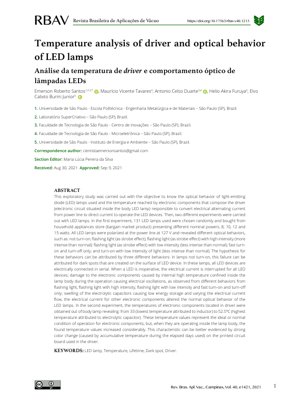
This exploratory study investigates the critical link between the thermal performance of the internal driver circuit and the optical reliability of commercially available Light-Emitting Diode (LED) lamps. While LEDs are celebrated for their energy efficiency and long theoretical lifespan, their practical longevity is often compromised by the failure of supporting electronic components, particularly within the confined, thermally challenging environment of the lamp housing. The research aims to empirically characterize common optical failure modes and correlate them with the operating temperatures of key driver components like electrolytic capacitors and inductors.
2. Methodology & Experimental Setup
The study was conducted through two distinct experimental phases to isolate and analyze different aspects of LED lamp failure.
2.1. Optical Behavior Analysis (Experiment 1)
A sample of 131 used LED lamps with nominal powers of 8W, 10W, 12W, and 15W was randomly selected from bargain retail markets. All lamps were powered at 127V AC, and their optical output was visually categorized. The failure modes were meticulously documented to establish a taxonomy of common issues.
2.2. Driver Temperature Measurement (Experiment 2)
To understand the thermal environment, the temperatures of individual electronic components on the driver's printed circuit board (PCB) were measured outside the lamp body (i.e., in an open-air, ideal散热 condition). This established a baseline for component temperatures before the compounding effect of the enclosed lamp housing is considered.
3. Results & Findings
Sample Size
131
LED Lamps Tested
Temperature Range (Open-Air)
33°C - 52.5°C
Inductor to Capacitor
Key Failure Cause
Thermal
Primary Driver of Degradation
3.1. Observed Optical Failure Modes
The study identified a spectrum of failure behaviors in the 131-lamp sample:
- Complete Failure (No Turn-on): The lamp does not illuminate.
- Strobing/Flashing: Intermittent light output, akin to a strobe effect. This was further subdivided into normal, high-intensity, and low-intensity flashing.
- Rapid Cycling: The lamp turns on and off in quick succession.
- Dim Operation: The lamp turns on but at a significantly reduced luminous intensity.
3.2. Driver Component Temperature Profile
When measured in open air, the driver components exhibited a significant temperature gradient:
- Electrolytic Capacitor: Recorded the highest temperature at 52.5°C.
- Inductor: Recorded the lowest temperature at 33°C.
The study emphasizes that these values represent a best-case scenario. When the same driver operates sealed inside the lamp body, temperatures rise considerably, accelerating component degradation. This was evidenced by visible discoloration (browning) of the PCB, a classic sign of prolonged thermal stress.
3.3. Failure Mechanism Hypotheses
The researchers proposed three primary mechanisms to explain the observed failures:
- LED Dark Spot Formation & Series Failure: For lamps that do not turn on, the failure is attributed to "dark spots" on individual LED chips. Since LEDs in these lamps are typically connected in series, the failure of a single LED interrupts current flow for the entire string.
- Thermal Damage to Driver Components: High internal temperatures degrade sensitive components (e.g., ICs, transistors), causing electrical oscillations that manifest as strobing, flashing, or rapid cycling.
- Electrolytic Capacitor Degradation: Heat causes the electrolyte within capacitors to evaporate, leading to swelling, reduced capacitance, and inability to smooth current properly. This results in unstable power delivery, causing dimming or erratic behavior.
4. Technical Analysis & Discussion
4.1. LED Electrical Characteristics
The LED's current-voltage (I-V) relationship is non-linear and crucial for driver design. Below the threshold voltage ($V_{th}$), the LED behaves like a high-resistance device. Once $V_{th}$ is exceeded, current increases rapidly with a small voltage increase. Different LED materials (colors) have different $V_{th}$ values, e.g., red (~1.8V), blue (~3.3V). The driver must provide a stable, regulated current despite this non-linearity and AC input.
Chart Description (Referencing Fig. 1 in PDF): The I-V curve shows distinct traces for infrared/red, orange/yellow, green, and blue LEDs. Each curve has a sharp "knee" at its characteristic threshold voltage, after which the current rises steeply. This visualization underscores why constant-current drivers are essential to prevent thermal runaway in LEDs.
4.2. Thermal Management & Reliability
The core finding is the conflict between miniaturization and thermal performance. The driver, responsible for AC-DC conversion and current regulation, is a significant heat source. Confining it in a sealed, plastic housing with limited thermal mass creates a hotspot. The Arrhenius equation models how failure rates accelerate with temperature: $\text{Rate} \propto e^{-E_a / kT}$, where $E_a$ is activation energy, $k$ is Boltzmann's constant, and $T$ is absolute temperature. A 10°C rise can halve the lifespan of electrolytic capacitors, making them the typical weak link.
Analysis Framework: Failure Mode Root-Cause Analysis
Scenario: An LED lamp exhibits low-intensity strobing after 6 months of use.
- Symptom Observation: Intermittent, dim flashing.
- Subsystem Isolation: The symptom points to unstable power delivery, implicating the driver over the LED array itself.
- Component-Level Hypothesis: The most likely culprit is the electrolytic capacitor in the primary smoothing stage. Thermal stress may have increased its Equivalent Series Resistance (ESR) and reduced its capacitance.
- Verification Test: Measure the capacitor's capacitance and ESR. A significant deviation from its nominal rating confirms the hypothesis. Correlate this with thermal imaging of the driver inside the housing to identify the hotspot.
- Root Cause: Inadequate thermal design → Elevated capacitor operating temperature → Accelerated electrolyte dry-out → Loss of capacitance/Increased ESR → Ripple current passes to LEDs → Dim, unstable light output.
This structured approach moves from symptom to systemic cause, highlighting the thermal-electrical interplay.
5. Core Insight & Analyst Perspective
Core Insight: The purported "long life" of an LED lamp is a myth, not of the semiconductor die, but of its ecosystem. The real product is a thermally compromised electromechanical assembly where the driver—specifically its electrolytic capacitors—acts as a deliberate, entropy-driven fuse. The study exposes a systemic industry failure: prioritizing luminous efficacy and cost per lumen over holistic thermodynamic design, trading a high-efficiency light source for a low-reliability product.
Logical Flow: The research logic is sound but reveals a grim reality. It starts with a broad survey of field failures (Experiment 1), correctly identifying symptoms like strobing and dimming. It then probes the presumed cause—heat—by measuring component temperatures in a benign environment (Experiment 2). The critical, unstated leap is the extrapolation: if components run at 33-52.5°C in open air, in a sealed plastic tomb with other heat sources (LEDs, diodes), temperatures easily surpass 70-85°C, entering the accelerated aging zone defined by the Arrhenius model. The link between observed failure and root cause is strongly implied by the PCB discoloration evidence.
Strengths & Flaws: The strength lies in its practical, field-based approach using bargain-bin lamps, which are the most likely to cut corners. It correctly identifies the capacitor as the thermal Achilles' heel, a fact well-documented in power electronics reliability literature, such as studies from the Center for Power Electronics Systems (CPES). The flaw is the lack of quantitative, in-situ temperature data inside the operational lamp body. The study shows the symptom and the suspect, but not the crime scene temperature. A more damning analysis would have used thermal imaging to map the 85°C+ hotspot on the capacitor inside the housing, directly correlating it with the measured optical decay rate.
Actionable Insights: For manufacturers, the mandate is clear: move to all-solid-state driver designs. Replace electrolytic capacitors with ceramic or film capacitors where possible. If electrolytics are unavoidable, use only high-temperature-rated (105°C+) types from reputable suppliers and provide explicit thermal derating guidelines in design. For standards bodies, this research is ammunition to push for mandatory lumen maintenance and lifetime testing under realistic thermal conditions, not just in open fixtures. For consumers, it's a warning: a lamp's warranty period is likely a better indicator of its expected life than the "50,000 hour" marketing claim. The future belongs to lamps designed as thermal systems first, and light sources second.
6. Future Applications & Research Directions
- Smart Thermal Management: Integration of miniature temperature sensors and microcontroller-based drivers that can dynamically reduce drive current (dimming) when critical temperature thresholds are exceeded, trading temporary brightness for long-term longevity.
- Advanced Materials: Adoption of substrates with higher thermal conductivity (e.g., metal-core PCBs, ceramics like AlN) for drivers, even in cost-sensitive applications. Research into more thermally stable, solid-state alternatives to liquid electrolyte capacitors.
- Digital Twin for Reliability: Creating simulation models that combine computational fluid dynamics (CFD) for thermal analysis with circuit simulation and reliability models (like MIL-HDBK-217F) to predict lifetime during the design phase, avoiding field failures.
- Standardized Accelerated Life Testing: Developing industry-wide testing protocols that subject LED lamps to combined thermal and electrical stress cycles that accurately mimic real-world enclosed fixture conditions, moving beyond simple Ta (ambient temperature) tests.
- Driver-on-Chip (DoC) Technology: Further miniaturization and integration of driver circuitry into a single, better-thermally-managed package, potentially co-packaged with the LED array to shorten thermal paths.
7. References
- Santos, E. R., Tavares, M. V., Duarte, A. C., Furuya, H. A., & Burini Junior, E. C. (2021). Temperature analysis of driver and optical behavior of LED lamps. Revista Brasileira de Aplicações de Vácuo, 40, e1421.
- Schubert, E. F. (2006). Light-Emitting Diodes (2nd ed.). Cambridge University Press. (For fundamental LED I-V characteristics).
- Raju, R., & Burgos, D. (2010). Reliability of DC-link capacitors in power electronic converters. In Proceedings of the IEEE Applied Power Electronics Conference and Exposition (APEC) (pp. 2109-2114). (For capacitor failure mechanisms under thermal stress).
- Center for Power Electronics Systems (CPES). (n.d.). Reliability in Power Electronics. Virginia Tech. Retrieved from [Hypothetical URL for CPES resources]. (For industry perspectives on thermal management).
- U.S. Department of Energy. (2020). LED Lifetime and Reliability. Solid-State Lighting Technology Fact Sheet. (For context on industry lifetime claims and testing).
- MIL-HDBK-217F. (1991). Reliability Prediction of Electronic Equipment. U.S. Department of Defense. (For standard reliability prediction models using Arrhenius equation).