1. Introduction & Overview
Large-scale LED lighting systems present a unique maintenance challenge. Their performance degrades through two primary mechanisms: the gradual lumen depreciation of LED packages and the abrupt, stochastic failure of drivers. Traditional reliability-centered maintenance (RCM) approaches, which focus on component failure rates, are insufficient because lighting system acceptability is defined by spatio-temporal illuminance compliance on the working plane, not merely component functionality.
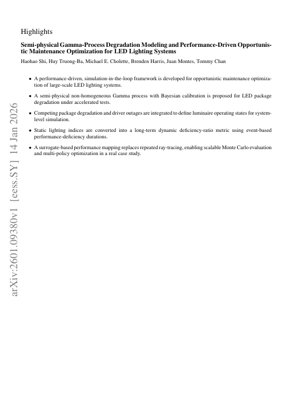
This paper bridges the gap between component-level degradation and system-level service quality. It proposes a novel, performance-driven framework that integrates physics-informed degradation modeling, Bayesian uncertainty quantification, high-fidelity ray-tracing simulation, and surrogate-based optimization to develop cost-effective, opportunistic maintenance policies for large facilities.
Key Challenge
System performance is a coupled, spatial function of hundreds of degrading luminaires, making long-term assessment complex.
Core Innovation
A simulation-in-the-loop framework that converts static lighting indices into a dynamic, long-term Performance Deficiency Ratio metric.
Practical Impact
Enables optimization of maintenance visits and replacements to balance lighting quality, operational cost, and resource use.
2. Methodology & Framework
The proposed framework is a closed-loop integration of degradation modeling, system simulation, and policy optimization.
2.1 Semi-Physical Degradation Modeling
LED package lumen depreciation is modeled using a non-homogeneous Gamma process (NHGP). Unlike a pure statistical model, it incorporates physical insight: the mean degradation path follows the exponential trend commonly observed in LM-80 testing data, described by the LED system's L70 lifetime (time to 70% of initial lumen output).
Mathematical Formulation:
Let $X(t)$ be the lumen output degradation at time $t$. The NHGP model is:
$$X(t) \sim \text{Gamma}(\alpha \Lambda(t; \theta), \beta)$$
where $\alpha, \beta$ are shape and rate parameters, and $\Lambda(t; \theta)$ is the mean function. A common form is $\Lambda(t) = (t / \eta)^\gamma$, but here it is informed by the exponential decay model $L(t) = L_0 \exp(-\lambda t)$, linking to the physical L70 parameter.
Driver failures are modeled separately using a Weibull lifetime distribution, accounting for abrupt, catastrophic failures.
2.2 Bayesian Parameter Calibration
Model parameters are not point estimates but distributions, calibrated from accelerated LM-80 degradation data using Bayesian inference. This allows for rigorous uncertainty propagation from the test data to real-world operating conditions. Markov Chain Monte Carlo (MCMC) methods are typically employed to sample from the posterior distributions of parameters like $\alpha, \beta, \lambda$, and Weibull shape/scale parameters.
2.3 System-Level Performance Simulation
The state of each luminaire (degraded package, failed driver, or functional) defines a system configuration. For each configuration, a ray-tracing engine (e.g., Radiance) calculates the illuminance field across the working plane. Static performance indices—average illuminance $\bar{E}$ and uniformity $U_0 = E_{min} / \bar{E}$—are computed and checked against standards (e.g., EN 12464-1).
Key Metric - Performance Deficiency Ratio (PDR): The framework's core innovation is converting static snapshots into a dynamic, long-term metric. Over a simulation horizon, the system accumulates "deficiency duration" whenever $\bar{E}$ or $U_0$ falls below thresholds. The PDR is the total deficiency time divided by the total operational time.
2.4 Surrogate Modeling for Scalability
Running Monte Carlo simulations with full ray-tracing for thousands of luminaires and time steps is computationally prohibitive. The authors employ surrogate modeling (e.g., Gaussian Process regression or neural networks) to create a fast-to-evaluate mapping from luminaire states to performance metrics (PDR). This surrogate is trained on a limited set of high-fidelity ray-tracing simulations, enabling efficient exploration of the maintenance policy space.
3. Results & Case Study
The framework was applied to a real large-scale indoor LED lighting system case study.
3.1 Model Calibration Results
Bayesian calibration using LM-80 data yielded posterior distributions for the NHGP parameters, showing significant uncertainty in long-term degradation paths. The driver Weibull model indicated an increasing failure rate over time (shape parameter > 1).
Chart Description (Imagined): A figure likely showed multiple sampled degradation paths from the NHGP posterior, fanning out over time, compared to the deterministic exponential mean curve. This visually communicates the uncertainty in predicting exact lumen output at future times.
3.2 Performance Deficiency Analysis
Simulations revealed that system performance (PDR) degrades non-linearly. Initial driver failures have a minor impact, but as cumulative degradation and failures increase, the PDR rises sharply once a critical number of luminaires are compromised, demonstrating a system-level tipping point.
3.3 Maintenance Policy Optimization
A multi-objective optimization was performed to find Pareto-optimal opportunistic maintenance policies. Objectives minimized were: 1) Performance Deficiency Ratio (PDR), 2) Number of site visits, and 3) Number of component replacements.
Chart Description (Imagined): A key result is a 3D Pareto frontier plot. It shows the trade-off surface: aggressive policies (high visits/replacements) achieve very low PDR, while passive policies save on cost but incur high PDR. The "knee" of the curve represents the most cost-effective policies.
The optimized opportunistic policy dictates: "During a scheduled visit for a failed driver, also replace any LED package whose predicted remaining useful life (RUL) falls below a certain threshold, or whose current degradation level is causing a disproportionate impact on local illuminance uniformity."
4. Technical Analysis & Insights
Analysis Framework Example (Non-Code)
Scenario: A university library with 500 LED luminaires wants to plan its 10-year maintenance budget.
- Inputs: BIM model, luminaire IES files, LM-80 data for the specific LED packages, driver warranty failure rates.
- Calibration: Run Bayesian calibration on the LM-80 data to get parameter distributions for the NHGP and Weibull models.
- Baseline Simulation: Run 10,000 Monte Carlo years of operation with no maintenance using the surrogate model. Output: a distribution of the PDR over time and the probability of violating illuminance standards in Year 5, 7, 10.
- Policy Evaluation: Define candidate policies (e.g., "inspect every 2 years, replace packages below 80% output," "opportunistic replacement during driver fixes"). Evaluate each policy's cost (visits + replacements) and performance (PDR) via the surrogate.
- Optimization & Decision: Plot the Pareto frontier. Leadership decides on a target PDR (e.g., < 5% deficiency). The framework identifies the policy on the frontier that meets this PDR at the lowest cost, providing a justified maintenance plan and budget forecast.
5. Future Applications & Directions
- Integration with IoT and Digital Twins: The framework is ideal for a lighting system digital twin. Real-time data from connected drivers (power consumption, temperature) and distributed light sensors can be fed back to update the degradation state (Bayesian filtering), enabling adaptive, condition-based policies rather than static schedules.
- Expansion to Adaptive Lighting: Modern systems dim or adjust color temperature. The framework can be extended to optimize maintenance for systems where control algorithms compensate for degradation, adding a new layer of decision-making: "Should we replace a fixture or simply increase its dimming level?"
- Circular Economy & Sustainability: The model can incorporate remanufacturing or component harvesting. The optimization could include objectives for material waste or carbon footprint, aligning maintenance with sustainability goals by deciding when to replace versus repair.
- Cross-Domain Application: The core methodology—semi-physical degradation + system-level performance simulation + surrogate optimization—is transferable. It could be applied to maintain photovoltaic arrays (power output vs. soiling/degradation), building HVAC systems (thermal comfort vs. component failure), or even network infrastructure (QoS vs. router/switch reliability).
6. References
- Shi, H., Truong-Ba, H., Cholette, M. E., Harris, B., Montes, J., & Chan, T. (2026). Semi-physical Gamma-Process Degradation Modeling and Performance-Driven Opportunistic Maintenance Optimization for LED Lighting Systems. arXiv preprint arXiv:2601.09380.
- IESNA. (2008). IESNA LM-80-08: Measuring Lumen Maintenance of LED Light Sources. Illuminating Engineering Society.
- EN 12464-1:2021. Light and lighting - Lighting of work places - Part 1: Indoor work places.
- Si, X. S., Wang, W., Hu, C. H., & Zhou, D. H. (2011). Remaining useful life estimation–A review on the statistical data driven approaches. European Journal of Operational Research, 213(1), 1-14. (For review of degradation modeling).
- Kennedy, M. C., & O'Hagan, A. (2001). Bayesian calibration of computer models. Journal of the Royal Statistical Society: Series B (Statistical Methodology), 63(3), 425-464. (Foundational for Bayesian calibration).
- Forrester, A. I., Sóbester, A., & Keane, A. J. (2008). Engineering design via surrogate modelling: a practical guide. John Wiley & Sons. (For surrogate modeling principles).
- Zhu, J. Y., Park, T., Isola, P., & Efros, A. A. (2017). Unpaired image-to-image translation using cycle-consistent adversarial networks. In Proceedings of the IEEE international conference on computer vision (pp. 2223-2232). (Cited as an example of a transformative framework in another domain—CycleGAN—to highlight the structural innovation of the paper's simulation-in-the-loop approach).
Core Insight
This paper isn't just about maintaining LEDs; it's a masterclass in shifting maintenance philosophy from component-centric reliability to system-centric serviceability. The authors correctly identify that the ultimate KPI for a lighting system is not "mean time between driver failures" but "percentage of time the workspace is adequately lit." This aligns with the broader industry shift towards Performance-Based Contracting (PBC) and "Lighting as a Service" (LaaS) models, where payment is tied to delivered lumens, not hardware ownership. Their dynamic Performance Deficiency Ratio is the precise metric needed to underpin such contracts.
Logical Flow
The framework's architecture is logically impeccable. It starts with physics (exponential decay trend), layers on stochasticity (Gamma process), quantifies uncertainty (Bayesian calibration), evaluates system impact (ray-tracing), and optimizes decisions (surrogate-based search). This end-to-end pipeline mirrors advanced frameworks in other fields, like the integration of physical models with deep learning for battery health forecasting (see work from the Stanford Energy Control Lab). The use of a surrogate model is a critical, pragmatic step that echoes the "simulation-based design" paradigm used in aerospace and automotive engineering, where computational fluid dynamics (CFD) simulations are replaced by response surfaces for optimization.
Strengths & Flaws
Strengths: The semi-physical NHGP model is a significant strength. Pure data-driven models (e.g., LSTM networks trained on sensor data) can be black boxes and require massive operational datasets. By embedding the known exponential decay physics, the model is more interpretable and data-efficient, needing only standard LM-80 test data for calibration—a clever use of existing industry data. The multi-objective optimization providing a Pareto frontier is superior to single-cost-function approaches, giving decision-makers clear trade-offs.
Potential Flaws & Omissions: The framework assumes independence between luminaire degradations and driver failures. In reality, thermal and electrical interactions in a fixture could create dependencies. The model also relies on the accuracy of the initial ray-tracing model (reflectances, geometry), which can drift over time due to dirt accumulation or space reconfiguration—a factor not addressed. Furthermore, while the surrogate model enables scalability, its accuracy depends on the training data's coverage of the high-dimensional state space; extrapolation to unseen, highly degraded states could be risky.
Actionable Insights
For facility managers and lighting service companies, the immediate takeaway is to start thinking in terms of dynamic spatial performance metrics, not just fixture counts. The paper provides a blueprint for developing a digital twin of a lighting system. The first step is to create a high-fidelity digital model (BIM + photometrics) of the facility. Second, integrate real-time or periodic data from power meters or simple photometers to update the degradation model's state (Bayesian updating). Third, use the optimized policy to schedule maintenance proactively. This moves maintenance from a reactive, cost-center activity to a predictive, value-preserving strategy. Companies like Signify (Philips Lighting) and Acuity Brands investing in IoT-connected lighting systems are perfectly positioned to implement this very framework.