UV Micro-LED for Test Mass Charge Management in Space-Based Gravitational Wave Detection
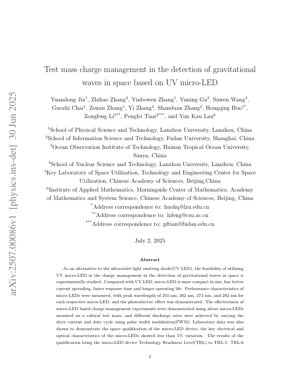
Experimental study on using UV micro-LEDs as a compact, efficient light source for neutralizing charges on test masses in space gravitational wave observatories like LISA.
Home »
Documentation »
UV Micro-LED for Test Mass Charge Management in Space-Based Gravitational Wave Detection
Overview
This research paper presents an experimental investigation into the use of Ultraviolet Micro-Light Emitting Diodes (UV micro-LEDs) for managing electrostatic charge on free-falling test masses in future space-based gravitational wave detectors, such as the Laser Interferometer Space Antenna (LISA). The study demonstrates that micro-LEDs offer a superior alternative to traditional mercury lamps and standard UV LEDs, providing advantages in size, power efficiency, control fidelity, and longevity, which are critical for the success of multi-year space missions.
1. Introduction
Space-based gravitational wave observatories operate in a harsh environment where cosmic rays and solar particles can charge the isolated test masses, generating electrostatic noise that masks the faint gravitational wave signals. Effective charge management is therefore a cornerstone technology. Historically, missions like Gravity Probe B and LISA Pathfinder used mercury lamps. This paper explores UV micro-LEDs as the next-generation solution, highlighting their potential for integration, precise control, and reliability in space.
2. Technology & Methodology
2.1 UV Micro-LED vs. Traditional Sources
The study compares micro-LEDs against conventional UV LEDs and mercury lamps. Key advantages identified include:
Compact Size & Weight: Enables direct integration onto electrode housings.
Superior Current Spreading & Efficiency: Leads to more uniform light emission.
Faster Response Time: Allows for rapid modulation (PWM) for fine-tuned discharge control.
Longer Operational Lifetime: Critical for decade-long missions like LISA.
Precise Optical Power Control: Capable of delivering power down to the picowatt level.
The core principle is the photoelectric effect: UV photons incident on the test mass (or its housing) eject electrons, thereby neutralizing accumulated positive charge. The experimental setup involved mounting micro-LEDs with peak wavelengths of 254 nm, 262 nm, 274 nm, and 282 nm onto a cubical test mass within a vacuum chamber to simulate space conditions. Discharge rates were controlled by varying the LED drive current and duty cycle via Pulse Width Modulation (PWM).
3. Results & Analysis
Wavelength Range
254 - 282 nm
Peak emission of tested micro-LEDs
Performance Stability
< 5%
Variation in key characteristics during qualification
Technology Readiness
TRL-5
Achieved; TRL-6 targeted with further tests
3.1 Micro-LED Performance Characteristics
The tested micro-LEDs demonstrated well-defined peak wavelengths within the deep-UV spectrum, optimal for ejecting electrons from gold-coated test masses. The photoelectric effect was successfully demonstrated, confirming the fundamental viability of the approach.
3.2 Discharge Rate Control via PWM
The experiment successfully showed that the charge discharge rate on the test mass could be linearly and precisely controlled by adjusting the PWM duty cycle and drive current of the micro-LED. This provides a robust method for implementing an active, feedback-controlled charge management system.
Chart Description: A hypothetical chart (based on the described methodology) would plot Discharge Rate (e/s) on the Y-axis against PWM Duty Cycle (%) on the X-axis for different constant drive currents (e.g., 5 mA, 10 mA, 20 mA). The curves would show a positive, roughly linear correlation, with higher currents yielding steeper slopes, demonstrating independent control parameters.
3.3 Space Qualification & TRL Assessment
Laboratory environmental tests simulating space conditions showed that the key electrical and optical characteristics of the micro-LEDs varied by less than 5%. This robustness underpins the assessment that the technology has reached Technology Readiness Level (TRL) 5 (component validation in relevant environment). The paper states that TRL-6 (system/subsystem model demonstration in relevant environment) is achievable with additional radiation and thermal vacuum testing.
4. Core Analyst Insight
Core Insight
This isn't just an incremental improvement in charge management; it's a foundational shift towards monolithic integration and digitized control in space metrology. The move from analog lamps to semiconductor micro-LEDs mirrors the revolution in computing from vacuum tubes to transistors, promising orders-of-magnitude gains in precision, reliability, and miniaturization for next-gen observatories.
Logical Flow
The paper's logic is sound but conservative. It correctly identifies the problem (charge noise), proposes a superior component (micro-LED), validates its basic function (photoelectric effect), and demonstrates preliminary control (PWM). However, it stops short of a full noise budget analysis or closed-loop control demonstration, which are the real gates to mission adoption. The logical next step is integrating this component into a system-level prototype.
Strengths & Flaws
Strengths: The experimental data on PWM control is compelling and directly actionable. Focusing on TRL is pragmatic and speaks the language of space agencies. The multi-wavelength approach is clever, allowing optimization for different electrode materials. Flaws: The paper's major weakness is the lack of long-duration lifetime data under intense UV operation. Micro-LED efficiency droop and degradation under constant deep-UV emission is a known industry challenge (as noted in research from Nature Photonics). Furthermore, the discussion of integrating micro-lenses for beam steering is tantalizing but presented without experimental validation, feeling speculative.
Actionable Insights
1. For Mission Planners (ESA/NASA/CNSA): Fund a dedicated, accelerated lifetime test campaign for these specific micro-LEDs under mission-representative UV flux and duty cycles. This is the single biggest risk reducer.
2. For the Research Team: Partner with a MEMS foundry to prototype the next iteration: an addressable micro-LED array with integrated micro-lenses. This allows for dynamic, spatially-varying charge neutralization, potentially mitigating patch field effects—a nasty noise source barely mentioned in the paper but critical for LISA's performance, as detailed in the official LISA Mission Requirements Document.
3. For Component Suppliers: This research opens a new high-reliability, low-volume, high-value market. Invest in developing space-qualified UV micro-LED packaging that meets outgassing and radiation hardness standards.
5. Technical Details & Framework
5.1 Photoelectric Effect & Discharge Modeling
The discharge current $I_{dis}$ can be modeled as a function of the incident UV photon flux:
$I_{dis} = e \cdot \Phi \cdot \eta \cdot QE(\lambda)$
Where:
$e$ is the elementary charge.
$\Phi$ is the photon flux incident on the surface (photons/s).
$\eta$ is a geometric factor accounting for the fraction of ejected electrons that escape the surface and are collected.
$QE(\lambda)$ is the quantum efficiency (electrons/photon) of the test mass surface material (e.g., gold) at the specific UV wavelength $\lambda$.
The micro-LED's optical power $P_{opt}$ relates to photon flux: $\Phi = \frac{P_{opt} \cdot \lambda}{h c}$, where $h$ is Planck's constant and $c$ is the speed of light. PWM control directly modulates $P_{opt}$ over time, enabling precise $I_{dis}$ control.
Evaluating such a component for space use requires a structured framework. Below is a simplified assessment matrix based on the paper's data:
Criteria
Assessment (Based on Paper)
Risk Level
Next Validation Step
Functional Performance
Photoelectric effect & PWM control demonstrated.
Low
Closed-loop stability test with simulated noise.
Environmental Robustness
<5% variation in lab tests. Radiation/Thermal Vacuum pending.
Medium-High
Full suite of ECSS-standard space qualification tests.
Lifetime & Reliability
Claimed to be longer than UV LED, but no data shown.
High
Accelerated lifetime testing to predict 10-year performance.
Integration Feasibility
Compact size is an advantage. No prototype of integrated array shown.
Medium
Design and test a mechanical/thermal integration prototype with electrode housing.
This framework helps systematically identify that lifetime/reliability and environmental testing are the critical path items, not basic functionality.
6. Future Applications & Directions
The implications of this technology extend beyond LISA-class missions:
Quantum Sensing & Atomic Interferometry in Space: Future missions using ultra-cold atoms or macroscopic quantum objects as test masses will have even stricter charge control requirements. Micro-LED arrays could provide the localized, non-invasive neutralization needed.
Deep-Space Optical Communication: The development of robust, efficient deep-UV sources directly benefits intersatellite laser communication, where UV can be used for acquisition and tracking.
In-Situ Spacecraft Potential Control: Similar micro-LED systems could be used to manage charge on sensitive telescope mirrors or external spacecraft surfaces, mitigating electrostatic discharge risks.
Next-Generation Gravitational Wave Missions: For concepts like the Big Bang Observer (BBO), which envisions constellations of interferometers, the miniaturization and efficiency gains from micro-LEDs become critical for feasibility.
The immediate future direction must be a concerted push to TRL-6 and TRL-7 through partnership with a space agency for a dedicated in-orbit technology demonstration, perhaps on a CubeSat platform.
7. References
J. P. et al., "Charge management for gravitational reference sensors," Class. Quantum Grav., vol. 26, 2009. (Representative of LISA Pathfinder heritage).
G. M. et al., "UV LED charge management for the LISA mission," Phys. Rev. D, vol. 105, 2022.
A. H. et al., "Efficiency droop in III-nitride micro-light-emitting diodes," Nature Photonics, vol. 15, pp. 148–155, 2021. (Highlights the fundamental technical challenge for micro-LED longevity).
European Cooperation for Space Standardization (ECSS), "Space engineering: Testing," ECSS-E-ST-10-03C, 2022. (The standard for space qualification testing).
Huazhong Gravity Group, "Preliminary study on micro-LED for space charge management," Chinese Journal of Space Science, 2023. (Cited as prior foundational work).
Isogai et al., "The Lifetime and Failure Mechanisms of Deep-UV LEDs," Journal of Applied Physics, vol. 125, 2019. (Provides context on reliability challenges).