Table of Contents
- 1. Product Overview
- 2. Detailed Technical Parameters
- 2.1 Absolute Maximum Ratings
- 2.2 Electro-Optical Characteristics
- 3. Performance Curve Analysis
- 3.1 Relationship Between Forward Current and Ambient Temperature
- 3.2 Spectral Distribution
- 3.3 Relationship Between Forward Current and Forward Voltage (I-V Curve)
- 3.4 Relationship Between Radiant Intensity and Forward Current
- 3.5 Relationship between Relative Radiant Intensity and Angular Displacement
- 4. Mechanical and Packaging Information
- 4.1 Package Dimensions
- 4.2 Pad Design and Stencil Recommendation
- 4.3 Polarity Marking
- 5. Soldering and Assembly Guide
- 5.1 Moisture Sensitivity and Storage
- 5.2 Reflow Soldering Process
- 5.3 Manual Soldering and Rework
- 5.4 Circuit Board Handling
- 6. Packaging and Ordering Information
- 6.1 Tape and Reel Specifications
- 6.2 Label Specifications
- 7. Application Recommendations
- 7.1 Typical Application Scenarios
- 7.2 Design Considerations
- 8. Technical Comparison and Differentiation
- 9. Frequently Asked Questions (Based on Technical Parameters)
- 9.1 Can I drive this LED directly from a 3.3V or 5V microcontroller pin?
- 9.2 What is the difference between the 20mA DC rating and the 100mA pulse rating?
- 9.3 Ta yaya ake fahimtar "kusurwar gani" na digiri 25?
- 9.4 Me ya sa hankali ga danshi da gasa suke da muhimmanci?
- 10. Ƙira na ainihi da Misalan Amfani
- 11. Ka'idar Aiki
- 12. Industry Trends and Development
1. Product Overview
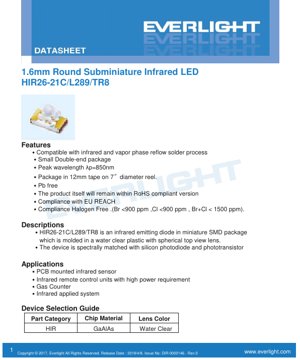
HIR26-21C/L289/TR8 is an ultra-miniature surface-mount device (SMD) infrared emitting diode. It is designed for applications requiring a compact, reliable infrared light source and is compatible with modern automated assembly processes. The device features a 1.6mm round package with a transparent plastic encapsulation and a spherical top lens to optimize its light output.
Its core advantage lies in the matching of its emission spectrum with silicon photodetectors (photodiodes and phototransistors), giving it high efficiency in sensing systems. The device is manufactured using GaAlAs (Gallium Aluminum Arsenide) chip material, which is the standard material for high-performance infrared emitters in this wavelength range.
The target market includes designers and manufacturers of consumer electronics, industrial sensors, and automation equipment, where space is limited and reliable infrared signal transmission or sensing is required.
2. Detailed Technical Parameters
2.1 Absolute Maximum Ratings
These ratings define the limits beyond which permanent damage to the device may occur. Operation outside these limits is not recommended.
- Continuous Forward Current (IF)): 65 mA. This is the maximum DC current that can be applied continuously at an ambient temperature (Ta) of 25°C.
- Peak Forward Current (IFP)): 1.0 A. Wannan babban ƙarfin lantarki yana izini ne kawai a cikin yanayin bugun jini mai faɗin bugun jini ≤100μs kuma cikin aiki ≤1%. Yawanci ana amfani da shi don aikace-aikacen sarrafa nesa waɗanda ke buƙatar ɗan gajeren lokaci, bugun jini mai ƙarfi.
- Ƙarfin lantarki na baya (VR)): 5 V. Wucewa wannan ƙarfin lantarki na baya na iya haifar da rushewar haɗin gwiwa.
- Yanayin aiki (Topr)): -40°C zuwa +85°C. Na'urar tana dacewa da kewayon zafin jiki na masana'antu.
- Yanayin ajiya (Tstg)): -40°C zuwa +100°C.
- Yanayin walda (Tsol)): 260°C, duration not exceeding 5 seconds, compatible with lead-free reflow process.
- Power Dissipation (Pd)): 130 mW at a free-air temperature of 25°C or below. This rating accounts for electrical power conversion and the device's heat dissipation capability.
2.2 Electro-Optical Characteristics
These parameters are measured at Ta=25°C and define the device's performance under typical operating conditions.
- Radiant Intensity (Ie)): Optical power output per unit solid angle (steradian). At a forward current of 20mA, the typical value is 17 mW/sr (minimum 10 mW/sr). Under pulsed conditions (100mA, ≤100μs, duty cycle ≤1%), the typical radiant intensity increases significantly to 85 mW/sr, highlighting the advantage of pulsed operation for peak output.
- Peak Wavelength (λp)): 850 nm (typical value). This falls within the near-infrared spectrum, making it highly suitable for silicon-based detectors. It is less visible to the human eye compared to shorter wavelengths like 940nm, while still maintaining good atmospheric transmittance.
- Spectral Bandwidth (Δλ)): 30 nm (typical value). This defines the range of emission wavelengths centered around the peak wavelength.
- Forward Voltage (VF)): At 20mA, the typical forward voltage is 1.40V (range 1.20V to 1.70V). At a 100mA pulsed current, VFincreases to a typical value of 1.60V (range 1.40V to 2.20V). This information is crucial for driver circuit design and power supply selection.
- Reverse Current (IR)): Maximum 10 μA at 5V reverse voltage, indicating good junction quality.
- Viewing Angle (2θ1/2)): 25 digiri (ƙimar al'ada). Wannan shine cikakken kusurwa lokacin da ƙarfin haske ya ragu zuwa rabin ƙimar kololuwar sa (axial). Kusurwar 25° tana ba da haske mai mai da hankali dangi, wanda ya dace da ji na yanki ko watsa sigina.
3. Performance Curve Analysis
Takardar ƙayyadaddun bayanai tana ba da ginshiƙai masu mahimmanci da yawa don fahimtar yadda na'urar ke aiki a yanayi daban-daban.
3.1 Relationship Between Forward Current and Ambient Temperature
Wannan lanƙwan yana nuna matsakaicin izinin ci gaba da halin yanzu na gaba yana raguwa yayin da yanayin zafi ya tashi sama da 25°C. Don hana zafi fiye da kima, lokacin da zafin ya tashi zuwa iyakar aiki ta 85°C, dole ne a rage halin yanzu a layi. Mai zane dole ne ya yi amfani da wannan ginshiƙi don tabbatar da aiki mai aminci a cikin yanayin zafi na aikace-aikacen sa.
3.2 Spectral Distribution
Wannan ginshiƙi yana zana dangantakar ƙarfin haske dangi da tsawon zango, yana tabbatar da gani na kololuwar 850nm da kuma faɗin bakan kusan 30nm. Yana nuna cewa na'urar tana fitar da hasken infrared mai tsafta dangi, wanda ke daidaitacce a tsayin zango da aka ƙayyade.
3.3 Relationship Between Forward Current and Forward Voltage (I-V Curve)
Wannan ainihin siffar siffa tana nuna alaƙar ma'auni tsakanin halin yanzu da ƙarfin wutar lantarki na diode. Yana da mahimmanci don tantance wurin aiki da ƙirar da'irar iyakance halin yanzu. Wannan lanƙwila zai motsa bisa canjin zafin jiki.
3.4 Relationship Between Radiant Intensity and Forward Current
Wannan jadawalin yana kwatanta fitowar haske a matsayin aikin halin yanzun tuƙi. Yawanci yana nuna alaƙar ƙasa da layi, a cikin halin yanzu mai matuƙar girma, inganci (ƙarfin radiyo a kowace mA) na iya raguwa saboda tasirin zafi da sauran tasiri. Wannan jadawalin yana taimakawa wajen inganta halin yanzun tuƙi don matakin fitowar haske da ake buƙata.
3.5 Relationship between Relative Radiant Intensity and Angular Displacement
Wannan zanen iyakacin duniya yana wakiltar kusurwar gani da tsarin radiyo na LED a zahiri. Yana nuna yadda ƙarfin yake raguwa lokacin da kusurwar kallo ta karkata daga tsakiyar gatari (0°), yana faɗuwa zuwa 50% a kusan ±12.5° (yana tabbatar da cikakkiyar kusurwar gani na 25°). Wannan yana da mahimmanci ga ƙirar tsarin gani, daidaitawa da fahimtar yankin rufewar hasken da aka fitar.
4. Mechanical and Packaging Information
4.1 Package Dimensions
Na'urar tana da kunshewar SMD mai ƙarshen biyu, tare da diamita na jiki na 1.6mm. Cikakken zanen injiniya a cikin takardar bayanin yana ba da duk mahimman girmansa, gami da daukakar gabaɗaya, tazarar ƙafafu, da siffar ruwan tabarau. Sai dai idan an faɗi daban, duk girmansa ana bayyana su a millimita, tare da daidaitaccen ƙima na ±0.1mm.
4.2 Pad Design and Stencil Recommendation
Don tabbatar da ingantaccen haɗin gwiwa da kuma guje wa matsaloli kamar ƙwallan haɗin gwiwa, an ba da shawarar shimfidar kafaffen ƙafa da ƙirar tagulla. Muhimman shawarwari sun haɗa da:
- Man guduro: Sn/Ag3.0/Cu0.5 (a common lead-free alloy).
- Stencil thickness: 0.10mm.
- The stencil aperture design shows a pattern intended to control the solder paste volume for small pads.
Important note: The recommended pad dimensions are for reference only. The final PCB pad pattern should be modified according to specific manufacturing processes, thermal requirements, and individual design needs.
4.3 Polarity Marking
The cathode is typically indicated by visual markers on the package, such as a notch, a flat edge, or a green marking on the base. The datasheet drawing clearly identifies the cathode side, which is crucial for correct PCB orientation.
5. Soldering and Assembly Guide
5.1 Moisture Sensitivity and Storage
This device is moisture sensitive. Precautions must be taken to prevent "popcorn" effect (package cracking due to rapid vapor expansion during reflow soldering).
- Do not open the moisture barrier bag until ready for use.
- After opening, store at ≤30°C and ≤60% relative humidity (RH).
- Use within 168 hours (7 days) after opening the bag.
- If the storage time is exceeded or the desiccant indicates moisture ingress, bake the components at 60 ±5°C for 24 hours before use.
5.2 Reflow Soldering Process
This device is compatible with infrared and vapor phase reflow processes. The datasheet recommends a lead-free reflow temperature profile. Key parameters include preheat, soak, peak reflow temperature (not exceeding 260°C, duration ≤5 seconds), and cooling rate. Reflow soldering should not be performed more than twice to minimize thermal stress on the component.
5.3 Manual Soldering and Rework
If hand soldering is necessary, extreme caution is required:
- 使用烙铁头温度<350°C的烙铁。
- 每个端子接触时间限制在≤3秒。Use a soldering iron with a capacity of 25W or lower.
- Allow an interval of ≥2 seconds between soldering each terminal to prevent heat accumulation.
- Repair after initial soldering is not recommended. If unavoidable, use a dual-tip soldering iron to simultaneously heat both terminals during removal to prevent mechanical stress on the solder joints and the LED itself. After any rework, always verify device functionality.
5.4 Circuit Board Handling
Avoid applying mechanical stress to the LED during heating (soldering). Do not bend the circuit board after soldering, as this may cause cracking of the component or its solder joints.
6. Packaging and Ordering Information
6.1 Tape and Reel Specifications
The device is supplied in embossed carrier tape on industry-standard 7-inch diameter reels. A detailed drawing of the carrier tape dimensions (pocket size, pitch, etc.) is provided. Each reel contains 1500 pieces.
6.2 Label Specifications
The reel label contains standard information for traceability and manufacturing:
- CPN (Customer Part Number)
- P/N (Manufacturer Part Number: HIR26-21C/L289/TR8)
- QTY (Quantity)
- CAT (Category/Grade)
- HUE (Peak Wavelength)
- REF (Reference)
- LOT No. (Lot Number)
- MSL-X (Moisture Sensitivity Level)
- Made In
7. Application Recommendations
7.1 Typical Application Scenarios
- PCB-Mounted Infrared Sensor: Proximity sensing, object detection, line following in robotics.
- Infrared Remote Control Unit: Suitable for applications requiring higher output power than standard remote control LEDs, potentially achieving longer distances or better performance in bright environments.
- Gas Counter/Meter: Commonly used for optical sensing mechanisms within utility meters.
- General-Purpose Infrared System: Any embedded system requiring a compact, reliable infrared light source for data transmission, encoding, or sensing.
7.2 Design Considerations
- Current Limiting is MandatoryAs explicitly stated in "Precautions," an external current-limiting resistor (or constant current driver) must be used in series with the LED. The forward voltage has a range, and if not properly limited, a slight increase in supply voltage can lead to a large, destructive increase in current.
- Thermal ManagementConsider power dissipation (Pd=VF*IF) and the derating of maximum current with temperature. Ensure sufficient PCB copper area or other means for heat dissipation, especially in high ambient temperature or high duty cycle pulse applications.
- Optical DesignThe 25° viewing angle provides directionality. For wider coverage, secondary optics (a diffuser) may be required. For longer distances, a lens can be used to collimate the beam.
- Drive CircuitFor pulse operation at 1A, a transistor or MOSFET switch is required. Ensure the driver can handle the peak current and the required fast rise/fall times.
8. Technical Comparison and Differentiation
Compared to standard 5mm or 3mm through-hole infrared LEDs, the HIR26-21C/L289/TR8 offers significant advantages:
- SizeThe 1.6mm SMD package enables miniaturization of end products and is compatible with high-speed SMT assembly.
- PerformanceThe typical 17 mW/sr radiant intensity at 20mA is competitive, while the 85 mW/sr under pulse conditions is a key feature for high-output requirements.
- Reliability: The SMD structure and compatibility with standard reflow processes result in stronger and more consistent solder joints compared to manually soldered through-hole components.
- Compliance:该器件无铅,符合RoHS、REACH标准,且无卤素(Br <900ppm,Cl <900ppm,Br+Cl <1500ppm),满足全球市场的严格环保法规。
9. Frequently Asked Questions (Based on Technical Parameters)
9.1 Can I drive this LED directly from a 3.3V or 5V microcontroller pin?
No.The typical forward voltage is only 1.4V-1.6V. Connecting it directly to a 3.3V or 5V supply without a current-limiting resistor will almost certainly damage the LED due to excessive current. Always use a series resistor calculated according to Ohm's Law: R = (VPower supply- VF) / IF.
9.2 What is the difference between the 20mA DC rating and the 100mA pulse rating?
The 20mA rating is suitable forcontinuousoperation. The 100mA rating is suitable for very shortpulse(≤100μs) kuma aikin yanayi ƙasa (≤1%). Wannan yana ba da damar LED a tuka da ƙarfi a cikin ɗan gajeren lokaci, samar da walƙiya mai haske (85 mW/sr idan aka kwatanta da 17 mW/sr) ba tare da yin zafi ba, saboda matsakaicin ƙarfin har yanzu yana da ƙasa. Wannan ya dace sosai da na'urar sarrafa nesa.
9.3 Ta yaya ake fahimtar "kusurwar gani" na digiri 25?
Wannan shine lokacin da ƙarfin haske ya kasance rabin ƙimar sa mafi girma (axial).全kusurwa. Ana iya ɗaukarsa azaman faɗin "katako" na farko ko faffadan haske. Akwai fitar da haske a waje da wannan kusurwa, amma ƙarfin ya ragu. Kusurwar 25° tana da matsakaicin mai da hankali.
9.4 Me ya sa hankali ga danshi da gasa suke da muhimmanci?
Kayan aikin SMD na filastik suna ɗaukar danshi daga iska. A cikin tsarin sake yin zafi mai zafi, wannan danshi ya zama tururi da sauri, yana haifar da matsa lamba na ciki, wanda zai iya haifar da fashewar kayan aikin ko rabuwa da guntu ("kwayar popcorn"). Yin bin jagororin ajiya da gasa yana hana wannan yanayin gazawa.
10. Ƙira na ainihi da Misalan Amfani
Yanayi: Ƙirƙirar Alamar Infrared mai Nisa
The designer requires a compact, battery-powered beacon that can be detected by a sensor 20 meters away in an indoor environment with some ambient infrared noise.
- Drive Method Selection: To maximize detection range, the designer selects pulsed operation to utilize a pulsed radiant intensity of up to 85 mW/sr.
- Circuit Design: A microcontroller GPIO pin controls an N-channel MOSFET. The LED is connected in series with a current-limiting resistor between the power supply (e.g., 3.3V) and the MOSFET drain. The resistor value is calculated for 100mA: R = (3.3V - 1.6V) / 0.1A = 17Ω (using a standard 18Ω value). The microcontroller generates pulses with a width of 100μs and a duty cycle of 1% (e.g., 100μs on, 9900μs off).
- PCB LayoutStart with the recommended pad layout. Add additional thermal pads and copper pour around the pads to help dissipate heat during high-current pulses.
- AssemblyPlace components on the PCB. Store the LED reel properly. Solder the assembled board using the recommended lead-free profile for one reflow cycle.
- Optics (Optional)To further extend the distance, a simple plastic collimating lens can be placed over the LED to narrow the beam, concentrating the output power into a smaller area at the target distance.
This case demonstrates how key datasheet parameters—pulse radiant intensity, forward voltage, current rating, and package size—directly guide practical design.
11. Ka'idar Aiki
An Infrared Light Emitting Diode (IR LED) operates based on the principle of electroluminescence in a semiconductor p-n junction. When a forward voltage is applied, electrons from the n-type material and holes from the p-type material are injected into the junction region. When these charge carriers recombine, they release energy. In a GaAlAs diode like this one, the bandgap of the semiconductor material is engineered so that the released energy corresponds to photons in the infrared spectrum, specifically at a wavelength of approximately 850 nm. The transparent epoxy package acts as a lens, shaping the emitted light into the specified radiation pattern (25° viewing angle).
12. Industry Trends and Development
The ultra-miniature infrared LED market continues to evolve. Key trends associated with devices like the HIR26-21C/L289/TR8 include:
- Increased Integration: The trend is to integrate infrared emitters with driver ICs and even photodetectors into a single package to simplify sensor modules.
- Higher Efficiency: Ongoing materials science research aims to improve the wall-plug efficiency (optical power output / electrical power input) of IR LEDs, enabling lower power consumption or higher output from the same package size.
- New Wavelengths: Hanga 850nm fi 940nm baay'ee fudhataman, haa ta'u malee, hojiwwan adda addaa (akka gasii qorannoo yookiin ijaa eegumsa guddisuuf) irratti, wavelengths infrared biroo irratti fedhii guddaa ta'u jira.
- Paakeejii Gahaa: Paakeejii Saalaa Chip (CSP) fi Paakeejii Saalaa Wafera guddifachuun, guddina fi kaffaltii hir'isuuf, yeroo walqabatee ho'aa dandeettii guddisuuf.
- Baay'ee Faa'ila:
- Biyomeetirikii fi Nageenya: Fuula beekumsa, ijaa skaanaa.
- MootoriiIn-vehicle occupant sensing, driver monitoring systems.
- Consumer ElectronicsProximity sensing and gesture recognition for mobile phones/tablets.
- Industrial Internet of ThingsMachine vision, condition monitoring.
Devices like the HIR26-21C/L289/TR8, with their compact form factor, reliable performance, and compliance with environmental standards, are well-suited to serve these expanding markets where compact, efficient infrared light sources are a fundamental requirement.
Detailed Explanation of LED Specification Terminology
Complete Explanation of LED Technical Terminology
1. Maɓuɓɓuka na Farko na Ayyukan Hasken Lantarki
| Kalma | Naúrar/Bayyana | Bayani Mai Sauƙi | Me Ya Sa Yake Da Muhimmanci |
|---|---|---|---|
| Tasirin Hasken Lantarki (Luminous Efficacy) | lm/W (lumens per watt) | The luminous flux emitted per watt of electrical power; higher values indicate greater energy efficiency. | Directly determines the energy efficiency rating and electricity cost of a luminaire. |
| Luminous Flux | lm (lumen) | The total quantity of light emitted by a source, commonly referred to as "brightness". | Determines whether the luminaire is bright enough. |
| Viewing Angle | ° (degrees), e.g., 120° | The angle at which light intensity drops to half, determining the beam width. | Affects the illumination range and uniformity. |
| CCT | K (Kelvin), e.g., 2700K/6500K | The warmth or coolness of light color; lower values are yellowish/warm, higher values are whitish/cool. | Determines the lighting ambiance and suitable application scenarios. |
| Color Rendering Index (CRI / Ra) | Unitless, 0–100 | The ability of a light source to reproduce an object's true colors; Ra≥80 is considered good. | Yana rinjayar gaskiyar launi, ana amfani da shi a wurare masu buƙatu kamar kantuna, gidajen fasaha. |
| Kuskuren launi (SDCM) | Matakan ellipse na MacAdam, misali "5-step" | Ma'auni na ƙididdiga na daidaiton launi, ƙananan matakan suna nuna mafi daidaiton launi. | Tabbatar da cewa fitilun da ke cikin rukuni ɗaya ba su da bambanci a launi. |
| Babban tsawon raƙuman ruwa (Dominant Wavelength) | nm (nanometer), e.g., 620nm (red) | The wavelength value corresponding to the color of a colored LED. | Determines the hue of monochromatic LEDs such as red, yellow, and green. |
| Spectral Distribution | Wavelength vs. Intensity Curve | Shows the intensity distribution of light emitted by an LED across various wavelengths. | Affects color rendering and color quality. |
II. Electrical Parameters
| Kalma | Symbol | Bayani Mai Sauƙi | Design Considerations |
|---|---|---|---|
| Forward Voltage (Forward Voltage) | Vf | Ƙarfin lantarki mafi ƙanƙanta da ake buƙata don kunna LED, kama da "ƙofar farawa". | Ƙarfin lantarkin mai turawa dole ne ya ≥ Vf, yayin haɗa LED da yawa a jere ƙarfin lantarki yana ƙaruwa. |
| Forward Current | If | Ƙimar igiyar ruwa da ke sa LED ta haskaka daidai. | Yawanci ana amfani da turawa mai dorewa, igiyar ruwa tana ƙayyade haske da tsawon rayuwa. |
| Matsakaicin ƙarfin kwarara na bugun jini (Pulse Current) | Ifp | Matsakaicin ƙarfin kwarara da za a iya jurewa a cikin ɗan gajeren lokaci, ana amfani dashi don daidaita haske ko walƙiya. | Dole ne a sarrafa faɗin bugun jini da rabon aiki da ƙarfi, in ba haka ba zai yi zafi kuma ya lalace. |
| Ƙarfin wutar lantarki na baya (Reverse Voltage) | Vr | The maximum reverse voltage that an LED can withstand; exceeding this may cause breakdown. | The circuit must be protected against reverse connection or voltage surges. |
| Thermal Resistance | Rth (°C/W) | The resistance to heat transfer from the chip to the solder point; a lower value indicates better heat dissipation. | High thermal resistance requires a stronger heat dissipation design; otherwise, the junction temperature will increase. |
| Electrostatic Discharge Immunity (ESD Immunity) | V (HBM), such as 1000V | The ability to withstand electrostatic strikes; a higher value means it is less susceptible to damage from static electricity. | Anti-static measures must be implemented during production, especially for high-sensitivity LEDs. |
III. Thermal Management and Reliability
| Kalma | Key Indicators | Bayani Mai Sauƙi | Impact |
|---|---|---|---|
| Junction Temperature | Tj (°C) | The actual operating temperature inside the LED chip. | For every 10°C reduction, lifespan may double; excessively high temperatures cause lumen depreciation and color shift. |
| Lumen Depreciation | L70 / L80 (hours) | The time required for brightness to drop to 70% or 80% of its initial value. | Directly defines the "service life" of an LED. |
| Lumen Maintenance | % (e.g., 70%) | The percentage of remaining brightness after a period of use. | Characterizes the ability to maintain brightness after long-term use. |
| Color Shift | Δu′v′ or MacAdam Ellipse | The degree of color change during use. | Affects the color consistency of the lighting scene. |
| Thermal Aging | Material performance degradation | Degradation of packaging materials due to long-term high temperature. | May lead to decreased brightness, color shift, or open-circuit failure. |
IV. Packaging and Materials
| Kalma | Common Types | Bayani Mai Sauƙi | Characteristics and Applications |
|---|---|---|---|
| Package Type | EMC, PPA, Ceramic | The housing material that protects the chip and provides optical and thermal interfaces. | EMC offers good heat resistance and low cost; ceramic provides superior heat dissipation and long lifespan. |
| Chip Structure | Front-side, Flip Chip | Chip electrode arrangement method. | Flip chip offers better heat dissipation and higher luminous efficacy, suitable for high power. |
| Phosphor coating | YAG, silicate, nitride | Coated on the blue LED chip, partially converting to yellow/red light, mixing to form white light. | Different phosphors affect luminous efficacy, color temperature, and color rendering. |
| Lens/Optical Design | Flat, microlens, total internal reflection | The optical structure on the encapsulation surface controls light distribution. | Determines the beam angle and light distribution curve. |
V. Quality Control and Binning
| Kalma | Binning Content | Bayani Mai Sauƙi | Purpose |
|---|---|---|---|
| Luminous Flux Binning | Codes such as 2G, 2H | Grouped by brightness level, each group has a minimum/maximum lumen value. | Ensure consistent brightness within the same batch of products. |
| Voltage Binning | Codes such as 6W, 6X | Grouped by forward voltage range. | Facilitates driver matching and improves system efficiency. |
| Color Binning | 5-step MacAdam ellipse | Grouped by color coordinates to ensure color falls within a minimal range. | Ensure color consistency to avoid uneven colors within the same luminaire. |
| Color temperature binning | 2700K, 3000K, etc. | Group by color temperature, each group has a corresponding coordinate range. | Meet the color temperature requirements of different scenarios. |
VI. Testing and Certification
| Kalma | Standard/Test | Bayani Mai Sauƙi | Significance |
|---|---|---|---|
| LM-80 | Lumen Maintenance Test | Long-term operation under constant temperature conditions, recording lumen depreciation data. | Used to estimate LED lifetime (in conjunction with TM-21). |
| TM-21 | Lifetime projection standard | Estimating lifetime under actual use conditions based on LM-80 data. | Provides scientific lifetime prediction. |
| IESNA standard | Illuminating Engineering Society standard | Covers optical, electrical, and thermal testing methods. | Industry-recognized testing basis. |
| RoHS / REACH | Environmental certification. | Ensures products are free from harmful substances (e.g., lead, mercury). | Entry requirements for the international market. |
| ENERGY STAR / DLC | Tabbatarwar ingancin amfani da makamashi. | Tabbatarwar ingancin amfani da makamashi da aiki don samfuran haske. | Ana amfani da shi sau da yawa a cikin sayayyar gwamnati, ayyukan tallafi, don haɓaka gasar kasuwa. |