Table of Contents
- 1. Product Overview
- 1.1 Core Advantages
- 1.2 Target Applications
- 2. Technical Parameter Analysis
- 2.1 Absolute Maximum Ratings
- 2.2 Photoelectric Characteristics
- 3. Performance Curve Analysis
- 3.1 Thermal Characteristics and Current Dependence
- 3.2 Light Output Characteristics
- 4. Mechanical and Packaging Information
- 4.1 Device Selection and Structure
- 4.2 Package Dimensions (T-1, 3mm)
- 5. Soldering and Assembly Guide
- 6. Packaging and Ordering Information
- 6.1 Packaging Specifications
- 6.2 Label Information
- 7. Application Design Considerations
- 7.1 LED Driver
- 7.2 Optical Design
- 8. Technical Comparison and Positioning
- 9. Frequently Asked Questions (FAQ)
- 10. Design and Use Case Studies
- 11. Working Principles
- 12. Technology Trends
1. Product Overview
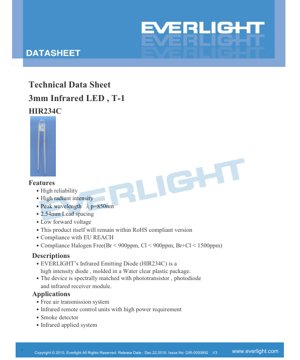
HIR234C, standart 3mm (T-1) şeffaf plastik paketleme kullanılan yüksek yoğunluklu bir kızılötesi yayıcı diyottur. 850nm'lik bir tepe dalga boyunda ışık yayacak şekilde tasarlanmıştır, bu da onu spektrum olarak yaygın silikon ışık hassas transistörleri, fotodiyotlar ve kızılötesi alıcı modüllerle uyumlu hale getirir. Bu cihaz, güvenilir ve verimli kızılötesi iletim gerektiren uygulamalar için özel olarak tasarlanmıştır.
1.1 Core Advantages
- High Radiant Intensity:Provides powerful optical output, suitable for long-distance or low-sensitivity receiver systems.
- High reliability:Designed for stable performance and long service life.
- Low forward voltage:Typical value of 1.65V at 20mA current, helps reduce power consumption in design.
- Environmental Compliance:产品符合 RoHS、欧盟 REACH 及无卤标准 (Br < 900ppm, Cl < 900ppm, Br+Cl < 1500ppm)。
- Standard Package:Familiar T-1 (3mm) form factor with 2.54mm pin spacing ensures easy integration into existing designs and PCB layouts.
1.2 Target Applications
This infrared LED is suitable for various systems requiring non-visible light communication or sensing.
- Infrared remote control units, especially those with higher power requirements.
- Free-space optical data transmission links.
- Smoke detection system.
- General infrared application system, including proximity sensors and object counters.
2. Technical Parameter Analysis
2.1 Absolute Maximum Ratings
These ratings define the limits beyond which permanent damage to the device may occur. Operation under these conditions is not guaranteed.
- Continuous Forward Current (IF):100 mA
- Peak Forward Current (IFP):1.0 A (Pulse width ≤ 100μs, Duty cycle ≤ 1%)
- Reverse Voltage (VR):5 V
- Operating Temperature (Topr):-40°C to +85°C
- Storage Temperature (Tstg):-40°C to +100°C
- Power Consumption (Pd):150 mW (when ambient temperature ≤ 25°C)
- Welding temperature (Tsol):260°C, duration ≤ 5 seconds
2.2 Photoelectric Characteristics
These parameters are measured at an ambient temperature (Ta) of 25°C, defining the typical performance of the device.
- Radiant intensity (Ie):
- 7.8 mW/sr (min) / 15 mW/sr (typ), at IF= 20mA (DC) yankin.
- 50 mW/sr (typical), a lokacin IF= 100mA (pulse) yankin.
- 300 mW/sr (typical), a lokacin IF= 1A (pulse) yankin.
- Peak Wavelength (λp):850 nm (Typical), at IF= 20mA.
- Spectral Bandwidth (Δλ):45 nm (typical value), at IF= 20mA.
- Forward voltage (VF):
- 1.45V (minimum) / 1.65V (typical value) / 1.65V (maximum), at IF= 20mA.
- 1.80V (typical value) / 2.40V (maximum), at IF= 100mA (pulse) yankin.
- 4.10V (typical value) / 5.25V (maximum), at IF= 1A (pulse) yankin.
- Reverse current (IR):10 μA (max), at VR= 5V.
- Viewing angle (2θ1/2):30° (typical), in IF= 20mA.
Measurement tolerance:Forward voltage ±0.1V, radiant intensity ±10%, peak wavelength ±1.0nm.
3. Performance Curve Analysis
The datasheet provides several characteristic curves that are crucial for understanding the device's behavior under different operating conditions.
3.1 Thermal Characteristics and Current Dependence
Forward Current vs. Ambient Temperature (Figure 1):This curve shows the derating of the maximum allowable forward current as ambient temperature increases. To ensure reliability and stay within power dissipation limits, the drive current must be reduced at higher temperatures.
Peak Emission Wavelength vs. Ambient Temperature (Figure 3):The peak wavelength of an LED has a temperature coefficient and typically shifts slightly with temperature. This curve quantifies this shift for the HIR234C, which is crucial for applications requiring precise spectral matching.
Forward Current vs. Forward Voltage (Figure 4):This is the fundamental I-V curve of a diode. It shows the exponential relationship between current and voltage. This curve is useful for designing current-limiting circuits and understanding the voltage drop of the LED under different driving conditions.
3.2 Light Output Characteristics
Spectral Distribution (Figure 2):This chart plots the relationship between relative radiant intensity and wavelength. It visually confirms the peak at 850nm and a spectral bandwidth of approximately 45nm, showing the wavelength range of the emission.
Radiant Intensity vs. Forward Current (Figure 5):This curve illustrates the relationship between the optical output power (in mW/sr) and the electrical input current. It is typically linear within the mid-range current but may saturate at very high currents due to thermal effects and efficiency droop.
Relative Radiant Intensity vs. Angular Displacement (Figure 6):This polar plot defines the radiation pattern of the LED. It shows how the intensity decreases when deviating from the central axis (0°), ultimately defining the 30-degree viewing angle at which the intensity drops to half of its peak value.
Radiant Intensity vs. Ambient Temperature (Figure 7):Light output decreases as the junction temperature rises. This curve quantifies the typical reduction in radiant intensity with increasing ambient temperature (and thus junction temperature), which is crucial for designing systems that operate over a wide temperature range.
Relative Forward Voltage vs. Ambient Temperature (Figure 8):The forward voltage of a diode has a negative temperature coefficient. This curve shows how VFtypically decreases as temperature increases, which can be a consideration in constant-voltage drive schemes or when using an LED as a temperature sensor.
4. Mechanical and Packaging Information
4.1 Device Selection and Structure
- Chip Material:GaAlAs.
- Lens/Color:Transparent plastic.
4.2 Package Dimensions (T-1, 3mm)
The device conforms to the standard T-1 (3mm) round LED package dimensions. Key mechanical specifications in the datasheet include:
- All dimensions are in millimeters (mm).
- Unless otherwise specified, the standard dimensional tolerance is ±0.25mm.
- The drawing typically shows the body diameter (3.0mm), lead pitch (2.54mm), and overall dimensions including lens shape and lead length/diameter.
Polarity identification:The cathode is typically identified by the flat side on the edge of the plastic lens and/or the shorter lead. Always refer to the package drawing for final confirmation.
5. Soldering and Assembly Guide
- Hand Soldering:Use a temperature-controlled soldering iron. The soldering time for each pin should not exceed 3 seconds, and the temperature should not exceed 350°C.
- Wave soldering:It can be used, but preheating and exposure time should be controlled to minimize thermal stress on the plastic package.
- Reflow soldering:According to absolute maximum ratings, this device can withstand a peak soldering temperature of 260°C for up to 5 seconds. This is compatible with standard lead-free reflow profiles (e.g., IPC/JEDEC J-STD-020).
- General Precautions:
- Avoid applying mechanical stress to the pins or lens during handling.
- Do not exceed the specified storage temperature range.
- Take appropriate ESD (Electrostatic Discharge) protection measures during handling and assembly.
6. Packaging and Ordering Information
6.1 Packaging Specifications
- Standard packaging: 200 to 1000 pieces per bag.
- 5 bags are packed into 1 box.
- 10 boxes are packed into 1 carton.
6.2 Label Information
Product labels contain key identifiers for traceability and verification:
- CPN:Customer Part Number
- P/N:Production Number (HIR234C)
- QTY:Namba a cikin marufi
- CAT:Level/Category (e.g., Brightness Bin)
- HUE:Peak Wavelength Information
- REF:Reference
- LOT No:Production lot number, used for traceability.
7. Application Design Considerations
7.1 LED Driver
Constant Current Drive:LED is a current-driven device. To achieve stable and predictable light output, use a constant current source or a current-limiting resistor in series with a voltage source. The resistor value can be calculated using Ohm's Law: R = (Vsupply- VF) / IF. For conservative design, always use the maximum V from the datasheet.Fvalue.
Pulse operation:For applications requiring extremely high instantaneous intensity (such as long-range remote controls), the LED can be driven with short-duration, high-current pulses (up to 1A) according to specifications. The limits for pulse width (≤100μs) and duty cycle (≤1%) must be strictly observed to prevent overheating.
7.2 Optical Design
Lens Selection:Transparent lens emits 30-degree beam. For narrower or differently shaped beams, secondary optics (plastic lenses, reflectors) can be used.
Receiver matching:The peak wavelength of 850nm is optimally detected by silicon-based sensors. Ensure the selected phototransistor, photodiode, or infrared receiver module has peak sensitivity within the 800-900nm range.
Immunity to ambient light:In environments with strong ambient light (especially sunlight containing infrared), consider modulating the LED drive signal at a specific frequency and using a receiver tuned to that frequency to suppress background noise.
8. Technical Comparison and Positioning
The HIR234C is positioned as a general-purpose, high-reliability infrared emitter in the commonly used 3mm package.
- Compared to standard 5mm infrared LEDs:The 3mm package occupies a smaller footprint, which is advantageous in miniaturized designs while still providing considerable radiant intensity.
- Compared to SMD infrared LEDs:Compared to surface-mount devices, through-hole T-1 packages are generally preferred for prototyping, manual assembly, or applications requiring higher mechanical strength or easier heat dissipation through the leads.
- Key Differentiators:其High Pulsed Radiant Intensity (300 mW/sr)与Standard PackageThe combination makes it suitable for applications requiring strong infrared light pulses from common form factors.
9. Frequently Asked Questions (FAQ)
Q1: What is the difference between radiant intensity (mW/sr) and power output (mW)?
A1: Radiant intensity measures the optical power per unit solid angle (steradian). It indicates how concentrated the beam is. The total radiant flux (mW) requires integrating the intensity over the entire emission pattern. For a 30-degree LED, the total power is much lower than the peak intensity value.
Q2: Can I drive this LED continuously at 100mA?
A2: The absolute maximum rating for continuous forward current is 100mA. However, continuous operation at this maximum current generates significant heat, raising the junction temperature. To ensure long-term reliable operation, it is recommended to operate at a lower current (e.g., 20-50mA) or implement adequate heat dissipation measures, especially in high ambient temperatures.
Q3: Why is the forward voltage at a 1A pulse (max 5.25V) so much higher than at 20mA DC (max 1.65V)?
A3: This is due to the series resistance within the LED chip and package. At extremely high currents, the voltage drop across this internal resistance becomes significant, leading to a total VFHigher. This is a common characteristic of all LEDs.
Q4: Is the 850nm LED visible?
A4: 850nm belongs to the near-infrared (NIR) spectrum. It is typically invisible to the human eye. However, some people may perceive a very faint deep red light from high-power 850nm LEDs because their emission spectrum has a small "tail" extending into the visible red region. For completely covert operations, 940nm LEDs are usually used.
10. Design and Use Case Studies
Case: Long-Range Infrared Remote Control Transmitter
Objective:Design a remote control that must reliably operate at a distance of 15 meters in a typical living room environment.
Design Choice:
- LED Selection:HIR234C was selected for its high pulsed radiant intensity (typical 300 mW/sr at 1A).
- Drive Circuit:Pulse drive an LED from a 3V battery supply using a simple transistor switch. Calculate the series resistor to limit the pulse current to approximately 800mA (safely below the 1A maximum), while accounting for battery voltage drop and LED Vf at high current.F。
- Signal Modulation:The drive pulse is encoded using a 38kHz carrier frequency, a common standard for infrared remote controls.
- Optical Components:Placing a simple plastic collimating lens in front of the LED narrows the beam from 30 degrees to approximately 10 degrees, concentrating more emitted energy onto the distant receiver.
Results:The combination of high-intensity pulsed drive and beam collimation ensures a strong, detectable signal is delivered to the infrared receiver module at the target distance, even in the presence of moderate ambient infrared noise.
11. Working Principles
Infrared Light Emitting Diode (IR LED) is a semiconductor p-n junction diode. When a forward voltage is applied, electrons from the n-region and holes from the p-region are injected into the junction region. When these carriers recombine, energy is released. For the GaAlAs material of the HIR234C, this energy corresponds to photons with a wavelength centered around 850 nanometers, which lies in the infrared portion of the electromagnetic spectrum. The specific wavelength is determined by the bandgap energy of the semiconductor material. The transparent epoxy package acts as a lens, shaping the emitted light into the specified viewing angle.
12. Technology Trends
Kızılötesi LED teknolojisi, görünür ışık LED teknolojisi ile birlikte sürekli gelişmektedir. HIR234C gibi cihazlarla ilişkili genel eğilimler şunları içerir:
- Verimlilik Artışı:Material and epitaxial growth continuous improvement bring higher electro-optical conversion efficiency (more light output per watt electrical input), thereby reducing power consumption and heat generation.
- Higher speed modulation:Advanced sensing applications such as optical data communication (IrDA, Li-Fi) and time-of-flight (ToF) drive the development of LEDs capable of faster switching.
- Miniaturization:Although through-hole packages remain popular, the market is strongly shifting towards Surface Mount Device (SMD) packages (e.g., 0805, 0603, chip-scale) to accommodate automated assembly and space-constrained designs.
- Multi-wavelength & VCSEL:For professional sensing (e.g., gas analysis, biometrics), multi-wavelength infrared light sources are emerging. Vertical-Cavity Surface-Emitting Lasers (VCSELs) are also gaining popularity in high-performance 3D sensing and structured light applications due to their precise beam characteristics.
HIR234C represents a mature, reliable, and cost-effective solution within this evolving landscape, ideally suited for its target applications in consumer electronics and industrial sensing.
Detailed Explanation of LED Specification Terminology
Complete Explanation of LED Technical Terminology
I. Core Indicators of Photoelectric Performance
| Terminology | Unit/Representation | Popular Explanation | Why It Is Important |
|---|---|---|---|
| Luminous Efficacy | lm/W (lumens per watt) | The luminous flux emitted per watt of electrical energy, the higher the more energy-efficient. | Directly determines the energy efficiency class and electricity cost of the luminaire. |
| Luminous Flux | lm (lumen) | The total amount of light emitted by a light source, commonly known as "brightness". | Determine if the light fixture is bright enough. |
| Viewing Angle | ° (degrees), such as 120° | The angle at which light intensity drops to half, determining the beam's width. | Affects the illumination range and uniformity. |
| Color Temperature (CCT) | K (Kelvin), e.g., 2700K/6500K | The warmth or coolness of light color; lower values are yellowish/warm, higher values are whitish/cool. | Determines the lighting atmosphere and suitable application scenarios. |
| Color Rendering Index (CRI / Ra) | No unit, 0–100 | The ability of a light source to reproduce the true colors of objects, Ra≥80 is recommended. | Affects color fidelity, used in high-demand places such as shopping malls and art galleries. |
| Color Tolerance (SDCM) | MacAdam ellipse steps, e.g., "5-step" | Quantitative indicator of color consistency, the smaller the step number, the more consistent the color. | Ensure no color difference among the same batch of luminaires. |
| Dominant Wavelength | nm (nanometer), e.g., 620nm (red) | The wavelength value corresponding to the color of a colored LED. | Determine the hue of monochromatic LEDs such as red, yellow, and green. |
| Spectral Distribution | Wavelength vs. Intensity Curve | It shows the intensity distribution of light emitted by an LED across various wavelengths. | It affects color rendering and color quality. |
II. Electrical Parameters
| Terminology | Symbols | Popular Explanation | Design Considerations |
|---|---|---|---|
| Forward Voltage | Vf | Minimum voltage required to turn on an LED, similar to a "starting threshold". | The driving power supply voltage must be ≥ Vf, and the voltage adds up when multiple LEDs are connected in series. |
| Forward Current | If | The current value that allows the LED to emit light normally. | Constant current drive is commonly used, where the current determines brightness and lifespan. |
| Maximum Pulse Current (Pulse Current) | Ifp | Peak current that can be withstood in a short time, used for dimming or flashing. | Pulse width and duty cycle must be strictly controlled, otherwise overheating damage. |
| Reverse Voltage | Vr | The maximum reverse voltage that an LED can withstand; exceeding it may cause breakdown. | A cikin da'ira, ya kamata a hana haɗin baya ko kuma ƙarfin lantarki mai ƙarfi. |
| Thermal Resistance | Rth (°C/W) | The resistance to heat flow from the chip to the solder joint. A lower value indicates better heat dissipation. | High thermal resistance requires a more robust thermal design; otherwise, the junction temperature will increase. |
| Electrostatic Discharge Immunity (ESD Immunity) | V (HBM), such as 1000V | Anti-static strike capability, the higher the value, the less susceptible to damage from static electricity. | Anti-static measures must be implemented during production, especially for high-sensitivity LEDs. |
III. Thermal Management and Reliability
| Terminology | Key Metrics | Popular Explanation | Impact |
|---|---|---|---|
| Junction Temperature | Tj (°C) | The actual operating temperature inside the LED chip. | For every 10°C reduction, the lifespan may double; excessively high temperatures cause lumen depreciation and color shift. |
| Lumen Depreciation | L70 / L80 (hours) | The time required for the brightness to drop to 70% or 80% of its initial value. | Directly defines the "service life" of an LED. |
| Lumen Maintenance | % (e.g., 70%) | The percentage of remaining brightness after a period of use. | Characterizes the ability to maintain brightness after long-term use. |
| Color Shift | Δu′v′ or MacAdam Ellipse | The degree of color change during use. | Affects the color consistency of the lighting scene. |
| Thermal Aging | Material performance degradation | Degradation of packaging materials due to prolonged high temperatures. | May lead to decreased brightness, color shift, or open-circuit failure. |
IV. Encapsulation and Materials
| Terminology | Common Types | Popular Explanation | Characteristics and Applications |
|---|---|---|---|
| Package Type | EMC, PPA, Ceramic | The housing material that protects the chip and provides optical and thermal interfaces. | EMC offers good heat resistance and low cost; ceramic provides superior heat dissipation and long lifespan. |
| Chip structure | Front-side, Flip Chip | Chip Electrode Layout Method. | Flip-chip provides better heat dissipation and higher luminous efficacy, suitable for high-power applications. |
| Phosphor coating | YAG, silicate, nitride | Covered on the blue light chip, partially converted into yellow/red light, mixed into white light. | Different phosphors affect luminous efficacy, color temperature, and color rendering. |
| Lens/Optical Design | Flat, Microlens, Total Internal Reflection | Optical structure on the encapsulation surface, controlling light distribution. | Determines the emission angle and light distribution curve. |
V. Quality Control and Binning
| Terminology | Grading Content | Popular Explanation | Purpose |
|---|---|---|---|
| Luminous Flux Grading | Codes such as 2G, 2H | Grouped by brightness level, each group has a minimum/maximum lumen value. | Ensure uniform brightness within the same batch of products. |
| Voltage binning | Codes such as 6W, 6X | Grouped by forward voltage range. | Facilitates driver power matching and improves system efficiency. |
| Color Grading | 5-step MacAdam ellipse | Group by color coordinates to ensure colors fall within a minimal range. | Ensure color consistency to avoid uneven colors within the same luminaire. |
| Color temperature binning | 2700K, 3000K, etc. | Grouped by color temperature, each group has a corresponding coordinate range. | To meet the color temperature requirements of different scenarios. |
VI. Testing and Certification
| Terminology | Standard/Test | Popular Explanation | Meaning |
|---|---|---|---|
| LM-80 | Lumen Maintenance Test | Long-term illumination under constant temperature conditions, recording brightness attenuation data. | Used to estimate LED lifetime (combined with TM-21). |
| TM-21 | Standard for Life Projection | Projecting the lifespan under actual use conditions based on LM-80 data. | Provide scientific life prediction. |
| IESNA standard | Illuminating Engineering Society Standards | Covers optical, electrical, and thermal test methods. | Industry-recognized testing basis. |
| RoHS / REACH | Environmental certification | Ensure the product does not contain harmful substances (such as lead, mercury). | Entry conditions for the international market. |
| ENERGY STAR / DLC | Energy Efficiency Certification | Energy efficiency and performance certification for lighting products. | Yawan da ake amfani da shi a cikin sayayyar gwamnati da ayyukan tallafi, don haɓaka gasar kasuwa. |