Table of Contents
- 1. Product Overview
- 1.1 Key Features and Core Advantages
- 1.2 Target Market and Applications
- 2. In-depth Technical Parameter Analysis
- 2.1 Absolute Maximum Ratings
- 2.2 Photoelectric Characteristics (Ta=25°C)
- 2.3 Thermal Characteristics
- 3. Grading System Description
- 4. Performance Curve Analysis
- 4.1 Relationship Between Forward Current and Ambient Temperature
- 4.2 Spectral Distribution
- 4.3 Relationship Between Radiant Intensity and Forward Current
- 4.4 Relationship Between Relative Radiant Intensity and Angular Displacement
- 5. Mechanical and Packaging Information
- 5.1 Package Dimensions
- 5.2 Polarity Identification
- 6. Welding and Assembly Guide
- 6.1 Pin Forming
- 6.2 Storage
- 6.3 Welding Process
- 6.4 Cleaning
- 6.5 Thermal Management
- 7. Packaging and Ordering Information
- 7.1 Packaging Specifications
- 7.2 Label Information
- 8. Application Suggestions and Design Considerations
- 8.1 Typical Application Circuit
- 8.2 Design Considerations
- 9. Technical Comparison and Differentiation
- 10. Frequently Asked Questions (FAQ)
- 11. Practical Design and Usage Examples
- 11.1 Simple Object Proximity Sensor
- 11.2 Infrared Data Link
- 12. Working Principle
- 13. Technology Trends
1. Product Overview
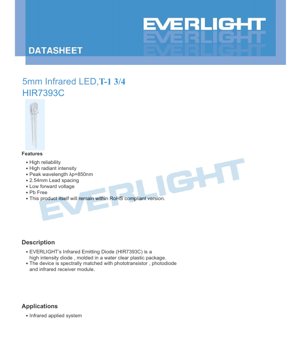
This device is a high-intensity infrared emitting diode (IRED) in a standard T-1 3/4 (5.0mm) package with a transparent plastic lens. It is designed to emit light with a peak wavelength of 850nm, matching its spectral characteristics to common silicon phototransistors, photodiodes, and infrared receiver modules, thereby ensuring reliable operation in sensing and communication systems.
1.1 Key Features and Core Advantages
- High Radiant Intensity:At a forward current of 20mA, the typical radiant intensity can reach 15 mW/sr, enabling strong signal transmission.
- Low Forward Voltage:At a current of 20mA, the typical forward voltage (VF) is 1.45V, which helps reduce circuit power consumption.
- High reliability:Yana da ƙarfi kuma an yi shi da ingantacciyar hanya, yana dacewa da aikace-aikacen masana'antu.
- Ba shi da gubar kuma ya dace da ka'idojin RoHS:Tsarin ƙirƙira ya dace da buƙatun dokokin muhalli.
- Matsakaicin tazarar fil:2.54mm (0.1 inch) pin spacing, compatible with standard breadboards and PCBs.
1.2 Target Market and Applications
This infrared LED is primarily aimed at electronic system designers and engineers who require invisible light sources. Its main application areas areInfrared Application System, widely including:
- Object Detection and Proximity Sensing
- Infrared data transmission (e.g., remote controls, short-range communication)
- Optical encoders and position sensing
- Barrier systems and security sensors
- Industrial Automation and Machine Vision Lighting
2. In-depth Technical Parameter Analysis
2.1 Absolute Maximum Ratings
These ratings define the limits beyond which permanent damage to the device may occur. Operation under these conditions is not guaranteed.
- Continuous Forward Current (IF):100 mA
- Peak Forward Current (IFP):1.0 A (pulse width ≤100μs, duty cycle ≤1%)
- Reverse Voltage (VR):5 V
- Operating Temperature (Topr):-40°C to +85°C
- Storage temperature (Tstg):-40°C to +100°C
- Power Consumption (Pd):150 mW (at 25°C or below free-air temperature)
- Soldering Temperature (Tsol):260°C, duration ≤5 seconds
2.2 Photoelectric Characteristics (Ta=25°C)
These are typical performance parameters under specified test conditions.
- Radiant Intensity (Ie):Min. 7.8, Typ. 15 mW/sr @ IF=20mA. Under pulse conditions, @ IF=100mA, it can reach approximately 50 mW/sr.
- Peak Wavelength (λp):850 nm (typical) @ IF=20mA. This wavelength is close to the peak sensitivity of silicon detectors.
- Spectral Bandwidth (Δλ):45 nm (typical) @ IF=20mA. Defined as the spectral width at half maximum intensity.
- Forward voltage (VF):Typical 1.45V, maximum 1.65V @ IF=20mA. Typical 1.80V, maximum 2.40V @ IF=100mA (pulse).
- Reverse current (IR):Maximum 10 μA @ VR=5V.
- Viewing angle (2θ1/2):45 degrees (typical) @ IF=20mA. This is the half-intensity full angle.
2.3 Thermal Characteristics
The power dissipation rating of 150mW is specified at an ambient temperature of 25°C or below. As the ambient temperature increases, the maximum allowable power dissipation decreases. Designers must refer to the derating curve (implied in the datasheet) to ensure the junction temperature does not exceed the safe limit, which is crucial for long-term reliability. The operating temperature range of -40°C to +85°C makes it suitable for harsh environments.
3. Grading System Description
HIR7393C ina toa daraja daban-daban na aiki ko "binning" dangane da ƙarfin haske da aka auna a IF= 20mA. Wannan yana ba da damar zaɓin na'urar da ta dace da takamaiman buƙatun haske.
Rarraba ƙarfin haske (raka'a: mW/sr):
- M gear:Minimum 7.8, maximum 12.5
- N gear:Minimum 11.0, maximum 17.6
- P gear:Minimum 15.0, maximum 24.0
- Q gear:Minimum value 21.0, maximum value 34.0
Selecting a higher gear (e.g., Q gear) ensures a higher minimum radiant intensity, which is crucial for maximizing the signal-to-noise ratio in sensing applications or increasing infrared transmission distance.
4. Performance Curve Analysis
4.1 Relationship Between Forward Current and Ambient Temperature
The derating curve shows the relationship between the maximum allowable continuous forward current and the ambient temperature. As the temperature increases, the maximum current must be reduced to prevent overheating and ensure the junction temperature remains within safe limits. This curve is crucial for designing reliable circuits, especially in high-temperature environments.
4.2 Spectral Distribution
The spectral distribution curve plots the relationship between relative radiant intensity and wavelength. It confirms the peak emission at 850nm and a spectral bandwidth of approximately 45nm. The curve is relatively symmetrical and centered at 850nm, making it well-suited for matching with silicon-based detectors whose peak sensitivity is around 800-900nm.
4.3 Relationship Between Radiant Intensity and Forward Current
The curve indicates that radiant intensity increases with forward current, but the relationship is not entirely linear, especially at higher currents due to heating and efficiency droop. Operating in pulse mode (as specified in the 100mA test) allows for higher peak intensity without the heat buildup associated with continuous operation.
4.4 Relationship Between Relative Radiant Intensity and Angular Displacement
This polar plot illustrates the spatial emission pattern of the LED. The 45-degree viewing angle (FWHM) indicates a moderate beam width. Intensity is highest at 0 degrees (on-axis) and smoothly decreases towards the edges. This pattern is crucial for designing optical systems to ensure adequate coverage or focus.
5. Mechanical and Packaging Information
5.1 Package Dimensions
The device uses a standard T-1 3/4 (5.0mm diameter) round package. Key dimensions include:
- Total diameter: 5.0mm.
- Pin spacing: 2.54mm (standard).
- Pin diameter: typically 0.45mm.
- Package height: approximately 8.6mm from the mounting plane to the top of the dome.
- Tolerance: ±0.25mm unless otherwise specified in the detailed dimension drawing.
For critical layout and pad design on the PCB, the precise mechanical drawing should be consulted.
5.2 Polarity Identification
The plastic lens of an LED has a flat edge or notch, which typically indicates the cathode (negative) side. The cathode lead is also usually the shorter one, although it may be trimmed during assembly. Always verify the polarity before soldering to prevent damage from reverse bias.
6. Welding and Assembly Guide
6.1 Pin Forming
- Bend the pins at least 3mm away from the epoxy LED base.
- Pin forming should be performedbefore soldering. soldering.
- Proceed. Avoid applying stress to the LED package during the bending process.
- Cut the leads at room temperature.
- Ensure perfect alignment between the PCB holes and the LED leads to avoid installation stress.
6.2 Storage
- Recommended storage conditions: ≤30°C and relative humidity (RH) ≤70%.
- Shelf life under these conditions: 3 months from the date of shipment.
- For longer storage (up to 1 year): use a sealed container with a nitrogen atmosphere and a desiccant.
- Avoid sudden temperature changes in humid environments to prevent condensation.
6.3 Welding Process
General Rules:Maintain a minimum distance of 3mm from the solder joint to the epoxy resin LED.
Manual Soldering:
- Soldering Iron Tip Temperature: Maximum 300°C (Suitable for irons up to 30W).
- Soldering time per pin: maximum 3 seconds.
Dip soldering/Wave soldering:
- Preheating temperature: up to 100°C (maximum 60 seconds).
- Solder pot temperature: up to 260°C.
- Dwell time in solder: maximum 5 seconds.
Key considerations:
- Avoid applying stress to the pins during the high-temperature phase.
- Do not perform more than one dip soldering/hand soldering.
- After soldering, protect the LED from mechanical shock/vibration until it cools to room temperature.
- Avoid rapid cooling processes.
- Use the lowest possible temperature that achieves reliable solder joints.
6.4 Cleaning
- If necessary, clean only with isopropanol at room temperature for ≤1 minute.
- Dry at room temperature before use.
- Avoid ultrasonic cleaning, unless absolutely necessary and pre-verified, as it may cause mechanical damage.
6.5 Thermal Management
Thermal management must be considered during the circuit design stage. Current must be appropriately derated according to the ambient temperature, as shown in the derating curve. Sufficient PCB copper area (thermal pad) around the LED pins helps with heat dissipation. For high-current or high-duty-cycle pulsed operation, additional cooling measures may be required.
7. Packaging and Ordering Information
7.1 Packaging Specifications
- Inner Packaging:500 pieces per anti-static bag.
- Inner Box:5 bags per inner box (total 2500 tablets).
- Outer Carton/Master Carton:10 inner boxes per outer carton (total 25,000 tablets).
7.2 Label Information
The product label contains several key identifiers:
- CPN:Customer Product Number.
- P/N:Manufacturer Product Number (e.g., HIR7393C).
- QTQ:Number of pieces per inner bag.
- CAT:Luminous Intensity Grade (bin code, e.g., M, N, P, Q).
- HUE:Dominant Wavelength Grade.
- REF:Forward voltage level.
- LOT No:Production lot number, used for traceability.
8. Application Suggestions and Design Considerations
8.1 Typical Application Circuit
The most common circuit is in series with a current-limiting resistor. The resistor value is calculated using Ohm's Law: R = (VPower supply- VF) / IF. For example, using a 5V power supply, VF=1.45V, expected IF=20mA: R = (5 - 1.45) / 0.02 = 177.5Ω. A standard 180Ω resistor will be suitable. For pulse operation requiring higher intensity, a transistor or MOSFET switch controlled by a microcontroller is typically used.
8.2 Design Considerations
- Current Drive:Always use a constant current source or a voltage-limited source to drive the LED to prevent thermal runaway.
- Reverse Voltage Protection:The maximum reverse voltage is only 5V. In circuits where reverse bias may occur (e.g., AC coupling, inductive loads), a protection diode should be connected in parallel across the LED (cathode to anode).
- Optical Design:When designing lenses, reflectors, or apertures for the system, consider a 45-degree field of view. Transparent lenses are suitable for use with external optical components.
- Detector Matching:Ensure the paired detectors (phototransistors, photodiodes, receiver ICs) are sensitive in the 850nm region for optimal performance.
9. Technical Comparison and Differentiation
Compared to standard visible LEDs or other infrared LEDs, the HIR7393C offers specific advantages:
- Comparison with visible light LEDs:Emits near-infrared spectrum, invisible to the human eye, making it ideal for covert sensing and communication.
- Comparison with 940nm infrared LEDs:850nm light is more easily detected by standard silicon detectors (which are more sensitive around 800-900nm) and appears as a faint red glow through some digital cameras, aiding in alignment during prototyping.
- Compared to low-power infrared LEDs:Its higher radiant intensity grades (P, Q) provide stronger output, enabling longer distances or better signal integrity in noisy environments.
- Compared to non-standard packages:T-1 3/4 packages are ubiquitous, easy to procure, prototype with, and replace.
10. Frequently Asked Questions (FAQ)
Q1: Can I drive this LED directly with a microcontroller pin?
A: Inategemea uwezo wa microcontroller kutoa mkondo. Pini nyingi za MCU zinaweza kutoa hadi 20mA, lakini hii kawaida ni kikomo cha juu. Ni salama zaidi na kupendekezwa kutumia transistor rahisi (kwa mfano, NPN kama 2N3904) kama swichi kuendesha LED, ikidhibitiwa na pini ya MCU.
Q2: Kwa nini mkondo wa juu wa msukumo (1A) ni mkubwa zaidi kuliko mkondo endelevu (100mA)?
A: Kiasi cha joto kinazalishwa ni sawia na mraba wa mkondo (I2R). A very short pulse (≤100μs) combined with a low duty cycle (≤1%) does not provide sufficient time for the LED chip to accumulate significant heat, thereby preventing thermal damage. Continuous operation at high currents leads to overheating.
Q3: What does "spectral matching" mean?
A: This means the LED's peak emission wavelength (850nm) is well-matched to the peak spectral sensitivity of common silicon-based photodetectors. This match maximizes the electrical signal generated by the detector for a given amount of infrared light, thereby improving system efficiency and signal-to-noise ratio.
Q4: How to select the correct bin (M, N, P, Q)?
A: Zaɓi bisa ga buƙatun hankalin tsarin ku. Idan kuna buƙatar fitarwa mai ƙarfi koyaushe (misali, don nisa mai tsawo ko ratsa abubuwa masu raguwa), ku saka matakin P ko Q. Don aikace-aikacen da ke da hankali ga farashi kuma ba su da buƙatar haske mafi ƙanƙanta, matakin M ko N na iya isa. Duba teburin rarrabawa don samun ainihin ƙimar mafi ƙanƙanta/mafi girma.
11. Practical Design and Usage Examples
11.1 Simple Object Proximity Sensor
A classic application is a reflective object sensor. Place the HIR7393C adjacent to a phototransistor. The LED illuminates the area in front of the sensor. When an object approaches, it reflects the infrared light back to the phototransistor, causing its collector current to increase. This change can be detected by a comparator or microcontroller ADC, thereby triggering an action. The LED's 45-degree beam provides a good balance between spot size and intensity for this type of sensing.
11.2 Infrared Data Link
For simple serial data transmission (e.g., TV remote control), an LED can be driven with high current (e.g., 100mA pulses) according to the modulated digital signal (e.g., 38kHz carrier). The high radiant intensity in pulse mode allows for a reasonable transmission distance. The receiving end will use a matching infrared receiver module (with built-in demodulator) tuned to the same frequency.
12. Working Principle
An infrared light-emitting diode (IRED) is a semiconductor p-n junction diode. When forward-biased, electrons from the n-region and holes from the p-region are injected into the active region. When these carriers recombine, they release energy. In an IRED made of gallium aluminum arsenide (GaAlAs), this energy is released primarily as photons in the infrared spectrum (approximately 850nm in this case). The transparent epoxy package acts as a lens, shaping the emitted light into a characteristic beam pattern. The efficiency of this electroluminescent process determines the radiant intensity for a given drive current.
13. Technology Trends
Duk da cewa ainihin T-1 3/4 kunshe da fasahar 850nm sun cika shekaru, abubuwan da ke faruwa na infrared LED sun haɗa da:
- Higher Efficiency:Continuous improvements in materials science aim to produce more optical power (radiant intensity) per unit of electrical input power, reducing heat generation and energy consumption.
- Narrower Spectrum:Some applications, such as gas sensing or high-speed communications, benefit from LEDs with very specific, narrow emission wavelengths.
- Integrated Devices:Trends include combining infrared LEDs and photodetectors in a single package (opto-coupler style) or integrating them with driving circuits to enable simpler system integration.
- Miniaturization:Although the 5mm package remains popular, Surface Mount Device (SMD) packages are becoming increasingly common for automated assembly and compact designs.
- Eye Safety:The HIR7393C represents a reliable, easy-to-understand component that continues to serve as a fundamental building block in a wide range of electronic sensing and control systems.
The HIR7393C represents a reliable, well-understood component that continues to serve as a fundamental building block in a wide array of electronic sensing and control systems.
Detailed Explanation of LED Specification Terminology
Complete Explanation of LED Technical Terminology
I. Core Indicators of Photoelectric Performance
| Terminology | Unit/Representation | Popular Explanation | Why It Is Important |
|---|---|---|---|
| Luminous Efficacy | lm/W (lumens per watt) | The luminous flux emitted per watt of electrical energy, the higher the more energy-efficient. | Directly determines the energy efficiency class and electricity cost of the luminaire. |
| Luminous Flux | lm (lumen) | The total amount of light emitted by a light source, commonly known as "brightness". | Determine if the lamp is bright enough. |
| Viewing Angle | ° (degree), such as 120° | The angle at which light intensity drops to half, determining the beam's width. | Affects the illumination range and uniformity. |
| Color Temperature (CCT) | K (Kelvin), e.g., 2700K/6500K | The warmth or coolness of light color; lower values are yellowish/warm, higher values are whitish/cool. | Determines the lighting atmosphere and suitable application scenarios. |
| Color Rendering Index (CRI / Ra) | No unit, 0–100 | The ability of a light source to reproduce the true colors of objects, Ra≥80 is recommended. | Affects color fidelity, used in high-demand places such as shopping malls and art galleries. |
| Color Tolerance (SDCM) | MacAdam Ellipse Steps, e.g., "5-step" | Quantitative indicator of color consistency, smaller step value indicates better color consistency. | Ensure no color difference among luminaires from the same batch. |
| Dominant Wavelength | nm (nanometer), e.g., 620nm (red) | The wavelength value corresponding to the color of a colored LED. | Determine the hue of monochromatic LEDs such as red, yellow, and green. |
| Spectral Distribution | Wavelength vs. Intensity Curve | Shows the intensity distribution of light emitted by an LED across various wavelengths. | Affects color rendering and color quality. |
II. Electrical Parameters
| Terminology | Symbols | Popular Explanation | Design Considerations |
|---|---|---|---|
| Forward Voltage | Vf | Minimum voltage required to turn on an LED, similar to a "starting threshold". | The driving power supply voltage must be ≥ Vf, and the voltage adds up when multiple LEDs are connected in series. |
| Forward Current | If | The current value that allows the LED to emit light normally. | Constant current drive is commonly used, where the current determines brightness and lifespan. |
| Maximum Pulse Current | Ifp | Peak current that can be withstood in a short time, used for dimming or flashing. | Pulse width and duty cycle must be strictly controlled, otherwise overheating damage will occur. |
| Reverse Voltage | Vr | The maximum reverse voltage that an LED can withstand; exceeding it may cause breakdown. | The circuit needs to prevent reverse connection or voltage surge. |
| Thermal Resistance | Rth (°C/W) | The resistance to heat flow from the chip to the solder joint. A lower value indicates better heat dissipation. | High thermal resistance requires a more robust thermal design; otherwise, the junction temperature will increase. |
| Electrostatic Discharge Immunity (ESD Immunity) | V (HBM), such as 1000V | Anti-static strike capability, the higher the value, the less susceptible to damage from static electricity. | Anti-static measures must be implemented during production, especially for high-sensitivity LEDs. |
III. Thermal Management and Reliability
| Terminology | Key Indicators | Popular Explanation | Impact |
|---|---|---|---|
| Junction Temperature | Tj (°C) | The actual operating temperature inside the LED chip. | For every 10°C reduction, the lifespan may double; excessively high temperatures lead to lumen depreciation and color shift. |
| Lumen Depreciation | L70 / L80 (hours) | The time required for brightness to drop to 70% or 80% of its initial value. | Directly defines the "useful life" of an LED. |
| Lumen Maintenance | % (e.g., 70%) | Percentage of remaining brightness after a period of use. | Characterizes the ability to maintain brightness after long-term use. |
| Color Shift | Δu′v′ or MacAdam Ellipse | The degree of color change during use. | Affects the color consistency of the lighting scene. |
| Thermal Aging | Material performance degradation | Degradation of packaging materials due to long-term high temperature. | May lead to decreased brightness, color shift, or open-circuit failure. |
IV. Encapsulation and Materials
| Terminology | Common Types | Popular Explanation | Characteristics and Applications |
|---|---|---|---|
| Package Type | EMC, PPA, Ceramic | The housing material that protects the chip and provides optical and thermal interfaces. | EMC has good heat resistance and low cost; ceramic has excellent heat dissipation and long lifespan. |
| Chip structure | Front-side, Flip Chip | Chip Electrode Layout. | Flip-chip offers better heat dissipation and higher luminous efficacy, suitable for high-power applications. |
| Phosphor coating | YAG, Silicate, Nitride | Covered on the blue light chip, partially converted into yellow/red light, mixed into white light. | Different phosphors affect luminous efficacy, color temperature, and color rendering. |
| Lens/Optical Design | Flat, Microlens, Total Internal Reflection | Optical structure on the encapsulation surface, controlling light distribution. | Determines the emission angle and light distribution curve. |
V. Quality Control and Binning
| Terminology | Grading Content | Popular Explanation | Purpose |
|---|---|---|---|
| Luminous Flux Grading | Codes such as 2G, 2H | Grouped by brightness level, each group has a minimum/maximum lumen value. | Ensure uniform brightness for products within the same batch. |
| Voltage binning | Codes such as 6W, 6X | Group by forward voltage range. | Facilitates driver power matching and improves system efficiency. |
| Color Grading | 5-step MacAdam Ellipse | Group by color coordinates to ensure colors fall within a minimal range. | Ensure color consistency to avoid uneven colors within the same luminaire. |
| Color temperature binning | 2700K, 3000K, etc. | Grouped by color temperature, each group has a corresponding coordinate range. | To meet the color temperature requirements of different scenarios. |
VI. Testing and Certification
| Terminology | Standard/Test | Popular Explanation | Meaning |
|---|---|---|---|
| LM-80 | Lumen Maintenance Test | Long-term illumination under constant temperature conditions, recording brightness attenuation data. | Used to estimate LED lifetime (combined with TM-21). |
| TM-21 | Standard for Life Projection | Projecting the actual service life based on LM-80 data. | Provide scientific life prediction. |
| IESNA standard | Standard of the Illuminating Engineering Society | Covers optical, electrical, and thermal testing methods. | Industry-recognized testing basis. |
| RoHS / REACH | Environmental certification | Ensure the product does not contain harmful substances (e.g., lead, mercury). | Entry requirements for the international market. |
| ENERGY STAR / DLC | Energy Efficiency Certification | Energy efficiency and performance certification for lighting products. | Yawan da ake amfani da shi a cikin sayayyar gwamnati da ayyukan tallafi, don haɓaka gasar kasuwa. |