Table of Contents
- 1. Product Overview
- 1.1 Core Advantages and Target Market
- 2. In-depth Analysis of Technical Parameters
- 2.1 Absolute Maximum Ratings
- 2.2 Electro-Optical Characteristics
- 3. Performance Curve Analysis
- 3.1 Spectral Distribution and Directivity
- 3.2 Electrical and Thermal Relations
- 3.3 Temperature Dependence
- 4. Mechanical and Packaging Information
- 4.1 Package Dimensions
- 4.2 Polarity Identification
- 5. Welding and Assembly Guide
- 5.1 Pin Forming
- 5.2 Storage
- 5.3 Welding Process
- 5.4 Cleaning
- 5.5 Thermal Management and ESD Protection
- 6. Packaging and Ordering Information
- 6.1 Packaging Specifications
- 6.2 Label Description
- 7. Application Suggestions and Design Considerations
- 7.1 Typical Application Scenarios
- 7.2 Design Considerations
- 8. Frequently Asked Questions (Based on Technical Specifications)
- 9. Technical Introduction and Development Trends
- 9.1 Working Principle
- 9.2 Industry Trends
1. Product Overview
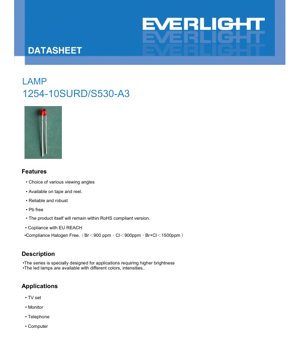
本文档提供了一款高亮度亮红色LED灯珠的完整技术规格。该器件属于专为要求卓越光输出和可靠性的应用而设计的系列产品。它采用AlGaInP芯片技术,封装在红色漫射树脂中,可发出独特的亮红色光。该产品设计注重坚固性,并符合现代环保与安全标准,包括无铅、符合RoHS指令、符合欧盟REACH法规,并满足无卤要求(溴含量≤900 ppm,氯含量≤900 ppm,溴+氯总含量≤1500 ppm)。产品提供编带包装,适用于自动化组装流程。<900 ppm,氯<900 ppm,溴+氯<1500 ppm)。产品提供编带包装,适用于自动化组装流程。
1.1 Core Advantages and Target Market
The main advantage of this LED lies in the combination of its high luminous intensity (typical value up to 400 mcd) and a reliable, robust structure. It offers a variety of viewing angle options (this specific model has a 30° half-angle), allowing designers to select the optimal beam pattern for their application. It complies with international environmental directives, making it suitable for the global market. Target applications are primarily focused in the consumer electronics field, including televisions, computer monitors, telephones, and general computing devices that require indicator lights or backlighting functions.
2. In-depth Analysis of Technical Parameters
This section provides an objective and detailed analysis of the device's key technical parameters based on the datasheet.
2.1 Absolute Maximum Ratings
Absolute Maximum Ratings define the stress limits that could cause permanent damage to the device. These are not normal operating conditions.
- Continuous Forward Current (IF)): 25 mA. Exceeding this current continuously will generate excessive heat, shorten the LED lifespan, and may lead to catastrophic failure.
- Peak Forward Current (IFP)): 60 mA (duty cycle 1/10, frequency 1 kHz). This rating allows for short-duration high-current pulses, suitable for multiplexing or PWM dimming schemes, but the average current must remain within the continuous rating.
- Reverse Voltage (VR)): 5 V. The reverse breakdown voltage of an LED is very low. Applying a reverse voltage exceeding 5V may cause immediate and irreversible junction breakdown.
- Power Dissipation (Pd)): 60 mW. This is at ambient temperature (Ta) is the maximum thermal power that the package can dissipate at 25°C. The actual usable power dissipation decreases as the ambient temperature increases.
- Operating and Storage Temperature: -40°C to +85°C (operating), -40°C to +100°C (storage). These ranges define the environmental conditions the device can withstand during use and non-operating periods.
- Soldering Temperature: 260°C for 5 seconds. This is crucial for wave soldering or reflow soldering processes to avoid thermal damage to the epoxy package and internal wire bonding.
2.2 Electro-Optical Characteristics
These characteristics are measured under standard test conditions (Ta=25°C, IF=20mA) measured, defining the device's performance.
- Luminous intensity (Iv)): 250 mcd (min), 400 mcd (typ). This is the primary metric for measuring brightness. A typical value of 400 mcd indicates very bright output for a standard LED lamp bead. Designers should use the minimum value for worst-case brightness calculations.
- Viewing angle (2θ1/2)): 30° (typical value). This is the full angle at which the luminous intensity drops to half of its peak. The 30° angle produces a relatively focused beam, suitable for directional indicator lights.
- Peak wavelength (λp)): 632 nm (typical value). The wavelength at which spectral emission is strongest. For a bright red color, this falls in the upper red/orange region of the spectrum.
- Dominant Wavelength (λd)): 624 nm (Typical). This is the single wavelength that matches the color of the LED light as perceived by the human eye. It is a key parameter for color specification.
- Forward Voltage (VF)): 1.7V (Min), 2.0V (Typ), 2.4V (Max) at 20mA. This is the voltage drop across the LED when operating. It is crucial for designing the current limiting circuit. The driver must be able to handle the maximum VFto ensure proper current regulation.
- Reverse current (IR)): 10 μA (max) at VR=5V. This is the small leakage current when the diode is reverse-biased within its maximum ratings.
Measurement uncertaintyThe specification sheet notes the specific measurement tolerances: VFis ±0.1V, Ivis ±10%, λdis ±1.0nm. These tolerances must be considered in high-precision applications.
3. Performance Curve Analysis
The provided characteristic curves offer deeper insights into the device's behavior under various conditions.
3.1 Spectral Distribution and Directivity
Relative Intensity vs. WavelengthThe curve shows a typical Gaussian-like distribution centered at 632 nm, with a spectral bandwidth (Δλ) of approximately 20 nm. This narrow bandwidth is characteristic of AlGaInP LEDs and produces saturated colors.DirectivityThe curve visually confirms the 30° viewing angle, showing how intensity symmetrically decreases as the angle deviates from the central axis.
3.2 Electrical and Thermal Relations
Forward Current vs. Forward Voltage (I-V Curve)It demonstrates the classic exponential diode relationship. At the typical operating point of 20mA, the voltage is 2.0V. This curve is crucial for understanding the dynamic resistance of the LED and for thermal analysis, as VFhas a negative temperature coefficient.
Relative Intensity vs. Forward CurrentThe curve shows that in the lower current range, the light output is nearly linear with current, but may saturate at higher currents due to thermal effects and efficiency droop. Operating at 20mA or below is optimal for linearity and lifetime.
3.3 Temperature Dependence
Relative Intensity vs. Ambient TemperatureThe curve indicates that the light output decreases significantly as the temperature increases. This is a critical design factor; compared to laboratory conditions at 25°C, LEDs will dim in high-temperature environments (e.g., inside enclosed electronic devices).
Forward Current vs. Ambient TemperatureThe curve, combined with the power dissipation rating, constitutesDeratingThe foundation. As the ambient temperature increases, the maximum allowable continuous forward current must be reduced to keep the junction temperature within safe limits and prevent accelerated aging. The datasheet recommends consulting the specific derating curve for the product.
4. Mechanical and Packaging Information
4.1 Package Dimensions
The datasheet includes detailed dimensional drawings of the LED chip. Key mechanical specifications include:
- All dimensions are in millimeters.
- The height of the flange (the edge at the bottom of the dome) must be less than 1.5mm (0.059 inches). This is critical for clearance in the final assembly.
- The standard tolerance for unspecified dimensions is ±0.25mm, which is typical for such components.
- The drawing defines the pin pitch, body diameter, overall height, and lens shape. Precise dimensions are crucial for PCB pad design and ensuring proper fit within the housing or lens.
4.2 Polarity Identification
The cathode (negative) pin is typically identified by a flat on the LED lens, a shorter lead, or a marking on the package. The dimensional drawing should clearly indicate this. Correct polarity during installation is critical, as applying reverse voltage will damage the device.
5. Welding and Assembly Guide
Proper handling is crucial for reliability. These guidelines are based on preventing mechanical, thermal, and electrostatic damage.
5.1 Pin Forming
- Bending must occur at least 3mm away from the base of the epoxy lamp bead to avoid stress transfer to the internal chip and wire bonding.
- Molding must be completedBefore soldering soldering.
- Completed. Pins should be cut at room temperature to prevent thermal shock.
- PCB holes must be perfectly aligned with LED pins to avoid mounting stress.
5.2 Storage
- Recommended storage conditions: temperature ≤30°C, relative humidity (RH) ≤70%.
- Shelf life after transport: 3 months under these conditions.
- For longer storage (up to 1 year), use a sealed container with nitrogen and desiccant.
- Avoid sudden temperature changes in humid environments to prevent condensation.
5.3 Welding Process
Manual Welding: Soldering iron tip temperature ≤300°C (applicable for a maximum 30W iron), soldering time per pin ≤3 seconds. Maintain a minimum distance of 3mm from the solder point to the epoxy resin LED.
Wave Soldering (Dip Soldering): Preheat ≤100°C, time ≤60 seconds. Solder bath temperature ≤260°C, time ≤5 seconds. Observe the 3mm distance rule.
Key Soldering Considerations:
- Avoid applying stress to the pins during the high-temperature stage.
- Do not perform multiple soldering (wave soldering or hand soldering) on the same LED.
- After soldering, protect the LED from mechanical impact until it cools down to room temperature.
- Allow gradual cooling; avoid rapid quenching.
- Always use the lowest effective soldering temperature and time.
5.4 Cleaning
If cleaning is required:
- Use isopropyl alcohol at room temperature.
- Soaking time should not exceed one minute.
- Air dry at room temperature.
- Avoid ultrasonic cleaning., unless absolutely necessary, and only after sufficient pre-qualification testing, as cavitation may damage internal structures.
5.5 Thermal Management and ESD Protection
Thermal Management: Effective thermal design is essential. Current must be derated according to ambient temperature, as shown in the product's derating curve. Controlling the LED's operating temperature is key to maintaining brightness and long-term reliability.
Electrostatic Discharge (ESD)This LED is sensitive to ESD. Standard ESD precautions must be followed during handling and assembly: use grounded workstations, wrist straps, and conductive containers. ESD can cause latent or catastrophic damage to the semiconductor chip.
6. Packaging and Ordering Information
6.1 Packaging Specifications
Device packaging aims to ensure moisture resistance and protection against electrostatic discharge.
- Primary packaging: 200-1000 pieces per antistatic bag.
- Secondary packaging: 4 bags per inner box.
- Tertiary packagingEach master (outer) carton contains 10 inner boxes.
6.2 Label Description
The label on the packaging contains key information for traceability and identification.
- CPN: Customer Part Number.
- P/N: Manufacturer Part Number (e.g., 1254-10SURD/S530-A3).
- QTY: Quantity per Bag/Box.
- CAT: Code for grade or classification (e.g., for intensity or wavelength).
- HUE: Code for dominant wavelength.
- REF: Reference Information.
- LOT NoProduction batch number, used for traceability.
7. Application Suggestions and Design Considerations
7.1 Typical Application Scenarios
LED hii inafaa kabisa kutumika kwa:
- Kiashiria cha hali: Kiashiria cha kuwashwa kwa umeme, kusubiri, au kuwashwa kwa utendaji kwenye Runinga, Monisha, na Kompyuta, mwangaza wa juu unahakikisha kuonekana vizuri.
- Backlight: Used to control small legends or symbols on panels or telephones.
- General Signal IndicationAny application in consumer electronics that requires clear, bright red visual signals.
7.2 Design Considerations
- Current LimitingAlways use a constant current source or a voltage source with a series resistor to drive the LED. Based on the power supply voltage (VCC), the maximum VFof the LED, and the required IF(For example, 20mA) Calculate the resistance value. R = (VCC- VF_max) / IF.
- Thermal Management: Ensure the PCB and surrounding design allow for heat dissipation. Avoid placing LEDs near other heat-generating components. If a high duty cycle or high ambient temperature is expected, consider using thermal vias on the PCB pads.
- Optical Integration: A 30° viewing angle provides a focused beam. For wider illumination, an external diffuser or lens may be required. Ensure the mechanical housing provides correct alignment and does not obstruct the viewing angle.
- Electrostatic ProtectionIn sensitive or exposed applications, consider connecting a small transient voltage suppression (TVS) diode or an RC network in parallel across the LED to protect it from voltage spikes.
8. Frequently Asked Questions (Based on Technical Specifications)
Q1: Ina iya amfani da 30mA don kunna wannan LED don ƙarin haske?
A1: A'a. Matsakaicin madaidaicin madaidaicin halin yanzu na ci gaba shine 25 mA. Yin aiki a 30 mA ya wuce wannan ƙimar, wanda zai sa haɗin gwiwa ya fuskanci matsin lamba, haifar da raguwar haske da sauri, canjin launi, kuma mai yuwuwar gazawa nan take. Koyaushe yi aiki a ƙarƙashin ƙayyadaddun matsakaicin halin yanzu na ci gaba ko ƙasa da shi.
Q2: Na yau da kullun VFshine 2.0V, amma da'irata tana amfani da wutar lantarki 5V. Wane ƙimar resistor ya kamata in yi amfani da shi?
A2: You must design for the worst-case (maximum) VFto ensure the current never exceeds the limit. Using VF_max= 2.4V and IF= 20mA: R = (5V - 2.4V) / 0.02A = 130 ohms. The nearest standard values are 130Ω or 150Ω. Using 150Ω, IF≈ (5-2.4)/150 = 17.3mA, this is a safe and common operating point.
Q3: If the internal temperature of my device is 60°C, how much will the brightness decrease?
A3: Referring to the Relative Intensity vs. Ambient Temperature curve, at 60°C, the relative intensity is approximately 0.8 (or 80%) of its value at 25°C. Therefore, if the LED outputs 400 mcd at 25°C, it will output approximately 320 mcd at 60°C. This must be considered in the optical design.
Q4: Is this LED suitable for automotive applications?
A4: The specified operating temperature range (-40°C to +85°C) covers many automotive environmental requirements. However, automotive applications typically require components to comply with specific standards (such as AEC-Q102) to ensure reliability under vibration, humidity, and extended temperature cycling. This standard datasheet does not indicate such certification. For automotive use, product models specifically certified should be sought.
9. Technical Introduction and Development Trends
9.1 Working Principle
This LED is based on an AlGaInP (aluminum gallium indium phosphide) semiconductor chip. When a forward voltage is applied, electrons and holes are injected into the active region of the semiconductor, where they recombine. This recombination process releases energy in the form of photons (light). The specific composition of the AlGaInP alloy determines the bandgap energy, which directly defines the wavelength (color) of the emitted light—in this case, a bright red of approximately 624-632 nm. The red diffused epoxy package serves to protect the chip, acts as the primary lens to shape the beam (30° angle), and diffuses the light to reduce glare and create a uniform appearance.
9.2 Industry Trends
LED industry continues to develop, with several distinct trends influencing such components:
- Efficiency improvement (lm/W): Although this datasheet specifies luminous intensity (mcd), the broader trend is to improve luminous efficacy, i.e., generating more light output per input electrical watt, thereby reducing energy consumption and thermal load.
- Miniaturization: The package is continuously shrinking while maintaining or improving light output.
- Enhanced Reliability and LifespanImprovements in chip design, packaging materials (such as using silicone instead of epoxy resin for better heat and UV resistance), and manufacturing processes are pushing the rated lifespan far beyond 50,000 hours.
- Stricter environmental complianceAs demonstrated by this product, the move toward halogen-free, RoHS, and REACH compliance has now become a fundamental requirement driven by global regulations and consumer demand.
- Smart and Integrated SolutionsThe trend is shifting from discrete indicator lights to LED modules with integrated built-in drivers (ICs) and controllers, enabling features such as dimming, color mixing, and communication protocols like I2C.
While this specific LED represents a mature and well-established technology for standard indicator applications, its specifications reflect the ongoing market demand for performance, reliability, and environmental responsibility in electronic components.
Detailed Explanation of LED Specification Terminology
Complete Interpretation of LED Technical Terminology
I. Core Indicators of Photoelectric Performance
| Terminology | Unit/Representation | Popular Explanation | Why It Matters |
|---|---|---|---|
| Luminous Efficacy | lm/W (lumens per watt) | The luminous flux emitted per watt of electrical power, higher values indicate greater energy efficiency. | It directly determines the energy efficiency rating of the luminaire and the electricity cost. |
| Luminous Flux | lm (lumen) | The total amount of light emitted by a light source, commonly known as "brightness". | Determining whether the lighting is sufficiently bright. |
| Viewing Angle | ° (degree), e.g., 120° | The angle at which luminous intensity drops to half, determining the beam width. | Affects the range and uniformity of illumination. |
| Color Temperature (CCT) | K (Kelvin), such as 2700K/6500K | Haske launin dumi da sanyi, ƙananan ƙima sun karkata zuwa rawaya/dumi, manyan ƙima sun karkata zuwa fari/sanyi. | Yana ƙayyade yanayin haske da yanayin da ya dace. |
| Color Rendering Index (CRI / Ra) | Unitless, 0–100 | The ability of a light source to reproduce the true colors of objects, with Ra≥80 being preferable. | Affects color fidelity, used in high-demand places such as shopping malls and art galleries. |
| Color tolerance (SDCM) | MacAdam ellipse step, such as "5-step" | A quantitative indicator of color consistency; a smaller step number indicates better color consistency. | Ensure no color difference among luminaires from the same batch. |
| Dominant Wavelength | nm (nanometer), e.g., 620nm (red) | Wavelength values corresponding to the colors of colored LEDs. | Determines the hue of monochromatic LEDs such as red, yellow, and green. |
| Spectral Distribution | Wavelength vs. Intensity Curve | Shows the intensity distribution of light emitted by an LED at each wavelength. | Affects color rendering and color quality. |
II. Electrical Parameters
| Terminology | Symbol | Popular Explanation | Design Considerations |
|---|---|---|---|
| Forward Voltage (Forward Voltage) | Vf | The minimum voltage required to light up an LED, similar to a "starting threshold". | The driving power supply voltage must be ≥ Vf; voltages add up when multiple LEDs are connected in series. |
| Forward Current | If | The current value that makes the LED emit light normally. | Constant current drive is often used, as the current determines brightness and lifespan. |
| Maximum Pulse Current | Ifp | Peak current that can be withstood for a short period, used for dimming or flashing. | Pulse width and duty cycle must be strictly controlled, otherwise overheating damage will occur. |
| Reverse Voltage | Vr | Maximum reverse voltage that an LED can withstand; exceeding it may cause breakdown. | Reverse connection or voltage surges must be prevented in the circuit. |
| Thermal Resistance (Thermal Resistance) | Rth (°C/W) | The resistance to heat flow from the chip to the solder joint. A lower value indicates better heat dissipation. | High thermal resistance requires stronger cooling design, otherwise junction temperature rises. |
| Electrostatic Discharge Immunity (ESD Immunity) | V (HBM), such as 1000V | Electrostatic discharge immunity; a higher value indicates greater resistance to damage from static electricity. | Anti-static measures must be implemented during production, especially for high-sensitivity LEDs. |
III. Thermal Management and Reliability
| Terminology | Key Indicators | Popular Explanation | Impact |
|---|---|---|---|
| Junction Temperature | Tj (°C) | The actual operating temperature inside the LED chip. | For every 10°C reduction, the lifespan may double; excessively high temperatures lead to lumen depreciation and color shift. |
| Lumen Depreciation | L70 / L80 (hours) | The time required for the brightness to drop to 70% or 80% of its initial value. | Directly define the "useful life" of an LED. |
| Lumen Maintenance | % (e.g., 70%) | The percentage of remaining brightness after a period of use. | Characterizes the ability to maintain brightness after long-term use. |
| Color Shift | Δu′v′ or MacAdam ellipse | The degree of color change during use. | Affects the color consistency of the lighting scene. |
| Thermal Aging | Material performance degradation | Degradation of packaging materials due to long-term high temperature. | Zai iya haifar da raguwar haske, canjin launi ko gazawar bude hanya. |
IV. Kullewa da Kayan aiki
| Terminology | Nau'o'in da aka saba gani | Popular Explanation | Characteristics and Applications |
|---|---|---|---|
| Package Types | EMC, PPA, Ceramics | The housing material that protects the chip and provides optical and thermal interfaces. | EMC offers good heat resistance and low cost; ceramics provide superior heat dissipation and long lifespan. |
| Chip Structure | Front-side, Flip Chip | Chip electrode arrangement method. | Flip-chip offers better heat dissipation and higher luminous efficacy, suitable for high-power applications. |
| Phosphor coating. | YAG, silicate, nitride | Coated on the blue LED chip, partially converted to yellow/red light, mixed to form white light. | Different phosphors affect luminous efficacy, color temperature, and color rendering. |
| Lens/Optical Design | Flat, microlens, total internal reflection | Optical structure on the packaging surface, controlling light distribution. | Determines the emission angle and light distribution curve. |
V. Quality Control and Grading
| Terminology | Grading Content | Popular Explanation | Purpose |
|---|---|---|---|
| Luminous Flux Binning | Codes such as 2G, 2H | Group by brightness level, each group has a minimum/maximum lumen value. | Ensure consistent brightness for products in the same batch. |
| Voltage binning | Code such as 6W, 6X | Grouped by forward voltage range. | Ease of driving power matching, improving system efficiency. |
| Color binning | 5-step MacAdam ellipse | Group by color coordinates to ensure colors fall within a minimal range. | Ensure color consistency to avoid uneven colors within the same luminaire. |
| Color temperature grading | 2700K, 3000K, etc. | Group by color temperature, each group has a corresponding coordinate range. | Meet the color temperature requirements of different scenarios. |
VI. Testing and Certification
| Terminology | Standard/Test | Popular Explanation | Meaning |
|---|---|---|---|
| LM-80 | Lumen Maintenance Test | Long-term operation under constant temperature conditions, recording luminance attenuation data. | For estimating LED lifetime (in conjunction with TM-21). |
| TM-21 | Lifetime projection standard | Projecting lifespan under actual use conditions based on LM-80 data. | Providing scientific life prediction. |
| IESNA Standard | Illuminating Engineering Society Standard | Covers optical, electrical, and thermal testing methods. | Industry-recognized testing basis. |
| RoHS / REACH | Environmental Certification | Ensure the product does not contain harmful substances (such as lead, mercury). | Entry conditions for the international market. |
| ENERGY STAR / DLC | Energy efficiency certification | Energy efficiency and performance certification for lighting products. | Commonly used in government procurement and subsidy programs to enhance market competitiveness. |