Table of Contents
- 1. Product Overview
- 1.1 Target Applications
- 2. Technical Parameters: In-Depth Objective Interpretation
- 2.1 Absolute Maximum Ratings
- 2.2 Electro-Optical Characteristics
- 3. Performance Curve Analysis
- 3.1 Relative Intensity vs. Wavelength
- 3.2 Directivity Pattern
- 3.3 Forward Current vs. Forward Voltage (IV Curve)
- 3.4 Relative Intensity vs. Forward Current
- 3.5 Thermal Characteristics
- 4. Mechanical and Package Information
- 4.1 Package Dimensions
- 4.2 Polarity Identification
- 5. Soldering and Assembly Guidelines
- 5.1 Lead Forming
- 5.2 Storage
- 5.3 Soldering Process
- 5.4 Cleaning
- 6. Thermal Management and Reliability
- 7. Electrostatic Discharge (ESD) Protection
- 8. Packing and Ordering Information
- 8.1 Packing Specification
- 8.2 Label Explanation
- 9. Application Suggestions and Design Considerations
- 9.1 Circuit Design
- 9.2 PCB Layout
- 9.3 Optical Design
- 10. Technical Comparison and Differentiation
- 11. Frequently Asked Questions (Based on Technical Parameters)
- 12. Practical Application Example
- 13. Operating Principle Introduction
- 14. Technology Trends and Context
1. Product Overview
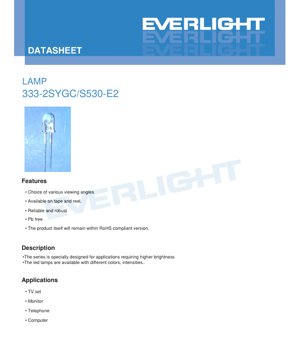
Takardar tana ba da cikakken ƙayyadaddun fasaha don fitilar LED 333-2SYGC/S530-E2. Wannan ɓangaren na'urar ne mai hawa a saman (SMD) wanda aka ƙera don aikace-aikacen da ke buƙatar haske mai ƙarfi da ingantaccen aiki a cikin ƙaramin siffa. LED tana fitar da haske mai haske rawaya-kore, wanda aka samu ta hanyar guntu na'urar semiconductor AlGaInP (Aluminum Gallium Indium Phosphide) wanda aka lulluɓe a cikin kunshin guduro mai tsabta. Wannan haɗin yana ba da kyakkyawan ƙarfin haske da tsaftar launi.
Jerin yana da halayen ginin sa mai ƙarfi, rashin gubar (Pb-free), da bin umarnin RoHS (Ƙuntata Abubuwa masu haɗari), wanda ya sa ya dace da masana'antar lantarki na zamani. Ana samunsa akan tef da reel don hanyoyin haɗawa ta atomatik, yana goyan bayan samarwa mai yawa.
1.1 Target Applications
The primary application areas for this LED lamp include backlighting and status indication in consumer and industrial electronics. Typical use cases are:
- Television sets (TV)
- Computer monitors
- Telephones
- Desktop and laptop computers
Its design makes it suitable for both indicator functions and area illumination where a distinct yellow-green signal is required.
2. Technical Parameters: In-Depth Objective Interpretation
This section provides a detailed analysis of the key electrical, optical, and thermal parameters defined in the datasheet. Understanding these values is critical for proper circuit design and ensuring long-term reliability.
2.1 Absolute Maximum Ratings
Absolute Maximum Ratings yana bayyana iyakokin damuwa wanda bayan su, lahani na dindindin na na'urar zai iya faruwa. Wadannan ba sharuddan aiki na yau da kullun ba ne.
- Continuous Forward Current (IF): 25 mA. Wannan shine matsakaicin ƙarfin DC wanda za'a iya amfani dashi akai-akai ba tare da lalata aikin LED ko tsawon rayuwarsa ba.
- Peak Forward Current (IFP): 60 mA. Oyi rating na yi ya shafi aikin pulsed tare da duty cycle na 1/10 a 1 kHz. Yana ba da damar ɗan gajeren lokaci na mafi girma na halin yanzu, mai amfani ga multiplexing ko cimma mafi girma haske na nan take.
- Reverse Voltage (VR): 5 V. Exceeding this voltage in the reverse direction can cause junction breakdown.
- Power Dissipation (Pd): 60 mW. This is the maximum power the package can dissipate as heat at an ambient temperature (Ta) of 25°C. Operating above this limit requires careful thermal management.
- Operating & Storage Temperature: The device can function from -40°C to +85°C and be stored from -40°C to +100°C.
- Soldering Temperature (Tsol): The leads can withstand 260°C for 5 seconds, which is compatible with standard lead-free reflow soldering profiles.
2.2 Electro-Optical Characteristics
These parameters are measured under standard test conditions (Ta=25°C, IF=20mA) and represent the typical performance of the device.
- Luminous Intensity (Iv): 400 mcd (Min), 800 mcd (Typ). This specifies the amount of visible light emitted in a given direction. The high typical value indicates a bright output suitable for many indicator applications.
- Viewing Angle (2θ1/2): 10° (Typ). This narrow viewing angle indicates a highly directional light beam, concentrating the luminous intensity within a small cone. This is ideal for applications where light needs to be directed precisely.
- Peak & Dominant Wavelength (λp, λd): Kusan da kusan 575 nm da 573 nm, bi da bi. Wannan ya sanya launin da aka fitar a cikin yankin rawaya-kore na bakan gani. Kusan kimar tsayin raƙuman ruwa da rinjaye suna nuna kyakkyawan jikewa launi.
- Spectrum Radiation Bandwidth (Δλ): 20 nm (Typ). This defines the spectral width of the emitted light at half its maximum intensity (Full Width at Half Maximum - FWHM). A value of 20 nm is typical for monochromatic LEDs.
- Forward Voltage (VF): 2.0 V (Typ), 2.4 V (Max) at 20mA. This is the voltage drop across the LED when operating. It is crucial for designing the current-limiting circuitry. The datasheet notes a measurement uncertainty of ±0.1V for this parameter.
- Reverse Current (IR): 10 μA (Max) at VR=5V. This is the leakage current when the LED is reverse-biased.
3. Performance Curve Analysis
The datasheet includes several characteristic curves that illustrate how the LED's performance varies with different operating conditions. These graphs are essential for understanding behavior beyond the single-point specifications.
3.1 Relative Intensity vs. Wavelength
Curve hii inaonyesha usambazaji wa nguvu ya wigo wa mwanga unaotolewa. Itafikia kilele karibu 575 nm (manjano-kijani) na FWHM ya kawaida ya 20 nm, ikithibitisha hali ya monochromatic ya pato.
3.2 Directivity Pattern
This polar plot visualizes the 10° viewing angle, showing how the luminous intensity decreases sharply as the observation angle moves away from the central axis (0°).
3.3 Forward Current vs. Forward Voltage (IV Curve)
This graph depicts the exponential relationship between current (I) and voltage (V) for a semiconductor diode. For designers, it highlights that a small change in forward voltage can lead to a large change in current, underscoring the importance of using a constant-current driver or a well-calculated current-limiting resistor.
3.4 Relative Intensity vs. Forward Current
This curve shows that light output (intensity) increases with forward current, but the relationship is not perfectly linear, especially at higher currents. It also implies that efficiency (lumens per watt) may decrease at very high currents.
3.5 Thermal Characteristics
The curves for Relative Intensity vs. Ambient Temperature and Forward Current vs. Ambient Temperature Are critical for thermal management. Typically, LED luminous output decreases as junction temperature rises. Furthermore, for a fixed driving voltage, the forward current will increase with temperature due to the negative temperature coefficient of the diode's forward voltage. This can lead to thermal runaway if not properly managed, making constant-current driving even more important.
4. Mechanical and Package Information
4.1 Package Dimensions
LED ina toa kwa kifurushi cha kawaida cha taa cha SMD. Mchoro wa vipimo unabainisha vipimo vyote muhimu ikiwa ni pamoja na urefu wa mwili, upana, urefu, nafasi ya waya, na maelezo ya flange. Vidokezo muhimu kutoka kwenye mchoro ni pamoja na:
- Vipimo vyote viko kwenye milimita (mm).
- Urefu wa flange lazima uwe chini ya 1.5mm.
- The general tolerance for unspecified dimensions is ±0.25mm.
These dimensions are vital for PCB footprint design, ensuring proper fit and soldering.
4.2 Polarity Identification
The cathode (negative) lead is typically indicated by a flat spot on the lens, a notch in the package, or a shorter lead. The datasheet's dimensional drawing should clearly mark the cathode. Correct polarity must be observed during assembly to prevent damage.
5. Soldering and Assembly Guidelines
Proper handling is essential to maintain the LED's integrity and performance.
5.1 Lead Forming
- Bending must be done at least 3mm from the base of the epoxy bulb.
- Form leads before soldering.
- Avoid applying stress to the package during bending.
- Cut leads at room temperature.
- Ensure PCB holes align perfectly with LED leads to avoid mounting stress.
5.2 Storage
- Store at ≤30°C and ≤70% Relative Humidity (RH).
- Shelf life after shipment is 3 months under these conditions.
- For longer storage (up to 1 year), use a sealed container with a nitrogen atmosphere and desiccant.
- Avoid rapid temperature changes in humid environments to prevent condensation.
5.3 Soldering Process
Maintain a minimum distance of 3mm from the solder joint to the epoxy bulb.
Solder da Hannu:
- Zazzabi ƙarfen ƙarfe: Matsakaicin 300°C (don matsakaicin ƙarfe na 30W).
- Soldering time per lead: Max 3 seconds.
Wave or Dip Soldering:
- Preheat temperature: Max 100°C (for max 60 seconds).
- Soldering bath temperature: Max 260°C.
- Soldering time: Max 5 seconds.
General Soldering Notes:
- Avoid stress on leads at high temperatures.
- Do not solder (dip/hand) more than once.
- Protect the LED from mechanical shock until it cools to room temperature.
- Avoid rapid cooling from peak temperature.
- Always use the lowest possible temperature that achieves a reliable solder joint.
5.4 Cleaning
- If necessary, clean only with isopropyl alcohol at room temperature for ≤1 minute.
- Air dry at room temperature.
- Do not use ultrasonic cleaning. unless absolutely necessary and only after thorough pre-qualification testing, as it can damage the internal structure.
6. Thermal Management and Reliability
Effective heat dissipation is paramount for LED performance and longevity.
- Heat management must be considered during the initial application design phase.
- The operating current should be appropriately de-rated based on the ambient temperature, referring to any de-rating curves provided in the specification.
- The temperature surrounding the LED in the final application must be controlled. Excessive heat reduces light output (lumen depreciation) and can significantly shorten the device's operational life.
7. Electrostatic Discharge (ESD) Protection
Kamar yawon shakatawa na semiconductor, wannan LED yana da hankali ga Electrostatic Discharge (ESD). Takardar bayani ta jaddada mahimmancin kariya daga ESD. Dole ne a bi ka'idojin sarrafa ESD na yau da kullun a kowane mataki na samarwa, haɗawa, da sarrafawa:
- Yi amfani da tashoshin aiki masu kasa da kayan hannu masu kasa.
- Store and transport components in anti-static packaging (as indicated in the packing specification).
- Avoid contact with insulating materials that can generate static charge.
8. Packing and Ordering Information
8.1 Packing Specification
The LEDs are packed to ensure protection from moisture and electrostatic discharge:
- Primary Packing: A minimum of 200 to 500 pieces are placed in one anti-electrostatic bag.
- Secondary Packing: Bags biyar ana a saka a cikin akwati na ciki guda ɗaya.
- Kayan Tufafi na Uku: Akwatuna na ciki goma ana tattara su a cikin babban akwati (na waje) guda ɗaya.
8.2 Label Explanation
Labels on the packaging contain key information for traceability and identification:
- CPN: Customer's Part Number
- P/N: Manufacturer's Part Number (e.g., 333-2SYGC/S530-E2)
- QTY: Yawan sassa a cikin jakar/akwatin
- CAT / Ranks: Wataƙila yana nuna binning na aiki (misali, matakin ƙarfin haske).
- HUE: Dominant Wavelength value.
- REF: Reference code.
- LOT No: Manufacturing Lot Number for traceability.
9. Application Suggestions and Design Considerations
9.1 Circuit Design
Always drive the LED with a constant current source or a voltage source in series with a current-limiting resistor. Calculate the resistor value using the typical forward voltage (2.0V) and the desired operating current (e.g., 20mA), factoring in the power supply voltage: R = (V_supply - Vf_LED) / I_LED. Choose a resistor with sufficient power rating.
9.2 PCB Layout
Design the PCB footprint exactly according to the package dimensions. Ensure adequate copper area or thermal vias around the LED's cathode/anode pads if operating at high currents or in high ambient temperatures to help dissipate heat.
9.3 Optical Design
The 10° narrow viewing angle makes this LED suitable for applications requiring a focused beam or where light should not spill into adjacent areas. For wider illumination, secondary optics (e.g., lenses or diffusers) would be required.
10. Technical Comparison and Differentiation
While a direct comparison requires specific competitor data, this LED's key differentiating features based on its datasheet are:
- High Brightness: A typical luminous intensity of 800 mcd is significant for a standard lamp package.
- Narrow Viewing Angle: The 10° beam is highly directional, which can be an advantage or a constraint depending on the application.
- AlGaInP Chip Technology: This material system is known for high efficiency in the yellow, orange, and red spectral regions, offering good performance for yellow-green.
- Robust Packaging & Guidelines: The detailed handling and soldering instructions support reliable manufacturing.
11. Frequently Asked Questions (Based on Technical Parameters)
Q1: Can I drive this LED at its maximum continuous current of 25mA?
A1: Yes, but you must ensure excellent thermal management. The LED's lifetime and light output stability will be better if operated at a lower current, such as the test condition of 20mA. Always refer to any lifetime or de-rating curves if available.
Q2: Why is the viewing angle so narrow (10°)?
A2: Kusantar kallon sakamakon ƙirar ruwan tabarau na fakitin da kuma sanya guntu. Yana tattara haske zuwa cikin ƙaƙƙarfan katako, yana haɓaka ƙarfin fuskantar gaba (candela). Wannan ya dace da alamomin panel inda mai amfani ya kalli LED kai tsaye.
Q3: Me ake nufi da resin "Water Clear"?
A3: Yana nufin epoxy ɗin da ke rufewa yana bayyane kuma ba shi da launi. Wannan yana ba da damar ainihin launin guntun AlGaInP (rawaya-kore) ya fitar ba tare da wani tinting ko yaduwa daga fakitin kansa ba.
Q4: Yaya muhimci ne nisanin 3mm don lanƙwasa da haɗa gubar?
A4: Yana da matuƙar mahimmanci. Lanƙwasa ko haɗa gubar kusa da kwararan fitila na epoxy yana canja wurin damuwa na injiniya da zafi kai tsaye zuwa ga na'urar semiconductor mai hankali da haɗin waya a ciki, yana iya haifar da gazawar nan take ko matsalolin amincin ɓoyayye.
12. Practical Application Example
Scenario: Designing a status indicator for a network router.
The LED needs to be clearly visible from the front of the device. A 5V supply rail is available.
- Selection: The 333-2SYGC/S530-E2 is chosen for its high brightness and distinct color.
- Circuit Calculation: Target current = 20mA. Using typical Vf = 2.0V. Resistor R = (5V - 2.0V) / 0.020A = 150 Ohms. The nearest standard value is 150Ω. Power dissipation in resistor: P = I^2 * R = (0.02^2)*150 = 0.06W. A standard 1/8W (0.125W) resistor is sufficient.
- PCB Design: The footprint is created exactly per the dimension drawing. The LED is placed behind a small aperture on the router's front panel. The narrow 10° viewing angle ensures the light is directed straight out through the aperture with minimal loss.
- Assembly: Components are placed using the tape and reel. The PCB undergoes a reflow soldering process, adhering to the 260°C for 5 seconds profile.
13. Operating Principle Introduction
Wannan LED yana aiki bisa ka'idar electroluminescence a cikin semiconductor p-n junction. Yankin aiki ya ƙunshi AlGaInP. Lokacin da ake amfani da ƙarfin lantarki na gaba, electrons daga yankin n-type da ramuka daga yankin p-type ana shigar da su cikin yankin aiki. Lokacin da waɗannan masu ɗaukar caji suka sake haɗuwa, suna sakin makamashi a cikin nau'in photons (haske). Takamaiman abun da ke cikin gawa na AlGaInP yana ƙayyade makamashin bandgap, wanda kuma ke ayyana tsayin raƙuman ruwa (launi) na fitowar haske—a wannan yanayin, rawaya-kore (~573-575 nm). Epoxy resin mai tsabta ta rufe guntu, yana ba da kariya ta injiniya, da siffanta fitowar haske (tasirin ruwan tabarau), da haɓaka fitar da haske daga kayan semiconductor.
14. Technology Trends and Context
AlGaInP-based LEDs represent a mature and highly efficient technology for the amber-to-red color range, including yellow-green. Key trends in the broader LED industry that provide context for such components include:
- Increased Efficiency: Ongoing material and packaging research continues to push the luminous efficacy (lumens per watt) higher.
- Miniaturization: While this is a standard package, the industry trend is towards ever-smaller chip-scale packages (CSP) for high-density applications.
- Smart Integration: The future may see more LEDs integrated with drivers, controllers, or sensors into single modules.
- Reliability Focus: As LEDs are used in more critical applications (automotive, industrial), datasheets and standards are placing greater emphasis on long-term reliability data (LM-80 testing, lifetime projections).
This particular LED, with its well-defined specifications and robust construction guidelines, is a reliable solution for traditional indicator and backlighting roles where proven performance and cost-effectiveness are key considerations.
LED Specification Terminology
Complete explanation of LED technical terms
Photoelectric Performance
| Term | Unit/Representation | Simple Explanation | Why Important |
|---|---|---|---|
| Luminous Efficacy | lm/W (lumens per watt) | Light output per watt of electricity, higher means more energy efficient. | Directly determines energy efficiency grade and electricity cost. |
| Luminous Flux | lm (lumens) | Total light emitted by source, commonly called "brightness". | Determines if the light is bright enough. |
| Viewing Angle | ° (degrees), e.g., 120° | Angle where light intensity drops to half, determines beam width. | Affects illumination range and uniformity. |
| CCT (Color Temperature) | K (Kelvin), e.g., 2700K/6500K | Warmth/coolness of light, lower values yellowish/warm, higher whitish/cool. | Determines lighting atmosphere and suitable scenarios. |
| CRI / Ra | Unitless, 0–100 | Ability to render object colors accurately, Ra≥80 is good. | Affects color authenticity, used in high-demand places like malls, museums. |
| SDCM | MacAdam ellipse steps, e.g., "5-step" | Metric ya usawa wa rangi, hatua ndogo zina maana rangi inayolingana zaidi. | Inahakikisha rangi sawa kwenye kundi moja la LED. |
| Dominant Wavelength | nm (nanometers), e.g., 620nm (red) | Wavelength corresponding to color of colored LEDs. | Determines hue of red, yellow, green monochrome LEDs. |
| Spectral Distribution | Wavelength vs intensity curve | Shows intensity distribution across wavelengths. | Affects color rendering and quality. |
Electrical Parameters
| Term | Symbol | Simple Explanation | Design Considerations |
|---|---|---|---|
| Forward Voltage | Vf | Minimum voltage to turn on LED, like "starting threshold". | Driver voltage must be ≥Vf, voltages add up for series LEDs. |
| Forward Current | If | Current value for normal LED operation. | Usually constant current drive, current determines brightness & lifespan. |
| Max Pulse Current | Ifp | Peak current tolerable for short periods, used for dimming or flashing. | Pulse width & duty cycle must be strictly controlled to avoid damage. |
| Reverse Voltage | Vr | Max reverse voltage LED can withstand, beyond may cause breakdown. | Circuit must prevent reverse connection or voltage spikes. |
| Thermal Resistance | Rth (°C/W) | Resistance to heat transfer from chip to solder, lower is better. | High thermal resistance requires stronger heat dissipation. |
| ESD Immunity | V (HBM), e.g., 1000V | Ability to withstand electrostatic discharge, higher means less vulnerable. | Anti-static measures needed in production, especially for sensitive LEDs. |
Thermal Management & Reliability
| Term | Key Metric | Simple Explanation | Impact |
|---|---|---|---|
| Junction Temperature | Tj (°C) | Actual operating temperature inside LED chip. | Every 10°C reduction may double lifespan; too high causes light decay, color shift. |
| Lumen Depreciation | L70 / L80 (hours) | Time for brightness to drop to 70% or 80% of initial. | Directly defines LED "service life". |
| Lumen Maintenance | % (e.g., 70%) | Percentage of brightness retained after time. | Indicates brightness retention over long-term use. |
| Color Shift | Δu′v′ or MacAdam ellipse | Degree of color change during use. | Affects color consistency in lighting scenes. |
| Thermal Aging | Material degradation | Deterioration due to long-term high temperature. | May cause brightness drop, color change, or open-circuit failure. |
Packaging & Materials
| Term | Common Types | Simple Explanation | Features & Applications |
|---|---|---|---|
| Package Type | EMC, PPA, Ceramic | Housing material protecting chip, providing optical/thermal interface. | EMC: good heat resistance, low cost; Ceramic: better heat dissipation, longer life. |
| Chip Structure | Front, Flip Chip | Chip electrode arrangement. | Flip chip: kona mafuta bora, ufanisi mkubwa, kwa nguvu kubwa. |
| Phosphor Coating | YAG, Silicate, Nitride | Covers blue chip, converts some to yellow/red, mixes to white. | Different phosphors affect efficacy, CCT, and CRI. |
| Lens/Optics | Flat, Microlens, TIR | Optical structure on surface controlling light distribution. | Determines viewing angle and light distribution curve. |
Quality Control & Binning
| Term | Binning Content | Simple Explanation | Purpose |
|---|---|---|---|
| Luminous Flux Bin | Code e.g., 2G, 2H | Grouped by brightness, each group has min/max lumen values. | E kia mau ai te taurite o te kanapa i roto i te rōpū kotahi. |
| Voltage Bin | Code e.g., 6W, 6X | Grouped by forward voltage range. | Facilitates driver matching, improves system efficiency. |
| Color Bin | 5-step MacAdam ellipse | Grouped by color coordinates, ensuring tight range. | Guarantees color consistency, avoids uneven color within fixture. |
| CCT Bin | 2700K, 3000K etc. | Grouped by CCT, each has corresponding coordinate range. | Meets different scene CCT requirements. |
Testing & Certification
| Term | Standard/Test | Simple Explanation | Significance |
|---|---|---|---|
| LM-80 | Lumen maintenance test | Long-term lighting at constant temperature, recording brightness decay. | Used to estimate LED life (with TM-21). |
| TM-21 | Life estimation standard | Estimates life under actual conditions based on LM-80 data. | Provides scientific life prediction. |
| IESNA | Illuminating Engineering Society | Covers optical, electrical, thermal test methods. | Industry-recognized test basis. |
| RoHS / REACH | Environmental certification | Ensures no harmful substances (lead, mercury). | Market access requirement internationally. |
| ENERGY STAR / DLC | Energy efficiency certification | Energy efficiency and performance certification for lighting. | Ana amfani a cikin sayayyar gwamnati, shirye-shiryen tallafi, yana haɓaka gasa. |