Table of Contents
- 1. Product Overview
- 2. In-depth Technical Parameter Analysis
- 2.1 Absolute Maximum Ratings
- 2.2 Electro-Optical Characteristics
- 3. Performance Curve Analysis
- 3.1 Relative Intensity vs. Wavelength Curve
- 3.2 Directivity Pattern
- 3.3 Forward Current vs. Forward Voltage Relationship Curve (IV Curve)
- 3.4 Relative Intensity vs. Forward Current Relationship Curve
- 3.5 Thermal Performance Curve
- 4. Mechanical and Packaging Information
- 4.1 Package Dimensions
- 4.2 Polarity Identification
- 5. Soldering and Assembly Guide
- 5.1 Lead Forming
- 5.2 Storage
- 5.3 Welding Process
- 5.4 Cleaning
- 5.5 Thermal Management
- 5.6 ESD (Electrostatic Discharge) Protection
- 6. Packaging and Ordering Information
- 6.1 Packaging Specifications
- 6.2 Labeling Instructions
- 7. Application Recommendations
- 7.1 Typical Application Scenarios
- 7.2 Design Considerations
- 8. Technical Comparison and Differentiation
- 9. Frequently Asked Questions (Based on Technical Parameters)
- 10. Practical Design and Usage Cases
- 11. Introduction to Working Principles
- 12. Teknoloji Trendleri
1. Product Overview
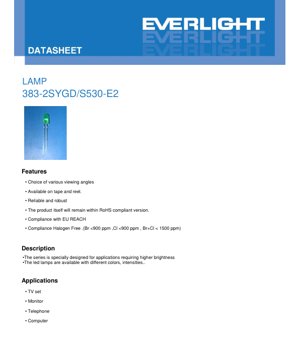
This document provides the complete technical specifications for a high-brightness bright yellow-green LED lamp bead. This device belongs to a series of products specifically designed for applications demanding exceptional luminous output and reliability. It utilizes AlGaInP chip technology, encapsulated in green diffused resin, capable of emitting a unique and vibrant yellow-green light.
The core advantages of this LED include its robust construction, compliance with major environmental regulations (RoHS, REACH, Halogen-Free), and the provision of multiple packaging options (such as tape and reel) to support automated assembly. It is designed for integration into various consumer and industrial electronic products requiring stable, bright indicator lighting.
The target market encompasses manufacturers of display panels, communication equipment, and computing devices, where requirements for component reliability and optical performance are extremely high.
2. In-depth Technical Parameter Analysis
2.1 Absolute Maximum Ratings
Absolute maximum ratings define the stress limits that may cause permanent damage to the device. These are not recommended operating conditions.
- Continuous Forward Current (IF):25 mA. This is the maximum DC current that can be continuously applied to the LED.
- Peak Forward Current (IFP):60 mA. This pulsed current rating (duty cycle 1/10, 1 kHz) allows for short periods of high-intensity operation, suitable for multiplexing or strobe effects.
- Reverse Voltage (VR):5 V. Exceeding this voltage under reverse bias may cause junction breakdown.
- Power Dissipation (Pd):60 mW. The maximum power the package can dissipate as heat, calculated as VF * IF.
- Operating and Storage Temperature:Range from -40°C to +85°C (operating) and -40°C to +100°C (storage). This wide range ensures functionality in harsh environments.
- Soldering Temperature (Tsol):260°C for 5 seconds. This defines the tolerance for the reflow soldering temperature profile.
2.2 Electro-Optical Characteristics
These parameters are measured under standard test conditions of Ta=25°C and IF=20mA, providing benchmark performance data.
- Luminous Intensity (Iv):40 (min), 80 (typ) mcd. This specifies the LED's perceived brightness to the human eye. A typical value of 80 mcd indicates its brightness output is suitable for indicator applications.
- Viewing Angle (2θ1/2):25° (typ). This narrow viewing angle concentrates the light output into a more directional beam, making it ideal for applications requiring a focused light spot.
- Peak Wavelength (λp):575 nm (typical). The wavelength at which spectral emission is strongest.
- Dominant Wavelength (λd):573 nm (typical value). A single wavelength perceived by the human eye, defining "bright yellow-green".
- Spectral Radiant Bandwidth (Δλ):20 nm (typical value). The range of emitted wavelengths, indicating relatively pure color.
- Forward Voltage (VF):1.7 (Min), 2.0 (Typ), 2.4 (Max) V. The voltage drop across the LED when operating at 20mA. This is crucial for circuit design and current-limiting resistor calculation.
- Reverse Current (IR):Max 10 μA at VR=5V. Specifies the leakage current under reverse bias.
Key parameters provide measurement uncertainty: luminous intensity (±10%), dominant wavelength (±1.0nm), and forward voltage (±0.1V), which is important for quality control and design margin analysis.
3. Performance Curve Analysis
The datasheet contains multiple characteristic curves illustrating the device's behavior under different conditions. This is crucial for understanding performance beyond standard test points.
3.1 Relative Intensity vs. Wavelength Curve
This curve shows the spectral power distribution. The peak is centered around 575 nm, with a typical bandwidth (FWHM) of 20 nm, confirming the yellow-green coordinate point. Its shape is characteristic of AlGaInP semiconductor material.
3.2 Directivity Pattern
The radiation pattern visually demonstrates a 25° viewing angle. The intensity is highest at 0° (on-axis) and drops to half at approximately ±12.5° off-axis, thereby defining the 2θ1/2 angle.
3.3 Forward Current vs. Forward Voltage Relationship Curve (IV Curve)
This graph illustrates the exponential relationship between the current (I) and voltage (V) of a diode. This curve allows designers to determine VF at currents other than 20mA. The typical 2.0V VF at 20mA can be seen on this graph.
3.4 Relative Intensity vs. Forward Current Relationship Curve
This curve indicates that, within the operating range, the light output (intensity) is approximately linearly related to the forward current. It confirms that driving the LED at the maximum continuous current (25mA) will yield higher brightness compared to the 20mA test current.
3.5 Thermal Performance Curve
Two key graphs relate performance to ambient temperature (Ta):Relationship between Relative Intensity and Ambient Temperature:Shows that luminous output decreases as temperature increases. This derating is crucial for applications in high-temperature environments; LEDs dim at elevated temperatures.Relationship between Forward Current and Ambient Temperature:It explains how the forward voltage (VF) changes with temperature at a given current. Typically, LEDs have a negative temperature coefficient for VF, meaning it slightly decreases as temperature increases.
4. Mechanical and Packaging Information
4.1 Package Dimensions
Mechanical drawings provide critical dimensions for PCB pad design and assembly. Key specifications include:
4.2 Polarity Identification
The cathode (negative) pin is typically indicated by a flat on the LED lens, a shorter lead, or a marking on the package. Correct polarity must be observed during installation to prevent damage from reverse bias.
5. Soldering and Assembly Guide
Proper handling is crucial for reliability. Detailed instructions are provided:
5.1 Lead Forming
- Bend the leads at a distance of at least 3mm from the epoxy LED base.
- Perform formingBaya soldering.
- Kada ka yi wa kayan rufi matsi; matsi na iya haifar da tsagewar epoxy ko lalata guntu.
- Cut the pins at room temperature.
- Ensure the PCB holes are perfectly aligned with the LED pins to avoid installation stress.
5.2 Storage
- Store at ≤30°C and ≤70% relative humidity. Under these conditions, the shelf life is 3 months.
- For longer-term storage (up to 1 year), use a sealed container with nitrogen and desiccant.
- Avoid sudden temperature changes in humid environments to prevent condensation.
5.3 Welding Process
General Rules:Maintain a minimum distance of 3mm between the solder joint and the epoxy resin LED.
Manual Soldering:- Soldering iron tip temperature: Maximum 300°C (suitable for irons up to 30W).
Wave soldering/Dip soldering:- Preheating temperature: maximum 100°C (maximum 60 seconds).
Key considerations:- Avoid applying stress to the pins during the high-temperature stage.
5.4 Cleaning
- If necessary, clean only with isopropyl alcohol at room temperature for ≤1 minute.
- Air-dry at room temperature.
- Avoid ultrasonic cleaning unless absolutely necessary and pre-validated, as it may damage the LED chip or bonding wires.
5.5 Thermal Management
Effective thermal design is crucial for extending lifespan and maintaining performance.
5.6 ESD (Electrostatic Discharge) Protection
LED e nuhunun kere tete a electrostatic discharge ne voltage surge, wanda zai iya lalata semiconductor chip. Dole ne a bi daidaitaccen matakan rigakafin ESD a duk lokacin haɗawa da aiki. Yi amfani da teburin ƙasa, wuyan hannu, da kwantena masu ɗaukar wutar lantarki.
6. Packaging and Ordering Information
6.1 Packaging Specifications
LED packaging is designed to ensure protection during transportation and handling:Primary Packaging:Anti-static bag (minimum 200 to 500 pieces per bag).Secondary packaging:5 bags are placed in one inner box.Tertiary packaging:10 inner boxes are packed into one master outer carton. This multi-layer packaging prevents moisture, static electricity, and physical damage.
6.2 Labeling Instructions
The label on the packaging contains key information for traceability and identification:CPN:Customer Production Number.P/N:Manufacturer Production Number (e.g., 383-2SYGD/S530-E2).QTY:Packaging quantity.CAT:Luminous Intensity Grade/Binning.HUE:Dominant Wavelength Grade/Binning.REF:Forward voltage grade/classification.LOT No:Production lot number, used for traceability.
7. Application Recommendations
7.1 Typical Application Scenarios
As listed in the datasheet, this LED is suitable for:Television and Monitor:Used as status indicator lights, button backlighting, or decorative lighting.Telephone:Call status indicator, message waiting light, or keyboard backlight.Computer:Power indicator, hard drive activity light, or decorative accents on peripherals. Its high brightness and reliable performance make it an ideal choice for consumer electronics products where long life and consistent color are important.
7.2 Design Considerations
- Current Limiting:Always use a series resistor or constant current driver to limit the forward current to the desired value (e.g., 20mA). Calculate the resistor value using the formula R = (Supply Voltage - VF) / IF.
- Thermal Design:Ensure sufficient PCB copper area or other heat dissipation measures when operating near maximum ratings or in high ambient temperatures.
- Optical Design:A 25° viewing angle provides a focused beam. For wider illumination, consider using a diffuser lens or selecting an LED with a wider viewing angle.
- ESD Protection:In sensitive applications, consider adding Transient Voltage Suppression (TVS) diodes or other protective measures to the LED circuit.
8. Technical Comparison and Differentiation
Although this individual datasheet does not provide a direct side-by-side comparison with other products, the key differentiating features of this LED can be inferred:Chip Technology:使用AlGaInP(磷化铝镓铟),该材料在黄、橙、红光谱区域以高效率著称,而InGaN则用于蓝光和绿光。环保合规:完全符合RoHS、REACH和无卤素标准(溴<900ppm,氯<900ppm,溴+氯<1500ppm),这对于面向法规严格的全球市场的产品是一个显著优势。 -Narrow viewing angle:25°视角比许多标准LED(通常为30-60°)更窄,提供了更定向的光输出,适用于特定的指示应用。详细操作指南:A comprehensive guide on soldering, storage, and ESD that goes beyond basic specifications indicates a design focus on reliability and manufacturability.
9. Frequently Asked Questions (Based on Technical Parameters)
Q1: To drive this LED with a 5V power supply at 20mA, what resistor value should be used?A1: Using typical VF 2.0V: R = (5V - 2.0V) / 0.020A = 150 ohms. Use the nearest standard value (e.g., 150Ω or 160Ω). Always calculate using the maximum VF (2.4V) to ensure sufficient current limiting under worst-case conditions: R_min = (5V - 2.4V) / 0.020A = 130 ohms.
Q2: Can I drive this LED at its maximum continuous current of 25mA?A2: Yes, but proper heat dissipation must be ensured. The luminous intensity will be higher than at 20mA (refer to the relative intensity vs. current curve), but the forward voltage will also be slightly higher, and the device will operate at a higher temperature. Derating may be necessary in high ambient temperatures.
Q3: The dominant wavelength is 573nm. Will the color be exactly the same for all units?A3: A'a. 573nm shine ƙimar al'ada. Akwai ƙayyadaddun ƙira, kuma LED galibi ana rarraba su ta matakin HUE. Ma'aunin rashin tabbas shine ±1.0nm. Don kiyaye daidaiton launi tsakanin LED da yawa a cikin samfur, ƙayyade ko zaɓi raka'a daga rarrabuwar HUE ɗaya.
Q4: Me yasa nisan walda (3mm daga fitilar) yake da mahimmanci haka?A4: Wannan yana hana wuce gona da iri na zafi yana tafiya ta hanyar ƙugiya zuwa fitilar epoxy yayin walda. Zafi mai yawa zai haifar da damuwa na zafi, yana haifar da tsagewar epoxy, lalata haɗin gwiwar guntu na ciki, ko canza launin ruwan tabarau, wanda zai rage fitar da haske.
10. Practical Design and Usage Cases
Case: Designing a Status Indicator Panel for a Network RouterDesigners need to install multiple bright, reliable status LEDs (power, internet, Wi-Fi, LAN ports) on routers intended for various home environments.Reason for Selection:This bright yellow-green LED was chosen for its high typical intensity (80 mcd), ensuring visibility even in well-lit rooms. Its compliance with environmental regulations is mandatory for the global market. It is supplied on tape and reel to support high-volume automated PCB assembly.Implementation:LED is driven at 18mA (slightly below the 20mA test point to allow margin) via the main microcontroller's GPIO pin and a series resistor. The PCB layout provides a small thermal pad connected to the ground plane to aid heat dissipation. The 25° viewing angle is ideal, as the LED is mounted behind a small transparent hole on the router's front panel, creating a clear, bright spot of light for each status. The detailed soldering temperature profile from the datasheet is programmed into the pick-and-place machine and reflow oven equipment to ensure a high-yield, reliable manufacturing process.
11. Introduction to Working Principles
This LED operates based on the principle of electroluminescence in a semiconductor p-n junction. The active region consists of an AlGaInP (aluminum gallium indium phosphide) layer. When a forward voltage exceeding the built-in potential of the junction (approximately 2.0V) is applied, electrons from the n-type region and holes from the p-type region are injected into the active region. Here, they recombine, releasing energy in the form of photons (light). The specific composition of the AlGaInP alloy determines the bandgap energy, which directly corresponds to the wavelength (color) of the emitted light—in this case, a yellow-green color of approximately 573-575 nm. A green diffusing resin package is used to protect the delicate semiconductor chip, shape the radiation pattern into a 25° viewing angle, and slightly diffuse the light to improve viewing uniformity.
12. Teknoloji Trendleri
LED teknolojisi sürekli gelişmektedir, aşağıdaki genel trendler bu tür cihazları etkilemektedir:Verimlilik Artışı:Continuous advancements in materials science and chip design lead to higher luminous efficacy (more light output per watt of electrical power), enabling brighter indicator lights or lower power consumption.Miniaturization:The drive for smaller electronic devices demands continuously shrinking LED package sizes while maintaining or improving optical performance.Enhanced Reliability and Lifetime:Improvements in packaging materials, die-attach methods, and phosphor technology (for white LEDs) continue to extend operational lifespan and reliability under harsh conditions.Smart Integration:There is a trend toward LEDs with built-in control ICs, such as addressable RGB LEDs, but for simple indicator lights like these, the focus remains on high-performance discrete components with cost-effectiveness.Standard za muhimu zaidi wa mazingira:Kufuata kanuni kama RoHS na REACH sasa ni mahitaji ya msingi. Mfumo wa halojeni ulioangaziwa katika maelezo haya ya vipimo ni sehemu ya mwelekeo huu wa kuondoa vitu hatari katika mnyororo wa usambazaji wa elektroniki.
Maelezo ya kina ya istilahi za vipimo vya LED
Full Explanation of LED Technical Terminology
I. Core Indicators of Photoelectric Performance
| Terminology | Unit/Representation | Popular Explanation | Why it is important |
|---|---|---|---|
| Luminous Efficacy | lm/W | The luminous flux emitted per watt of electrical energy, the higher the more energy-efficient. | Directly determines the energy efficiency class and electricity cost of the luminaire. |
| Luminous Flux | lm (lumen) | The total amount of light emitted by a light source, commonly known as "brightness". | Determines whether the luminaire is bright enough. |
| Viewing Angle | ° (degree), such as 120° | The angle at which light intensity drops to half, determining the beam width. | Affects the illumination range and uniformity. |
| Color Temperature (CCT) | K (Kelvin), e.g., 2700K/6500K | The color temperature of light, lower values lean yellow/warm, higher values lean white/cool. | Determines the lighting ambiance and suitable application scenarios. |
| Color Rendering Index (CRI / Ra) | Unitless, 0–100 | The ability of a light source to reproduce the true colors of objects, with Ra≥80 being good. | Affects color fidelity, used in high-demand places such as shopping malls and art galleries. |
| Color tolerance (SDCM) | MacAdam ellipse steps, such as "5-step" | A quantitative indicator of color consistency, where a smaller step number indicates better color consistency. | Ensure no color difference among luminaires from the same batch. |
| Dominant Wavelength | nm (nanometer), e.g., 620nm (red) | The wavelength value corresponding to the color of a colored LED. | Determines the hue of monochromatic LEDs such as red, yellow, and green. |
| Spectral Distribution | Wavelength vs. Intensity curve | Shows the intensity distribution of light emitted by an LED at various wavelengths. | Affects color rendering and color quality. |
II. Electrical Parameters
| Terminology | Symbol | Popular Explanation | Design Considerations |
|---|---|---|---|
| Forward Voltage (Forward Voltage) | Vf | The minimum voltage required to light up an LED, similar to a "starting threshold". | The driving power supply voltage must be ≥ Vf, and the voltage adds up when multiple LEDs are connected in series. |
| Forward Current | If | The current value that makes the LED emit light normally. | Constant current drive is often used, as the current determines brightness and lifespan. |
| Maximum Pulse Current | Ifp | Peak current that can be withstood for a short period of time, used for dimming or flashing. | Pulse width and duty cycle must be strictly controlled, otherwise overheating damage will occur. |
| Reverse Voltage | Vr | LED yana iya jurewa mafi girman ƙarfin lantarki na baya, wanda ya wuce hakan zai iya lalata shi. | A cikin da'ira, ya kamata a hana haɗuwa ta baya ko kuma ƙarfin lantarki mai ƙarfi. |
| Thermal Resistance | Rth (°C/W) | The resistance to heat flow from the chip to the solder joint. A lower value indicates better heat dissipation. | High thermal resistance requires a stronger heat dissipation design, otherwise the junction temperature will increase. |
| Electrostatic Discharge Immunity (ESD Immunity) | V (HBM), such as 1000V | Electrostatic discharge immunity, the higher the value, the less susceptible to damage from static electricity. | Anti-static measures must be implemented during production, especially for high-sensitivity LEDs. |
III. Thermal Management and Reliability
| Terminology | Key Indicators | Popular Explanation | Impact |
|---|---|---|---|
| Junction Temperature | Tj (°C) | The actual operating temperature inside the LED chip. | For every 10°C reduction, the lifespan may double; excessively high temperatures lead to lumen depreciation and color shift. |
| Lumen Depreciation | L70 / L80 (hours) | The time required for brightness to drop to 70% or 80% of its initial value. | Directly define the "service life" of an LED. |
| Lumen Maintenance | % (e.g., 70%) | The percentage of remaining brightness after a period of use. | Characterizes the ability to maintain brightness after long-term use. |
| Color Shift | Δu′v′ or MacAdam Ellipse | The degree of color change during use. | Affects the color consistency of the lighting scene. |
| Thermal Aging | Material performance degradation | Degradation of packaging materials due to prolonged high temperature. | May lead to decreased brightness, color shift, or open-circuit failure. |
IV. Kunshewa da Kayan aiki
| Terminology | Nau'ikan gama gari | Popular Explanation | Features and Applications |
|---|---|---|---|
| Package Type | EMC, PPA, Ceramic | A housing material that protects the chip and provides optical and thermal interfaces. | EMC has good heat resistance and low cost; ceramics offer superior heat dissipation and long lifespan. |
| Chip Structure | Face-up, Flip Chip | Chip Electrode Layout Method. | Flip-chip offers better heat dissipation and higher luminous efficacy, suitable for high-power applications. |
| Phosphor coating | YAG, silicate, nitride | Covered on the blue light chip, partially converted to yellow/red light, mixed into white light. | Different phosphors affect luminous efficacy, color temperature, and color rendering. |
| Lens/Optical Design | Flat, microlens, total internal reflection | The optical structure of the encapsulation surface controls the distribution of light. | Determines the light emission angle and the light distribution curve. |
V. Quality Control and Binning
| Terminology | Grading Content | Popular Explanation | Purpose |
|---|---|---|---|
| Luminous Flux Binning | Codes such as 2G, 2H | Grouped by brightness level, each group has a minimum/maximum lumen value. | Ensure consistent brightness within the same batch of products. |
| Voltage binning | Codes such as 6W, 6X | Group by forward voltage range. | Facilitates driver power matching and improves system efficiency. |
| Color binning | 5-step MacAdam ellipse | Group by color coordinates to ensure colors fall within an extremely narrow range. | Ensure color consistency to avoid uneven color within the same luminaire. |
| Color temperature binning | 2700K, 3000K, etc. | Group by color temperature, each group has a corresponding coordinate range. | To meet the color temperature requirements of different scenarios. |
VI. Testing and Certification
| Terminology | Standard/Test | Popular Explanation | Meaning |
|---|---|---|---|
| LM-80 | Lumen Maintenance Test | Long-term operation under constant temperature conditions, recording luminance attenuation data. | Used to estimate LED lifetime (combined with TM-21). |
| TM-21 | Lifetime projection standard | Life estimation under actual operating conditions based on LM-80 data. | Provide scientific life prediction. |
| IESNA standard | Illuminating Engineering Society Standard | Covers optical, electrical, and thermal test methods. | Industry-recognized testing basis. |
| RoHS / REACH | Environmental certification. | Ensure products do not contain harmful substances (e.g., lead, mercury). | Entry requirements for the international market. |
| ENERGY STAR / DLC | Energy Efficiency Certification | Energy efficiency and performance certification for lighting products. | Commonly used in government procurement and subsidy programs to enhance market competitiveness. |