Table of Contents
- 1. Product Overview
- 1.1 Core Advantages and Target Market
- 2. In-Depth Technical Parameter Analysis
- 2.1 Absolute Maximum Ratings
- 2.2 Electro-Optical Characteristics
- 3. Performance Curve Analysis
- 3.1 Relative Intensity vs. Wavelength
- 3.2 Directivity Pattern
- 3.3 Forward Current vs. Forward Voltage (I-V Curve)
- 3.4 Relative Intensity vs. Forward Current
- 3.5 Thermal Characteristics
- 4. Mechanical and Package Information
- 4.1 Package Dimensions
- 4.2 Polarity Identification
- 5. Soldering and Assembly Guidelines
- 5.1 Lead Forming
- 5.2 Soldering Process
- 5.3 Storage Conditions
- 5.4 Cleaning
- 6. Heat and ESD Management
- 6.1 Heat Management
- 6.2 ESD (Electrostatic Discharge) Protection
- 7. Packaging and Ordering Information
- 7.1 Packing Specification
- 7.2 Label Explanation
- 8. Application Suggestions and Design Considerations
- 8.1 Typical Application Circuits
- 8.2 Design Considerations
- 9. Technical Comparison and Differentiation
- 10. Frequently Asked Questions (FAQ)
- 11. Practical Application Example
- 12. Operating Principle
- 13. Technology Trends
1. Product Overview
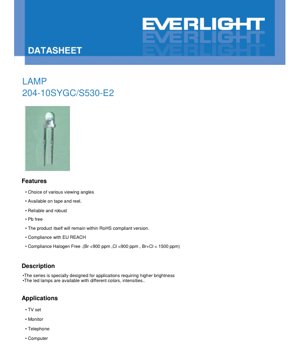
The 204-10SYGC/S530-E2 is a high-brightness, through-hole LED lamp designed for applications requiring reliable and robust illumination. It utilizes an AlGaInP (Aluminum Gallium Indium Phosphide) semiconductor chip to produce a Brilliant Yellow Green light output. The device is housed in a standard 5mm round, water-clear epoxy resin package, offering a compact and versatile solution for various indicator and backlighting applications.
This LED series is engineered to deliver consistent performance with a choice of viewing angles. It is compliant with major environmental and safety standards, including RoHS (Restriction of Hazardous Substances), EU REACH regulation, and is manufactured as a Halogen-Free component, ensuring its suitability for modern electronic designs with stringent material requirements.
1.1 Core Advantages and Target Market
The primary advantages of this LED lamp include its high luminous intensity, reliable construction, and broad environmental compliance. Its robust design makes it suitable for applications where long-term reliability is critical. The product is available on tape and reel for automated assembly processes, enhancing manufacturing efficiency.
The target applications for this device are primarily in consumer and industrial electronics where clear, bright indication is needed. Typical use cases include status indicators, backlighting for buttons or panels, and general-purpose illumination in compact spaces. Its specifications make it a suitable choice for cost-effective yet reliable lighting solutions.
2. In-Depth Technical Parameter Analysis
This section provides a detailed, objective interpretation of the key technical parameters specified in the datasheet. Understanding these values is crucial for proper circuit design and ensuring the LED operates within its safe operating area (SOA).
2.1 Absolute Maximum Ratings
Absolute Maximum Ratings ihe nkọwa nke oke nrụgide nke nwere ike imebi ngwaọrụ ahụ kpamkpam ma ọ bụrụ na agafere ya. Ndị a abụghị ọnọdụ maka ọrụ nkịtị.
- Continuous Forward Current (IF): 25 mA. This is the maximum DC current that can be continuously applied to the LED under specified ambient conditions (Ta=25°C). Exceeding this value will generate excessive heat, potentially degrading the semiconductor junction and reducing lifespan.
- Peak Forward Current (IFP): 60 mA. Oyi nọ́ yin gbigbẹ́n lẹ́tà tó ń ṣiṣẹ́ pẹ̀lú àwọn ìgbà tó ń yípadà ní 1/10 ní 1 kHz. Ó gba láti ní àwọn ìgbà kúkúrú tí àwọn ìyọ̀ tó ga jù, tí ó lè ṣe ìlọ́síwájú fún gbígbẹ́n tí ó ga jù ní àwọn ìlò tó ń ṣe àkópọ̀ tàbí àwọn ìlò tó ń ṣe gbígbẹ́n.
- Reverse Voltage (VR): 5 V. LED lè dúró fún ìyọ̀ tó ga jù ní 5 volts ní ìtọ́sọ̀nà tó ń yípadà. Fífún ìyọ̀ tó ga jù lè fa ìparun àti ìparun tó burú jù. Àwọn ètò ìṣirò yẹ kí ó ní àbò, bíi resistor tó ń tẹ̀lé tàbí diode àbò tó ń ṣe àkópọ̀, tí ó bá ṣeé ṣe kí ìyọ̀ tó ń yípadà wà.
- Power Dissipation (Pd): 60 mW. This is the maximum total power (VF * IF) the package can dissipate without exceeding its maximum junction temperature. Proper heat sinking or current derating at higher ambient temperatures is necessary to stay within this limit.
- Operating & Storage Temperature: The device is rated for operation from -40°C to +85°C and can be stored from -40°C to +100°C. This wide range ensures functionality in harsh environments.
- Soldering Temperature: 260°C for 5 seconds. This defines the maximum thermal profile the LED can endure during wave or hand soldering processes without damaging the internal bonds or the epoxy lens.
2.2 Electro-Optical Characteristics
Iɓe parameter ɗin, an auna su a daidaitaccen gwajin na'ura na 20 mA da yanayin yanayi na 25°C, suna bayyana aikin haske da na lantarki na LED.
- Luminous Intensity (Iv): 125 mcd (Min), 250 mcd (Typ). Wannan yana ƙayyadad da adadin hasken da ake fitarwa a wata hanya. Ƙimar al'ada na millicandelas 250 tana nuna fitarwa mai haske wanda ya dace da aikace-aikacen nuna alama da yawa. Mafi ƙarancin ƙimar da aka tabbatar shine 125 mcd, wanda yake da mahimmanci don daidaiton ƙira.
- Viewing Angle (2θ1/2): 20° (Typ). This is the full angle at which the luminous intensity is half of the peak intensity (measured on-axis). A 20° viewing angle indicates a relatively narrow beam, concentrating light in a forward direction. This is ideal for applications requiring a directed light source rather than wide-area illumination.
- Peak Wavelength (λp): 575 nm (Typ). Wannan shine tsayin raƙuman ruwa wanda rarraba ƙarfin haske da aka fitar ya fi girma. Ga Brilliant Yellow Green LED, wannan ya faɗi a cikin yankin rawaya-kore na bakan gani.
- Dominant Wavelength (λd): 573 nm (Typ). Wannan shine tsayin raƙuman ruwa guda ɗaya wanda idon ɗan adam ke gani wanda ya dace da launin hasken LED. Shi ne babban ma'auni don ƙayyadaddun launi.
- Forward Voltage (VF): 1.7 V (Min), 2.0 V (Typ), 2.4 V (Max) at IF=20mA. This is the voltage drop across the LED when forward-biased and conducting current. The typical value of 2.0V is critical for calculating the current-limiting resistor value in a series circuit: R = (Vsupply - VF) / IFDesigning for the maximum VF ensures sufficient current drive under all conditions.
- Reverse Current (IR): 10 μA (Max) at VR=5V. This is the small leakage current that flows when the diode is reverse-biased within its maximum rating.
Measurement Uncertainties: The datasheet notes specific tolerances for key measurements: ±0.1V for VF, ±10% for Iv, and ±1.0nm for λd. These must be considered in precision applications.
3. Performance Curve Analysis
The provided characteristic curves offer valuable insights into the LED's behavior under varying conditions, which is essential for robust system design.
3.1 Relative Intensity vs. Wavelength
Wannan jadawalin rarraba haske yana nuna fitowar haske a matsayin aikin tsayin raƙuman ruwa. Ga AlGaInP-based yellow-green LED, bakan yawanci koli ɗaya ne, kunkuntar kunkuntar da ke tsakiya a kusa da tsayin raƙuman ruwa (573 nm typ). Cikakken faɗi a rabin matsakaici (FWHM), wanda aka nuna ta hanyar bandwidth na radiation na bakan (Δλ) na 20 nm typ, yana bayyana tsaftar launi. Ƙunƙuntar bandwidth yana nuna launi mai cikakkiyar jikewa, tsafta.
3.2 Directivity Pattern
The directivity (or radiation pattern) curve illustrates how light intensity varies with angle from the central axis. For a LED with a 20° viewing angle, this curve will show a sharp drop in intensity beyond approximately ±10° from the center. This pattern is influenced by the shape of the epoxy lens and the position of the chip within the package.
3.3 Forward Current vs. Forward Voltage (I-V Curve)
This fundamental curve demonstrates the exponential relationship between current and voltage in a semiconductor diode. For LEDs, the "turn-on" or "knee" voltage is clearly visible. Operating significantly above this knee voltage results in a rapid increase in current for a small increase in voltage. This highlights the critical importance of using a current-limiting mechanism (almost always a series resistor for simple circuits) rather than attempting to drive an LED with a constant voltage source alone.
3.4 Relative Intensity vs. Forward Current
This curve shows that light output (luminous intensity) is generally proportional to forward current, but the relationship is not perfectly linear, especially at higher currents. Efficiency (light output per unit of electrical input) may decrease at very high currents due to increased heat generation and other non-ideal effects. It is important to operate within the recommended current range for optimal efficiency and longevity.
3.5 Thermal Characteristics
The curves for Relative Intensity vs. Ambient Temperature and Forward Current vs. Ambient Temperature are crucial for thermal management.
- Intensity vs. Temperature: Yawanci, fitilar LED tana raguwa yayin da zafin jiki ya karu. Wannan lanƙwasa tana ƙididdige wannan raguwa. Don aiki mai dogaro a cikin yanayin zafi mai girma, ana iya buƙatar rage yawan kuzarin tuƙi don rama wannan raguwar inganci da kuma hana guduwar zafi.
- Forward Voltage vs. Temperature: The forward voltage of an LED has a negative temperature coefficient; it decreases as temperature increases. This can have implications for constant-voltage drive circuits, as a lower VF at high temperature could lead to an increase in current if not properly regulated.
4. Mechanical and Package Information
4.1 Package Dimensions
The LED is housed in a standard 5mm round radial-leaded package. Key dimensional notes from the datasheet include:
- All dimensions are in millimeters.
- The height of the flange (the rim at the base of the dome) must be less than 1.5mm (0.059"). This is important for clearance during PCB mounting.
- The general tolerance for unspecified dimensions is ±0.25mm, which is standard for this type of component.
The dimensional drawing provides precise measurements for the lead spacing, body diameter, lens height, and lead length and diameter. These are critical for PCB footprint design, ensuring proper fit in the mounting holes and correct positioning of the lens relative to the panel or diffuser.
4.2 Polarity Identification
For radial-leaded LEDs, the cathode is typically identified by a flat spot on the rim of the plastic flange and/or by the shorter lead length. The datasheet diagram should clearly indicate which lead is the cathode (usually the one marked with the flat edge). Correct polarity is essential for device operation.
5. Soldering and Assembly Guidelines
Adhering to these guidelines is paramount to ensuring the reliability and longevity of the LED after assembly.
5.1 Lead Forming
- Bending must occur at a point at least 3mm from the base of the epoxy bulb to avoid transferring stress to the internal wire bonds.
- Forming must be done before soldering, while the leads and package are at room temperature.
- Excessive stress during forming can crack the epoxy or damage the internal die attachment.
- PCB holes must align perfectly with the LED leads to avoid mounting stress.
5.2 Soldering Process
The datasheet provides specific recommendations for both hand and dip soldering:
- Hand Soldering: Iron tip temperature maximum 300°C (for a 30W max iron), soldering time maximum 3 seconds per lead. Maintain a minimum distance of 3mm from the solder joint to the epoxy bulb.
- Dip (Wave) Soldering: Preheat temperature maximum 100°C for up to 60 seconds. Solder bath temperature maximum 260°C for a maximum immersion time of 5 seconds. Again, maintain 3mm clearance from the bulb.
- A recommended soldering profile graph typically shows a gradual temperature ramp-up, a controlled time above liquidus, and a controlled cooldown. Rapid thermal cycling should be avoided.
- Critical Rule: Dip or hand soldering should be performed only once. Repeated heating significantly increases the risk of failure.
- After soldering, the LED must be protected from mechanical shock or vibration until it returns to room temperature to prevent stress on the hot, softened epoxy and internal bonds.
5.3 Storage Conditions
LEDs are moisture-sensitive devices. The recommended storage after shipment is at 30°C or less and 70% relative humidity or less, with a shelf life of 3 months. For longer storage (up to one year), they should be kept in a sealed container with a nitrogen atmosphere and desiccant. Rapid temperature changes in humid environments must be avoided to prevent condensation inside the package.
5.4 Cleaning
If cleaning is necessary after soldering, use only isopropyl alcohol at room temperature for no more than one minute. Ultrasonic cleaning is strongly discouraged as the high-frequency vibrations can fracture the delicate wire bonds inside the package. If absolutely required, the process must be carefully qualified beforehand.
6. Heat and ESD Management
6.1 Heat Management
Gaskata mai inganci na thermal shine mabuɗin amincin LED da kuma fitar da haske mai tsayayye. Dole ne a rage yawan ƙarfin lantarki daidai a yanayin zafi mafi girma, kamar yadda aka nuna ta hanyar lanƙwasa rage ƙarfin lantarki. Dole ne a sarrafa yanayin zafi da ke kewaye da LED a aikace-aikacen ƙarshe. Wannan sau da yawa ya haɗa da la'akari da tsarin PCB (yankin tagulla don yada zafi), iskar yanayi, da yuwuwar amfani da heatsinks don aikace-aikacen ƙarfi mai ƙarfi ko yawan girma.
6.2 ESD (Electrostatic Discharge) Protection
Die na semiconductor yana da matukar hankali ga fitar da wutar lantarki ta electrostatic. Abubuwan ESD na iya haifar da gazawa nan take ko lalacewa a ɓoye wanda ke rage amincin dogon lokaci. Dole ne a bi tsarin sarrafa ESD daidai a duk matakan samarwa, haɗawa, da sarrafawa. Wannan ya haɗa da amfani da tashoshin aiki masu tushe, igiyoyin wuyan hannu, da kwantena masu ɗaukar wutar lantarki. Kayan tattarawa da aka ƙayyade (jakunkuna anti-electrostatic) an ƙera su ne don kare na'urori yayin jigilar su da adanawa.
7. Packaging and Ordering Information
7.1 Packing Specification
LEDs are packaged to ensure protection from moisture, electrostatic discharge, and physical damage.
- Primary Packing: A minimum of 200-1000 pieces are packed in one anti-electrostatic bag.
- Secondary Packing: Four bags are placed into one inner carton.
- Tertiary Packing: Ten inner cartons are packed into one master outside carton for shipment.
7.2 Label Explanation
The packing labels contain several codes for traceability and identification:
- CPN: Customer's Production Number.
- P/N: Manufacturer's Production Number (the part number).
- QTY: Packing Quantity within the bag/carton.
- CAT / Ranks: May indicate performance bins (e.g., for luminous intensity or wavelength).
- HUE: Dominant Wavelength value for that specific batch.
- LOT No: Lot Number for full manufacturing traceability.
8. Application Suggestions and Design Considerations
8.1 Typical Application Circuits
The most basic and common drive circuit for a single LED is a series current-limiting resistor. The resistor value is calculated as: R = (Vsupply - VF) / IF. For example, with a 5V supply, a typical VF of 2.0V, and a desired IF of 20mA: R = (5V - 2.0V) / 0.020A = 150 Ω. The power rating of the resistor should be at least P = IF2 * R = (0.02)2 * 150 = 0.06W, so a standard 1/8W (0.125W) or 1/4W resistor is sufficient.
For driving multiple LEDs, they are typically connected in series (if the supply voltage is high enough to overcome the sum of VFs) with a single resistor, or in parallel each with its own series resistor. Parallel connection without individual resistors is not recommended due to VF variation between LEDs, which can cause uneven current sharing and brightness.
8.2 Design Considerations
- Current Drive: Always design for a constant or well-regulated current, not voltage.
- Thermal Design: Yi la'akari yanar gizo da kuma samar da isasshen taimako na zafi akan PCB, musamman idan ana tuƙi kusa da matsakaicin ci gaba na yanzu.
- Optical Design: Kallon kusurwar 20° yana haifar da haske mai mai da hankali. Don haske mai faɗi, ana iya buƙatar ruwan tabarau mai watsawa ko mai nuna haske. Ruwan tabarau mai tsabta yana ba da mafi girman watsawar haske.
- Reverse Voltage Protection: In circuits where reverse voltage is possible (e.g., AC coupling, inductive loads), include a protection diode in parallel with the LED (cathode to anode) to clamp reverse voltage to a safe level (~0.7V).
9. Technical Comparison and Differentiation
Compared to older technology like GaP (Gallium Phosphide) based green LEDs, this AlGaInP device offers significantly higher brightness and efficiency for a given current. The Brilliant Yellow Green color is often more visually distinct and vibrant than standard green.
Within its own category of 5mm round LEDs, its key differentiators are its specific combination of high typical luminous intensity (250 mcd), narrow viewing angle (20°), and full compliance with modern environmental standards (RoHS, REACH, Halogen-Free). The detailed and conservative maximum ratings and handling guidelines also indicate a design focused on robustness and reliability in demanding applications.
10. Frequently Asked Questions (FAQ)
Q: Can I drive this LED with a 3.3V supply?
A: Yes. Using the formula R = (3.3V - 2.0V) / 0.020A = 65 Ω. A 68 Ω standard resistor value would give IF ≈ 19.1 mA, which is acceptable.
Q: Why is the soldering distance (3mm from the bulb) so important?
A: Heat travels up the metal leads. If solder is applied too close to the epoxy bulb, the excessive heat can soften or crack the epoxy, damage the internal seal, or re-melt the internal wire bonds, leading to immediate or intermittent failure.
Q: The datasheet shows a typical intensity of 250 mcd. What does the minimum of 125 mcd mean for my design?
A: You must design your optical system (e.g., brightness required behind a diffuser) based on the minimum guaranteed value (125 mcd) to ensure all units in your production run meet the requirement. The typical value is what most units will achieve, but there is natural variation.
Q: Can I use this LED outdoors?
A: Kewayon zafin aiki (-40°C zuwa +85°C) yana ba da damar amfani da shi a waje dangane da zafin jiki. Duk da haka, fakitin epoxy na iya zama mai saukin lalacewa ta UV da shigar danshi a cikin dogon lokaci idan ba a rufe shi da kyau ko kuma ba a kare shi ba. Don wuraren waje masu tsauri, ana ba da shawarar LED da aka ƙayyade musamman don irin waɗannan yanayi (sau da yawa tare da ruwan tabarau na silicone).
11. Practical Application Example
Scenario: Zayyana panel mai nuna matsayi don kayan aikin masana'antu. The panel has multiple indicators showing power, fault, and standby status. Space is limited, and indicators need to be visible in brightly lit environments.
Design Choice: The 204-10SYGC/S530-E2 LED is selected for the "Standby" indicator due to its bright yellow-green color, which is distinct from red (fault) and green (power on). Its 20° viewing angle ensures the light is directed towards the operator's line of sight without excessive spill, improving contrast. The LED is driven at 15 mA (below the 20mA test current) via a current-limiting resistor from the equipment's 24V DC rail. This lower current increases longevity and reduces heat. The PCB footprint is designed exactly per the package dimensions, with 0.8mm holes for the leads. During assembly, a dedicated soldering fixture ensures the 3mm clearance rule is maintained during wave soldering. The final assembly passes a 48-hour burn-in test to screen for early failures.
12. Operating Principle
Light Emitting Diodes (LEDs) are semiconductor devices that emit light through electroluminescence. The 204-10SYGC/S530-E2 uses an AlGaInP (Aluminum Gallium Indium Phosphide) compound semiconductor. When a forward voltage is applied across the p-n junction, electrons from the n-type region and holes from the p-type region are injected into the active region. When these charge carriers (electrons and holes) recombine, they release energy. In this specific material system, the energy bandgap is such that the released energy corresponds to a photon in the yellow-green wavelength range (~573 nm). The water-clear epoxy resin package serves as a lens, shaping the light output beam and protecting the delicate semiconductor chip.
13. Technology Trends
While through-hole LEDs like the 5mm round package remain popular for prototyping, educational use, and certain industrial applications, the overall industry trend has shifted significantly towards surface-mount device (SMD) packages (e.g., 0603, 0805, 2835, 5050). SMD LEDs offer advantages in automated assembly, board space savings, and often better thermal performance due to a lower profile and direct connection to the PCB pad acting as a heatsink.
Furthermore, the efficiency (lumens per watt) of LED technology continues to improve across all color ranges due to advancements in epitaxial growth, chip design, and package extraction efficiency. For indicator applications, the focus is often on reliability, color consistency, and cost-effectiveness rather than pushing absolute efficiency limits. Compliance with evolving environmental regulations (like Halogen-Free requirements) remains a key driver for component updates and new product introductions.
LED Specification Terminology
Complete explanation of LED technical terms
Photoelectric Performance
| Term | Unit/Representation | Simple Explanation | Why Important |
|---|---|---|---|
| Luminous Efficacy | lm/W (lumens per watt) | Light output per watt of electricity, higher means more energy efficient. | Directly determines energy efficiency grade and electricity cost. |
| Luminous Flux | lm (lumens) | Total light emitted by source, commonly called "brightness". | Determines if the light is bright enough. |
| Kwanin Duba | ° (digiri), misali, 120° | Kwanin da ƙarfin haske ya ragu zuwa rabi, yana ƙayyade faɗin katako. | Affects illumination range and uniformity. |
| CCT (Color Temperature) | K (Kelvin), misal, 2700K/6500K | Gumi/ƙanƙanin haske, ƙananan ƙimomi suna da rawaya/dumi, mafi girma farare/sanyi. | Yana ƙayyade yanayin hasken da ya dace da yanayi. |
| CRI / Ra | Unitless, 0–100 | Ability to render object colors accurately, Ra≥80 is good. | Affects color authenticity, used in high-demand places like malls, museums. |
| SDCM | MacAdam ellipse steps, e.g., "5-step" | Color consistency metric, smaller steps mean more consistent color. | Ensures uniform color across same batch of LEDs. |
| Dominant Wavelength | nm (nanometers), e.g., 620nm (red) | Wavelength corresponding to color of colored LEDs. | Determines hue of red, yellow, green monochrome LEDs. |
| Spectral Distribution | Wavelength vs intensity curve | Shows intensity distribution across wavelengths. | Affects color rendering and quality. |
Electrical Parameters
| Term | Symbol | Simple Explanation | Design Considerations |
|---|---|---|---|
| Forward Voltage | Vf | Minimum voltage to turn on LED, like "starting threshold". | Driver voltage must be ≥Vf, voltages add up for series LEDs. |
| Forward Current | If | Current value for normal LED operation. | Usually constant current drive, current determines brightness & lifespan. |
| Max Pulse Current | Ifp | Peak current tolerable for short periods, used for dimming or flashing. | Pulse width & duty cycle must be strictly controlled to avoid damage. |
| Reverse Voltage | Vr | Max reverse voltage LED can withstand, beyond may cause breakdown. | Circuit must prevent reverse connection or voltage spikes. |
| Thermal Resistance | Rth (°C/W) | Resistance to heat transfer from chip to solder, lower is better. | High thermal resistance requires stronger heat dissipation. |
| ESD Immunity | V (HBM), e.g., 1000V | Ability to withstand electrostatic discharge, higher means less vulnerable. | Anti-static measures needed in production, especially for sensitive LEDs. |
Thermal Management & Reliability
| Term | Key Metric | Simple Explanation | Impact |
|---|---|---|---|
| Junction Temperature | Tj (°C) | Halin zazzabi aiki na ainihi a cikin guntun LED. | Kowane raguwar 10°C na iya ninka tsawon rayuwa; yawan zafi yana haifar da raguwar haske, canjin launi. |
| Kupungua kwa Lumen | L70 / L80 (masaa) | Time for brightness to drop to 70% or 80% of initial. | Directly defines LED "service life". |
| Lumen Maintenance | % (e.g., 70%) | Percentage of brightness retained after time. | Indicates brightness retention over long-term use. |
| Color Shift | Δu′v′ or MacAdam ellipse | Degree of color change during use. | Affects color consistency in lighting scenes. |
| Thermal Aging | Material degradation | Deterioration due to long-term high temperature. | May cause brightness drop, color change, or open-circuit failure. |
Packaging & Materials
| Term | Common Types | Simple Explanation | Features & Applications |
|---|---|---|---|
| Package Type | EMC, PPA, Ceramic | Housing material protecting chip, providing optical/thermal interface. | EMC: yana da kyau mai jure zafi, farashi mai rahusa; Ceramic: mafi kyau zubar da zafi, tsawon rai. |
| Tsarin Chip | Gaba, Flip Chip | Chip electrode arrangement. | Flip chip: better heat dissipation, higher efficacy, for high-power. |
| Phosphor Coating | YAG, Silicate, Nitride | Covers blue chip, converts some to yellow/red, mixes to white. | Different phosphors affect efficacy, CCT, and CRI. |
| Lens/Optics | Flat, Microlens, TIR | Optical structure on surface controlling light distribution. | Determines viewing angle and light distribution curve. |
Quality Control & Binning
| Term | Binning Content | Simple Explanation | Purpose |
|---|---|---|---|
| Luminous Flux Bin | Code e.g., 2G, 2H | Grouped by brightness, each group has min/max lumen values. | Ensures uniform brightness in same batch. |
| Voltage Bin | Code e.g., 6W, 6X | An rarrabe ta hanyar kewayon ƙarfin lantarki na gaba. | Facilitates driver matching, improves system efficiency. |
| Color Bin | 5-step MacAdam ellipse | An rarraba ta hanyar daidaitawar launi, tabbatar da kewayon matsi. | Yana ba da tabbacin daidaiton launi, ya guji rashin daidaiton launi a cikin kayan haske. |
| CCT Bin | 2700K, 3000K etc. | Grouped by CCT, each has corresponding coordinate range. | Meets different scene CCT requirements. |
Testing & Certification
| Term | Standard/Test | Simple Explanation | Significance |
|---|---|---|---|
| LM-80 | Lumen maintenance test | Long-term lighting at constant temperature, recording brightness decay. | Used to estimate LED life (with TM-21). |
| TM-21 | Standard ya kukadiria maisha | Inakadiria maisha chini ya hali halisi kulingana na data ya LM-80. | Inatoa utabiri wa kisayansi wa maisha. |
| IESNA | Illuminating Engineering Society | Covers optical, electrical, thermal test methods. | Industry-recognized test basis. |
| RoHS / REACH | Takaddama muhalli | Tabbatar da babu abubuwa masu cutarwa (dariya, mercury). | Market access requirement internationally. |
| ENERGY STAR / DLC | Energy efficiency certification | Energy efficiency and performance certification for lighting. | Used in government procurement, subsidy programs, enhances competitiveness. |