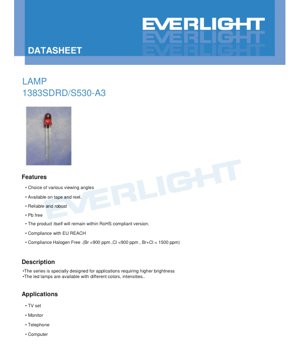
1. Product Overview
The 1383SDRD/S530-A3 is a high-brightness, deep-red LED lamp designed for through-hole mounting. It utilizes an AlGaInP (Aluminum Gallium Indium Phosphide) chip material to produce a deep red emitted color with a red diffused resin lens. This series is engineered for applications demanding superior luminous intensity and reliable performance.
1.1 Core Features and Advantages
- High Brightness: Specifically designed for applications requiring higher luminous output.
- Viewing Angle Options: Available in various viewing angles to suit different application needs.
- Robust Construction: Built for reliability and durability in demanding environments.
- Compliance: The product is Pb-free, compliant with RoHS, EU REACH, and Halogen-Free standards (Br <900 ppm, Cl <900 ppm, Br+Cl < 1500 ppm).
- Fa'apipi'i: E maua i luga o le lipine ma le ta'avale mo faiga fa'apipi'i otometi.
1.2 Talosaga Fa'atatau
This LED is suitable for a wide range of indicator and backlighting applications, including but not limited to: television sets, computer monitors, telephones, and general computing equipment.
2. Technical Specifications and In-Depth Analysis
2.1 Absolute Maximum Ratings
These ratings define the limits beyond which permanent damage to the device may occur. Operation under these conditions is not guaranteed.
- Continuous Forward Current (IF): 25 mA
- Peak Forward Current (IFP): 60 mA (Duty Cycle 1/10 @ 1 kHz)
- Reverse Voltage (VR): 5 V
- Power Dissipation (Pd): 60 mW
- Operating Temperature (Topr): -40°C to +85°C
- Storage Temperature (Tstg): -40°C to +100°C
- Soldering Temperature (Tsol): 260°C for 5 seconds (wave or hand soldering)
2.2 Electro-Optical Characteristics (Ta = 25°C)
These parameters define the typical performance of the LED under standard test conditions (IF = 20 mA).
- Luminous Intensity (Iv): 160 mcd (Min), 320 mcd (Typical). This high intensity is a key feature for visibility.
- Viewing Angle (2θ1/2): 30° (Typical). This defines the angular spread where intensity is at least half of the peak value.
- Peak Wavelength (λp): 650 nm (Typical). The wavelength at which the optical output power is maximum.
- Dominant Wavelength (λd): 639 nm (Typical). Wavelength guda ɗaya da idon ɗan adam ke gani, wanda ke ayyana launi.
- Faɗin Bakan Tsarin Haske (Δλ): 20 nm (Typical). Yankin tsayin raƙuman da ake fitarwa, wanda ya ta'allaka a kusa da kololuwa.
- Ƙarfin Wutar Gaba (VF): 1.7 V (Min), 2.0 V (Typ), 2.4 V (Max). Voltage drop across the LED when conducting 20mA.
- Reverse Current (IR): 10 µA (Max) at VR = 5V.
Measurement Tolerances: Forward Voltage (±0.1V), Luminous Intensity (±10%), Dominant Wavelength (±1.0nm). These must be considered in precision designs.
2.3 Thermal Characteristics
Proper heat management is critical for LED longevity and performance stability. The operating and storage temperature ranges must be adhered to. The power dissipation limit of 60mW must be respected, which often requires current derating at higher ambient temperatures.
3. Performance Curve Analysis
The datasheet provides several characteristic curves that are essential for understanding device behavior under varying conditions.
3.1 Relative Intensity vs. Wavelength
This curve shows the spectral power distribution, peaking at 650nm with a typical bandwidth of 20nm, confirming the deep red color output.
3.2 Directivity Pattern
Illustrates the spatial distribution of light, confirming the 30° viewing angle. The intensity is highest at 0° (on-axis) and decreases symmetrically.
3.3 Forward Current vs. Forward Voltage (I-V Curve)
This non-linear relationship is fundamental for driver design. The typical VF is 2.0V at 20mA. The curve shows the exponential relationship typical of a diode.
3.4 Relative Intensity vs. Forward Current
Shows that light output is approximately proportional to forward current within the operating range, though efficiency may vary.
3.5 Relative Intensity vs. Ambient Temperature
Demonstrates the negative temperature coefficient of luminous output. Intensity decreases as ambient temperature rises, highlighting the need for thermal management.
3.6 Forward Current vs. Ambient Temperature
Yawan ake amfani da shi don tantance rage yawan ƙarfin lantarki da ake buƙata. Don kiyaye amincin aiki, matsakaicin ƙarfin lantarki da aka halatta yana raguwa yayin da yanayin zafi na muhalli ya ƙaru zuwa iyakar aiki.
4. Mechanical and Package Information
4.1 Package Dimensions
The LED features a standard 3mm round radial leaded package. Key dimensional notes include:
- All dimensions are in millimeters (mm).
- The height of the flange must be less than 1.5mm (0.059").
- Standard tolerance is ±0.25mm unless otherwise specified.
The detailed dimensioned drawing in the datasheet provides exact measurements for lead spacing, body diameter, and overall height, which are critical for PCB footprint design and ensuring proper fit in enclosures.
4.2 Polarity Identification
Cathode typically identified by flat spot on LED lens rim and/or shorter lead. Correct polarity must be observed during installation.
5. Soldering and Assembly Guidelines
Adherence to these guidelines is crucial to prevent damage during the manufacturing process.
5.1 Lead Forming
- Bending must occur at a point at least 3mm from the base of the epoxy bulb.
- Form leads before soldering.
- Avoid stressing the package. Misaligned PCB holes causing lead stress can degrade the epoxy and LED performance.
- Cut leads at room temperature.
5.2 Storage Conditions
- Store at ≤30°C and ≤70% Relative Humidity (RH).
- Shelf life after shipping is 3 months under these conditions.
- For longer storage (up to 1 year), use a sealed container with a nitrogen atmosphere and desiccant.
- Avoid rapid temperature changes in humid environments to prevent condensation.
5.3 Soldering Process
General Rule: Kula da nesa aƙalla 3mm daga haɗin gwiwar solder zuwa kwararan epoxy.
Solder da Hannu:
- Zazzabi na Ƙarshen Ƙarfe: 300°C Matsakaici (Ƙarfe 30W matsakaici).
- Lokacin Solder: 3 seconds Matsakaici kowace jagora.
Wave/Dip Soldering:
- Preheat Temperature: 100°C Max (60 sec Max).
- Solder Bath Temperature & Time: 260°C Max for 5 seconds Max.
Critical Soldering Notes:
- Avoid mechanical stress on leads while the LED is hot.
- Do not perform dip/hand soldering more than once.
- Protect the LED from shock/vibration until it cools to room temperature after soldering.
- Avoid rapid cooling from peak soldering temperature.
- Always use the lowest effective soldering temperature.
- Wave soldering parameters must be strictly controlled.
5.4 Cleaning
- If necessary, clean only with isopropyl alcohol at room temperature for ≤1 minute.
- Air dry at room temperature.
- Avoid ultrasonic cleaning. If absolutely required, extensive pre-qualification is necessary to ensure no damage occurs, as it depends on power and assembly conditions.
6. Packaging and Ordering Information
6.1 Packing Specification
The LEDs are packed to ensure electrostatic discharge (ESD) protection and moisture resistance.
- Primary Pack: Anti-electrostatic bag.
- Secondary Pack: Inner carton containing multiple bags.
- Tertiary Pack: Outside carton containing multiple inner cartons.
6.2 Packing Quantity
- 200-500 pieces per anti-static bag.
- 5 bags per inner carton.
- 10 inner cartons per outside carton.
6.3 Label Explanation
Labels on packaging contain key information: Customer's Part Number (CPN), Manufacturer's Part Number (P/N), Quantity (QTY), Binning Ranks (CAT), Dominant Wavelength (HUE), Reference data (REF), and Lot Number (LOT No).
7. Application Notes and Design Considerations
7.1 Typical Application Circuits
Always use a current-limiting resistor in series with the LED when connecting to a voltage source. The resistor value can be calculated using Ohm's Law: R = (Vsource - VF) / IF. For a 5V source and a target IF of 20mA with VF = 2.0V: R = (5V - 2.0V) / 0.02A = 150 Ω. The resistor power rating should be P = IF2 * R = (0.02)2 * 150 = 0.06W, so a standard 1/8W or 1/4W resistor is sufficient.
7.2 Heat Management in Design
As noted in the datasheet, thermal management must be considered during the design stage. For continuous operation at high ambient temperatures or at currents near the maximum rating, consider:
- Implementing current derating based on the IF vs. Ta curve.
- Providing adequate ventilation or heatsinking if the LED is enclosed.
- Using a PCB with thermal relief or a larger copper area connected to the LED leads to act as a heat sink.
7.3 Long-Term Reliability
Operating the LED well within its Absolute Maximum Ratings, particularly for current and temperature, is the primary factor ensuring long-term reliability. Avoiding electrical overstress (EOS) from transients and electrostatic discharge (ESD) is also critical, even though the device has some inherent protection (5V reverse voltage rating).
8. Frequently Asked Questions (FAQ)
8.1 Menene bambanci tsakanin Peak Wavelength (650nm) da Dominant Wavelength (639nm)?
Peak Wavelength shine tsayin raƙuman ruwa na zahiri inda LED ke fitar da mafi yawan ƙarfin haske. Dominant Wavelength kuma shine tsayin raƙuman ruwa guda ɗaya na ilimin halayen ɗan adam wanda idon ɗan adam ke ganinsa yayi daidai da launin duk hasken da LED ke fitarwa. Ga LED masu launin ja mai zurfi, sau da yawa Dominant Wavelength yakan ɗan gajarta kaɗan fiye da Peak Wavelength saboda siffar bakan hasken da ake fitarwa da kuma hankalin idon ɗan adam (photopic response).
8.2 Can I drive this LED with a constant voltage source?
It is strongly discouraged. LEDs are current-driven devices. Their forward voltage has a tolerance and varies with temperature. Connecting directly to a voltage source slightly above VF can cause a large, potentially destructive, increase in current. Always use a series current-limiting resistor or a dedicated constant-current LED driver.
8.3 Why is the storage condition (3 months) important?
LED packages can absorb moisture from the atmosphere. During the high-temperature soldering process, this trapped moisture can rapidly expand, causing internal delamination or "popcorning," which cracks the epoxy package and destroys the LED. The 3-month shelf life assumes standard factory dry-pack conditions. For components stored longer or in humid environments, baking before soldering is often required, following the manufacturer's or industry-standard (e.g., IPC/JEDEC) guidelines.
8.4 Me ake nufi da "Pb-free" da "Halogen-Free"?
\"Pb-free\" indicates the product does not contain lead, complying with environmental regulations like RoHS. \"Halogen-Free\" (specifically Br <900ppm, Cl <900ppm, Br+Cl <1500ppm) means it contains very low levels of bromine and chlorine, which are used as flame retardants. Reducing halogens is beneficial for environmental and safety reasons during disposal or in case of fire.
Kalmomin Ƙayyadaddun LED
Cikakken bayanin kalmomin fasahar LED
Photoelectric Performance
| Term | Unit/Representation | Simple Explanation | Why Important |
|---|---|---|---|
| Luminous Efficacy | lm/W (lumens per watt) | Light output per watt of electricity, higher means more energy efficient. | Directly determines energy efficiency grade and electricity cost. |
| Luminous Flux | lm (lumens) | Total light emitted by source, commonly called "brightness". | Determines if the light is bright enough. |
| Viewing Angle | ° (degrees), e.g., 120° | Kwanin da ƙarfin haske ya ragu zuwa rabi, yana ƙayyade faɗin katako. | Yana shafar kewayon haskakawa da daidaito. |
| CCT (Color Temperature) | K (Kelvin), e.g., 2700K/6500K | Warmth/coolness of light, lower values yellowish/warm, higher whitish/cool. | Determines lighting atmosphere and suitable scenarios. |
| CRI / Ra | Unitless, 0–100 | Ability to render object colors accurately, Ra≥80 is good. | Affects color authenticity, used in high-demand places like malls, museums. |
| SDCM | MacAdam ellipse steps, e.g., "5-step" | Metric ya Consistency ya Rangi, hatua ndogo zina maana rangi inayolingana zaidi. | Inahakikisha rangi sawa kwenye kundi moja la LEDs. |
| Dominant Wavelength | nm (nanometers), e.g., 620nm (red) | Wavelength corresponding to color of colored LEDs. | Determines hue of red, yellow, green monochrome LEDs. |
| Spectral Distribution | Wavelength vs intensity curve | Shows intensity distribution across wavelengths. | Affects color rendering and quality. |
Electrical Parameters
| Term | Symbol | Simple Explanation | Design Considerations |
|---|---|---|---|
| Forward Voltage | Vf | Minimum voltage to turn on LED, like "starting threshold". | Driver voltage must be ≥Vf, voltages add up for series LEDs. |
| Forward Current | If | Current value for normal LED operation. | Usually constant current drive, current determines brightness & lifespan. |
| Max Pulse Current | Ifp | Peak current tolerable for short periods, used for dimming or flashing. | Pulse width & duty cycle must be strictly controlled to avoid damage. |
| Reverse Voltage | Vr | Max reverse voltage LED can withstand, beyond may cause breakdown. | Circuit must prevent reverse connection or voltage spikes. |
| Thermal Resistance | Rth (°C/W) | Resistance to heat transfer from chip to solder, lower is better. | High thermal resistance requires stronger heat dissipation. |
| ESD Immunity | V (HBM), e.g., 1000V | Ability to withstand electrostatic discharge, higher means less vulnerable. | Anti-static measures needed in production, especially for sensitive LEDs. |
Thermal Management & Reliability
| Term | Key Metric | Simple Explanation | Impact |
|---|---|---|---|
| Junction Temperature | Tj (°C) | Actual operating temperature inside LED chip. | Every 10°C reduction may double lifespan; too high causes light decay, color shift. |
| Lumen Depreciation | L70 / L80 (hours) | Time for brightness to drop to 70% or 80% of initial. | Directly defines LED "service life". |
| Lumen Maintenance | % (e.g., 70%) | Percentage of brightness retained after time. | Indicates brightness retention over long-term use. |
| Color Shift | Δu′v′ or MacAdam ellipse | Degree of color change during use. | Affects color consistency in lighting scenes. |
| Thermal Aging | Material degradation | Deterioration due to long-term high temperature. | May cause brightness drop, color change, or open-circuit failure. |
Packaging & Materials
| Term | Common Types | Simple Explanation | Features & Applications |
|---|---|---|---|
| Package Type | EMC, PPA, Ceramic | Housing material protecting chip, providing optical/thermal interface. | EMC: good heat resistance, low cost; Ceramic: better heat dissipation, longer life. |
| Chip Structure | Front, Flip Chip | Chip electrode arrangement. | Flip chip: kona mafuta bora, ufanisi mkubwa, kwa nguvu kubwa. |
| Phosphor Coating | YAG, Silicate, Nitride | Covers blue chip, converts some to yellow/red, mixes to white. | Different phosphors affect efficacy, CCT, and CRI. |
| Lens/Optics | Flat, Microlens, TIR | Optical structure on surface controlling light distribution. | Determines viewing angle and light distribution curve. |
Quality Control & Binning
| Term | Binning Content | Simple Explanation | Purpose |
|---|---|---|---|
| Luminous Flux Bin | Code e.g., 2G, 2H | Grouped by brightness, each group has min/max lumen values. | E kia mau tonu te tūrama i roto i te pātaka kotahi. |
| Voltage Bin | Code e.g., 6W, 6X | Grouped by forward voltage range. | Facilitates driver matching, improves system efficiency. |
| Color Bin | 5-step MacAdam ellipse | Grouped by color coordinates, ensuring tight range. | Guarantees color consistency, avoids uneven color within fixture. |
| CCT Bin | 2700K, 3000K etc. | Grouped by CCT, each has corresponding coordinate range. | Meets different scene CCT requirements. |
Testing & Certification
| Term | Standard/Test | Simple Explanation | Significance |
|---|---|---|---|
| LM-80 | Lumen maintenance test | Long-term lighting at constant temperature, recording brightness decay. | Used to estimate LED life (with TM-21). |
| TM-21 | Life estimation standard | Estimates life under actual conditions based on LM-80 data. | Provides scientific life prediction. |
| IESNA | Illuminating Engineering Society | Covers optical, electrical, thermal test methods. | Industry-recognized test basis. |
| RoHS / REACH | Environmental certification | Yana tabbatar da babu abubuwa masu cutarwa (gubar, mercury). | Bukatar shiga kasuwa a duniya. |
| ENERGY STAR / DLC | Ilimin ingancin makamashi | Ilimin ingancin makamashi da aiki don hasken wuta. | Used in government procurement, subsidy programs, enhances competitiveness. |