Table of Contents
- 1. Product Overview
- 1.1 Core Features and Advantages
- 1.2 Target Applications
- 2. Technical Specifications and In-depth Interpretation
- 2.1 Absolute Maximum Ratings
- 2.2 Photoelectric Characteristics (Ta=25°C)
- 3. Binning System Description
- 3.1 Luminous Flux Binning
- 3.2 Forward Voltage Binning
- 3.3 Dominant Wavelength Binning
- 4. Performance Curve Analysis
- 4.1 Spectral Distribution
- 4.2 Radiation Pattern
- 4.3 Forward Current vs. Forward Voltage (I-V Curve)
- 4.4 Dominant Wavelength vs. Forward Current
- 4.5 Relative Luminous Intensity vs. Forward Current
- 4.6 Maximum Allowable Forward Current vs. Temperature
- 5. Mechanical and Packaging Information
- 5.1 Package Dimensions
- 5.2 Pin Arrangement and Polarity Identification
- 6. Welding and Assembly Guide
- 6.1 Reflow Soldering Parameters
- 6.2 Manual Soldering
- 6.3 Storage Conditions
- 7. Packaging and Ordering Information
- 7.1 Reel and Carrier Tape Specifications
- 7.2 Label Description
- 8. Application Design Considerations
- 8.1 Drive Circuit Design
- Tsarin PCB: Yi amfani da PCB mai isassun yanki na tagulla (tushen sanyaya) kuma a haɗa shi da tushen sanyaya na LED (idan akwai) ko ƙugiya, don watsa zafi.
- 9. Technical Comparison and Differentiation
- 10. Frequently Asked Questions (Based on Technical Parameters)
- 10.1 Can I drive all three colors using a single 5V power supply and one resistor?
- 10.2 What is the difference between luminous flux (lm) and luminous intensity (mcd)?
- 10.3 How to use this RGB LED to achieve white light?
- 10.4 Why is the maximum junction temperature only 115°C?
- 11. Practical Design and Usage Examples
- 11.1 Example: Status Indicator for Consumer Electronic Devices
- 11.2 Example: Backlight for Small Signage
- 12. Working Principle
- 13. Teknoloji Trendleri
1. Product Overview
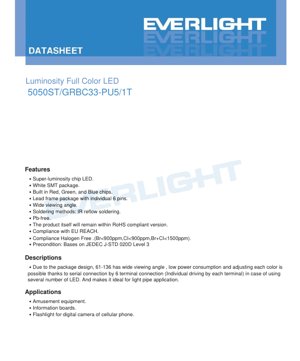
This document elaborates on the technical specifications of a high-performance full-color Surface Mount Technology (SMT) LED. The device integrates independent red, green, and blue semiconductor chips within a single 5050 package, capable of generating a broad color spectrum through the principle of additive color mixing. Its primary design objectives are to achieve high luminous output, a wide viewing angle, and suitability for automated assembly processes.
1.1 Core Features and Advantages
- High-Brightness Chips:Utilizes advanced semiconductor materials (GaInAlP for red light, InGaN for green and blue light) to achieve excellent light output.
- SMT Package:White plastic SMT package, designed to be compatible with standard infrared (IR) reflow soldering processes, facilitating high-volume, automated PCB assembly.
- Independent chip control:It adopts a 6-pin lead frame package, and the anode and cathode of each color (red, green, blue) are independently accessible. This enables precise independent driving and control of each color channel, which is crucial for color calibration and series connection of multiple LEDs.
- Wide viewing angle:The packaging design achieves a typical viewing angle of 120 degrees (2θ1/2), ensuring good visibility from a wide range of viewing angles.
- Environmental Compliance:产品为无铅(Pb-free)设计,符合欧盟REACH法规,并满足无卤标准(Br < 900ppm, Cl < 900ppm, Br+Cl < 1500ppm)。产品本身符合RoHS指令。
- Reliability:Preconditioning is based on the JEDEC J-STD-020D Level 3 standard, indicating its ability to effectively resist moisture-induced stress during the soldering process.
1.2 Target Applications
The combination of high brightness, full-color capability, and SMT form factor makes this LED suitable for a variety of applications requiring vibrant, controllable lighting.
- Entertainment and Gaming Devices:For decorative lighting, status indicators, and interactive lighting effects.
- Information Display Boards:For signage, information boards, and other displays requiring multi-color indication.
- Mobile device flash:With its compact size and color capabilities, it is suitable for use as a camera flash or fill light for mobile phones and digital cameras.
- Light guide tube application:Its wide viewing angle and point source characteristics make it an ideal choice for coupling into light guides or light pipes, used in edge-lit panels or indicator light systems.
2. Technical Specifications and In-depth Interpretation
2.1 Absolute Maximum Ratings
These ratings define the limits that may cause permanent damage to the device. Operation under these conditions is not guaranteed.
- Forward Current (IF):Each color (red, green, blue) is 150 mA. This is the maximum continuous DC current recommended for reliable operation.
- Peak Forward Current (IFP):Each color is 200 mA, allowed only under pulse conditions (duty cycle 1/10, frequency 1 kHz). Even briefly exceeding the continuous rating may lead to chip performance degradation.
- Power Dissipation (Pd):Red light: 420 mW; Green/Blue light: 555 mW. This is the maximum heat the package can dissipate at an ambient temperature of 25°C. Proper PCB thermal design is crucial to ensure this limit is not exceeded during operation.
- Junction Temperature (Tj):Maximum 115°C. The temperature of the semiconductor chip itself must not exceed this value.
- Operating and Storage Temperature:-40°C to +85°C (operating), -40°C to +100°C (storage).
- Soldering temperature:Reflow soldering: peak temperature 260°C, maximum 10 seconds. Hand soldering: 350°C, maximum 3 seconds. These temperature profiles are critical to prevent package cracking or internal bond wire damage.
2.2 Photoelectric Characteristics (Ta=25°C)
These are typical performance parameters measured under standard test conditions (ambient temperature 25°C, each color IF=150mA).
- Luminous Flux (Iv):Total visible light output.
- Red light: typical value 25 lumens (lm), range 13.9-39.8 lm.
- Green light: typical value 40 lm, range 13.9-51.7 lm.
- Blue light: typical value 8.5 lm, range 4.9-18.1 lm.
- Luminous intensity (Iv):Light output in a specific direction (candela). Typical values are 7550 mcd (red), 12100 mcd (green), and 2550 mcd (blue).
- Viewing angle (2θ1/2):Typical value 120 degrees (range 110-130 degrees). This is the full angle at which the luminous intensity is at least half of the peak value.
- Dominant Wavelength (λd):Perceived color of light.
- Red light: typical value 622 nm (617-629 nm).
- Green light: typical value 525 nm (518-530 nm).
- Blue light: typical value 457 nm (455-470 nm).
- Forward voltage (VF):Voltage drop across the LED under test current.
- Red light: typical value 2.3V (1.8-2.8V).
- Green light: typical value 3.4V (2.7-3.7V).
- Blue: Typical value 3.2V (2.7-3.7V).
- Reverse current (IR):Maximum 10 μA at 5V reverse bias. LED is not designed for reverse voltage operation.
3. Binning System Description
To ensure consistency in mass production, LEDs are sorted (binned) based on key optical and electrical parameters. This allows designers to select devices that meet the color and brightness uniformity requirements of specific applications.
3.1 Luminous Flux Binning
LEDs are classified based on their light output measured at 150mA. The binning range for each color overlaps to cover the full min-max specification range.
- Red (R):Binning R1 to R4, covering 13.9 lm to 39.8 lm.
- Green light (G):Binning G1 to G5, covering 13.9 lm to 51.7 lm.
- Blue light (B):Grading B1 to B5, covering 4.9 lm to 18.1 lm.
The luminous flux value within each grade allows a tolerance of ±11%.
3.2 Forward Voltage Binning
LEDs are binned according to their forward voltage to aid in circuit design and power supply selection.
- Red Light:Single bin "1828", covering 1.8V to 2.8V.
- 绿光 & Blue light:Single bin "2737", covering 2.7V to 3.7V.
A tolerance of ±0.1V is allowed.
3.3 Dominant Wavelength Binning
For color-sensitive applications, this is the most critical binning to ensure tonal consistency.
- Red Light:Binning RA (617-621 nm), RB (621-625 nm), RC (625-629 nm).
- Green light:Binning GA to GD (518-530 nm, approximately in 3nm steps).
- Blue light:Classification BA to BE (455-470 nm, approximately in 3nm steps).
The dominant wavelength allows a tolerance of ±1nm.
4. Performance Curve Analysis
4.1 Spectral Distribution
Typical spectral distribution curves show the relative intensity of light emitted by each chip at different wavelengths. The red chip emits light in a narrow band centered around 622nm. The green chip emits around 525nm, and the blue chip emits around 457nm. The purity of these spectral peaks is crucial for achieving saturated colors. This curve should be compared with the standard human eye response curve (V(λ)) to understand perceived brightness.
4.2 Radiation Pattern
The radiation pattern illustrates the spatial distribution of light intensity (relative intensity vs. angle). The curve confirms its broad, Lambertian-like emission pattern, with a typical viewing angle of 120 degrees, fairly uniform intensity in the central region, and attenuation towards the edges.
4.3 Forward Current vs. Forward Voltage (I-V Curve)
The I-V curve of blue chips (and other chips) shows an exponential relationship between current and voltage. Below the turn-on voltage (approximately 2.7V for blue/green, 1.8V for red), almost no current flows. Beyond this threshold, current increases rapidly with a small increase in voltage. This characteristic necessitates the use of a constant current driver, not a constant voltage source, to prevent thermal runaway and ensure stable light output.
4.4 Dominant Wavelength vs. Forward Current
These curves for the red, green, and blue chips show how the emission color (dominant wavelength) changes with the drive current. Typically, as the current increases, the junction temperature rises, causing a slight shift in wavelength (usually towards longer wavelengths for InGaN-based green/blue LEDs). This effect is crucial for applications requiring precise color stability across different brightness levels.
4.5 Relative Luminous Intensity vs. Forward Current
This curve describes the light output (relative to a reference) as a function of the drive current. It is typically linear at lower currents, but may exhibit saturation or roll-off at higher currents due to thermal effects and efficiency droop. The curve reveals the trade-off between brightness and efficiency/heat.
4.6 Maximum Allowable Forward Current vs. Temperature
This derating curve is crucial for thermal management. It shows the maximum safe continuous forward current as a function of ambient (or case) temperature. As the temperature increases, the maximum allowable current decreases linearly. For example, at 85°C, the allowable current is significantly lower than the 150mA rating at 25°C. Designers must use this graph to ensure the LED is not overdriven in the application's operating environment.
5. Mechanical and Packaging Information
5.1 Package Dimensions
The LED uses a standard 5050 SMT package. Key dimensions are as follows:
- Package length: 5.0 mm
- Package width: 5.0 mm
- Package height (typical): 1.6 mm
5.2 Pin Arrangement and Polarity Identification
This package has six pins arranged in two rows of three each. When viewed from the top, pins are typically numbered counterclockwise. The datasheet diagram clearly marks the anode and cathode pins for the red, green, and blue chips. Correct polarity identification is crucial to prevent reverse biasing of the LED during assembly. The bottom view usually includes a polarity mark (such as a notch or a dot) to aid in PCB orientation.
6. Welding and Assembly Guide
6.1 Reflow Soldering Parameters
Recommended infrared (IR) reflow soldering temperature profile is a critical process parameter.
- Peak temperature:Maximum 260°C.
- Time above liquidus (TAL):The time the solder joint spends above its melting point should be controlled, typically recommending a dwell of 10 seconds at peak temperature.
- Ramp-up/Ramp-down Rate:It is recommended to control the heating and cooling rates (e.g., 1-3°C/sec) to minimize thermal shock to the plastic package and internal bond wires.
6.2 Manual Soldering
If hand soldering is required, extreme care must be taken:
- Limit the soldering iron tip temperature to a maximum of 350°C.
- Limit the contact time for each pin to a maximum of 3 seconds.
- Use a heat sink (e.g., tweezers) on the pin between the solder joint and the package body to prevent excessive heat from transferring to the LED.
6.3 Storage Conditions
Devices should be stored in their original moisture barrier bag with desiccant, at a temperature between -40°C and +100°C, in a non-condensing environment. Once the sealed bag is opened, the duration for which the device is exposed to ambient humidity is limited by its MSL rating (Level 3).
7. Packaging and Ordering Information
7.1 Reel and Carrier Tape Specifications
LEDs are supplied in embossed tape on reels, suitable for automated placement machines.
- Tape dimensions:Pocket dimensions (Dimension A): 5.70±0.10 mm, (Dimension B): 5.38±0.10 mm, Depth (Dimension C): 1.60±0.10 mm.
- Reel dimensions:Standard 13-inch (330mm) reel dimensions are provided.
- Quantity per reel:Standard packaging is 1000 pieces per reel. Minimum order quantity can be 250 or 500 pieces per reel.
7.2 Label Description
The reel label contains a code specifying the LED binning on that reel:
- CAT:Luminous intensity class (based on luminous flux binning).
- HUE:Primary Wavelength Grade (Wavelength Binning Code).
- REF:Forward Voltage Grade (Voltage Binning Code).
- LOT No:Traceable lot number.
- P/N:Full product number.
- QTY:Quantity on reel.
8. Application Design Considerations
8.1 Drive Circuit Design
Due to the different forward voltages of red light (∼2.3V) and green/blue light (∼3.4V) chips, using a single current-limiting resistor for a simple series connection is not optimal if uniform current is desired. The recommended approach is to use independent current-limiting resistors for each color channel, or better yet, to use a dedicated multi-channel constant-current LED driver IC. This ensures that regardless of power supply voltage variations or VFHow the gear difference is, can maintain consistent brightness and color. Pulse Width Modulation (PWM) is the preferred method for dimming and color mixing because it can maintain a constant current (and thus a stable color point) while changing the duty cycle.
8.2 Thermal Management
The power consumption of each LED can be up to 0.555W (green/blue light at 150mA). When multiple LEDs are used on a circuit board, the total heat generation can be considerable. Proper thermal design is crucial:
- PCB Layout:Use a PCB with sufficient copper foil area (thermal pad) and connect it to the LED's thermal pad (if available) or pins to conduct heat.
- Thermal vias:Arrange a set of thermal vias under the LED pad to transfer heat to the internal ground plane or the back of the circuit board.
- Derating:Always refer to the derating curve for maximum current versus temperature. In applications with high ambient temperatures, the drive current should be reduced accordingly to ensure the junction temperature remains below 115°C.
8.3 Optical Design
The 120-degree wide viewing angle is beneficial for general lighting, but for applications requiring a focused beam, secondary optics (lenses, reflectors) may be necessary. For light guide tube applications, its small light-emitting area and wide viewing angle facilitate efficient coupling. When designing color mixing, the spatial overlap of the red, green, and blue emission patterns must be considered to achieve uniform mixed color at the target location.
9. Technical Comparison and Differentiation
Compared to earlier RGB LED packages or discrete monochromatic LEDs, this device offers several key advantages:
- Integration Level:Three chips are integrated into one SMT package, saving PCB space and simplifying assembly compared to using three separate LEDs.
- Independent Control:The 6-pin design provides truly independent anode/cathode access for each color, offering greater flexibility compared to common-anode or common-cathode 4-pin RGB LEDs. This enables more complex driving schemes, such as series connection for higher voltage operation.
- Performance:The use of "ultra-high brightness" chips indicates higher efficiency and light output compared to standard products in the same package size.
- Compliance:Full compliance with modern environmental regulations (RoHS, REACH, halogen-free) is a basic requirement, but it is explicitly confirmed here.
10. Frequently Asked Questions (Based on Technical Parameters)
10.1 Can I drive all three colors using a single 5V power supply and one resistor?
Not the optimal solution. The forward voltage of green and blue LEDs (∼3.4V) leaves only ∼1.6V for the current-limiting resistor under a 5V supply, which allows for stable current control. However, the red LED (∼2.3V) will have ∼2.7V dropped across its resistor. Using the same resistor value for all three colors will result in vastly different currents and brightness levels due to the different VFvalues. Independent resistors or constant current drivers are required.
10.2 What is the difference between luminous flux (lm) and luminous intensity (mcd)?
Luminous flux (lumens) measures the total amount of visible light emitted by a light source in all directions. Luminous intensity (candela) measures how bright a light source appears in a specific direction. For wide-viewing-angle LEDs like this one, the intensity value is typically the peak measured on-axis. Total luminous flux better reflects the overall light output for illumination, while luminous intensity is relevant for indicator lights viewed from a specific angle.
10.3 How to use this RGB LED to achieve white light?
White light is produced by mixing red, green, and blue light at appropriate intensities. The exact ratio depends on the specific chromaticity target (e.g., cool white, warm white) and the spectral characteristics of the individual LEDs. Due to variations in chip efficiency and binning, achieving a consistent, high-quality white point typically requires individual calibration within the system or the use of a color sensor for feedback. This is more complex than using a dedicated white LED phosphor.
10.4 Why is the maximum junction temperature only 115°C?
The junction temperature limit is determined by the materials used in the LED chip, bond wires, and package. Overheating accelerates performance degradation mechanisms, reduces light output (lumen depreciation), and can lead to catastrophic failure. Operating at the maximum Tjor near the maximum T
will significantly shorten the device's service life. Good thermal design aims to keep the junction temperature as low as possible during operation.
11. Practical Design and Usage Examples
11.1 Example: Status Indicator for Consumer Electronic Devices
In smart home devices, a 5050 RGB LED can provide various status codes: red indicates an error, green indicates ready, blue indicates Bluetooth pairing, yellow (red+green) indicates standby, etc. The wide viewing angle ensures visibility from any direction. A simple microcontroller with three GPIO pins featuring PWM functionality and three current-limiting resistors (e.g., 15-20Ω when driving approximately 20mA from a 3.3V or 5V power supply) is sufficient to drive this LED. Low current extends lifespan and minimizes heat generation.
11.2 Example: Backlight for Small Signage
Don hasken gefen alamar acrylic, ana iya sanya ƴan irin waɗannan LED ɗin a gefe. Faɗin hangen nesa nasu yana taimakawa wajen haɗa haske cikin acrylic. Ta hanyar jera su a jere (misali, duk haske ja a jere, duk kore a jere, duk shuɗi a jere), ana iya amfani da injin tuƙi mafi girma ƙarfin lantarki, ƙananan ƙarfin lantarki, don haka ƙara inganci. Sarrafa kai tsaye yana ba da damar shirya launi na alama ta hanyar tsari mai ƙarfi. Gudanar da zafi ya ƙunshi tabbatar da cewa acrylic ko tushen shigarwa zai iya watsar da zafi daga dukan tsararrun LED.
12. Working Principle
This device operates based on the principle of electroluminescence in semiconductor materials. When the forward voltage applied across the p-n junction exceeds the bandgap energy of the chip, electrons and holes recombine, releasing energy in the form of photons (light). The color (wavelength) of the emitted light is determined by the bandgap energy of the semiconductor material: red light (∼622 nm) uses GaInAlP material, while green light (∼525 nm) and blue light (∼457 nm) use InGaN material. Three separate semiconductor chips made from these different materials are mounted within a reflector cup and encapsulated in transparent or diffused resin to form a complete LED package.
13. Teknoloji Trendleri
Detailed Explanation of LED Specification Terminology
Complete Interpretation of LED Technical Terminology
I. Core Indicators of Photoelectric Performance
| Terminology | Unit/Representation | Popular Explanation | Aiseā e Taua ai |
|---|---|---|---|
| Luminous Efficacy | lm/W (lumens per watt) | The luminous flux emitted per watt of electrical power; higher values indicate greater energy efficiency. | It directly determines the energy efficiency rating of the luminaire and the electricity cost. |
| Luminous Flux | lm (lumen) | The total amount of light emitted by a light source, commonly known as "brightness". | Determines whether a luminaire is bright enough. |
| Viewing Angle | ° (degree), e.g., 120° | The angle at which luminous intensity drops to half, determining the beam width. | Affects the range and uniformity of illumination. |
| Color Temperature (CCT) | K (Kelvin), such as 2700K/6500K | Haske launin sanyi ko zafi, ƙananan ƙima sun fi rawaya/dumi, manyan ƙima sun fi fari/sanyi. | Yana ƙayyade yanayin hasken wuta da kuma yanayin da ya dace. |
| Color Rendering Index (CRI / Ra) | Unitless, 0–100 | The ability of a light source to reproduce the true colors of objects, with Ra≥80 being preferable. | Affects color authenticity, used in high-demand places such as shopping malls and art galleries. |
| Color tolerance (SDCM) | MacAdam ellipse step, such as "5-step" | A quantitative indicator of color consistency; the smaller the step number, the better the color consistency. | Ensure no color difference among luminaires from the same batch. |
| Dominant Wavelength | nm (nanometer), e.g., 620nm (red) | Wavelength values corresponding to the colors of colored LEDs. | Determines the hue of monochromatic LEDs such as red, yellow, and green. |
| Spectral Distribution | Wavelength vs. Intensity Curve | Shows the intensity distribution of light emitted by an LED at each wavelength. | Affects color rendering and color quality. |
II. Electrical Parameters
| Terminology | Symbol | Popular Explanation | Design Considerations |
|---|---|---|---|
| Forward Voltage (Forward Voltage) | Vf | The minimum voltage required to light up an LED, similar to a "starting threshold". | The driving power supply voltage must be ≥ Vf; the voltages add up when multiple LEDs are connected in series. |
| Forward Current | If | The current value that makes the LED emit light normally. | Constant current drive is often used, as the current determines brightness and lifespan. |
| Maximum Pulse Current | Ifp | The peak current that can be withstood for a short period of time, used for dimming or flashing. | Pulse width and duty cycle must be strictly controlled, otherwise overheating damage will occur. |
| Reverse Voltage | Vr | Maximum reverse voltage that an LED can withstand; exceeding it may cause breakdown. | Reverse connection or voltage surges must be prevented in the circuit. |
| Thermal Resistance (Thermal Resistance) | Rth (°C/W) | The resistance to heat flow from the chip to the solder joint. A lower value indicates better heat dissipation. | High thermal resistance requires stronger cooling design, otherwise junction temperature rises. |
| Electrostatic Discharge Immunity (ESD Immunity) | V (HBM), such as 1000V | Electrostatic discharge immunity; a higher value indicates greater resistance to damage from static electricity. | Anti-static measures must be implemented during production, especially for high-sensitivity LEDs. |
III. Thermal Management and Reliability
| Terminology | Key Indicators | Popular Explanation | Impact |
|---|---|---|---|
| Junction Temperature | Tj (°C) | The actual operating temperature inside the LED chip. | For every 10°C reduction, the lifespan may double; excessively high temperatures cause lumen depreciation and color shift. |
| Lumen Depreciation | L70 / L80 (hours) | The time required for the brightness to drop to 70% or 80% of its initial value. | Directly define the "useful life" of LED. |
| Lumen Maintenance | % (e.g., 70%) | The percentage of remaining brightness after a period of use. | Characterizes the ability to maintain brightness after long-term use. |
| Color Shift | Δu′v′ or MacAdam ellipse | The degree of color change during use. | Affects the color consistency of the lighting scene. |
| Thermal Aging | Material performance degradation | Degradation of packaging materials due to prolonged high temperatures. | It may lead to a decrease in brightness, color change, or open-circuit failure. |
IV. Packaging and Materials
| Terminology | Common Types | Popular Explanation | Characteristics and Applications |
|---|---|---|---|
| Package Types | EMC, PPA, Ceramics | The housing material that protects the chip and provides optical and thermal interfaces. | EMC offers good heat resistance and low cost; ceramics provide superior heat dissipation and long lifespan. |
| Chip Structure | Front-side, Flip Chip | Chip electrode arrangement method. | Flip-chip offers better heat dissipation and higher luminous efficacy, suitable for high-power applications. |
| Phosphor coating. | YAG, silicate, nitride | Coated on the blue LED chip, partially converted to yellow/red light, mixed to form white light. | Different phosphors affect luminous efficacy, color temperature, and color rendering. |
| Lens/Optical Design | Planar, microlens, total internal reflection | Optical structure on the packaging surface, controlling light distribution. | Determines the emission angle and light distribution curve. |
V. Quality Control and Grading
| Terminology | Grading Content | Popular Explanation | Purpose |
|---|---|---|---|
| Luminous Flux Binning | Codes such as 2G, 2H | Group by brightness level, each group has a minimum/maximum lumen value. | Ensure consistent brightness for products in the same batch. |
| Voltage binning | Code such as 6W, 6X | Grouped by forward voltage range. | Ease of matching the driving power supply, improving system efficiency. |
| Color binning | 5-step MacAdam ellipse | Group by color coordinates to ensure colors fall within a minimal range. | Ensure color consistency to avoid uneven color within the same luminaire. |
| Color Temperature Grading | 2700K, 3000K, etc. | Group by color temperature, each group has a corresponding coordinate range. | Meet the color temperature requirements of different scenarios. |
VI. Testing and Certification
| Terminology | Standard/Test | Popular Explanation | Meaning |
|---|---|---|---|
| LM-80 | Lumen maintenance test | Long-term operation under constant temperature conditions, recording luminance attenuation data. | For estimating LED lifetime (in conjunction with TM-21). |
| TM-21 | Lifetime extrapolation standard | Estimating lifespan under actual use conditions based on LM-80 data. | Providing scientific life prediction. |
| IESNA Standard | Illuminating Engineering Society Standard | Covers optical, electrical, and thermal test methods. | Industry-recognized testing basis. |
| RoHS / REACH | Environmental Certification | Ensure the product does not contain harmful substances (e.g., lead, mercury). | Entry requirements for the international market. |
| ENERGY STAR / DLC | Energy efficiency certification | Energy efficiency and performance certification for lighting products. | Commonly used in government procurement and subsidy programs to enhance market competitiveness. |