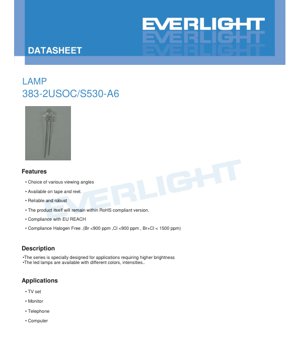
1. Product Overview
This document details the specifications for a high-brightness LED lamp designed for applications requiring superior luminous output. The device utilizes an AlGaInP (Aluminum Gallium Indium Phosphide) chip to produce a sunset-orange color, encapsulated in a water-clear resin package. Its primary design goal is to deliver reliable and robust performance in a compact form factor.
1.1 Core Advantages and Target Market
The series offers a choice of various viewing angles to suit different application needs and is available on tape and reel for automated assembly processes, enhancing production efficiency. It is designed to be reliable and robust, ensuring consistent performance. The product complies with key environmental regulations, including the EU RoHS (Restriction of Hazardous Substances) directive, EU REACH (Registration, Evaluation, Authorisation and Restriction of Chemicals) regulations, and is Halogen-Free, with Bromine (Br) and Chlorine (Cl) content strictly controlled below 900 ppm individually and 1500 ppm combined.
The target applications for this LED are primarily in consumer electronics and display backlighting, including television sets, computer monitors, telephones, and general computer indicator applications where a distinct, bright orange signal is required.
2. Technical Parameter Deep Dive
2.1 Absolute Maximum Ratings
These ratings define the limits beyond which permanent damage to the device may occur. Operation under or at these conditions is not guaranteed and should be avoided for reliable long-term performance.
- Continuous Forward Current (IF): 25 mA. This is the maximum DC current that can be continuously applied to the LED.
- Peak Forward Current (IFP): 160 mA. This is the maximum pulsed current, applicable under a duty cycle of 1/10 at 1 kHz frequency.
- Reverse Voltage (VR): 5 V. Exceeding this voltage in reverse bias can damage the LED junction.
- Electrostatic Discharge (ESD) Human Body Model: 2000 V. This indicates the LED's sensitivity to static electricity; proper ESD handling precautions are necessary.
- Power Dissipation (Pd): 60 mW. The maximum power the package can dissipate without exceeding its thermal limits.
- Operating Temperature (Topr): -40°C to +85°C. The ambient temperature range over which the device is designed to function.
- Storage Temperature (Tstg): -40°C to +100°C. The temperature range for non-operational storage.
- Soldering Temperature (Tsol): 260°C for 5 seconds. The maximum temperature and time the leads can withstand during wave or reflow soldering.
2.2 Electro-Optical Characteristics
These parameters are measured at a standard test condition of an ambient temperature (Ta) of 25°C and a forward current (IF) of 20 mA, unless otherwise specified. They define the typical performance of the LED.
- Luminous Intensity (Iv): 6300 mcd (Min), 8000 mcd (Typ). This is a measure of the perceived brightness of the LED in a specific direction. The measurement uncertainty is ±10%.
- Viewing Angle (2θ1/2): 6° (Typ). This is the full angle at which the luminous intensity is half of the intensity at 0° (on-axis). A 6° angle indicates a very narrow, focused beam.
- Peak Wavelength (λp): 621 nm (Typ). Wavelength da ake fitar da haske ya fi girma.
- Dominant Wavelength (λd): 615 nm (Typ). Tsawon zango guda daya da idon mutum ya gane wanda ya dace da launin LED. Rashin tabbas shine ±1.0 nm.
- Spectrum Radiation Bandwidth (Δλ): 18 nm (Typ). The range of wavelengths where the radiant power is at least half of the peak power, indicating the spectral purity.
- Forward Voltage (VF): 2.0 V (Typ), 2.4 V (Max). The voltage drop across the LED when operating at the specified current. Uncertainty is ±0.1 V.
- Reverse Current (IR): 10 μA (Max). The small leakage current that flows when the specified reverse voltage (5V) is applied.
3. Performance Curve Analysis
The datasheet provides several characteristic curves that illustrate how key parameters change with operating conditions. These are essential for circuit design and thermal management.
3.1 Spectral Distribution and Directivity
The Relative Intensity vs. Wavelength curve shows a sharp peak centered around 621 nm, confirming the orange color emission. The Directivity Curve visually represents the very narrow 6° viewing angle, showing how intensity drops rapidly off-axis, which is ideal for focused indicator applications.
3.2 Electrical and Thermal Dependencies
The Forward Current vs. Forward Voltage (IV Curve) shows the exponential relationship typical of a diode. At 20 mA, the voltage is approximately 2.0V. The Relative Intensity vs. Forward Current curve demonstrates that light output increases linearly with current up to the maximum rated continuous current.
The Relative Intensity vs. Ambient Temperature curve is critical for thermal design. It shows that luminous output decreases as the ambient temperature rises. For example, at 85°C, the output may be only 50-60% of its value at 25°C. Conversely, the Forward Current vs. Ambient Temperature curve (likely under constant voltage) would show how current changes with temperature, important for designing constant-current drivers to maintain stable brightness.
4. Mechanical and Package Information
4.1 Package Dimensions
LED yana cikin daidaitaccen fakitin zagaye na 3mm, wanda ake kira da girman "T-1". Cikakken zanen girma ya ƙayyade diamita na ruwan tabarau, tazarar jagora, diamita na jagora, da kuma tsayin gaba ɗaya. Wani muhimmin bayanin ya ƙayyade cewa tsayin flange (ƙwanƙolin da ke gindin kumfa) dole ne ya zama ƙasa da 1.5mm (0.059"). Duk girmansu suna cikin milimita, tare da daidaitaccen jurewar ±0.25mm sai dai idan an faɗi akasin haka. Daidaitattun girma suna da muhimmanci ga ƙirar ƙafar PCB da kuma tabbatar da dacewa daidai a cikin gidaje.
4.2 Gano Polarity
LED yana da jagora guda biyu: anode (tabbatacce) da cathode (korau). Yawanci, ana gano cathode ta wurin wani fili a gefen ruwan tabarau na filastik ko ta wurin gajeriyar jagora. Ya kamata a duba zanen takardar bayanan don tabbatar da ainihin alamar polarity don wannan takamaiman lambar sashi don hana sanyawa baya.
5. Soldering and Assembly Guidelines
Proper handling is essential to prevent damage and ensure reliability.
5.1 Lead Forming
- Bending must occur at least 3mm from the base of the epoxy bulb to avoid stress on the seal.
- Forming must be done before haɗawa.
- Kauce wa damuwa ga kunshin. Ramin PCB mara daidai wanda ke tilasta jagororin yayin shigarwa na iya haifar da tsagewa ko lalacewa.
- Yanke jagororin a yanayin daki.
5.2 Soldering Process
Hand Soldering: Iron tip temperature should not exceed 300°C (for a max 30W iron), and soldering time per lead should be 3 seconds maximum. Maintain a minimum distance of 3mm from the solder joint to the epoxy bulb.
Wave (DIP) Soldering: Preheat temperature should not exceed 100°C for a maximum of 60 seconds. The solder bath temperature should be a maximum of 260°C with a dwell time of 5 seconds. Again, maintain a 3mm distance from the joint to the bulb.
A recommended soldering profile graph would typically show a gradual preheat ramp, a brief peak at 260°C, and a controlled cooling slope. Rapid cooling is not recommended. Dip or hand soldering should not be performed more than once.
5.3 Storage and Cleaning
Storage: LEDs should be stored at ≤30°C and ≤70% Relative Humidity. The shelf life after shipping is 3 months. For longer storage (up to 1 year), use a sealed container with a nitrogen atmosphere and desiccant. Avoid rapid temperature changes in humid environments to prevent condensation.
Cleaning: If necessary, clean only with isopropyl alcohol at room temperature for no more than one minute. Do not use ultrasonic cleaning unless absolutely necessary and only after pre-qualification, as it can cause internal damage.
6. Heat Management Principle
Ko ba LED mai ƙarfi ba, kula da zafi har yanzu muhimmin abu ne na ƙira. Ƙarfin gaba da na yanzu suna haifar da zafi (Ƙarfi = Vf * If). Wannan zafin, idan ba a kawar da shi ba, yana ɗaga yanayin zafi a cikin LED. Kamar yadda aka nuna a cikin lanƙwan aiki, babban yanayin zafi kai tsaye yana rage fitowar haske (ƙarfin haske) kuma yana iya haɓaka lalacewar dogon lokaci, yana rage tsawon rayuwar LED. Saboda haka, yayin matakin ƙira na aikace-aikace, ya kamata a yi la'akari da hanyar zafi daga jagororin LED zuwa PCB kuma mai yiyuwa zuwa heatsink, musamman idan ana aiki kusa da matsakaicin ci gaba na yanzu ko a cikin yanayin zafi mai girma. Ƙimar ɓarnawar ƙarfin 60mW shine iyaka ga fakitin; wuce gona da iri zai sa yanayin zafi ya wuce iyakokin aminci.
7. Packaging and Ordering Information
7.1 Packing Specification
LEDs are packed in anti-static bags to protect from ESD. The packing hierarchy is as follows:
1. Reel/Bag: Minimum 200 to 500 pieces per anti-static bag.
2. Inner Carton: 6 bags per inner carton.
3. Master/Outside Carton: 10 inner cartons per master carton.
7.2 Label Explanation
Labels on the packaging contain several codes:
- CPN: Customer's Part Number.
- P/N: Manufacturer's Part Number (e.g., 383-2USOC/S530-A6).
- QTY: Yawan kayan a cikin kunshin.
- CAT: Matsayi ko kwandon don Ƙarfin Hasken (Iv).
- HUE: Ranks or bins for Dominant Wavelength (λd).
- REF: Ranks or bins for Forward Voltage (Vf).
- LOT No: Traceable manufacturing lot number.
8. Application Suggestions and Design Considerations
8.1 Typical Application Circuits
Wannan LED ya kamata a sarrafa shi ta hanyar tushen kwararar kaya na yau da kullun don tsayayyen haske. Madaidaicin resistor na jeri ya zama ruwan dare ga aikace-aikacen ƙarancin wutar lantarki. Ana ƙididdige ƙimar resistor (R) kamar R = (Vsupply - Vf) / If. Misali, tare da wadatar 5V, Vf na 2.0V, da kuma If da ake so na 20mA: R = (5 - 2.0) / 0.02 = 150 Ω. Ya kamata ƙimar wutar resistor ta kasance aƙalla (5-2.0)*0.02 = 0.06W, don haka resistor na 1/8W ko 1/4W ya isa. Ga aikace-aikacen da ke buƙatar tsayayyen haske akan yanayin zafi ko bambance-bambancen wutar lantarki, ana ba da shawarar LED driver IC na musamman.
8.2 Design Considerations
- Viewing Angle: The 6° narrow angle makes it suitable for panel indicators where light should be directed straight at the viewer, not for wide-area illumination.
- Current Limiting: Always use a current-limiting resistor or circuit. Connecting directly to a voltage source will cause excessive current flow, destroying the LED.
- PCB Layout: Ensure the PCB footprint matches the datasheet dimensions and polarity. Provide adequate copper area around the leads to act as a minor heatsink.
- ESD Protection: Implement ESD protection on input lines if the LED is user-accessible, and follow ESD-safe handling procedures during assembly.
9. Technology Introduction and Differentiation
9.1 AlGaInP Chip Technology
Wannan LED yana amfani da kayan semiconductor na AlGaInP (Aluminum Gallium Indium Phosphide). Wannan tsarin kayan yana da inganci sosai wajen samar da haske a cikin bakan amber, orange, ja, da kore-rawaya. Idan aka kwatanta da tsofaffin fasahohi kamar GaAsP (Gallium Arsenide Phosphide), AlGaInP LEDs suna ba da haske da inganci sosai mafi girma ga wani ƙayyadadden igiyar ruwa, wanda shine dalilin da ya sa wannan ɓangaren zai iya kaiwa 8000 mcd a 20mA kawai. Ruwan tabarau na resin mai tsabta, sabanin wanda aka yada ko an yi shi da launi, yana ƙara fitar da haske sosai, yana ba da gudummawa ga babban ƙarfin haske.
9.2 Differentiation from Similar Products
The key differentiators of this specific LED are its very high luminous intensity (8000 mcd) at a standard 20mA drive current and its very narrow viewing angle (6°). Many standard 3mm orange LEDs may have intensities in the 100-1000 mcd range with wider angles (15-30°). This makes it a specialist component for applications where a highly visible, focused beam of orange light is required from a small source, such as a high-brightness status indicator on professional equipment or a precise optical sensor trigger.
10. Frequently Asked Questions (Based on Technical Parameters)
Q1: Inaweza kuendesha LED hii kwa 25mA kila wakati?
A1: Ndiyo, 25mA ndiyo Upeo Kabisa wa Mwendelezo wa Sasa wa Mbele. Kwa uimara bora na kuzingatia hali halisi za joto, inashauriwa kuendesha kwa au kidogo chini ya sasa ya kawaida ya majaribio ya 20mA.
Q2: Nguvu ya mwanga ni 8000 mcd kwa kawaida. Kwa nini kipimo changu kinatofautiana?
A2: The datasheet specifies a ±10% measurement uncertainty. Furthermore, intensity is measured under specific conditions (20mA, 25°C) with the photodetector placed on-axis (0°). Any deviation in current, temperature, or measurement angle (especially critical with a 6° beam) will result in a different reading.
Q3: What do the CAT, HUE, and REF bins mean?
A3: Due to manufacturing variations, LEDs are sorted (binned) after production. CAT groups LEDs by similar luminous intensity (e.g., 7000-8000 mcd, 8000-9000 mcd). HUE groups by dominant wavelength (e.g., 613-617 nm). REF groups by forward voltage (e.g., 1.9-2.1V). For applications requiring color or brightness consistency, specifying or purchasing within a tight bin is important.
Q4: How do I interpret the 2000V ESD rating?
A4: A 2000V HBM (Human Body Model) rating is considered relatively robust for an LED but still requires basic ESD precautions. It means the device can typically withstand a 2000V discharge from a human model. Always handle on grounded surfaces, use wrist straps, and package in anti-static materials.
LED Specification Terminology
Complete explanation of LED technical terms
Photoelectric Performance
| Term | Unit/Representation | Simple Explanation | Why Important |
|---|---|---|---|
| Luminous Efficacy | lm/W (lumens per watt) | Light output per watt of electricity, higher means more energy efficient. | Directly determines energy efficiency grade and electricity cost. |
| Luminous Flux | lm (lumens) | Total light emitted by source, commonly called "brightness". | Determines if the light is bright enough. |
| Viewing Angle | ° (degrees), e.g., 120° | Angle where light intensity drops to half, determines beam width. | Affects illumination range and uniformity. |
| CCT (Color Temperature) | K (Kelvin), e.g., 2700K/6500K | Warmth/coolness of light, lower values yellowish/warm, higher whitish/cool. | Determines lighting atmosphere and suitable scenarios. |
| CRI / Ra | Unitless, 0–100 | Ability to render object colors accurately, Ra≥80 is good. | Affects color authenticity, used in high-demand places like malls, museums. |
| SDCM | MacAdam ellipse steps, e.g., "5-step" | Color consistency metric, smaller steps mean more consistent color. | Inahakikisha rangi sawa kwenye kundi moja la LED. |
| Dominant Wavelength | nm (nanometers), e.g., 620nm (red) | Wavelength corresponding to color of colored LEDs. | Determines hue of red, yellow, green monochrome LEDs. |
| Spectral Distribution | Wavelength vs intensity curve | Inaonyesha usambazaji wa nguvu kwenye urefu wa mawimbi. | Inaathiri uwasilishaji wa rangi na ubora. |
Electrical Parameters
| Term | Symbol | Simple Explanation | Design Considerations |
|---|---|---|---|
| Forward Voltage | Vf | Minimum voltage to turn on LED, like "starting threshold". | Driver voltage must be ≥Vf, voltages add up for series LEDs. |
| Forward Current | If | Current value for normal LED operation. | Usually constant current drive, current determines brightness & lifespan. |
| Max Pulse Current | Ifp | Peak current tolerable for short periods, used for dimming or flashing. | Pulse width & duty cycle must be strictly controlled to avoid damage. |
| Reverse Voltage | Vr | Max reverse voltage LED can withstand, beyond may cause breakdown. | Circuit must prevent reverse connection or voltage spikes. |
| Thermal Resistance | Rth (°C/W) | Resistance to heat transfer from chip to solder, lower is better. | High thermal resistance requires stronger heat dissipation. |
| ESD Immunity | V (HBM), e.g., 1000V | Ability to withstand electrostatic discharge, higher means less vulnerable. | Anti-static measures needed in production, especially for sensitive LEDs. |
Thermal Management & Reliability
| Term | Metric Key | Simple Explanation | Impact |
|---|---|---|---|
| Junction Temperature | Tj (°C) | Actual operating temperature inside LED chip. | Kila kupungua kwa 10°C kunaweza kuongeza maisha ya taa mara mbili; joto la juu sana husababisha kupungua kwa mwanga, na mabadiliko ya rangi. |
| Kupungua kwa Lumen | L70 / L80 (saa) | Time for brightness to drop to 70% or 80% of initial. | Directly defines LED "service life". |
| Lumen Maintenance | % (e.g., 70%) | Percentage of brightness retained after time. | Indicates brightness retention over long-term use. |
| Color Shift | Δu′v′ or MacAdam ellipse | Degree of color change during use. | Affects color consistency in lighting scenes. |
| Thermal Aging | Material degradation | Deterioration due to long-term high temperature. | May cause brightness drop, color change, or open-circuit failure. |
Packaging & Materials
| Term | Common Types | Simple Explanation | Features & Applications |
|---|---|---|---|
| Package Type | EMC, PPA, Ceramic | Housing material protecting chip, providing optical/thermal interface. | EMC: good heat resistance, low cost; Ceramic: better heat dissipation, longer life. |
| Chip Structure | Front, Flip Chip | Chip electrode arrangement. | Flip chip: better heat dissipation, higher efficacy, for high-power. |
| Phosphor Coating | YAG, Silicate, Nitride | Covers blue chip, converts some to yellow/red, mixes to white. | Different phosphors affect efficacy, CCT, and CRI. |
| Lens/Optics | Flat, Microlens, TIR | Optical structure on surface controlling light distribution. | Determines viewing angle and light distribution curve. |
Quality Control & Binning
| Term | Binning Content | Simple Explanation | Purpose |
|---|---|---|---|
| Luminous Flux Bin | Code e.g., 2G, 2H | Grouped by brightness, each group has min/max lumen values. | Ensures uniform brightness in same batch. |
| Voltage Bin | Code e.g., 6W, 6X | Grouped by forward voltage range. | Facilitates driver matching, improves system efficiency. |
| Color Bin | 5-step MacAdam ellipse | Grouped by color coordinates, ensuring tight range. | Guarantees color consistency, avoids uneven color within fixture. |
| CCT Bin | 2700K, 3000K etc. | Grouped by CCT, each has corresponding coordinate range. | Meets different scene CCT requirements. |
Testing & Certification
| Term | Standard/Test | Simple Explanation | Significance |
|---|---|---|---|
| LM-80 | Lumen maintenance test | Long-term lighting at constant temperature, recording brightness decay. | Used to estimate LED life (with TM-21). |
| TM-21 | Standard ya kukadiria maisha | Inakadiria maisha chini ya hali halisi kulingana na data ya LM-80. | Provides scientific life prediction. |
| IESNA | Illuminating Engineering Society | Covers optical, electrical, thermal test methods. | Industry-recognized test basis. |
| RoHS / REACH | Environmental certification | Ensures no harmful substances (lead, mercury). | Market access requirement internationally. |
| ENERGY STAR / DLC | Energy efficiency certification | Energy efficiency and performance certification for lighting. | Used in government procurement, subsidy programs, enhances competitiveness. |