Jerin Abubuwa
- 1. Product Overview
- 1.1 Core Advantages and Target Market
- 2. In-depth Technical Parameter Analysis
- 2.1 Absolute Maximum Ratings
- 2.2 Electro-Optical Characteristics (Ta=25°C)
- 3. Explanation of the Grading System
- 3.1 Luminous Intensity Grading
- 3.2 Forward Voltage Binning
- 4. Performance Curve Analysis
- 4.1 Relative Light Intensity vs. Forward Current
- 4.2 Forward Current vs. Forward Voltage (I-V Curve)
- 4.3 Relative Luminous Intensity vs. Ambient Temperature
- 4.4 Chromaticity Coordinates vs. Forward Current
- 4.5 Spectral Distribution
- 5. Mechanical and Packaging Information
- 5.1 Package Size
- 5.2 Polarity Identification
- 6. Welding and Assembly Guide
- 6.1 Lead Forming
- 6.2 Storage Conditions
- 6.3 Welding Process
- 7. Packaging and Ordering Information
- 7.1 Packaging Specifications
- 7.2 Label Description
- 8. Application Description and Design Considerations
- 8.1 Typical Application Scenarios
- 8.2 Circuit Design Considerations
- 9. Technical Comparison and Differentiation
- 10. Frequently Asked Questions (FAQ)
- 11. How It Works
- 12. Teknoloji Trendleri
1. Product Overview
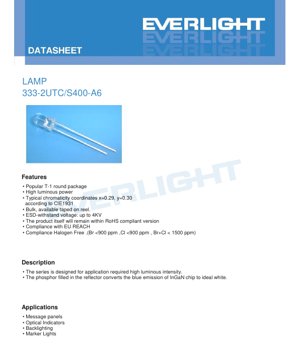
This document elaborates on the technical specifications of a high-brightness white light-emitting diode (LED) utilizing the mainstream T-1 (3mm) round package. This device is designed to deliver exceptional luminous output, suitable for application scenarios requiring bright, clear indication or illumination.
Its core technology employs an indium gallium nitride (InGaN) semiconductor chip, which emits blue light. This blue light is converted into broad-spectrum white light via a phosphor coating deposited inside the LED reflector cup. The resulting white light possesses specific chromaticity coordinate characteristics defined by the CIE 1931 chromaticity diagram standard.
1.1 Core Advantages and Target Market
The primary advantage of this LED series lies in achieving high optical power within a compact, industry-standard form factor. The device is designed for reliability and complies with modern environmental and safety standards.
- High Optical Output:It provides high intensity brightness at the same size.
- Standard Package:T-1 round package ensures compatibility with existing PCB pads and sockets.
- Regulatory Compliance:The product complies with RoHS (Restriction of Hazardous Substances), EU REACH regulations, and is classified as a halogen-free product, meeting specific limits for bromine (Br) and chlorine (Cl) content.
- ESD Protection:It features an electrostatic discharge (ESD) withstand voltage of up to 4kV, enhancing handling robustness.
The target applications are extensive, primarily concentrated in fields requiring clear and bright signal indication. Key markets include backlighting for information panels and displays, status or optical indicators in consumer and industrial electronics, as well as various sign lighting applications.
2. In-depth Technical Parameter Analysis
A thorough understanding of the device's absolute maximum ratings and operating characteristics is crucial for reliable circuit design and long-term performance.
2.1 Absolute Maximum Ratings
These ratings define the stress limits that may cause permanent damage to the device. Operation at or beyond these limits is not guaranteed and should be avoided to ensure reliable performance.
- Continuous Forward Current (IF):30 mA
- Peak Forward Current (IFP):100 mA (under conditions of 1/10 duty cycle, 1 kHz frequency)
- Reverse Voltage (VR):5 V
- Power Consumption (Pd):100 mW
- Operating temperature (Topr):-40°C to +85°C
- Storage temperature (Tstg):-40°C to +100°C
- Soldering temperature (Tsol):Maximum 260°C, up to 5 seconds (wave soldering or reflow soldering).
2.2 Electro-Optical Characteristics (Ta=25°C)
These parameters are measured under standard test conditions and represent the typical performance of the device when driven at a forward current (IF) of 20 mA.
- Forward voltage (VF):2.8 V (min), 3.2 V (typ), 3.6 V (max). The typical voltage drop across the LED is 3.2V.
- Luminous intensity (IV):14,250 mcd (minimum), 28,500 mcd (maximum). The actual intensity has been binned (see Section 3).
- Viewing angle (2θ1/2):15 degrees (typical). This narrow viewing angle concentrates the light output, contributing to high axial luminous intensity.
- Chromaticity coordinates:According to the CIE 1931 chromaticity space, x=0.29, y=0.30 (typical). This defines the specific white point of the emitted light.
- Reverse current (IR):At VRAt =5V, maximum 50 µA.
3. Explanation of the Grading System
To manage production variations and allow for precise selection, LEDs are sorted into different bins based on key parameters.
3.1 Luminous Intensity Grading
LEDs are sorted based on their luminous intensity measured at 20 mA. This allows designers to select the appropriate brightness grade for their application.
- W Grade:14,250 to 18,000 mcd
- X grade:18,000 to 22,500 mcd
- Y Grade:22,500 to 28,500 mcd
The overall tolerance of luminous intensity is ±10%.
3.2 Forward Voltage Binning
LEDs are also binned according to their forward voltage drop, which is crucial for power supply design and ensuring current uniformity in parallel configurations.
- Grade 0: VF= 2.8V to 3.0V
- 1 gear: VF= 3.0V to 3.2V
- 2nd gear: VF= 3.2V to 3.4V
- 3rd gear: VF= 3.4V to 3.6V
The measurement uncertainty of the forward voltage is ±0.1V.
4. Performance Curve Analysis
The datasheet provides several characteristic curves to illustrate the device's behavior under different conditions.
4.1 Relative Light Intensity vs. Forward Current
This curve shows that the light output (relative luminous intensity) increases with the forward current, but the relationship is not entirely linear, especially at higher currents. Driving the LED beyond the recommended continuous current (30mA) may lead to reduced efficiency and accelerated aging.
4.2 Forward Current vs. Forward Voltage (I-V Curve)
The I-V curve exhibits the typical exponential relationship of a diode. For this white LED, the "knee" voltage, where the current begins to increase significantly, is approximately between 2.8V and 3.0V. A stable constant current drive, rather than a constant voltage drive, is crucial for maintaining consistent light output.
4.3 Relative Luminous Intensity vs. Ambient Temperature
The light output of an LED is temperature-dependent. This curve typically shows that as the ambient temperature (Ta) increases, the luminous intensity decreases. Effective thermal management is required in applications to maintain brightness, especially when operating near the maximum temperature limit.
4.4 Chromaticity Coordinates vs. Forward Current
This graph reveals how the white light color (its chromaticity coordinates) shifts slightly with changes in drive current. For applications with strict color requirements, a constant current driver must be used to maintain a stable white point.
4.5 Spectral Distribution
The relative intensity vs. wavelength plot shows the emission spectrum. A white LED using a blue chip + phosphor system will show a strong blue peak (from the InGaN chip) and a broader yellow/red emission band (from the phosphor). The combined spectrum determines the Color Rendering Index (CRI) and Correlated Color Temperature (CCT), although specific CCT values are not listed in this datasheet.
5. Mechanical and Packaging Information
5.1 Package Size
The LED uses a standard T-1 (3mm) radial lead package. Key dimensions include:
- Overall diameter: approximately 5.0 mm (max).
- Pin pitch: 2.54 mm (standard 0.1-inch pitch, measured at the point where the pin extends from the package).
- Total height: Variable, includes epoxy lens and pins. The protruding resin below the flange is a maximum of 1.5mm.
- Lead diameter: Complies with standard component insertion requirements.
Unless otherwise specified, all dimensional tolerances are ±0.25mm. Designers must refer to the detailed mechanical drawings to determine the precise PCB hole locations and keep-out areas.
5.2 Polarity Identification
For radial lead LEDs, polarity is typically indicated by two features: the longer lead is the anode (positive), and there is usually a flat or notch on the plastic lens edge near the cathode (negative) lead. Correct polarity must be observed during assembly to prevent damage from reverse bias.
6. Welding and Assembly Guide
Proper handling and soldering are crucial to prevent mechanical or thermal damage to the LED.
6.1 Lead Forming
- Bending must be performed at a distance of at least 3mm from the base of the epoxy lens.
- Pin forming should always be completedSoldering processBefore.
- Avoid applying stress to the LED package during the bending process.
- Cut the leads at room temperature; using hot cutters may cause failure.
- PCB holes must be perfectly aligned with the LED leads to avoid mounting stress.
6.2 Storage Conditions
- Recommended storage conditions: ≤ 30°C, relative humidity (RH) ≤ 70%.
- Shelf life in the original transport bag: 3 months.
- For longer storage (up to 1 year), place in a sealed container filled with nitrogen and containing a desiccant.
- Avoid sudden temperature changes in humid environments to prevent condensation.
6.3 Welding Process
The minimum distance from the solder joint to the epoxy resin lamp body must be 3mm.
Manual Welding:
- Soldering iron tip temperature: maximum 300°C (for irons up to 30W).
- Soldering time per pin: maximum 3 seconds.
Wave soldering or dip soldering:
- Preheat temperature: maximum 100°C (maximum 60 seconds).
- Solder pot temperature: up to 260°C.
- Contact time in the pot: maximum 5 seconds.
Key Considerations:
- Avoid applying stress to the pins while the LED is hot from soldering.
- Do not subject the LED to more than one soldering cycle (dip soldering/hand soldering).
- Protect the epoxy resin lens from flux splashes and cleaning solvent damage.
7. Packaging and Ordering Information
7.1 Packaging Specifications
LED packaging is designed to prevent electrostatic discharge (ESD) and moisture damage during transportation and storage.
- Primary packaging:Anti-static bag.
- Quantity per bag:200 zuwa 500.
- Tufafi na biyu:5 jakunkuna a cikin akwatin ciki.
- Tufafi na uku:10 inner boxes are packed into one master (outer) carton.
7.2 Label Description
The labels on the bags and cartons contain the following information for traceability and identification:
- P/N:Part number (specific product code).
- CAT:Code ya daraja, inayoonyesha mchanganyiko wa nguvu ya mwanga na voltage ya mbele (kwa mfano, nambari inayowakilisha daraja Y ya nguvu na daraja 1 ya voltage).
- HUE:Daraja ya rangi au daraja ya kiwango cha rangi.
- LOT No:Production batch number, used for quality tracking.
- QTY:Quantity in package.
8. Application Description and Design Considerations
8.1 Typical Application Scenarios
- Information Panel and Backlight:Its high intensity and narrow viewing angle make it ideal for backlit segmented or dot-matrix displays, where bright, easily readable characters are required.
- Optical Indicator:Perfect for status lights, power indicators, or warning lights in equipment, requiring high visibility even under ambient light.
- Sign lights:Suitable for position indicators, exit signs, or low-illumination architectural decorative lighting.
8.2 Circuit Design Considerations
- Current Limiting:Always use a series current-limiting resistor or a constant current driver. Use the formula R = (VPower Supply- VF) / IFCalculate the resistance value. Use the maximum V from the grading or datasheetFvalue to ensure at VFWhen the current is low, it does not exceed the limit.
- Parallel connection:Avoid directly connecting LEDs in parallel without independent current-limiting components.FDifferences in Vf can cause uneven current distribution, where one LED draws most of the current and fails prematurely.
- Thermal Management:Despite low power consumption (max. 100mW), ensure adequate ventilation and avoid placing the LED on the PCB near other heat sources. High junction temperature reduces light output and lifespan.
- Reverse Voltage Protection:The maximum reverse voltage is only 5V. In AC or bipolar signal applications, or in situations where reverse connection may occur, a protection diode should be connected in parallel with the LED (cathode to anode, anode to cathode) to clamp the reverse voltage.
9. Technical Comparison and Differentiation
Compared to generic 3mm white LEDs, this device offers significant advantages:
- Higher intensity setting:Maximum intensity reaches 28,500 mcd, significantly brighter than standard 3mm LEDs which typically range from 2,000 to 10,000 mcd.
- Narrow viewing angle (15°):Concentrating luminous flux into a narrower beam results in higher axial (on-axis) luminous intensity compared to LEDs with wider viewing angles (e.g., 30° or 60°). This is a key differentiating factor for directional lighting applications.
- Integrated Zener diode (optional/protected version):The Zener reverse voltage (Vz) and current (Iz) indicates that some models may include an integrated reverse voltage protection Zener diode, which is not common in basic LED packages.
- Full Compliance:Clear compliance with halogen-free, REACH, and RoHS standards is a key factor for designers targeting regulated markets such as Europe and for companies with strict environmental policies.
10. Frequently Asked Questions (FAQ)
Q1: What drive current should I use?
A1: The standard test condition and recommended operating point is 20 mA. You can drive it up to the absolute maximum rating of 30 mA continuous current, but this will increase power consumption, generate more heat, and may shorten the operating lifetime. For the best balance between brightness, efficiency, and lifetime, 20 mA is recommended.
Q2: How to interpret the luminous intensity binning?
A2: Lambobin rarrabuwa akan alamar kunshin (W, X, Y) suna gaya muku mafi ƙarancin da mafi girman ƙarfin da aka tabbatar da shi na wannan rukunin LED. Misali, LED na rukunin Y zai kasance mafi haske a cikin wannan jeri. Lokacin yin oda, ku ƙayyade rukunin da ake buƙata don tabbatar da daidaiton haske a cikin samarwa.
Q3: Zan iya amfani da wannan LED don aikace-aikacen waje?
A3: Kewayon zafin aiki (-40°C zuwa +85°C) yana goyan bayan yawancin yanayin waje. Duk da haka, kayan ruwan tabarau na epoxy na iya zama mai saukin lalacewa ta UV da launin rawaya a ƙarƙashin hasken rana kai tsaye na dogon lokaci, wanda zai rage fitar da haske kuma ya canza launi. Don amfani mai tsanani na waje, LED tare da ruwan tabarau na silicone mai jure UV ya fi dacewa.
Q4: Why is the viewing angle so narrow?
A4: The 15° narrow viewing angle is a design feature intended to achieve very high axial luminous intensity (in millicandelas). The light is focused into a narrower beam. If you need to illuminate a wider area, you should choose an LED with a wider viewing angle (e.g., 60°), but its axial light intensity will be lower.
11. How It Works
This LED operates based on the principle of electroluminescence in semiconductors. When a forward voltage exceeding the diode's bandgap is applied, electrons and holes recombine within the InGaN active region, releasing energy in the form of photons. The specific composition of the InGaN alloy results in the emission of blue light with a wavelength of approximately 450-470 nm.
This blue light is not emitted directly. Instead, it strikes a layer of phosphor material (typically cerium-doped yttrium aluminum garnet, i.e., YAG:Ce) deposited inside the reflector cup. The phosphor absorbs the high-energy blue photons and re-emits lower-energy photons across a broad spectrum in the yellow and red regions. The human eye perceives the mixture of the remaining blue light and the converted yellow/red light as white light. The exact white "tone" (cool white, neutral white, warm white) is determined by the ratio of blue to yellow/red light, which is controlled by the phosphor's composition and thickness.
12. Teknoloji Trendleri
Bahsedilen teknoloji, LED'den beyaz ışık üretmek için olgun ve yaygın olarak benimsenmiş bir yöntemi temsil etmektedir. "Mavi çip + fosfor" yöntemi uygun maliyetlidir ve renk sıcaklığı üzerinde iyi bir kontrol sağlar. Mevcut endüstri trendleri şunları içerir:
- Verimlilik artışı (lm/W):InGaN chip design, phosphor efficiency, and packaging architecture continue to improve, driving up luminous efficacy and reducing energy consumption for the same light output.
- Color quality improvement:Development of multi-phosphor mixtures (adding red phosphors) to increase the Color Rendering Index (CRI), providing more natural and accurate color reproduction under LED light.
- Miniaturization and high-density packaging:Although this is a through-hole component, the broader market trend is toward smaller surface-mount device (SMD) packages (e.g., 2835, 2016, 1515) to enable automated assembly and higher-density lighting arrays.
- Specialized Spectra:LEDs are being engineered with specific spectral outputs for applications beyond general lighting, such as horticultural lighting (optimized for plant growth) or human-centric lighting (tunable white light to mimic natural daylight cycles).
Detailed Explanation of LED Specification Terminology
Complete Explanation of LED Technical Terminology
I. Core Indicators of Photoelectric Performance
| Terminology | Unit/Representation | Popular Explanation | Why It Matters |
|---|---|---|---|
| Luminous Efficacy | lm/W | The luminous flux emitted per watt of electrical power, the higher the more energy efficient. | Directly determines the energy efficiency rating and electricity cost of the lighting fixture. |
| Luminous Flux | lm (lumen) | Total light output from a light source, commonly known as "brightness". | Determines whether a luminaire is bright enough. |
| Viewing Angle | ° (degrees), e.g., 120° | The angle at which luminous intensity drops to half, determining the beam width. | Affects the illumination range and uniformity. |
| Color Temperature (CCT) | K (Kelvin), e.g., 2700K/6500K | The warmth or coolness of light color; lower values are yellowish/warm, higher values are whitish/cool. | Determines the lighting ambiance and suitable application scenarios. |
| Color Rendering Index (CRI / Ra) | Unitless, 0–100 | The ability of a light source to restore the true color of an object, Ra≥80 is recommended. | Affects color authenticity, used in high-demand places such as shopping malls and art galleries. |
| Color tolerance (SDCM) | MacAdam ellipse steps, e.g., "5-step" | A quantitative indicator of color consistency; a smaller step number indicates better color consistency. | Ensure no color variation among luminaires from the same batch. |
| Dominant Wavelength | nm (nanometer), e.g., 620nm (red) | Rangi ya LED ya rangi inayolingana na thamani ya urefu wa mawimbi. | Inaamua rangi ya LED moja kama nyekundu, manjano, kijani, n.k. |
| Spectral Distribution | Wavelength vs. Intensity Curve | Shows the intensity distribution of light emitted by an LED at each wavelength. | Affects color rendering and color quality. |
II. Electrical Parameters
| Terminology | Symbol | Popular Explanation | Design Considerations |
|---|---|---|---|
| Forward Voltage | Vf | The minimum voltage required to light up an LED, similar to a "starting threshold". | The driving power supply voltage must be ≥ Vf, and the voltage accumulates when multiple LEDs are connected in series. |
| Forward Current | If | The current value that makes the LED emit light normally. | Constant current drive is often used, as the current determines brightness and lifespan. |
| Maximum Pulse Current (Pulse Current) | Ifp | Peak current that can be withstood for a short period, used for dimming or flashing. | Pulse width and duty cycle must be strictly controlled, otherwise overheating damage will occur. |
| Reverse Voltage | Vr | The maximum reverse voltage that an LED can withstand; exceeding this may cause breakdown. | The circuit must be protected against reverse connection or voltage surges. |
| Thermal Resistance | Rth (°C/W) | The resistance to heat transfer from the chip to the solder joint; a lower value indicates better heat dissipation. | High thermal resistance requires a more robust heat dissipation design; otherwise, the junction temperature will increase. |
| Electrostatic Discharge Immunity (ESD Immunity) | V (HBM), e.g., 1000V | ESD strike resistance, the higher the value, the less susceptible to ESD damage. | Anti-static measures must be implemented during production, especially for high-sensitivity LEDs. |
III. Thermal Management and Reliability
| Terminology | Key Indicators | Popular Explanation | Impact |
|---|---|---|---|
| Junction Temperature | Tj (°C) | The actual operating temperature inside the LED chip. | For every 10°C reduction, the lifespan may double; excessively high temperatures lead to lumen depreciation and color shift. |
| Lumen Depreciation | L70 / L80 (hours) | Time required for brightness to drop to 70% or 80% of its initial value. | Directly define the "useful life" of an LED. |
| Lumen Maintenance | % (e.g., 70%) | The percentage of remaining brightness after a period of use. | Characterization of luminance maintenance capability after long-term use. |
| Color Shift | Δu′v′ or MacAdam ellipse | The degree of color change during use. | Affects the color consistency of the lighting scene. |
| Thermal Aging | Material performance degradation | Deterioration of packaging materials due to prolonged high temperatures. | May lead to decreased brightness, color changes, or open-circuit failure. |
IV. Packaging and Materials
| Terminology | Common Types | Popular Explanation | Features and Applications |
|---|---|---|---|
| Package Types | EMC, PPA, Ceramic | A housing material that protects the chip and provides optical and thermal interfaces. | EMC has good heat resistance and low cost; ceramic has excellent heat dissipation and long lifespan. |
| Chip Structure | Front Side, Flip Chip | Chip electrode arrangement method. | Flip Chip offers better heat dissipation and higher luminous efficacy, suitable for high-power applications. |
| Phosphor coating | YAG, silicate, nitride | Coated on the blue LED chip, partially converted to yellow/red light, mixed to form white light. | Different phosphors affect luminous efficacy, color temperature, and color rendering. |
| Lens/Optical Design | Planar, microlens, total internal reflection | Optical structure on the encapsulation surface, controlling light distribution. | Determines the emission angle and light distribution curve. |
V. Quality Control and Binning
| Terminology | Binning Content | Popular Explanation | Purpose |
|---|---|---|---|
| Luminous Flux Binning | Codes such as 2G, 2H | Group by brightness level, each group has a minimum/maximum lumen value. | Ensure consistent brightness for products within the same batch. |
| Voltage binning | Codes such as 6W, 6X | Grouped by forward voltage range. | Facilitates driver power matching and improves system efficiency. |
| Color binning | 5-step MacAdam ellipse | Group by color coordinates to ensure colors fall within an extremely small range. | Ensure color consistency to avoid color unevenness within the same luminaire. |
| Color temperature binning | 2700K, 3000K, etc. | Group by color temperature, each group has a corresponding coordinate range. | Meet the color temperature requirements of different scenarios. |
VI. Testing and Certification
| Terminology | Standard/Test | Popular Explanation | Significance |
|---|---|---|---|
| LM-80 | Lumen Maintenance Test | Long-term operation under constant temperature conditions, recording data on luminance attenuation. | Used to estimate LED lifespan (combined with TM-21). |
| TM-21 | Life Prediction Standard | Estimating lifespan under actual use conditions based on LM-80 data. | Providing scientific life prediction. |
| IESNA Standard | Illuminating Engineering Society Standard | Covers optical, electrical, and thermal testing methods. | Industry-recognized testing basis. |
| RoHS / REACH | Environmental Certification | Ensure the product does not contain hazardous substances (e.g., lead, mercury). | Conditions for market entry into the international market. |
| ENERGY STAR / DLC | Energy efficiency certification. | Energy Efficiency and Performance Certification for Lighting Products. | Commonly used in government procurement and subsidy programs to enhance market competitiveness. |