Table of Contents
- 1. Product Overview
- 1.1 Core Advantages and Target Market
- 2. Detailed Technical Parameters
- 2.1 Absolute Maximum Ratings
- 2.2 Electro-Optical Characteristics
- 3. Explanation of the Grading System
- 3.1 Light Intensity Grading
- 3.2 Forward Voltage Binning
- 3.3 Chromaticity Binning
- 4. Performance Curve Analysis
- 4.1 Relationship between Relative Light Intensity and Wavelength
- 4.2 Directivity Distribution Diagram
- 3.3 Relationship Between Forward Current and Forward Voltage (IV Curve)
- 4.4 Relationship Between Relative Light Intensity and Forward Current
- 4.5 Relationship between Chromaticity and Forward Current
- 4.6 Relationship between Forward Current and Ambient Temperature
- 5. Mechanical and Packaging Information
- 6. Soldering and Assembly Guide
- 6.1 Lead Forming
- 6.2 Storage Conditions
- 6.3 Welding Process
- 7. Packaging and Ordering Information
- 7.1 Packaging Specifications
- 7.2 Label Description
- 7.3 Model Naming Rules
- 8. Application Suggestions and Design Considerations
- 8.1 Typical Application Circuit
- 8.2 Thermal Management
- 8.3 Optical Integration
- 9. Technical Comparison and Differentiation
- 10. Frequently Asked Questions (Based on Technical Specifications)
- 11. Practical Design and Usage Cases
- 12. Introduction to Working Principles
- 13. Technical Trends and Background
1. Product Overview
Bu belge, yüksek performanslı sıcak beyaz bir LED ışık kaynağının özelliklerini ayrıntılı olarak açıklamaktadır. Bu cihaz, yüksek ışık şiddeti çıkışı sağlamak üzere tasarlanmış olup, parlak ve net aydınlatma gerektiren uygulama senaryoları için uygundur. Çekirdeğinde InGaN yarı iletken çip kullanılmaktadır. Bu çipin yaydığı mavi ışık, reflektör kadeh içinde paketlenmiş fosfor tabakası tarafından sıcak beyaz ışığa dönüştürülür. Bu tasarım yöntemi, hassas renk kontrolü ve yüksek ışık verimliliği sağlar.
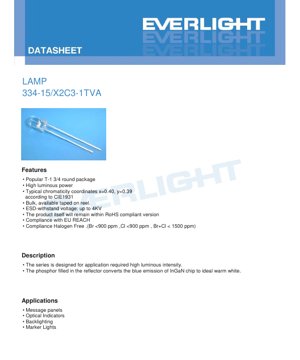
This LED employs the widely adopted industry-standard through-hole package form—the T-1 3/4 round package, renowned for its reliability and ease of assembly. The device complies with key environmental and safety regulations, including RoHS, EU REACH, and halogen-free standards, ensuring it meets modern manufacturing requirements.
1.1 Core Advantages and Target Market
The primary advantage of this LED series lies in its achievement of high luminous output within a standard, cost-effective package. Its typical luminous intensity value is significant, providing ample brightness for indicator and illumination applications. The warm white color (with typical CIE 1931 chromaticity coordinates of x=0.40, y=0.39) is designed for visual comfort and is commonly used in display backlighting and panel indicator lights.
The target application areas are diverse, primarily focusing on scenarios requiring clear and reliable visual signals. This includes information panels and display boards composed of individual LEDs forming characters or graphics. It is also suitable for general optical indicator lights in consumer electronics, industrial equipment, and automotive interiors. Furthermore, its high brightness makes it suitable for providing backlighting for small panels, switches, or dials. Marker light applications, such as those in appliances or signage, can also benefit from its performance.
2. Detailed Technical Parameters
A comprehensive understanding of the device's limits and operating characteristics is crucial for reliable circuit design and long-term performance.
2.1 Absolute Maximum Ratings
These ratings define the stress limits that may cause permanent damage to the device. Operation at or beyond these limits is not guaranteed.
- Continuous Forward Current (IF):30 mA. This is the maximum DC current that can be continuously applied to the LED anode.
- Peak Forward Current (IFP):100 mA. This higher current is only permitted under pulse conditions, with a duty cycle of 1/10 and a frequency of 1 kHz specified here. Even briefly exceeding the continuous current rating may lead to degradation of LED performance.
- Reverse Voltage (VR):5 V. Applying a reverse bias voltage higher than this value may cause junction breakdown.
- Power Dissipation (Pd):110 mW. This is the maximum power the device can dissipate as heat, calculated as the forward voltage (VF) multiplied by the forward current (IF).
- Operating and Storage Temperature:The device can operate in an ambient temperature range of -40°C to +85°C and can be stored at temperatures from -40°C to +100°C.
- ESD Withstand Voltage (HBM):4 kV. The device provides good Human Body Model electrostatic discharge protection capability, which is very important for handling during the assembly process.
- Soldering temperature:The pins can withstand a soldering temperature of 260°C for up to 5 seconds, compatible with standard wave soldering or manual soldering processes.
2.2 Electro-Optical Characteristics
These parameters are measured under typical conditions (Ta=25°C) and define the operating performance of the device.
- Forward Voltage (VF):At a test current of 20mA, the range is from 2.8V to 3.6V. This range is crucial for designing current-limiting circuits. The typical value falls within this range, and the actual voltage will depend on the specific bin (see Section 3).
- Light Intensity (IV):The minimum value is 7150 millicandelas (mcd) at 20mA. This is an indicator that measures the perceived brightness of an LED in a specific direction. The actual light intensity of a specific unit will fall into the defined bin (T, U, or V).
- Viewing Angle (2θ1/2):Typical half-intensity full viewing angle is 30 degrees. This describes the angular distribution of light output; such a small angle indicates a more concentrated, more directional beam.
- Chromaticity coordinates:The typical chromaticity point is defined as x=0.40, y=0.39 on the CIE 1931 chromaticity diagram. This places the white light in the "warm white" region. Individual devices are grouped into specific chromaticity bins (D1, D2, E1, E2, F1, F2) to ensure color consistency.
- Reverse current (IR):When a 5V reverse bias is applied, the maximum is 50 µA.
- Zener reverse voltage (Vz):When a 5mA Zener current (Iz) is applied, the typical value is 5.2V. This indicates that the device may integrate reverse voltage protection, which is a valuable feature for preventing damage caused by accidental reverse connection.
3. Explanation of the Grading System
To ensure consistency in brightness, color, and electrical characteristics during mass production, LEDs are sorted into different bins. This allows designers to select components that meet the requirements of specific applications.
3.1 Light Intensity Grading
Based on the luminous intensity measured at 20mA, LEDs are categorized into three grades:
- T grade:7150 mcd to 9000 mcd.
- U grade:9000 mcd to 11250 mcd.
- V grade:11250 mcd to 14250 mcd.
The light intensity tolerance is ±10%. Selecting a higher bin (e.g., Bin V) ensures a brighter minimum output.
3.2 Forward Voltage Binning
Forward voltage is divided into four bins to aid power supply design and current matching in multi-LED arrays:
- Bin 0:2.8V to 3.0V.
- Level 1:3.0V to 3.2V.
- Gear 2:3.2V to 3.4V.
- Gear 3:3.4V to 3.6V.
VFThe measurement uncertainty is ±0.1V.
3.3 Chromaticity Binning
Warm white color is strictly controlled by grouping LEDs into specific chromaticity areas on the CIE diagram (marked as D1, D2, E1, E2, F1, and F2). The datasheet provides the angular coordinate ranges for these hexagonal bins. For ordering, these bins are combined into one group (Group 1: D1+D2+E1+E2+F1+F2), meaning shipped products may come from any of these six chromaticity grades, ensuring they are all within the warm white specification range. The measurement uncertainty for chromaticity coordinates is ±0.01.
4. Performance Curve Analysis
The provided characteristic curves offer insight into the device's behavior under various conditions.
4.1 Relationship between Relative Light Intensity and Wavelength
This spectral distribution curve shows the LED emitting a broad spectrum characteristic of phosphor-converted white LEDs. It has a peak in the blue region (from the InGaN chip) and a broader peak in the yellow/red region (from the phosphor), which combine to produce white light. The curve confirms its "warm" light quality by having significant energy at longer wavelengths.
4.2 Directivity Distribution Diagram
The radiation pattern confirms a typical viewing angle of 30 degrees. The intensity is highest at 0 degrees (on-axis) and symmetrically drops to half its value at approximately ±15 degrees.
3.3 Relationship Between Forward Current and Forward Voltage (IV Curve)
This curve shows the typical exponential relationship of a diode. The forward voltage increases with increasing current. Designers use this curve to determine the required drive voltage for a selected operating current, ensuring the correct sizing of the current-limiting resistor or driver.
4.4 Relationship Between Relative Light Intensity and Forward Current
This curve indicates that the light output (relative luminous intensity) increases with increasing forward current, but the relationship is not perfectly linear, especially at higher currents. It highlights the importance of stable current control for maintaining consistent brightness.
4.5 Relationship between Chromaticity and Forward Current
This diagram shows how the chromaticity coordinates (x, y) shift slightly with changes in the drive current. This is a known phenomenon in white LEDs due to variations in phosphor efficiency and chip characteristics. For applications with strict color requirements, operating at the recommended 20mA ensures the color remains within the specified binning range.
4.6 Relationship between Forward Current and Ambient Temperature
This derating curve is crucial for reliability. It indicates that the maximum allowable forward current decreases as the ambient temperature rises. To prevent overheating and premature failure, the drive current must be reduced when operating at high ambient temperatures, staying within the power dissipation limits.
5. Mechanical and Packaging Information
This device utilizes a standard T-1 3/4 (5mm) round LED package with two axial leads. Key dimensional specifications include:
- Unless otherwise specified, all dimensions are in millimeters, with a general tolerance of ±0.25mm.
- Lead spacing is measured at the point where the leads exit the package body.
- The maximum allowable protrusion of the resin lens below the flange is 1.5mm.
The package drawing provides precise dimensions for lens diameter, body height, lead length, and lead pitch, which are crucial for PCB pad design and ensuring proper installation within the housing or panel.
6. Soldering and Assembly Guide
Proper handling is essential for maintaining device integrity and performance.
6.1 Lead Forming
- Bending must occur at least 3mm from the epoxy lens root to avoid stress on the internal chip and bonding wires.
- Forming must beWelding processBefore
- Completed.
- Over-stress during bending may cause epoxy cracking or damage internal connections.
- Pin cutting should be performed at room temperature; hot cutting may cause thermal shock.
PCB holes must be perfectly aligned with LED pins to avoid mounting stress.
- 6.2 Storage Conditions
- Recommended storage conditions after receipt: ≤30°C and relative humidity ≤70%, for up to 3 months.
- For longer-term storage (up to 1 year), devices should be kept in a sealed, nitrogen-filled container with desiccant.
Avoid sudden temperature changes in humid environments to prevent condensation on the device.
- 6.3 Welding Process
- Maintain a distance greater than 3mm from the solder joint to the epoxy resin lens.
- It is recommended to solder only to the root of the lead frame tie bar.
- For manual soldering, control the soldering iron tip temperature and time to prevent overheating.
For dip/wave soldering, the leads can withstand 260°C for 5 seconds.
7. Packaging and Ordering Information
7.1 Packaging Specifications
LEDs are packaged with anti-damage and anti-static protection:
- Placed in anti-static bags.
- Kowane jakar ya ƙunshi aƙalla fale-fale 200, har zuwa 500.
- Jakuna biyar ana shigar da su cikin akwati ɗaya na ciki.
- Akwatuna goma na ciki ana shigar da su cikin babban akwati ɗaya.
7.2 Label Description
- Labels on the packaging include:CPN:
- Customer Part Number reference.P/N:
- Manufacturer Part Number.QTY:
- Quantity of devices in the package.CAT:
- Combination code for luminous intensity and forward voltage bin.HUE:
- Chroma grade code (e.g., D1, E2).REF:
- Reference information.LOT No:
Nambari ya kundi la uzalishaji inayoweza kufuatiliwa.
7.3 Model Naming RulesNambari ya sehemu hufuata muundo ulioundwa:334-15/X2C3- □ □ □ □
The blank squares (□) are code placeholders used to specify the specific bin selection for luminous intensity, forward voltage, and chromaticity grade. This allows customers to order customized parts according to their specific requirements for brightness, voltage drop, and color consistency.
8. Application Suggestions and Design Considerations
8.1 Typical Application CircuitThe most common driving method is a simple series resistor. The resistor value (Rseries) The calculation formula is: Rseries= (VsupplyF- VF) / IF. Use the maximum V from the binning or datasheetF(e.g., 3.6V) to ensure that even if the LED resistance is low, the current does not exceed the required I
(e.g., 20mA). For example, using a 5V supply: R = (5V - 3.6V) / 0.020A = 70 ohms. Standard 68 or 75 ohm resistors are suitable. For multiple LEDs, if the supply voltage is high enough, they can be connected in series with one current-limiting resistor; or use parallel strings, each with its own resistor, for better current matching.
8.2 Thermal Management
Although the power dissipation is relatively low (maximum 110mW), proper thermal design extends lifespan and maintains light output. Ensure sufficient copper area around the LED pins on the PCB acts as a heat sink, especially when operating near maximum current or in high ambient temperatures. Avoid placing the LED near other heat-generating components.
8.3 Optical Integration
A 30-degree viewing angle provides a focused beam. For wider illumination, secondary optics such as diffusers or lenses may be required. Warm white light is less likely to cause glare than cool white light, making it suitable for use as a direct-view indicator light.
9. Technical Comparison and Differentiation
1. Compared to common 5mm white LEDs, this device offers the following key advantages:Higher luminous intensity:
2. Minimum 7150 mcd, much brighter than standard indicator-grade LEDs, making them suitable for sunlight-visible displays or as small-area light sources.Integrated Protection:
3. 4kV ESD rating and Zener clamp recommendation (Vz=5.2V) provide robustness against handling and electrical transients, which typically come at an additional cost or require external components in basic LEDs.Strict binning:
4. Detailed binning for luminous intensity, voltage, and color allows for precise selection and achieves better consistency in applications where uniformity of brightness or color across multiple units is critical.Environmental Compliance:
Fully compliant with RoHS, REACH, and halogen-free standards, making it suitable for global markets with stringent environmental regulations.
10. Frequently Asked Questions (Based on Technical Specifications)
Q: Can I drive this LED continuously at 30mA?
A: Yes, 30mA is the absolute maximum continuous forward current. For best lifetime and reliability, it is common practice to operate below this maximum, e.g., at 20mA as specified in the typical characteristics.
Q: What is the purpose of the different chromaticity bins (D1, F2, etc.)?
A: All bins (D1 through F2) produce a warm white light, but with slight variations in exact hue (e.g., more yellow vs. more pink). Grouping them allows the manufacturer to use all produced LEDs while guaranteeing they fall within an acceptable warm white range. For most applications, Group 1 is sufficient. For applications requiring very tight color matching, specifying a single bin may be necessary.
Q: How to understand forward voltage binning?FA: If your design is sensitive to voltage drop (e.g., powered by a low-voltage battery), selecting a lower V
bin (0 or 1) will ensure more consistent brightness as the battery discharges, because a lower forward voltage leaves more voltage across the current-limiting resistor.
Q: Is a current-limiting resistor always necessary?
A: Yes. LEDs are current-driven devices. Connecting them directly to a voltage source without current limiting will cause them to draw excessive current and fail immediately. A series resistor or constant current driver is required.
11. Practical Design and Usage Cases
Case: Designing a Status Indicator Panel for Industrial Equipment
Engineers need to design a panel with 20 bright warm white status indicators. Requirements: uniform brightness and color, 24V DC power supply, high reliability.
1. Design Steps:Driving Method:FFor simplicity and cost-effectiveness, use series resistors. Connect LED strings in parallel to efficiently utilize the 24V power supply. The maximum V
2. is approximately 14.4V (4 * 3.6V). Resistor value: R = (24V - 14.4V) / 0.020A = 480 ohms. Use a 470 ohm, 1/4W resistor. Create 5 identical strings, each consisting of 4 LEDs + 1 resistor.Binning Selection:
3. To ensure visual consistency, specify the same luminous intensity bin (e.g., U-bin) and the same chromaticity group for all units in the order.PCB Layout:
4. Provide sufficient pad size for the LED pins. Include a small area of copper pour connected to the cathode pin to assist with heat dissipation. Ensure compliance with the 3mm lead bend rule in the pad design.Assembly:
Follow the welding guidelines and use controlled processes to avoid thermal damage.
12. Introduction to Working Principles
Wannan LED yana aiki bisa ka'idar haske ta lantarki a cikin semiconductor. Yankin aiki an yi shi da InGaN. Lokacin da ake amfani da ƙarfin lantarki mai kyau, ana shigar da electrons da ramuka cikin yankin aiki, inda suke haɗuwa, suna sakin makamashi a cikin nau'in photons. Takamaiman abun da ke cikin InGaN yana ƙayyade cewa waɗannan photons suna cikin kewayon tsawon rawaya (kimanin 450-470 nm).
Don samar da farin haske, an shafa wani Layer na phosphor akan guntun shuɗi. Wannan phosphor wani kayan yumbu ne da aka haɗa da sinadaran ƙasa. Lokacin da ƙananan ƙwayoyin shuɗi masu ƙarfi suka bugi phosphor, ana sha su kuma a sake fitar da su a cikin nau'in photons masu ƙarancin makamashi, suna rufe fadi mai fadi, musamman a yankuna rawaya da ja. Hasken shuɗi da ba a canza shi ba yana haɗuwa da rawaya/ja mai ƙarancin canzawa, wanda idon mutum yake ganinsa a matsayin farin haske. Ta hanyar daidaita abun da ke cikin phosphor don haɓaka sassan mafi tsayi na tsawon rawaya (ja), an cimma ingancin haske mai "dumi".
13. Technical Trends and Background
1. The dominant technology for producing white light LEDs (known as pc-LEDs) involves using InGaN-based blue chips combined with phosphor conversion. This device represents a mature, high-volume product in through-hole packaging. Industry trends are moving in the following directions:Efficiency improvement (lm/W):
2. Continuous advancements in chip design, phosphor efficiency, and package light extraction technology consistently drive improvements in luminous efficacy, reducing energy consumption for the same light output.Kalite na launi:
3. Ci gaba a fasahar phosphor, gami da amfani da phosphor iri-iri ko ƙwayoyin quantum, yana haɓaka ma'aunin nuna launi (CRI), yana sa farin haske ya zama mafi dabi'u, yana nuna launi daidai.Ƙananan kulli da ƙaura zuwa SMT:
4. Ko da yake T-1 3/4 har yanzu ya shahara, amma kayan haɗin SMD (kamar 3528, 5050) suna zama ruwan dare gama gari a cikin haɗin kai ta atomatik da ƙirar da ta fi yawa. Duk da haka, LEDs masu ratsa ramuka kamar wannan samfurin suna da fa'ida a cikin ƙirar samfuri, gyara, da aikace-aikacen da ke buƙatar mafi girman haske ɗaya ko ƙarfin juzu'i.Smart and Connected Lighting:
The broader market is integrating LEDs with sensors and controllers for smart lighting systems, although this primarily affects high-power lighting modules, not discrete indicator lights.
Detailed Explanation of LED Specification Terminology
Complete Interpretation of LED Technical Terminology
I. Core Indicators of Photoelectric Performance
| Terminology | Unit/Representation | Popular Explanation | Why it matters |
|---|---|---|---|
| Luminous Efficacy | lm/W (lumens per watt) | The luminous flux emitted per watt of electrical power; higher values indicate greater energy efficiency. | It directly determines the energy efficiency rating of the luminaire and the electricity cost. |
| Luminous Flux | lm (lumen) | The total amount of light emitted by a light source, commonly known as "brightness". | Determines whether the luminaire is bright enough. |
| Viewing Angle | ° (degree), e.g., 120° | The angle at which luminous intensity drops to half, determining the beam width. | Affects the range and uniformity of illumination. |
| Correlated Color Temperature (CCT) | K (Kelvin), such as 2700K/6500K | Haske launin dumi da sanyi, ƙananan ƙima sun karkata zuwa rawaya/dumi, manyan ƙima sun karkata zuwa fari/sanyi. | Yana ƙayyade yanayin hasken wuta da kuma yanayin da ya dace. |
| Color Rendering Index (CRI / Ra) | Unitless, 0–100 | The ability of a light source to reproduce the true colors of objects, with Ra≥80 being preferable. | Affects color fidelity, used in high-demand places such as shopping malls and art galleries. |
| Color tolerance (SDCM) | MacAdam ellipse step, such as "5-step" | A quantitative metric for color consistency; a smaller step number indicates better color consistency. | Ensure no color variation among luminaires from the same batch. |
| Dominant Wavelength | nm (nanometer), e.g., 620nm (red) | Wavelength values corresponding to the colors of colored LEDs. | Determines the hue of monochromatic LEDs such as red, yellow, and green. |
| Spectral Distribution | Wavelength vs. Intensity Curve | Shows the intensity distribution of light emitted by an LED at each wavelength. | Affects color rendering and color quality. |
II. Electrical Parameters
| Terminology | Symbols | Popular Explanation | Design Considerations |
|---|---|---|---|
| Forward Voltage (Forward Voltage) | Vf | The minimum voltage required to light up an LED, similar to a "starting threshold". | The driving power supply voltage must be ≥ Vf; the voltages add up when multiple LEDs are connected in series. |
| Forward Current | If | The current value that makes the LED emit light normally. | Constant current drive is often used, as the current determines brightness and lifespan. |
| Maximum Pulse Current | Ifp | The peak current that can be withstood for a short period of time, used for dimming or flashing. | Pulse width and duty cycle must be strictly controlled to prevent overheating damage. |
| Reverse Voltage | Vr | The maximum reverse voltage that an LED can withstand; exceeding this may cause breakdown. | Reverse connection or voltage surges must be prevented in the circuit. |
| Thermal Resistance (Thermal Resistance) | Rth (°C/W) | The resistance to heat flow from the chip to the solder joint. A lower value indicates better heat dissipation. | High thermal resistance requires stronger heat dissipation design, otherwise junction temperature rises. |
| Electrostatic Discharge Immunity (ESD Immunity) | V (HBM), such as 1000V | Electrostatic discharge immunity; a higher value indicates greater resistance to damage from static electricity. | Anti-static measures must be implemented during production, especially for high-sensitivity LEDs. |
III. Thermal Management and Reliability
| Terminology | Key Indicators | Popular Explanation | Impact |
|---|---|---|---|
| Junction Temperature | Tj (°C) | The actual operating temperature inside the LED chip. | For every 10°C reduction, the lifespan may double; excessively high temperatures lead to lumen depreciation and color shift. |
| Lumen Depreciation | L70 / L80 (hours) | The time required for the brightness to drop to 70% or 80% of its initial value. | Directly define the "useful life" of an LED. |
| Lumen Maintenance | % (e.g., 70%) | The percentage of remaining brightness after a period of use. | Characterizes the ability to maintain brightness after long-term use. |
| Color Shift | Δu′v′ or MacAdam ellipse | The degree of color change during use. | Affects the color consistency of the lighting scene. |
| Thermal Aging | Material performance degradation | Degradation of packaging materials due to long-term high temperature. | Zai iya haifar da raguwar haske, canjin launi ko gazawar bude hanya. |
IV. Kunshewa da Kayan aiki
| Terminology | Nau'o'in gama gari | Popular Explanation | Characteristics and Applications |
|---|---|---|---|
| Package Types | EMC, PPA, Ceramic | The housing material that protects the chip and provides optical and thermal interfaces. | EMC offers good heat resistance and low cost; ceramic provides superior heat dissipation and long lifespan. |
| Chip Structure | Front-side, Flip Chip | Chip electrode arrangement method. | Flip-chip offers better heat dissipation and higher luminous efficacy, suitable for high-power applications. |
| Phosphor coating. | YAG, silicate, nitride | Coated on the blue LED chip, partially converted to yellow/red light, mixed to form white light. | Different phosphors affect luminous efficacy, color temperature, and color rendering. |
| Lens/Optical Design | Flat, microlens, total internal reflection | Optical structure on the packaging surface, controlling light distribution. | Determines the emission angle and light distribution curve. |
V. Quality Control and Grading
| Terminology | Grading Content | Popular Explanation | Purpose |
|---|---|---|---|
| Luminous Flux Binning | Codes such as 2G, 2H | Group by brightness level, each group has a minimum/maximum lumen value. | Ensure consistent brightness for products in the same batch. |
| Voltage binning | Codes such as 6W, 6X | Grouped by forward voltage range. | Facilitating driver power matching to enhance system efficiency. |
| Color binning | 5-step MacAdam ellipse | Group by color coordinates to ensure colors fall within an extremely small range. | Ensure color consistency to avoid color unevenness within the same luminaire. |
| Color temperature grading | 2700K, 3000K, etc. | Group by color temperature, each group has a corresponding coordinate range. | Meet the color temperature requirements of different scenarios. |
VI. Testing and Certification
| Terminology | Standard/Test | Popular Explanation | Meaning |
|---|---|---|---|
| LM-80 | Lumen Maintenance Test | Long-term operation under constant temperature conditions, recording luminance attenuation data. | For estimating LED lifetime (in conjunction with TM-21). |
| TM-21 | Lifetime projection standard | Estimating lifespan under actual usage conditions based on LM-80 data. | Providing scientific life prediction. |
| IESNA Standard | Illuminating Engineering Society Standard | Covers optical, electrical, and thermal test methods. | Industry-recognized testing basis. |
| RoHS / REACH | Environmental Certification | Ensure the product does not contain harmful substances (e.g., lead, mercury). | Entry requirements for the international market. |
| ENERGY STAR / DLC | Energy efficiency certification | Energy efficiency and performance certification for lighting products. | Commonly used in government procurement and subsidy programs to enhance market competitiveness. |