Table of Contents
- 1. Product Overview
- 2. Detailed Technical Parameters
- 2.1 Absolute Maximum Ratings
- 2.2 Electro-Optical Characteristics
- 3. Performance Curve Analysis
- 3.1 Infrared Emitter (905nm) Characteristics
- 3.2 Red Light Emitter (660nm) Characteristics
- 3.3 Angular Characteristics
- 4. Mechanical and Packaging Information
- 4.1 Package Dimensions
- 4.2 Polarity Identification
- 4.3 Carrier Tape and Reel Specifications
- 5. Soldering and Assembly Guide
- 5.1 Storage and Handling
- 5.2 Reflow Soldering
- 5.3 Manual Welding
- 5.4 Rework and Repair
- 6. Application Suggestions and Design Considerations
- 6.1 Typical Application Circuit
- 6.2 Thermal Management
- 6.3 Optical Design
- 7. Technical Comparison and Differentiation
- 8. Frequently Asked Questions (Based on Technical Parameters)
- 9. Practical Design and Usage Cases
- 10. Introduction to Working Principles
- 11. Teknoloji Trendleri ve Arka Plan
1. Product Overview
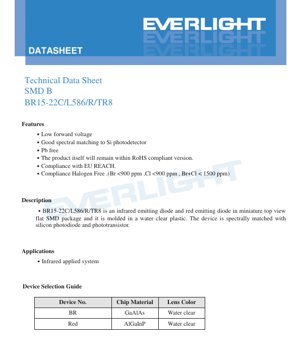
BR15-22C/L586/R/TR8 is a dual-emitter surface-mount device (SMD) LED that integrates an infrared (IR) and a red light-emitting diode within a miniature top-view flat package. The device employs a transparent plastic encapsulation, enabling efficient light transmission. Its key design feature is the matching of its spectral output with the sensitivity characteristics of silicon photodiodes and phototransistors, making it an ideal light source for optical sensing and detection systems.
该元件的核心优势包括低正向电压,这有助于提高电路设计的能效。它采用无铅(Pb-free)制造,并符合RoHS、欧盟REACH和无卤素标准(Br <900ppm, Cl <900ppm, Br+Cl <1500ppm)等主要环保法规,确保其适用于现代注重环保的电子制造。
Its primary target markets and applications are infrared application systems, such as proximity sensors, object detection, encoders, and other optoelectronic interfaces requiring reliable and matched light emission.
2. Detailed Technical Parameters
2.1 Absolute Maximum Ratings
These ratings define the limits that may cause permanent damage to the device. Operation under these conditions is not guaranteed.
- Continuous Forward Current (IF): Both the IR and red light chips are 50 mA.
- Reverse Voltage (VR): 5 V. Exceeding this value may cause junction breakdown.
- Operating Temperature (Topr):-40°C to +85°C. This defines the ambient temperature range for reliable operation.
- Storage temperature (Tstg):-40°C to +100°C.
- Soldering temperature (Tsol): Maximum 260°C, duration not exceeding 5 seconds. This is crucial for the reflow soldering assembly process.
- Pc: For free air temperature ≤25°C, 100 mW for the infrared emitter and 125 mW for the red light emitter. This parameter is critical for thermal management design.
2.2 Electro-Optical Characteristics
These are typical performance parameters measured at Ta=25°C, providing expected behavior under normal operating conditions.
- Radiant Intensity (IE): For infrared emitters (BR), the typical value is 0.50 mW/sr at IF=20mA. For red light emitters, it is 1.50 mW/sr at the same current. This measures the light power emitted per unit solid angle.
- Peak Wavelength (λp): The peak wavelength for infrared emitters is 905 nm, while for red light emitters it is 660 nm. This defines the dominant color of the emitted light.
- Spectral Bandwidth (Δλ): Both emitters are approximately 30 nm, indicating the wavelength distribution range around the peak wavelength.
- Forward Voltage (VF)At IF=20mA, the typical VF for the infrared chip is 1.30V (max 1.80V), and for the red chip it is 1.80V (max 2.60V). Low VF is a key characteristic for improving energy efficiency.
- Reverse Current (IR)At VR=5V, the maximum reverse current for both chips is 10 µA, indicating the leakage current in the off state.
- Viewing Angle (2θ1/2): 140 degrees. This wide viewing angle is characteristic of top-view lensless packages, providing a broad emission range.
3. Performance Curve Analysis
3.1 Infrared Emitter (905nm) Characteristics
The provided chart illustrates the relationship between key parameters of the infrared chip.Radiant Intensity vs. Forward CurrentThe curve shows that the optical output increases nearly linearly with current until the maximum rating is reached.Forward Current and Forward VoltageThe curve demonstrates the exponential I-V relationship of a diode, which is crucial for designing current-limiting circuits.Spectral DistributionThe graph confirms the peak at 905nm and its defined bandwidth.Forward Current vs. Ambient TemperatureThe curve is crucial for understanding derating requirements; as temperature increases, the maximum allowable continuous current decreases to prevent overheating.
3.2 Red Light Emitter (660nm) Characteristics
Similar curves are provided for the red light emitter. Notably, its radiant intensity is higher than that of the infrared emitter at a given current. The spectral diagram shows a sharp peak at 660nm in the visible red light spectrum. Its electrical characteristics (IV curve) follow the same diode law, but the typical forward voltage is higher.
3.3 Angular Characteristics
Referred to a chart namedRelative photocurrent versus angular displacement. This curve is crucial for application design, showing how the intensity perceived by the detector varies with the angle between the LED and the detector. The 140-degree viewing angle is defined as the angle at which the intensity drops to half of its axial value.
4. Mechanical and Packaging Information
4.1 Package Dimensions
The device employs a compact SMD package. Key dimensions (unit: mm) include a body length of approximately 3.2, a width of 1.6, and a height of 1.1. The detailed drawing specifies the pad layout, component outline, and tolerances (typically ±0.1mm unless otherwise noted), which are crucial for PCB pad design.
4.2 Polarity Identification
The package includes markings or specific pad designs (typically a notch or a dot) to indicate the cathode. Correct polarity identification during assembly is essential to prevent damage from reverse bias.
4.3 Carrier Tape and Reel Specifications
The product is supplied in carrier tape and reel form for automated assembly. Carrier tape dimensions are specified, and the standard reel contains 2000 devices. This information is necessary for setting up the pick-and-place machine.
5. Soldering and Assembly Guide
5.1 Storage and Handling
LEDs are sensitive to moisture. Precautions include: Keep the sealed moisture barrier bag unopened before use; Store unopened bags at ≤30°C/90%RH and use within one year; After opening, store at ≤30°C/60%RH and use within 168 hours (7 days). If the storage time is exceeded, baking at 60±5°C for at least 24 hours is required.
5.2 Reflow Soldering
It is recommended to use a lead-free solder temperature profile. Reflow soldering should not exceed two cycles to avoid thermal stress. During the heating process, no mechanical stress should be applied to the LED body. The PCB should not warp after soldering.
5.3 Manual Welding
If manual soldering is necessary, use a soldering iron with a tip temperature below 350°C, heat each pin for no more than 3 seconds, and use an iron with a power rating of 25W or lower. Allow a cooling interval of more than 2 seconds between soldering each pin.
5.4 Rework and Repair
Repair after soldering is not recommended. If unavoidable, use a dual-tip soldering iron to heat two pins simultaneously to minimize thermal stress on the package. The potential for damage to LED characteristics must be evaluated beforehand.
6. Application Suggestions and Design Considerations
6.1 Typical Application Circuit
The most critical design rule isOvercurrent protectionAn external current-limiting resistor must be used. Due to the exponential IV characteristic of the diode, a small increase in voltage can lead to a large, destructive increase in current. The resistor value must be calculated using the formula based on the supply voltage (Vs), the required forward current (If), and the LED's forward voltage (Vf): R = (Vs - Vf) / If. If driving the infrared and red emitters independently, separate resistors are required.
6.2 Thermal Management
Although the power consumption is low, a reasonable PCB layout helps with heat dissipation. Ensure that the copper foil area connected to the thermal pad (if present) or device pins is sufficient. Follow the power derating guidelines implied by the maximum ratings—reduce the forward current when operating at high ambient temperatures.
6.3 Optical Design
For applications requiring wide coverage, its 140-degree wide viewing angle can be utilized. For longer distances or more directional sensing, external lenses or reflectors may be required. Clear lenses are suitable for applications that require precise chip emission patterns and do not require color filtering.
7. Technical Comparison and Differentiation
The main differentiation of BR15-22C/L586/R/TR8 lies in itsDual-wavelength capabilityIntegrated into a single compact SMD package. This saves board space compared to using two separate LEDs. ItsSpectral match with silicon detectorsAfter optimization, it may improve the signal-to-noise ratio in sensing applications.Low forward voltage, especially for infrared emitters, provides energy efficiency advantages. Compliance with strict environmental standards (RoHS, REACH, halogen-free) makes it suitable for a wide range of global markets.
8. Frequently Asked Questions (Based on Technical Parameters)
Q: Can I drive the infrared and red LEDs simultaneously at their respective maximum currents of 50mA each?
A: No. The absolute maximum continuous forward current rating for each chip is 50mA. Driving both at 50mA simultaneously may exceed the total power dissipation limit (Pc) of the package and cause overheating. The drive current must be derated based on the total power and thermal conditions.
Q: Why is the current limiting resistor absolutely necessary?
A: LEDs are current-driven devices. Their forward voltage varies slightly with current and temperature. Connecting them directly to a voltage source (even a regulated one) causes current to rise uncontrollably until the device is damaged, as there is no internal resistance to limit it. The resistor provides a stable, predictable current.
Q: What does "spectral matching to silicon photodetectors" mean?
A: Silicon photodiodes and phototransistors have specific spectral response curves; they are most sensitive to certain wavelengths (typically in the near-infrared and red regions). The peak wavelengths of these LEDs (905nm infrared and 660nm red) are chosen to fall within the high-sensitivity regions of these detectors, thereby maximizing the generated electrical signal for a given optical power.
Q: How to understand the 140-degree "viewing angle"?
A: This refers to the full angle at which the radiation intensity drops to half (50%) of its axial (0-degree) measured value. Therefore, the emitted light is effectively usable within a very wide ±70-degree cone from the center.
9. Practical Design and Usage Cases
Case: Designing a Proximity Sensor for Mobile Devices
The BR15-22C/L586/R/TR8 can be used in a proximity sensor to detect if an object (such as a user's ear during a call) is near the phone. The infrared emitter (905nm) is driven in pulses. A nearby silicon photodiode detects the reflected infrared light. The red light emitter is not used in this specific mode but can be utilized for other functions, such as a status indicator. Design steps include: 1) Calculate the current-limiting resistor for the IR LED based on the driver IC's output voltage and the required pulse current (e.g., 20mA for good intensity). 2) Place the LED and photodiode on the PCB and establish an optical barrier between them to prevent direct crosstalk. 3) Precisely follow the reflow soldering temperature profile to avoid damaging the moisture-sensitive package. 4) Implement firmware to drive the LED in pulses and read the photodiode signal, using a threshold to determine the "near" or "far" state.
10. Introduction to Working Principles
Light-emitting diode (LED) is a semiconductor device that emits light through electroluminescence. When a forward voltage is applied across the p-n junction, electrons from the n-type region recombine with holes from the p-type region. This recombination releases energy in the form of photons (light). The specific wavelength (color) of the emitted light is determined by the bandgap energy of the semiconductor material used. Infrared emitters use gallium aluminum arsenide (GaAlAs), whose bandgap corresponds to 905nm infrared light. Red light emitters use aluminum gallium indium phosphide (AlGaInP), producing 660nm red light. A transparent epoxy resin lens encapsulates the chip, providing mechanical protection and shaping the light output pattern.
11. Teknoloji Trendleri ve Arka Plan
The development of SMD LEDs like the BR15-22C/L586/R/TR8 is driven by trends toward miniaturization, automation, and multifunctionality in electronic products. The shift toward lead-free and halogen-free manufacturing reflects the global push for environmentally sustainable components. In sensing applications, there is a continuous demand for higher efficiency (more light output per watt of electrical power) and tighter spectral matching to improve system performance and reduce power consumption. Integrating multiple wavelengths or functions into a single package is a logical step to save space and cost in increasingly complex devices. Furthermore, improvements in packaging materials and designs aim to enhance reliability under thermal stress and moisture exposure, which is critical for automotive, industrial, and consumer applications.
Detailed Explanation of LED Specification Terminology
Complete Explanation of LED Technical Terminology
I. Core Indicators of Photoelectric Performance
| Terminology | Unit/Representation | Popular Explanation | Why It Is Important |
|---|---|---|---|
| Luminous Efficacy | lm/W (lumens per watt) | The luminous flux emitted per watt of electrical power; higher values indicate greater energy efficiency. | Directly determines the energy efficiency rating and electricity cost of the luminaire. |
| Luminous Flux | lm (lumen) | The total amount of light emitted by a light source, commonly known as "brightness". | Determines whether a luminaire is bright enough. |
| Viewing Angle | ° (degrees), e.g., 120° | The angle at which light intensity drops to half determines the beam width. | Affects the illumination range and uniformity. |
| Correlated Color Temperature (CCT) | K (Kelvin), e.g., 2700K/6500K | The warmth or coolness of light color; lower values are yellowish/warm, higher values are whitish/cool. | Determining the lighting atmosphere and applicable scenarios. |
| Color Rendering Index (CRI / Ra) | Unitless, 0–100 | The ability of a light source to restore the true color of an object, Ra≥80 is recommended. | Affects color authenticity, used in high-demand places such as shopping malls and art galleries. |
| Color Tolerance (SDCM) | MacAdam Ellipse Steps, e.g., "5-step" | A quantitative indicator of color consistency; a smaller step number indicates higher color consistency. | Ensure no color difference among the same batch of luminaires. |
| Dominant Wavelength | nm (nanometer), misali 620nm (ja) | Rangi ya LED zenye rangi zinazolingana na thamani ya urefu wa wimbi. | Kuamua rangi ya LED moja kama nyekundu, manjano, kijani, n.k. |
| Spectral Distribution | Wavelength vs. Intensity Curve | Display the intensity distribution of light emitted by the LED across various wavelengths. | Affects color rendering and color quality. |
II. Electrical Parameters
| Terminology | Symbol | Popular Explanation | Design Considerations |
|---|---|---|---|
| Forward Voltage | Vf | The minimum voltage required to light up an LED, similar to a "starting threshold". | The driving power supply voltage must be ≥ Vf; voltages add up when multiple LEDs are connected in series. |
| Forward Current | If | The current value that makes the LED emit light normally. | Constant current drive is often used, as the current determines brightness and lifespan. |
| Matsakaicin ƙarfin wutar lantarki na bugun jini (Pulse Current) | Ifp | Peak current that can be sustained for a short period, used for dimming or flashing. | Pulse width and duty cycle must be strictly controlled to prevent overheating and damage. |
| Reverse Voltage | Vr | The maximum reverse voltage that an LED can withstand; exceeding it may cause breakdown. | The circuit must be protected against reverse polarity or voltage surges. |
| Thermal Resistance | Rth(°C/W) | The resistance to heat transfer from the chip to the solder joint. A lower value indicates better heat dissipation. | High thermal resistance requires a stronger heat dissipation design; otherwise, the junction temperature will increase. |
| ESD Immunity | V (HBM), such as 1000V | The ability to withstand electrostatic discharge. A higher value indicates greater resistance to damage from static electricity. | Anti-static measures must be taken during production, especially for high-sensitivity LEDs. |
III. Thermal Management and Reliability
| Terminology | Key Indicators | Popular Explanation | Impact |
|---|---|---|---|
| Junction Temperature | Tj (°C) | The actual operating temperature inside the LED chip. | For every 10°C reduction, lifespan may double; excessively high temperatures cause lumen depreciation and color shift. |
| Lumen Depreciation | L70 / L80 (hours) | The time required for brightness to drop to 70% or 80% of its initial value. | Directly defines the "lifetime" of an LED. |
| Lumen Maintenance | % (e.g., 70%) | The percentage of remaining brightness after a period of use. | Characterizes the ability to maintain brightness after long-term use. |
| Color Shift | Δu′v′ or MacAdam ellipse | The degree of color change during use. | Affects the color consistency of the lighting scene. |
| Thermal Aging | Material performance degradation | Deterioration of packaging materials due to prolonged high temperatures. | May lead to decreased brightness, color shift, or open-circuit failure. |
IV. Packaging and Materials
| Terminology | Common Types | Popular Explanation | Characteristics and Applications |
|---|---|---|---|
| Packaging Type | EMC, PPA, Ceramic | The housing material that protects the chip and provides optical and thermal interfaces. | EMC tahan panas baik, biaya rendah; keramik pendinginan unggul, umur panjang. |
| Struktur chip | Face-up, Flip Chip | Chip electrode arrangement method. | Flip Chip offers better heat dissipation and higher luminous efficacy, suitable for high-power applications. |
| Phosphor coating | YAG, silicate, nitride | Covered on the blue light chip, partially converted into yellow/red light, mixed into white light. | Different phosphors affect luminous efficacy, color temperature, and color rendering. |
| Lens/Optical design | Flat, Microlens, Total Internal Reflection | Optical structure on the encapsulation surface, controlling light distribution. | Determine the beam angle and light distribution curve. |
V. Quality Control and Binning
| Terminology | Binning Content | Popular Explanation | Purpose |
|---|---|---|---|
| Luminous Flux Classification | Codes such as 2G, 2H | Group by brightness level, each group has a minimum/maximum lumen value. | Ensure consistent brightness for the same batch of products. |
| Voltage binning | Codes such as 6W, 6X | Group by forward voltage range. | Facilitates driver matching and improves system efficiency. |
| Color binning. | 5-step MacAdam ellipse | Group by color coordinates to ensure colors fall within a minimal range. | Ensure color consistency to avoid uneven color within the same luminaire. |
| Color temperature binning | 2700K, 3000K, etc. | Grouped by color temperature, each group has a corresponding coordinate range. | To meet the color temperature requirements of different scenarios. |
VI. Testing and Certification
| Terminology | Standards/Testing | Popular Explanation | Significance |
|---|---|---|---|
| LM-80 | Lumen Maintenance Test | Record brightness attenuation data under constant temperature conditions over a long period of illumination. | Used to estimate LED lifetime (combined with TM-21). |
| TM-21 | Standard for Lifetime Projection | Projecting lifetime under actual use conditions based on LM-80 data. | Provide scientific life prediction. |
| IESNA Standard | Illuminating Engineering Society Standard | Covers optical, electrical, and thermal testing methods. | Industry-recognized testing basis. |
| RoHS / REACH | Environmental Certification | Ensure products are free from hazardous substances (e.g., lead, mercury). | Market access requirements for entering the international market. |
| ENERGY STAR / DLC | Energy Efficiency Certification | Energy Efficiency and Performance Certification for Lighting Products. | Commonly used in government procurement and subsidy programs to enhance market competitiveness. |