Table of Contents
- 1. Product Overview
- 2. Technical Parameters Deep Objective Interpretation
- 2.1 Electro-Optical Characteristics
- 2.2 Absolute Maximum Ratings
- 2.3 Thermal Characteristics
- 3. Binning System Explanation
- 3.1 Color Temperature (CCT) and Chromaticity Binning
- 3.2 Luminous Flux Binning
- 3.3 Forward Voltage Binning
- 3.4 Color Rendering Index (CRI) Index
- 4. Performance Curve Analysis
- 4.1 Forward Voltage vs. Junction Temperature
- 4.2 Relative Luminous Intensity vs. Forward Current
- 4.3 Relative Luminous Flux vs. Junction Temperature
- 4.4 Forward Current vs. Forward Voltage (IV Curve)
- 4.5 Maximum Driving Current vs. Soldering Temperature
- 4.6 Radiation Pattern
- 4.7 Spectrum Distribution
- 5. Mechanical and Package Information
- 5.1 Package Dimensions
- 5.2 Pad Layout and Polarity Identification
- 6. Soldering and Assembly Guidelines
- 6.1 Reflow Soldering Parameters
- 6.2 Hand Soldering
- 6.3 Electrostatic Discharge (ESD) Sensitivity
- 7. Packaging and Ordering Information
- 7.1 Product Number Explanation
- 7.2 Mass Production List
- 7.3 Packing Quantity
- 8. Application Suggestions
- 8.1 Typical Application Scenarios
- 8.2 Design Considerations
- 9. Technical Comparison and Differentiation
- 10. Frequently Asked Questions (Based on Technical Parameters)
- 10.1 Why is the forward voltage so high (72V)?
- 10.2 Yaya zaɓi CCT da flux bin da suka dace?
- 10.3 Menene tasirin zafin junction akan aiki?
- 10.4 Shin zan iya tuka wannan LED da tushen wutar lantarki mai tsayi?
- 11. Zane na Aiki da Amfani na Aiki
- 12. Principle Introduction
- 13. Development Trends
1. Product Overview
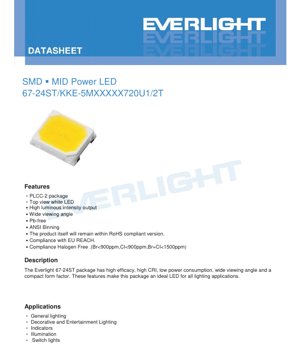
The 67-24ST is a surface-mount device (SMD) mid-power LED designed for general lighting applications. It utilizes a PLCC-2 (Plastic Leaded Chip Carrier) package, offering a compact form factor with dimensions of approximately 3.50mm x 3.50mm x 2.00mm. The primary emitted color is white, available in various correlated color temperatures (CCT) including cool white, neutral white, and warm white variants. The encapsulating resin is water clear. Key advantages of this LED include high luminous efficacy, excellent color rendering index (CRI), low power consumption, and a very wide viewing angle of 120 degrees, making it suitable for applications requiring uniform illumination.
2. Technical Parameters Deep Objective Interpretation
2.1 Electro-Optical Characteristics
The primary electro-optical parameters are measured at a standard forward current (IF) of 15mA and a soldering point temperature (Tsoldering) of 25°C.
- Luminous Flux (Φ): The minimum luminous flux output varies by product variant, ranging from 160 lumens to 175 lumens, with a typical tolerance of ±11%.
- Forward Voltage (VF): The maximum forward voltage is specified at 72.0V, with a typical operating range and a tolerance of ±0.1V.
- Color Rendering Index (Ra/CRI): This product series offers a minimum CRI of 80, with a tolerance of ±2. Higher CRI values indicate better color fidelity of illuminated objects.
- Viewing Angle (2θ1/2): The half-intensity angle is 120 degrees, providing a very broad emission pattern.
2.2 Absolute Maximum Ratings
These ratings define the limits beyond which permanent damage to the device may occur. Operation should be maintained within these limits.
- Forward Current (IF): 15 mA (continuous).
- Peak Forward Current (IFP): 20 mA (pulsed, duty cycle 1/10, pulse width 10ms).
- Power Dissipation (Pd): 1080 mW.
- Operating Temperature (Topr): -40°C to +85°C.
- Storage Temperature (Tstg): -40°C to +100°C.
- Junction Temperature (Tj): 115°C (maximum).
2.3 Thermal Characteristics
Effective thermal management is crucial for LED performance and longevity.
- Thermal Resistance (Rth J-S): The junction-to-soldering point thermal resistance is 17°C/W. This parameter is critical for calculating the junction temperature rise based on the power dissipated and the PCB's thermal design.
3. Binning System Explanation
The product uses a comprehensive binning system to ensure color and performance consistency.
3.1 Color Temperature (CCT) and Chromaticity Binning
LEDs are binned according to correlated color temperature (CCT) on a 5-step MacAdam ellipse system, ensuring tight color consistency. Available CCT bins include 2700K, 3000K, 3500K, 4000K, 5000K, 5700K, and 6500K. The chromaticity coordinates (Cx, Cy) for each bin are provided with a tolerance of ±0.01 on the CIE 1931 diagram.
3.2 Luminous Flux Binning
Luminous flux is categorized into bins denoted by codes like 160L5, 165L5, up to 185L5. Each bin specifies a minimum and maximum luminous output range (e.g., 160L5: 160-165 lm) under the standard test condition of IF=15mA.
3.3 Forward Voltage Binning
Forward voltage is binned into three categories: 660T (66-68V), 680T (68-70V), and 700T (70-72V). This helps in designing driver circuits with appropriate voltage requirements.
3.4 Color Rendering Index (CRI) Index
The CRI is indicated by a single-letter code in the part number (e.g., 'K' for CRI ≥80). Other potential codes include M (60), N (65), L (70), Q (75), P (85), and H (90).
4. Performance Curve Analysis
The datasheet includes several characteristic curves essential for design.
4.1 Forward Voltage vs. Junction Temperature
Figure 1 shows the forward voltage shift relative to junction temperature. The forward voltage typically has a negative temperature coefficient, decreasing as the junction temperature increases. This must be considered in constant-current driver design.
4.2 Relative Luminous Intensity vs. Forward Current
Figure 2 illustrates the relationship between relative luminous output and forward current. The output is generally linear within the recommended operating range but will saturate at higher currents.
4.3 Relative Luminous Flux vs. Junction Temperature
Figure 3 depicts how luminous output decreases as the junction temperature rises. Maintaining a low junction temperature is vital for maximizing light output and lifespan.
4.4 Forward Current vs. Forward Voltage (IV Curve)
Figure 4 provides the typical IV characteristic curve, which is fundamental for determining the operating point and power consumption.
4.5 Maximum Driving Current vs. Soldering Temperature
Figure 5 is a derating curve showing the maximum allowable forward current as a function of the soldering point temperature, based on the thermal resistance (Rth j-s=17°C/W). This graph is critical for ensuring the junction temperature does not exceed its maximum rating under different operating conditions.
4.6 Radiation Pattern
Figure 6 shows the spatial radiation (intensity) diagram, confirming the wide 120-degree viewing angle with a near-Lambertian distribution.
4.7 Spectrum Distribution
A typical spectral power distribution graph is provided, showing the emission profile of the white phosphor-converted LED, which is important for color quality analysis.
5. Mechanical and Package Information
5.1 Package Dimensions
The detailed mechanical drawing specifies the PLCC-2 package dimensions. Key measurements include a body size of 3.50mm ± 0.05mm in length and width, and a height of 2.00mm ± 0.05mm. The drawing also shows the lens profile and lead frame details.
5.2 Pad Layout and Polarity Identification
The recommended soldering pad pattern (land pattern) is provided to ensure proper solder joint formation and mechanical stability. The polarity is clearly marked on the package itself and in the diagram; the anode (+) and cathode (-) must be correctly identified during assembly to prevent reverse bias.
6. Soldering and Assembly Guidelines
6.1 Reflow Soldering Parameters
LED yana dacewa da hanyoyin haɗa reflow. Matsakaicin zafin haɗa da aka yarda shine 260°C na tsawon dakika 10. Bayanin zafin jiki ya kamata ya bi ka'idojin IPC/JEDEC na daidaitattun na'urori masu saurin danshi.
6.2 Hand Soldering
If hand soldering is necessary, the iron tip temperature must not exceed 350°C, and the contact time should be limited to 3 seconds per pad to prevent thermal damage to the plastic package and the LED chip.
6.3 Electrostatic Discharge (ESD) Sensitivity
The device is sensitive to electrostatic discharge. Proper ESD precautions, such as using grounded workstations and wrist straps, must be observed during handling and assembly.
7. Packaging and Ordering Information
7.1 Product Number Explanation
The part number follows a specific structure: 67-24ST/KKE-5MXXXXX720U1/2T.
- 67-24ST/: Base package code.
- K: CRI index (e.g., K=80 Min).
- KE-5M: Internal code series.
- XXX: Three digits representing CCT (e.g., 650 for 6500K).
- XXX: Three digits representing minimum luminous flux in lumens (e.g., 175).
- 720: Forward voltage index (72.0V max).
- U1: Forward current index (IF=15mA).
- 2T: Packing quantity per reel (e.g., 2000 pieces).
7.2 Mass Production List
A table lists available standard products with their specific CCT, minimum CRI, and minimum luminous flux values, providing a quick selection guide for common requirements.
7.3 Packing Quantity
The devices are typically supplied on tape and reel. The suffix "2T" in the part number indicates a standard reel quantity, which is commonly 2000 pieces per reel for this package type, facilitating automated pick-and-place assembly.
8. Application Suggestions
8.1 Typical Application Scenarios
- General Lighting: Ideal for LED bulbs, tubes, and panels due to high efficacy and good CRI.
- Decorative and Entertainment Lighting: Yana da dacewa don hasken kara haske, alamar kasuwanci, da hasken dandamali wanda ke amfana daga faɗin kusurwar kallo.
- Alamomi da Haskakawa: Ana iya amfani da shi don hasken baya, alamomin yanayi, da hasken sauya.
8.2 Design Considerations
- Thermal Management: Given the power dissipation (up to ~1W) and thermal resistance, an adequately designed PCB with sufficient copper area or a metal-core board is recommended to keep the junction temperature low, ensuring long life and stable light output.
- Driver Selection: A constant current driver is mandatory. The driver must be rated for the high forward voltage (up to 72V) and provide a stable 15mA output. Consider the negative temperature coefficient of VF in the driver design.
- Optical Design: The wide 120-degree beam angle reduces the need for secondary optics in many diffuse lighting applications but should be considered when designing for specific beam patterns.
9. Technical Comparison and Differentiation
While a direct side-by-side comparison with other products is not provided in the datasheet, key differentiating features of this LED can be inferred:
- High Voltage Configuration: The unusually high forward voltage (72V max) suggests the package likely contains multiple LED chips connected in series internally. This reduces current requirements for a given power level, which can simplify driver design in some scenarios by minimizing resistive losses (I2R).
- Balanced Performance: It offers a combination of good luminous flux, high CRI (≥80), and a very wide viewing angle in a standard PLCC-2 package, making it a versatile choice for quality-oriented general lighting.
- Compliance: Full compliance with RoHS, REACH, and halogen-free standards makes it suitable for global markets with strict environmental regulations.
10. Frequently Asked Questions (Based on Technical Parameters)
10.1 Why is the forward voltage so high (72V)?
This indicates the package integrates multiple LED semiconductor junctions connected in series. For example, if each junction has a typical forward voltage of ~3V, approximately 24 junctions would be connected in series to reach ~72V. This configuration allows operation at a lower current (15mA) for a given power, which can be advantageous for driver efficiency and thermal management.
10.2 Yaya zaɓi CCT da flux bin da suka dace?
Use the Mass Production List and the bin code explanation. Choose the CCT (e.g., 3000K for warm white) based on the application's ambiance. Select the flux bin based on the required light output, keeping in mind the ±11% tolerance. For consistent color, ensure all LEDs in a fixture are from the same CCT and CRI bin.
10.3 Menene tasirin zafin junction akan aiki?
As shown in the curves, higher junction temperatures lead to reduced light output (lumen depreciation) and a shift in forward voltage. Exceeding the maximum junction temperature (115°C) will drastically shorten the LED's lifespan. Proper heat sinking is essential.
10.4 Shin zan iya tuka wannan LED da tushen wutar lantarki mai tsayi?
A'a. LEDs na'urori ne masu amfani da halin yanzu. Tushen ƙarfin lantarki na dindindin zai haifar da kwararar halin yanzu mara sarrafawa, mai yuwuwar wuce iyakar matsakaicin matsakaici kuma yana haifar da gazawar nan take. Koyaushe yi amfani da direban halin yanzu na dindindin ko da'ira wacce ke iyakance halin yanzu a zahiri.
11. Zane na Aiki da Amfani na Aiki
Scenario: Designing a Linear LED Module for Office Lighting.
An engineer is designing a 2-foot LED tube light replacement. The design goal is 2000 lumens with a CCT of 4000K and a CRI >80. Using the 67-24ST/KKE-5M40175720U1/2T variant (4000K, 175 lm min):
- Quantity Calculation: Target flux / Min flux per LED = 2000 / 175 ≈ 11.4 LEDs. Using 12 LEDs provides a design margin.
- Electrical Design: All 12 LEDs will be connected in series. Total forward voltage: 12 * ~70V (typical) = ~840V. This requires a high-voltage, constant-current driver capable of supplying 15mA at >840V. Alternatively, they could be arranged in series-parallel combinations to lower the voltage requirement, but current matching between parallel strings must be carefully managed.
- Thermal Design: Total power dissipation: 12 LEDs * (70V * 0.015A) ≈ 12.6W. The PCB must be designed as an aluminum substrate (MCPCB) to effectively transfer heat from the soldering point to the environment, keeping Tj well below 115°C.
- Optical Design: The native 120-degree beam angle is suitable for providing diffuse, glare-free illumination in an office troffer without additional lenses.
12. Principle Introduction
This LED is a phosphor-converted white LED. The core is a semiconductor chip, typically based on indium gallium nitride (InGaN), which emits light in the blue or ultraviolet spectrum when forward biased. This primary light is then partially absorbed by a phosphor layer deposited on or around the chip. The phosphor re-emits light at longer wavelengths (yellow, red). The combination of the remaining blue light and the broad-spectrum phosphor emission results in the perception of white light. The specific blend of phosphors determines the Correlated Color Temperature (CCT) and Color Rendering Index (CRI) of the final white light output. The PLCC-2 package provides mechanical protection, houses the lead frame for electrical connection, and incorporates a molded lens that shapes the light output to achieve the specified viewing angle.
13. Development Trends
The evolution of mid-power LEDs like the 67-24ST follows several key industry trends:
- Increased Efficacy (lm/W): Ongoing improvements in chip technology, phosphor efficiency, and package design continuously push for higher light output per electrical watt, reducing energy consumption for the same light level.
- Enhanced Color Quality: There is a strong market drive towards higher CRI values (90+), especially for applications where accurate color rendition is critical, such as retail, museums, and healthcare. Improved color consistency (tighter binning) is also a focus.
- Improved Reliability and Lifetime: Advancements in materials (e.g., more stable phosphors, robust encapsulants) and thermal management designs aim to extend operational lifetime and reduce lumen depreciation over time.
- Miniaturization and Higher Density: While the PLCC-2 remains popular, there is a trend towards smaller packages and chip-scale packages (CSP) that allow for higher pixel density in applications like video walls and finer-pitch linear lighting.
- Smart and Tunable Lighting: Integration with control systems for dimming and color tuning (CCT tunable from warm to cool white) is becoming more common, though this typically requires multi-channel LEDs or multiple single-color LEDs.
LED Specification Terminology
Complete explanation of LED technical terms
Photoelectric Performance
| Term | Unit/Representation | Simple Explanation | Why Important |
|---|---|---|---|
| Luminous Efficacy | lm/W (lumens per watt) | Light output per watt of electricity, higher means more energy efficient. | Directly determines energy efficiency grade and electricity cost. |
| Luminous Flux | lm (lumens) | Total light emitted by source, commonly called "brightness". | Determines if the light is bright enough. |
| Viewing Angle | ° (degrees), e.g., 120° | Angle where light intensity drops to half, determines beam width. | Affects illumination range and uniformity. |
| CCT (Color Temperature) | K (Kelvin), misal, 2700K/6500K | Gumi na haske ko sanyi, ƙananan ƙimomi suna da rawaya/dumi, mafi girma fari/sanyi. | Yana ƙayyade yanayin hasken da ya dace da yanayi. |
| CRI / Ra | Unitless, 0–100 | Ability to render object colors accurately, Ra≥80 is good. | Affects color authenticity, used in high-demand places like malls, museums. |
| SDCM | MacAdam ellipse steps, e.g., "5-step" | Color consistency metric, smaller steps mean more consistent color. | Ensures uniform color across same batch of LEDs. |
| Dominant Wavelength | nm (nanometers), e.g., 620nm (red) | Wavelength corresponding to color of colored LEDs. | Determines hue of red, yellow, green monochrome LEDs. |
| Spectral Distribution | Wavelength vs intensity curve | Shows intensity distribution across wavelengths. | Affects color rendering and quality. |
Electrical Parameters
| Term | Symbol | Simple Explanation | Design Considerations |
|---|---|---|---|
| Forward Voltage | Vf | Minimum voltage to turn on LED, like "starting threshold". | Driver voltage must be ≥Vf, voltages add up for series LEDs. |
| Forward Current | If | Current value for normal LED operation. | Usually constant current drive, current determines brightness & lifespan. |
| Max Pulse Current | Ifp | Peak current tolerable for short periods, used for dimming or flashing. | Pulse width & duty cycle must be strictly controlled to avoid damage. |
| Reverse Voltage | Vr | Max reverse voltage LED can withstand, beyond may cause breakdown. | Circuit must prevent reverse connection or voltage spikes. |
| Thermal Resistance | Rth (°C/W) | Resistance to heat transfer from chip to solder, lower is better. | High thermal resistance requires stronger heat dissipation. |
| ESD Immunity | V (HBM), e.g., 1000V | Ability to withstand electrostatic discharge, higher means less vulnerable. | Anti-static measures needed in production, especially for sensitive LEDs. |
Thermal Management & Reliability
| Term | Key Metric | Simple Explanation | Impact |
|---|---|---|---|
| Junction Temperature | Tj (°C) | Halin yanayin aiki na ainihi a cikin guntu LED. | Kowane raguwa na 10°C na iya ninka tsawon rayuwa; yana da yawa yana haifar da lalacewar haske, canjin launi. |
| Kupungua kwa Lumen | L70 / L80 (masaa) | Time for brightness to drop to 70% or 80% of initial. | Directly defines LED "service life". |
| Lumen Maintenance | % (e.g., 70%) | Percentage of brightness retained after time. | Indicates brightness retention over long-term use. |
| Color Shift | Δu′v′ or MacAdam ellipse | Degree of color change during use. | Affects color consistency in lighting scenes. |
| Thermal Aging | Material degradation | Deterioration due to long-term high temperature. | May cause brightness drop, color change, or open-circuit failure. |
Packaging & Materials
| Term | Common Types | Simple Explanation | Features & Applications |
|---|---|---|---|
| Package Type | EMC, PPA, Ceramic | Housing material protecting chip, providing optical/thermal interface. | EMC: yana da kyau mai jure zafi, farashi mai rahusa; Ceramic: mafi kyau zubar da zafi, tsawon rai. |
| Tsarin Chip | Gaba, Flip Chip | Chip electrode arrangement. | Flip chip: better heat dissipation, higher efficacy, for high-power. |
| Phosphor Coating | YAG, Silicate, Nitride | Covers blue chip, converts some to yellow/red, mixes to white. | Different phosphors affect efficacy, CCT, and CRI. |
| Lens/Optics | Flat, Microlens, TIR | Optical structure on surface controlling light distribution. | Determines viewing angle and light distribution curve. |
Quality Control & Binning
| Term | Binning Content | Simple Explanation | Purpose |
|---|---|---|---|
| Luminous Flux Bin | Code e.g., 2G, 2H | Grouped by brightness, each group has min/max lumen values. | Ensures uniform brightness in same batch. |
| Voltage Bin | Code e.g., 6W, 6X | An rarrabe ta hanyar kewayon ƙarfin lantarki na gaba. | Facilitates driver matching, improves system efficiency. |
| Color Bin | 5-step MacAdam ellipse | An rarraba ta hanyar daidaitawar launi, tabbatar da kewayon matsi. | Yana ba da tabbacin daidaiton launi, yana guje wa rashin daidaiton launi a cikin kayan haske. |
| CCT Bin | 2700K, 3000K etc. | Grouped by CCT, each has corresponding coordinate range. | Meets different scene CCT requirements. |
Testing & Certification
| Term | Standard/Test | Simple Explanation | Significance |
|---|---|---|---|
| LM-80 | Lumen maintenance test | Long-term lighting at constant temperature, recording brightness decay. | Used to estimate LED life (with TM-21). |
| TM-21 | Standard ya kukadiria maisha | Inakadiria maisha chini ya hali halisi kulingana na data ya LM-80. | Inatoa utabiri wa kisayansi wa maisha. |
| IESNA | Illuminating Engineering Society | Covers optical, electrical, thermal test methods. | Industry-recognized test basis. |
| RoHS / REACH | Takardun muhalli | Ya tabbatar da babu abubuwa masu cutarwa (dariya, mercury). | Market access requirement internationally. |
| ENERGY STAR / DLC | Energy efficiency certification | Energy efficiency and performance certification for lighting. | Used in government procurement, subsidy programs, enhances competitiveness. |