Table of Contents
- 1. Product Overview
- 1.1 Core Advantages
- 1.2 Target Market and Applications
- 2. In-depth Technical Parameter Analysis
- 2.1 Photoelectric Characteristics
- 2.2 Absolute Maximum Ratings
- 3. Grading System Description
- 3.1 Product Number Decoding
- 3.2 Color Rendering Index (CRI) Grading
- 3.3 Luminous Flux Grading
- 3.4 Forward Voltage Binning
- 3.5 Chromaticity Binning (MacAdam Ellipse)
- 4. Performance Curve Analysis
- 4.1 Forward Voltage vs. Junction Temperature (Figure 1)
- 4.2 Relative Luminous Intensity vs. Forward Current (Figure 2)
- 4.3 Relative Luminous Flux vs. Junction Temperature (Figure 3)
- 4.4 Forward Current vs. Forward Voltage (IV Curve) (Figure 4)
- 4.5 Maximum Drive Current vs. Solder Point Temperature (Figure 5)
- 4.6 Radiation Pattern (Figure 6)
- 4.7 Spectral Distribution
- 5. Welding and Assembly Guide
- 5.1 Reflow Soldering Parameters
- 5.2 Manual Soldering
- 5.3 Storage Conditions
- 6. Application Design Considerations
- 6.1 Drive Selection
- 6.2 Thermal Management
- 6.3 Optical Design
- 7. Technical Comparison and Differentiation
- 8. Frequently Asked Questions (Based on Technical Parameters)
- 9. Design and Use Case Studies
- 10. Technical Principle Introduction
- 11. Industry Trends
1. Product Overview
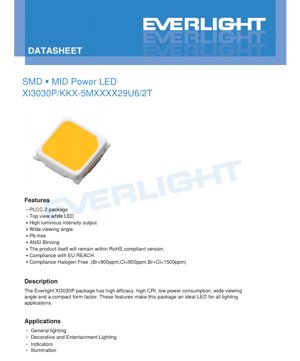
XI3030P is a mid-power LED in a surface-mount device (SMD) package using PLCC-2 (Plastic Leaded Chip Carrier). It is designed as a top-view white LED, integrating high luminous efficacy, excellent color rendering, and a compact form factor. Its primary design goal is to provide high energy efficiency and reliable performance for a wide range of lighting applications.
1.1 Core Advantages
The main advantages of this LED package include:
- High luminous efficacy:At 65mA and 5000K color temperature, the typical luminous efficacy can reach 225 lm/W, which helps reduce energy consumption.
- High Color Rendering Index (CRI):Provides a minimum color rendering index of 80 (Ra), with models up to 90 available, ensuring accurate and pleasing color reproduction.
- Wide Viewing Angle:Typical viewing angle (2θ1/2) is 120 degrees, providing uniform and wide illumination.
- Compact Form Factor:The small 3.0mm x 3.0mm footprint allows for flexible and dense PCB layout design.
- Environmental Compliance:产品无铅,符合RoHS、欧盟REACH及无卤标准(Br<900ppm, Cl<900ppm, Br+Cl<1500ppm)。
1.2 Target Market and Applications
This LED is an ideal solution for various lighting applications that require a balance between performance, efficiency, and cost. The main application areas include:
- General Lighting:Suitable for lighting fixtures in residential, commercial, and industrial environments.
- Decorative and Entertainment Lighting:With its good color quality, it can be used for accent lighting, architectural lighting, and stage lighting.
- Indicator Light and Backlight:Suitable for backlighting, signage, and status indicator lights.
- Switch Indicator Light:It can be integrated into illuminated switches and control panels.
2. In-depth Technical Parameter Analysis
This section provides a detailed and objective interpretation of the key technical parameters defined in the specification sheet.
2.1 Photoelectric Characteristics
Main performance indicators are defined under standard test conditions (solder point temperature = 25°C, forward current IF = 65mA).
- Luminous flux (Φ):Minimum luminous flux varies by product model, ranging from 37 lm to 39 lm depending on the correlated color temperature (CCT). The applicable tolerance is ±11%.
- Forward Voltage (VF):The maximum forward voltage is specified as 2.9V, with a typical tolerance of ±0.1V. A lower VF helps improve system efficiency.
- Color Rendering Index (CRI/Ra):The minimum Ra for the standard series is 80, with a strict tolerance controlled within ±2, ensuring consistency in color quality across different production batches.
- Viewing Angle (2θ1/2):The typical value is 120 degrees, which is considered a wide viewing angle, suitable for applications requiring diffuse light distribution.
- Luminous Efficacy:The typical luminous efficacy measured at 65mA and 5000K color temperature is 225 lm/W. This is a key indicator for measuring energy efficiency.
- Reverse Current (IR):A lokacin da aka koma baya (VR) ya kasance 5V, mafi girman koma baya na yanzu shine 50 µA, yana nuna halayen zubar da diode.
2.2 Absolute Maximum Ratings
Waɗannan ƙimar suna ayyana iyakar da za ta iya haifar da lalacewa ta dindindin ga na'urar. Aiki ya kamata ya kasance koyaushe a cikin iyakokin.
- Gaba da yanzu (IF):180 mA (continuous).
- Peak Forward Current (IFP):300 mA, allowed only under pulse conditions (duty cycle 1/10, pulse width 10ms).
- Power Dissipation (Pd):580 mW.
- Operating and Storage Temperature:-40°C to +85°C (operating), -40°C to +100°C (storage).
- Thermal Resistance (RθJ-S):The junction-to-solder point thermal resistance is 21 °C/W. This parameter is critical for thermal management design.
- Junction Temperature (Tj):The maximum allowable junction temperature is 115°C.
- Soldering Temperature:Reflow soldering: maximum 260°C for 10 seconds. Hand soldering: maximum 350°C for 3 seconds.
Important Notice:This device is sensitive to electrostatic discharge (ESD). Proper ESD handling precautions must be observed during assembly and operation.
3. Grading System Description
The product employs a comprehensive binning system to ensure consistency in electrical and optical characteristics. The part number explains the binning code.
3.1 Product Number Decoding
Example: XI3030P/KKX-5M403929U6/2T
- XI3030P:Series ya ufumbuzi na saizi (3.0mm x 3.0mm).
- KKX-5M:Internal series code.
- The first 'XX' (40):Represents the Correlated Color Temperature (CCT). '40' = 4000K.
- The second 'XX' (39):Represents the minimum luminous flux bin code. '39' = 39 lm (minimum value).
- The third 'XX' (29):Represents the maximum forward voltage bin code. '29' corresponds to a VF maximum of 2.9V.
- U6:Forward current index, indicating an operating current of 65mA.
- 2T:Additional product model code.
3.2 Color Rendering Index (CRI) Grading
The datasheet provides a table mapping single-letter symbols to minimum CRI values:
- M: CRI 60, N: 65, L: 70, Q: 75, K: 80, P: 85, H: 90.
3.3 Luminous Flux Grading
Light flux is graded according to CCT. For example:
- 3000K:Grade codes 37L2 (37-39 lm), 39L2 (39-41 lm), 41L2 (41-43 lm).
- 4000K/5000K/5700K:Binning code 39L2 (39-41 lm), 41L2 (41-43 lm), 43L2 (43-45 lm).
- 6500K:Binning code 38L2 (38-40 lm), 40L2 (40-42 lm), 42L2 (42-44 lm).
3.4 Forward Voltage Binning
Forward voltage is grouped under code '2629', containing three sub-bins:
- 26A: 2.6V - 2.7V
- 27A: 2.7V - 2.8V
- 28A: 2.8V - 2.9V (maximum)
3.5 Chromaticity Binning (MacAdam Ellipse)
The color point (chromaticity coordinates) of an LED is controlled within a specific ellipse on the CIE 1931 diagram to ensure color consistency.
- MacAdam 3-step:Stricter color control means that under standard conditions, the human eye can hardly distinguish color differences between LEDs located within the 3-step ellipse.
- MacAdam 5-step:Standard color control, suitable for most general lighting applications where slight color variation is acceptable.
4. Performance Curve Analysis
Typical curves reveal the behavioral characteristics of LEDs under different operating conditions.
4.1 Forward Voltage vs. Junction Temperature (Figure 1)
Forward voltage (VF) has a negative temperature coefficient. When the junction temperature (Tj) increases from 25°C to 115°C, VF decreases linearly by approximately 0.2V. This characteristic is very important for constant current driver design and thermal compensation considerations.
4.2 Relative Luminous Intensity vs. Forward Current (Figure 2)
The light output exhibits a sublinear relationship with current. While output increases with current, luminous efficacy (lumens per watt) typically decreases at higher currents due to thermal effects and efficiency droop. Operating at the recommended 65mA ensures optimal efficacy and lifetime.
4.3 Relative Luminous Flux vs. Junction Temperature (Figure 3)
Light output decreases as junction temperature increases. The curve shows that at Tj of 100°C, the relative luminous flux is approximately 85% of its value at 25°C. Effective thermal management (low RθJ-A) is crucial for maintaining light output and lifetime.
4.4 Forward Current vs. Forward Voltage (IV Curve) (Figure 4)
This graph shows the typical exponential relationship between diode current and voltage. This is crucial for selecting the appropriate driving method (LEDs must be driven by constant current).
4.5 Maximum Drive Current vs. Solder Point Temperature (Figure 5)
This derating curve indicates that the maximum allowable forward current decreases as the solder point temperature increases. This is a key design rule to ensure the LED operates within its Safe Operating Area (SOA) under all environmental conditions.
4.6 Radiation Pattern (Figure 6)
The polar plot confirms its broad, Lambertian-like emission pattern, with a typical viewing angle of 120°. Within the wide central region, the light intensity is quite uniform.
4.7 Spectral Distribution
The spectral power distribution graph (mentioned but not detailed in the text) will show a broad blue pump LED peak and a broader phosphor-converted yellow emission peak, characteristic of white phosphor-converted LEDs. The exact shape determines the CCT and CRI.
5. Welding and Assembly Guide
5.1 Reflow Soldering Parameters
This LED is compatible with standard infrared or convection reflow processes. The key parameter is the peak soldering temperature, which must not exceed 260°C for more than 10 seconds. It is recommended to use a standard lead-free reflow profile (e.g., JEDEC J-STD-020). Precise control is required to avoid thermal damage to the plastic package and internal die attachment.
5.2 Manual Soldering
If manual soldering is necessary, the soldering iron tip temperature should be controlled at a maximum of 350°C, and the contact time with each pad must be limited to 3 seconds or less to prevent overheating.
5.3 Storage Conditions
LED yana iya ajiyewa a cikin jakar rigakafin danshi na asali (idan an rarraba shi azaman na'urar da ke da hankali ga danshi), yanayin zafi tsakanin -40°C zuwa +100°C kuma yanayin danshi ya yi ƙasa. Idan ya dace, bi daidaitattun jagororin IPC/JEDEC don sarrafa na'urorin da ke da hankali ga danshi (MSD).
6. Application Design Considerations
6.1 Drive Selection
A constant current driver is required. The recommended operating current is 65mA. The driver should be selected based on the required series voltage (sum of LED VF) and must include appropriate protection features such as overcurrent, overvoltage, and open/short circuit protection. In some precision applications, the driver's feedback loop design should account for the negative VF temperature coefficient.
6.2 Thermal Management
Saboda juriyar zafi daga junction zuwa solder point (RθJ-S) yana da 21°C/W, yana da mahimmanci a sami ingantacciyar hanyar fitar da zafi, musamman lokacin aiki kusa ko kaiwa ga matsakaicin ƙimar iyaka. PCB ya kamata ya sami isassun ramukan zafi da yankunan tagulla masu haɗe da LED heat sink pad (idan akwai a cikin kewayon) don fitar da zafi. Ba za a wuce matsakaicin zafin junction na 115°C ba. Yi amfani da dabara: Tj = Ts + (RθJ-S * Pd), inda Ts shine zafin solder point, Pd shine amfani da wutar lantarki (VF * IF).
6.3 Optical Design
Faɗin kusurwar kallo na 120° ya sa wannan LED ya dace da aikace-aikacen da ke buƙatar haske mai watsewa, daidaitacce ba tare da na'urorin gani na biyu ba. Don mai da hankali kan hasken, dole ne a tsara na'urar gani ta farko (ruwan tabarau ko mai nuna) da ta dace bisa tsarin fitarwa da girman jiki na LED.
7. Technical Comparison and Differentiation
Although the datasheet does not provide a direct side-by-side comparison with other products, based on its specifications, the key differentiating features of the XI3030P include:
- Balance of Luminous Efficacy and Color Rendering:Achieving a typical luminous efficacy of 225 lm/W at CRI 80 provides a good balance, while some competitors may offer higher efficacy at lower CRI, or vice versa.
- Comprehensive Binning:Detailed binning for luminous flux, voltage, and chromaticity (3-step/5-step MacAdam ellipse), compared to products with looser binning, allows for stricter system design and achieves better color consistency in multi-LED luminaires.
- Robust Maximum Ratings:A relatively high maximum junction temperature (115°C) and power dissipation (580mW) provide a wider safety margin and design flexibility in thermally challenging environments.
- Environmental Compliance:Full compliance with modern environmental standards (RoHS, REACH, Halogen-Free) is a basic requirement, but it is explicitly listed as a feature.
8. Frequently Asked Questions (Based on Technical Parameters)
Q1: Can I drive this LED with 150mA for higher output?
A: No. The absolute maximum continuous forward current is 180mA, but the recommended operating condition is 65mA. Operating at 150mA will significantly increase the junction temperature, reduce luminous efficacy, accelerate lumen depreciation, and may void the warranty. Always design according to the recommended current.
Q2: What is the difference between 3-step and 5-step MacAdam ellipse binning?
A: The 3-step ellipse represents stricter color control, where most observers can hardly distinguish the color difference. The 5-step ellipse allows slightly more color variation, which may be noticeable in side-by-side comparison but is acceptable for many applications. The choice depends on the final product's requirements for color uniformity.
Q3: How to calculate the required heat sink?
A: You need to determine the target solder joint temperature (Ts). Using the formula Tj = Ts + (RθJ-S * Pd), set Tj to a safe value below 115°C (e.g., 105°C). Calculate Pd as VF * IF (e.g., 2.9V * 0.065A = 0.1885W). Then, Ts_max = Tj_max - (21°C/W * 0.1885W) ≈ 105°C - 4°C ≈ 101°C. The thermal design of the PCB and system must ensure the solder joint temperature is below this calculated Ts_max.
Q4: Is constant voltage power supply applicable?
A: Not applicable. LEDs are current-driven devices. Under a constant voltage source, a slight variation in forward voltage (due to temperature or binning differences) can cause a significant change in current, potentially leading to thermal runaway and failure. Always use a constant current driver or a current-limiting circuit.
9. Design and Use Case Studies
Scenario: Design a linear LED luminaire for office environment lighting.
- Requirements:中性白光(4000K),良好的显色性(CRI >80),高效率,并在2米长度上实现均匀照明。
- Device Selection:Select XI3030P/KKX-5M403929U6/2T for its 4000K color temperature, CRI 80, and high luminous efficacy.
- Thermal Design:The luminaire uses an aluminum-based printed circuit board (MCPCB) with a thermal conductivity of 1-2 W/mK. The power consumption per LED is calculated to be approximately 0.19W. One hundred LEDs are evenly distributed on a 2-meter-long aluminum profile (serving as a heat sink). Thermal simulation confirms that at an ambient temperature of 25°C, the junction temperature remains below 90°C.
- Electrical Design:LEDs are connected in series with 20 LEDs per string (maximum total VF approximately 58V). A constant current driver with an output of 65mA and a voltage range covering 58V is selected. Includes overvoltage protection.
- Optical Design:Utilizing the LED's 120° wide beam angle, combined with a milky polycarbonate diffuser plate placed at the calculated distance, achieves the required uniform illumination without visible light spots, meeting office lighting standards.
10. Technical Principle Introduction
The XI3030P is a phosphor-converted white LED. Its fundamental principle involves a semiconductor chip (typically made of indium gallium nitride (InGaN)) that emits blue light (electroluminescence) when forward biased. A portion of this blue light is absorbed by a phosphor layer (e.g., YAG:Ce) deposited on or around the chip. The phosphor down-converts a portion of the blue photons into a broad spectrum in the yellow and red regions. The remaining blue light mixes with the yellow/red light emitted by the phosphor, which is perceived by the human eye as white light. The precise ratio of blue to yellow light and the phosphor composition determine the correlated color temperature (CCT) and color rendering index (CRI) of the emitted white light.
11. Industry Trends
The mid-power LED sector, represented by packages such as the XI3030P, continues to evolve. Objective industry trends include:
- Efficacy Improvement:Ci gaba da inganta ingancin kwayoyin halitta na ciki (IQE) na guntu shuɗi, ingancin canza sinadarin phosphor, da ingancin fitar da haske na ɗaurin kayan aiki suna haɓaka ingancin haske.
- Inganta ingancin launi:Buƙatar ƙarin CRI (90+) da inganta daidaiton launi (matsakaicin ellipse na MacAdam) yana ƙaruwa, musamman a fagen hasken kasuwanci da na dillali.
- Reliability and Lifespan Improvement:Advances in packaging materials (molding compounds, substrates) and manufacturing processes aim to reduce lumen depreciation and increase operational lifetime (L90).
- Miniaturization and Integration:Although 3030 is a standard size, the trend is moving towards smaller package sizes while maintaining comparable or better performance, as well as modules integrating multiple LEDs and drivers.
- Smart & Dimmable:There is a growing integration of LEDs with control electronics to enable dimming, color temperature adjustment (CCT tunable), and connectivity for IoT-based lighting systems.
Detailed Explanation of LED Specification Terminology
Complete Explanation of LED Technical Terminology
I. Core Indicators of Photoelectric Performance
| Terminology | Unit/Representation | Popular Explanation | Why It Is Important |
|---|---|---|---|
| Luminous Efficacy | lm/W | The luminous flux emitted per watt of electrical power, higher values indicate greater energy efficiency. | Directly determines the energy efficiency rating and electricity cost of the lighting fixture. |
| Luminous Flux | lm (Lumen) | Total light output from a light source, commonly known as "brightness". | Determines if a luminaire is bright enough. |
| Viewing Angle | ° (degrees), e.g., 120° | The angle at which luminous intensity drops to half, determining the width of the light beam. | Affects the illumination range and uniformity. |
| Color Temperature (CCT) | K (Kelvin), such as 2700K/6500K | The color temperature of light; lower values are yellowish/warm, higher values are whitish/cool. | Determines the lighting ambiance and suitable application scenarios. |
| Color Rendering Index (CRI / Ra) | Unitless, 0–100 | The ability of a light source to restore the true color of an object, Ra≥80 is recommended. | Affects color authenticity, used in high-demand places such as shopping malls and art galleries. |
| Color tolerance (SDCM) | MacAdam ellipse steps, e.g., "5-step" | A quantitative metric for color consistency; a smaller step number indicates better color consistency. | Ensure no color variation among luminaires from the same batch. |
| Dominant Wavelength | nm (nanometer), e.g., 620nm (red) | Rangi ya LED ya rangi inayolingana na thamani ya urefu wa wimbi. | Inaamua rangi ya LED moja kama nyekundu, manjano, kijani, n.k. |
| Spectral Distribution | Wavelength vs. Intensity Curve | Shows the intensity distribution of light emitted by an LED at each wavelength. | Affects color rendering and color quality. |
II. Electrical Parameters
| Terminology | Symbol | Popular Explanation | Design Considerations |
|---|---|---|---|
| Forward Voltage | Vf | The minimum voltage required to light up an LED, similar to a "starting threshold". | The driving power supply voltage must be ≥ Vf, and the voltage accumulates when multiple LEDs are connected in series. |
| Forward Current | If | The current value that makes the LED emit light normally. | Constant current drive is often used, as current determines brightness and lifespan. |
| Maximum Pulse Current (Pulse Current) | Ifp | Peak current that can be withstood for a short period, used for dimming or flashing. | Pulse width and duty cycle must be strictly controlled to prevent overheating and damage. |
| Reverse Voltage | Vr | The maximum reverse voltage that an LED can withstand; exceeding this may cause breakdown. | The circuit must be protected against reverse connection or voltage surges. |
| Thermal Resistance | Rth (°C/W) | The resistance to heat transfer from the chip to the solder joint; a lower value indicates better heat dissipation. | High thermal resistance requires a stronger heat dissipation design; otherwise, the junction temperature will increase. |
| Electrostatic Discharge Immunity (ESD Immunity) | V (HBM), e.g., 1000V | ESD strike resistance, the higher the value, the less susceptible to ESD damage. | Anti-static measures must be implemented during production, especially for high-sensitivity LEDs. |
III. Thermal Management and Reliability
| Terminology | Key Indicators | Popular Explanation | Impact |
|---|---|---|---|
| Junction Temperature | Tj (°C) | The actual operating temperature inside the LED chip. | For every 10°C reduction, the lifespan may double; excessively high temperatures lead to lumen depreciation and color shift. |
| Lumen Depreciation | L70 / L80 (hours) | Time required for brightness to drop to 70% or 80% of its initial value. | Directly define the "useful life" of an LED. |
| Lumen Maintenance | % (e.g., 70%) | The percentage of remaining brightness after a period of use. | Characterization of luminance maintenance capability after long-term use. |
| Color Shift | Δu′v′ or MacAdam ellipse | The degree of color change during use. | Affects the color consistency of the lighting scene. |
| Thermal Aging | Material performance degradation | Deterioration of packaging materials due to prolonged high temperatures. | May lead to decreased brightness, color shift, or open-circuit failure. |
IV. Packaging and Materials
| Terminology | Common Types | Popular Explanation | Features and Applications |
|---|---|---|---|
| Package Types | EMC, PPA, Ceramic | The housing material that protects the chip and provides optical and thermal interfaces. | EMC has good heat resistance and low cost; ceramic has excellent heat dissipation and long lifespan. |
| Chip structure | Front side, Flip Chip | Chip electrode arrangement method. | Flip Chip offers better heat dissipation and higher luminous efficacy, suitable for high-power applications. |
| Phosphor coating | YAG, silicate, nitride | Coated on the blue LED chip, partially converted to yellow/red light, mixed to form white light. | Different phosphors affect luminous efficacy, color temperature, and color rendering. |
| Lens/Optical Design | Planar, microlens, total internal reflection | Optical structure on the encapsulation surface, controlling light distribution. | Determines the emission angle and light distribution curve. |
V. Quality Control and Binning
| Terminology | Binning Content | Popular Explanation | Purpose |
|---|---|---|---|
| Luminous Flux Binning | Codes such as 2G, 2H | Group by brightness level, each group has a minimum/maximum lumen value. | Ensure consistent brightness for products in the same batch. |
| Voltage binning | Codes such as 6W, 6X | Grouped by forward voltage range. | Facilitate driver power matching and improve system efficiency. |
| Color binning | 5-step MacAdam ellipse | Group by color coordinates to ensure colors fall within an extremely small range. | Ensure color consistency to avoid color unevenness within the same luminaire. |
| Color temperature binning | 2700K, 3000K, etc. | Group by color temperature, each group has a corresponding coordinate range. | Meet the color temperature requirements of different scenarios. |
VI. Testing and Certification
| Terminology | Standard/Test | Popular Explanation | Significance |
|---|---|---|---|
| LM-80 | Lumen Maintenance Test | Long-term operation under constant temperature conditions, recording data on brightness attenuation. | Used for estimating LED lifespan (combined with TM-21). |
| TM-21 | Life Prediction Standard | Estimating lifespan under actual use conditions based on LM-80 data. | Providing scientific life prediction. |
| IESNA Standard | Illuminating Engineering Society Standard | Covering optical, electrical, and thermal testing methods. | Industry-recognized testing basis. |
| RoHS / REACH | Environmental Certification | Ensure products are free from hazardous substances (e.g., lead, mercury). | Conditions for market entry into the international market. |
| ENERGY STAR / DLC | Energy efficiency certification. | Energy Efficiency and Performance Certification for Lighting Products. | Commonly used in government procurement and subsidy programs to enhance market competitiveness. |