Table of Contents
- 1. Product Overview
- 1.1 Core Advantages and Target Market
- 2. In-depth Technical Parameter Analysis
- 2.1 Absolute Maximum Ratings
- 2.2 Electro-Optical Characteristics
- 3. Performance Curve Analysis
- 3.1 Forward Current vs. Ambient Temperature Relationship
- 3.2 Spectral Sensitivity
- 3.3 Relationship Between Forward Current and Forward Voltage
- 4. Mechanical and Packaging Information
- 4.1 Package Dimensions
- 4.2 Polarity Identification and Installation
- 5. Welding and Assembly Guide
- 5.1 Pin Forming
- 5.2 Soldering Process
- 5.3 Cleaning and Storage
- 6. Packaging and Ordering Information
- 7. Application Recommendations
- 7.1 Typical Application Scenarios
- 7.2 Design Considerations and Circuit Interfaces
- 8. Technical Comparison and Differentiation
- 9. Frequently Asked Questions (Based on Technical Parameters)
- 9.1 What is the typical operating current of an infrared LED?
- 9.2 Why is the range of the collector current (0.2mA to 5.0mA) so wide?
- 9.3 Can this sensor be used outdoors?
- 9.4 How close must an object be to block the beam?
- 10. Design Use Case Study
- 11. Working Principle
- 12. Technology Trends
1. Product Overview
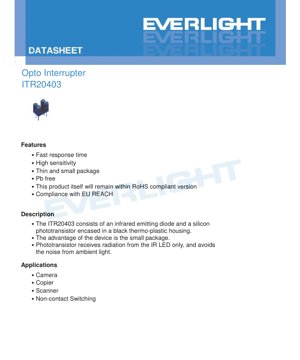
ITR20403, temasız algılama uygulamaları için tasarlanmış kompakt bir fotoelektrik kesici modüldür. Küçük, siyah bir termoplastik muhafaza içinde bir kızılötesi yayan diyot (IRED) ve bir silikon fototransistör entegre eder. Cihazın ana işlevi, vericisi ve alıcısı arasındaki kızılötesi ışın hüzmesinin kesilmesini algılamaktır.
1.1 Core Advantages and Target Market
This device offers several key advantages, making it suitable for precision applications. Its fast response time and high sensitivity enable reliable detection of rapidly moving objects. The thin, compact package facilitates integration into space-constrained designs, which is common in consumer electronics and office automation equipment. An important technical feature is its housing design, which ensures the phototransistor primarily receives radiation from the integrated infrared LED, thereby minimizing interference and noise from ambient light sources. The primary target markets include imaging equipment, document processing systems, and various automated control devices requiring precise position or presence detection.
2. In-depth Technical Parameter Analysis
This section provides a detailed and objective interpretation of the device's electrical, optical, and thermal specifications as defined in the datasheet.
2.1 Absolute Maximum Ratings
Absolute maximum ratings define the stress limits that may cause permanent damage to the device. These are not recommended operating conditions.
- Input (IRED) Power Dissipation (Pd):When the free-air temperature is equal to or below 25°C, the maximum value is 75 mW. Exceeding this limit may cause thermal damage to the LED chip.
- Input Reverse Voltage (VR):Maximum 5 V. Applying a higher reverse voltage may cause junction breakdown.
- Continuous Forward Current (IF):Maximum 50 mA. This is the highest DC current that the IRED can withstand.
- Output (Phototransistor) Power Dissipation (Pd):Maximum 75 mW when the free-air temperature is equal to or below 25°C.
- Collector current (IC):Phototransistor output maximum 20 mA.
- Collector-emitter voltage (BVCEO):Maximum 30 V. This is the breakdown voltage when the base is open.
- Operating temperature (Topr):-25°C to +80°C. Ensures the device operates normally within this ambient temperature range.
- Storage temperature (Tstg):-40°C to +85°C.
- Pin soldering temperature (Tsol):Measured at 3mm from the package body, maximum 260°C for 5 seconds. This is crucial for assembly process control.
2.2 Electro-Optical Characteristics
These parameters are measured under standard test conditions (Ta=25°C) and represent the typical performance of the device.
- Forward Voltage (VF):Typical value 1.23V, maximum 1.6V at IF=20mA. This parameter is crucial for designing the current-limiting drive circuit for the IRED.
- Peak wavelength (λP):940 nm. This is the nominal wavelength of the emitted infrared light, matching the peak sensitivity of the receiving phototransistor.
- Collector dark current (ICEO):In VCE=20V and no illumination, maximum 100 nA. This leakage current determines the noise floor of the sensor in the "off" state.
- Collector-emitter saturation voltage (VCE(sat)):In IC=2mA and irradiance (Ee) is 1 mW/cm², the maximum is 0.4V. For digital switching applications, a low saturation voltage is ideal.
- On-state collector current (IC(on)):In VCE=5V and IFUnder test conditions of =20mA, the range is from a minimum of 0.2 mA to a maximum of 5.0 mA. This wide range indicates differences in the Current Transfer Ratio (CTR) between devices, which must be considered in circuit design.
- Rise/Fall time (tr, tf):Under specified switching conditions, typically 15 μs each. This defines the maximum switching frequency achievable by the device.
3. Performance Curve Analysis
The datasheet includes typical characteristic curves, which help in understanding the device's behavior under various conditions.
3.1 Forward Current vs. Ambient Temperature Relationship
This curve illustrates the required derating of the IRED forward current as the ambient temperature increases. To prevent exceeding the maximum junction temperature and ensure long-term reliability, the operating current must be reduced when the device is used in high-temperature environments. Designers must refer to this graph to determine the safe operating current at the maximum ambient temperature for their specific application.
3.2 Spectral Sensitivity
Spectral sensitivity curves are provided for the infrared emitter and the phototransistor, respectively. The IRED curve shows the relative radiant intensity versus wavelength, peaking at 940 nm. The phototransistor curve shows its relative response versus the wavelength of incident light, with its peak designed to align with the emitter's output. This narrow and matched response minimizes sensitivity to visible ambient light, a key characteristic for stable operation under varying lighting conditions.
3.3 Relationship Between Forward Current and Forward Voltage
This IV curve of the IRED shows the nonlinear relationship between forward voltage and current. This is crucial for selecting appropriate current limiting schemes (e.g., resistor, constant current source) to ensure stable infrared output across the operating temperature range and production variations.
4. Mechanical and Packaging Information
4.1 Package Dimensions
The device is packaged in a compact housing. Key dimensions include a body width of approximately 4.0 mm, a depth of 3.0 mm, and a height of 2.0 mm. The pin pitch is 2.54 mm (0.1 inch), which is the standard pitch for through-hole PCB mounting. Unless otherwise specified, all dimensional tolerances are ±0.25 mm. Pin dimensions are measured where they extend from the package body.
4.2 Polarity Identification and Installation
This component has four pins. The standard convention for such a photointerrupter is that the two pins on one side belong to the infrared emitter (anode and cathode), and the two pins on the other side belong to the phototransistor (emitter and collector). The exact pin arrangement must be verified from the package diagram. During installation, the PCB holes must be precisely aligned with the pin positions to avoid applying mechanical stress to the epoxy body during insertion, which could otherwise lead to performance degradation or failure.
5. Welding and Assembly Guide
Proper handling is crucial for maintaining the integrity and performance of the device.
5.1 Pin Forming
If pin bending is required, it must be performedbefore soldering.The bend point should be greater than 3 mm from the bottom of the epoxy resin package body. The lead frame must be firmly secured during bending to prevent stress from being transmitted to the fragile epoxy resin bubble shell, otherwise cracking or internal damage may occur. Pin cutting should be performed at room temperature.
5.2 Soldering Process
A minimum distance of 3 mm must be maintained between the solder joint and the epoxy resin bubble shell. Recommended conditions are as follows:
- Manual Welding:The maximum temperature of the soldering iron tip is 300°C (for a 30W iron), with a maximum soldering time of 3 seconds per pin.
- Wave soldering/Dip soldering:Maximum preheating temperature is 100°C, for a maximum of 60 seconds. Maximum solder bath temperature is 260°C, with a maximum dwell time of 5 seconds.
Avoid applying any mechanical stress to the device pins while the device is at high temperature. Dip soldering or manual soldering should not be repeated. After soldering, protect the device from mechanical shock or vibration until it returns to room temperature. Rapid cooling processes are not recommended.
5.3 Cleaning and Storage
Ultrasonic cleaning is prohibited., because high-frequency vibration may damage internal components or epoxy resin sealing. For storage, devices should be stored at 10-30°C and 70% RH or lower for up to 3 months after shipment. For longer-term storage (up to one year), it is recommended to use a sealed container with a nitrogen atmosphere, temperature 10-25°C, humidity 20-60%. After opening the moisture-proof packaging, devices should be used within 24 hours or as soon as possible, and remaining components should be promptly resealed.
6. Packaging and Ordering Information
Standard packaging specifications are 120 pieces per tube, 96 tubes per box, and 2 boxes per carton. The packaging label contains fields such as Customer Part Number (CPN), Manufacturer Part Number (P/N), Quantity (QTY), Reference Number (REF), and Lot Number (LOT No.).
7. Application Recommendations
7.1 Typical Application Scenarios
- Paper Detection in Printers/Copiers/Scanners:Detects the presence of paper, paper jams, or the leading/trailing edge of a document.
- Lens cap or filter position detection in cameras:Senses whether the lens cap is closed or the filter wheel is in the correct position.
- Non-contact limit sensing:For scanners, plotters, or automated platforms, to detect origin or limit positions without physical contact.
- Object counting or sorting:Detekti objektojn kiuj blokas la infraruĝan lumfaskon sur la transportilo.
- Rotacia kodila diska sensado:Legi la fendojn sur rotacia disko por mezuri rapidecon aŭ pozicion (kvankam dediĉitaj kodilaj moduloj kutime estas pli taŭgaj por alt-rezoluciaj taskoj).
7.2 Design Considerations and Circuit Interfaces
When designing with ITR20403, the following factors must be considered:
- Current Limiting for the IRED:It must be based on the power supply voltage (VCC), the required forward current (IF, typically 20mA to achieve the rated output) and the forward voltage drop (VF~1.23V) Calculate the series resistance. R = (VCC- VF) / IF.
- Output interface circuit:Phototransistors can be used in two common configurations:
- Switching mode:Connect the collector to V through a pull-up resistor (e.g., 1kΩ to 10kΩ)CC. The emitter is grounded. When the light beam is not blocked (transistor is on), the collector output is low (close to VCE(sat)); when the beam is blocked (transistor cutoff), the output is high level (VCC).
- Analog mode:Phototransistors can be used in a common-emitter configuration with a collector resistor to generate a voltage proportional to light intensity. However, compared to photodiodes with op-amp circuits, their nonlinear response and temperature dependence make them less suitable for precise analog measurements.
- Noise Immunity:Although resistant to ambient light, the circuit may still pick up electrical noise. It is recommended to use a bypass capacitor (0.1 μF) near the device's power supply pins and carefully design the PCB layout. For long cables or noisy environments, shielding or driving the output into a Schmitt trigger input can improve reliability.
- Aperture and Slit Design:Objects blocking the beam should be opaque to infrared light. The resolution and repeatability of detection depend on the ratio of the object's width to the slit width in the device housing. For edge detection, a blade or shutter with a sharp edge provides the most precise timing.
8. Technical Comparison and Differentiation
The ITR20403 differentiates itself primarily through its compact, low-profile form factor, which is advantageous in miniaturized consumer electronics. Its fast response time of 15 μs is suitable for detecting medium to high-speed events. The integrated housing with spectrally matched emitter and receiver provides inherent ambient light suppression, a feature that simplifies design compared to using discrete components. Compared to reflective object sensors, the interrupter offers higher positional accuracy and is less sensitive to the color or reflectivity of the target object. Compared to slotted optical switches with wider gaps, this device's narrow gap allows for the detection of smaller objects or enables more precise edge detection.
9. Frequently Asked Questions (Based on Technical Parameters)
9.1 What is the typical operating current of an infrared LED?
Photoelectric characteristics are tested at IF= 20 mA, which is a common and recommended operating point for achieving the specified on-state collector current. The circuit design must ensure that the absolute maximum rating of 50 mA is not exceeded.
9.2 Why is the range of the collector current (0.2mA to 5.0mA) so wide?
This range represents the variation in Current Transfer Ratio (CTR) between devices, which is the phototransistor output current (IC) The ratio to the IRED input current (IF) This variation is inherent in the manufacturing process of photocouplers and interrupters. The circuit must be designed to operate reliably at the specified minimum IC(on)(0.2mA) to ensure the reliability of all production units.
9.3 Can this sensor be used outdoors?
Although the housing provides good ambient light suppression, direct sunlight contains a large amount of infrared radiation that may saturate the sensor. For outdoor use, additional optical filtering, shielding, or pulsed operation with synchronous detection is required to achieve reliable performance. The operating temperature range (-25°C to +80°C) also limits its application in extreme environments.
9.4 How close must an object be to block the beam?
The device has a narrow, focused gap. The object must physically pass through the slit between the emitter and the detector. It does not have "proximity" sensing capability; the beam must be completely blocked for the output state to change reliably.
10. Design Use Case Study
Scenario: Paper-out sensor in a desktop printer.
Implementation Plan:ITR20403 is installed on the paper feed path of the printer. A lever or flag connected to a spring rests in the sensor's slot when no paper is present. When paper is fed, it pushes the flag out of the slot, allowing the infrared beam to pass and turning the phototransistor on.
Circuit Design:The IRED is driven at 20mA by the printer's 5V logic supply through a current-limiting resistor. The phototransistor collector is connected to the 3.3V microcontroller input pin via a 4.7kΩ pull-up resistor. The emitter is grounded.
Software Logic:Microcontroller pin configured as digital input. Low-level reading indicates the beam is not blocked (flag removed, paper present). High-level reading indicates the beam is blocked (flag in slot, no paper), thereby triggering a "paper out" alarm to the user. Debounce logic (e.g., in software) is added to ignore mechanical vibrations of the flag.
Key considerations for this case:The flag mechanism must be designed to reliably and fully enter the sensor slit. The spring must provide sufficient force to ensure proper positioning, but not so great as to damage the paper or cause sensor wear. The sensor's position must be securely fixed to maintain alignment.
11. Working Principle
ITR20403 operates on the principle of modulated light transmission and detection. An infrared emitting diode (IRED) is biased with a constant forward current, causing it to emit photons at a peak wavelength of 940 nm. Within the same housing, directly opposite, is a silicon NPN phototransistor. When the infrared beam passes unobstructed across the gap, it illuminates the base region of the phototransistor. The absorbed photons generate electron-hole pairs, which act as base current, turning the transistor on and allowing collector current (IC) to flow, which is proportional to the light intensity. When an opaque object enters the gap, it blocks the light beam, the photogenerated base current ceases, and the transistor turns off. The output circuit converts this on/off state change into a usable electrical signal. The black thermoplastic housing serves to contain the optical path, prevent optical crosstalk, and block most ambient visible light, whose photons typically lack sufficient energy to be absorbed by the silicon phototransistor's bandgap, thus providing inherent optical filtering.
12. Technology Trends
Photoelectric interrupters such as the ITR20403 represent a mature and reliable technology. Current trends in this field focus on several aspects: further miniaturization for integration into smaller portable and wearable devices; development of surface-mount device (SMD) versions with improved reflow soldering compatibility to suit automated assembly; increasing switching speed to support higher data rates in encoder applications or faster machinery; and enhancing robustness against environmental factors such as high temperature, humidity, and contamination. There is also a trend toward integrating additional features, such as built-in Schmitt triggers at the output for hysteresis, or even digital interfaces (I2C, SPI) for smarter, addressable sensor modules. However, basic through-hole discrete component designs, as exemplified by the ITR20403, remain highly cost-effective and widely used in applications where their performance and form factor are sufficient.
Detailed Explanation of LED Specification Terminology
Complete Explanation of LED Technical Terminology
I. Core Indicators of Photoelectric Performance
| Terminology | Unit/Representation | Popular Explanation | Why It Is Important |
|---|---|---|---|
| Luminous Efficacy | lm/W (lumens per watt) | The luminous flux emitted per watt of electrical energy, the higher the more energy-efficient. | Directly determines the energy efficiency class and electricity cost of the luminaire. |
| Luminous Flux | lm (lumen) | The total amount of light emitted by a light source, commonly known as "brightness". | Determine if the lamp is bright enough. |
| Viewing Angle | ° (degrees), such as 120° | The angle at which light intensity drops to half, determining the beam's width. | Affects the illumination range and uniformity. |
| Color Temperature (CCT) | K (Kelvin), e.g., 2700K/6500K | The warmth or coolness of light color; lower values are yellowish/warm, higher values are whitish/cool. | Determines the lighting atmosphere and suitable application scenarios. |
| Color Rendering Index (CRI / Ra) | No unit, 0–100 | The ability of a light source to reproduce the true colors of objects, Ra≥80 is recommended. | Affects color fidelity, used in high-demand places such as shopping malls and art galleries. |
| Color Tolerance (SDCM) | MacAdam Ellipse Steps, e.g., "5-step" | Quantitative indicator of color consistency, the smaller the step number, the more consistent the color. | Ensure no color difference among the same batch of luminaires. |
| Dominant Wavelength | nm (nanometer), e.g., 620nm (red) | The wavelength value corresponding to the color of a colored LED. | Determine the hue of monochromatic LEDs such as red, yellow, and green. |
| Spectral Distribution | Wavelength vs. Intensity curve | It shows the intensity distribution of light emitted by an LED across various wavelengths. | It affects color rendering and color quality. |
II. Electrical Parameters
| Terminology | Symbols | Popular Explanation | Design Considerations |
|---|---|---|---|
| Forward Voltage | Vf | Minimum voltage required to turn on an LED, similar to a "starting threshold". | The driving power supply voltage must be ≥ Vf, and the voltage adds up when multiple LEDs are connected in series. |
| Forward Current | If | The current value that allows the LED to emit light normally. | A cikin yawancin lokuta ana amfani da tuƙi mai tsayayyen ƙarfi, ƙarfin lantarki yana ƙayyadaddun haske da tsawon rayuwa. |
| Matsakaicin ƙarfin bugun jini (Pulse Current) | Ifp | Peak current that can be withstood in a short time, used for dimming or flashing. | Pulse width and duty cycle must be strictly controlled, otherwise overheating damage will occur. |
| Reverse Voltage | Vr | The maximum reverse voltage that an LED can withstand; exceeding it may cause breakdown. | Reverse connection or voltage surge must be prevented in the circuit. |
| Thermal Resistance | Rth (°C/W) | The resistance to heat flow from the chip to the solder joint. A lower value indicates better heat dissipation. | High thermal resistance requires a more robust thermal design; otherwise, the junction temperature will increase. |
| Electrostatic Discharge Immunity (ESD Immunity) | V (HBM), such as 1000V | Anti-static strike capability, the higher the value, the less susceptible to damage from static electricity. | Anti-static measures must be implemented during production, especially for high-sensitivity LEDs. |
III. Thermal Management and Reliability
| Terminology | Key Indicators | Popular Explanation | Impact |
|---|---|---|---|
| Junction Temperature | Tj (°C) | The actual operating temperature inside the LED chip. | For every 10°C reduction, the lifespan may double; excessively high temperatures lead to lumen depreciation and color shift. |
| Lumen Depreciation | L70 / L80 (hours) | The time required for brightness to drop to 70% or 80% of its initial value. | Directly defines the "useful life" of an LED. |
| Lumen Maintenance | % (e.g., 70%) | Percentage of remaining brightness after a period of use. | Characterizes the ability to maintain brightness after long-term use. |
| Color Shift | Δu′v′ or MacAdam Ellipse | The degree of color change during use. | Affects the color consistency of the lighting scene. |
| Thermal Aging | Material performance degradation | Degradation of packaging materials due to long-term high temperature. | May lead to decreased brightness, color shift, or open-circuit failure. |
IV. Encapsulation and Materials
| Terminology | Common Types | Popular Explanation | Characteristics and Applications |
|---|---|---|---|
| Package Type | EMC, PPA, Ceramic | Material casing yang melindungi chip dan menyediakan antarmuka optik serta termal. | EMC tahan panas baik, biaya rendah; keramik disipasi panas unggul, umur panjang. |
| Struktur chip | Front-side, Flip Chip | Chip Electrode Layout. | Flip-chip offers better heat dissipation and higher luminous efficacy, suitable for high-power applications. |
| Phosphor coating | YAG, Silicate, Nitride | Covered on the blue light chip, partially converted into yellow/red light, mixed into white light. | Different phosphors affect luminous efficacy, color temperature, and color rendering. |
| Lens/Optical Design | Flat, Microlens, Total Internal Reflection | Optical structure on the encapsulation surface, controlling light distribution. | Determines the emission angle and light distribution curve. |
V. Quality Control and Binning
| Terminology | Bin Content | Popular Explanation | Purpose |
|---|---|---|---|
| Luminous Flux Binning | Codes such as 2G, 2H | Grouped by brightness level, each group has a minimum/maximum lumen value. | Ensure uniform brightness within the same batch of products. |
| Voltage binning | Codes such as 6W, 6X | Group by forward voltage range. | Facilitates driver power supply matching and improves system efficiency. |
| Color Grading | 5-step MacAdam Ellipse | Group by color coordinates to ensure colors fall within a minimal range. | Ensure color consistency to avoid uneven colors within the same luminaire. |
| Color temperature binning | 2700K, 3000K, etc. | Grouped by color temperature, each group has a corresponding coordinate range. | To meet the color temperature requirements of different scenarios. |
VI. Testing and Certification
| Terminology | Standard/Test | Popular Explanation | Meaning |
|---|---|---|---|
| LM-80 | Lumen Maintenance Test | Long-term illumination under constant temperature conditions, recording brightness attenuation data. | Used to estimate LED lifetime (combined with TM-21). |
| TM-21 | Standard for Lifetime Projection | Projecting lifetime under actual use conditions based on LM-80 data. | Provide scientific life prediction. |
| IESNA standard | Standard of the Illuminating Engineering Society | Covers optical, electrical, and thermal test methods. | Industry-recognized testing basis. |
| RoHS / REACH | Environmental certification | Ensure the product does not contain harmful substances (e.g., lead, mercury). | Access conditions for entering the international market. |
| ENERGY STAR / DLC | Energy Efficiency Certification | Energy efficiency and performance certification for lighting products. | Yawan da ake amfani da shi a cikin sayayyar gwamnati da ayyukan tallafi, don haɓaka gasar kasuwa. |