Table of Contents
- 1. Product Overview
- 1.1 Core Advantages and Product Positioning
- 1.2 Target Market and Applications
- 2. In-depth Analysis of Technical Parameters
- 2.1 Absolute Maximum Ratings
- 2.2 Photoelectric Characteristics
- 2.3 Thermal Characteristics
- 3. Grading System Description
- 3.1 Luminous Intensity Grading
- 3.2 Dominant Wavelength Binning
- 4. Performance Curve Analysis
- 4.1 Relationship Between Relative Intensity and Wavelength
- 4.2 Directivity Pattern
- 4.3 Forward Current vs. Forward Voltage Relationship (I-V Curve)
- 4.4 Relationship between Relative Intensity and Forward Current
- 4.5 Temperature Dependence Curve
- 5. Mechanical and Packaging Information
- 5.1 Package Dimensions
- 5.2 Polarity Identification
- 6. Welding and Assembly Guide
- 6.1 Pin Forming
- 6.2 Storage Conditions
- 6.3 Welding Process
- 7. Packaging and Ordering Information
- 7.1 Moisture-Proof Packaging
- 7.2 Packaging Quantity
- 7.3 Label Description
- 7.4 Carrier Tape and Reel Specifications
- 7.5 Product Model/Part Number Rules
- 8. Application Suggestions and Design Considerations
- 8.1 Typical Application Circuit
- 8.2 Thermal Management
- 8.3 Optical Integration
- 9. Technical Comparison and Differentiation
- 10. Frequently Asked Questions (FAQ)
- 11. Design and Use Case Studies
- 12. Working Principles
1. Product Overview
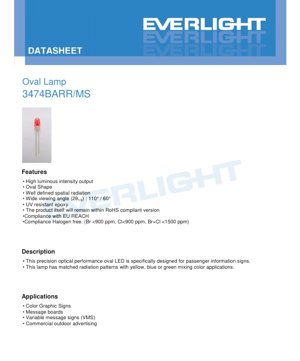
This document details the specifications of a high-performance elliptical LED lamp bead. This device is specifically designed for applications within information display systems that require precise optical performance and reliable illumination.
1.1 Core Advantages and Product Positioning
The main advantage of this LED lies in its unique elliptical radiation pattern, which is specifically matched and designed for color mixing applications in yellow, blue, or green systems. It aims to provide high luminous intensity output within a defined spatial radiation envelope. This product is positioned as a key specialized component in the commercial and public information display fields, where strict requirements exist for clarity, reliability, and specific beam shaping.
1.2 Target Market and Applications
The target market encompasses manufacturers of professional signage and information systems. Primary applications include:
- Color graphic signs
- Information Board
- Variable Message Sign (VMS)
- Commercial Outdoor Advertising
These applications benefit from the high brightness, well-defined beam patterns, and environmental robustness of LEDs.
2. In-depth Analysis of Technical Parameters
This section objectively analyzes the key electrical, optical, and thermal characteristics of the device.
2.1 Absolute Maximum Ratings
Absolute Maximum Ratings define the stress limits that may cause permanent damage to the device. It is not recommended to operate the device continuously at or near these limits, as doing so will affect reliability.
- Reverse voltage (VR):5 V. Exceeding this voltage under reverse bias may cause junction breakdown.
- Forward current (IF):50 mA (continuous).
- Peak forward current (IFP):160 mA (pulse, duty cycle 1/10 @ 1kHz). This rating allows short-term overdrive, suitable for multiplexed display applications.
- Power consumption (Pd):120 mW. This is the maximum power that can be dissipated by the package at Ta=25°C. It must be derated at higher ambient temperatures.
- Operating temperature (Topr):-40°C to +85°C. This wide range ensures functionality in harsh outdoor environments.
- Storage temperature (Tstg):-40°C to +100°C.
- Welding temperature (Tsol):260°C for 5 seconds. This defines the tolerance of the reflow soldering temperature profile.
2.2 Photoelectric Characteristics
These parameters are measured under standard test conditions IF= 15mA and Ta = 25°C, providing a benchmark for performance comparison.
- Luminous intensity (Iv):715 mcd (minimum), 1573 mcd (maximum). Typical values fall within this binning range (see Section 3). High brightness is crucial for the visibility of signage under daylight.
- Perspective (2θ1/2):110° (X-axis) / 60° (Y-axis). This asymmetric elliptical pattern is a key feature, providing wide horizontal coverage and more focused vertical emission, making it ideal for signage viewed from different horizontal angles.
- Peak wavelength (λp):632 nm (typical value). This is the wavelength at which the spectral power distribution reaches its maximum.
- Dominant Wavelength (λd):619 nm (minimum), 621 nm (typical value), 629 nm (maximum). This is the single wavelength point perceived by the human eye for the LED color and is subject to binning control.
- Spectral Radiant Bandwidth (Δλ):20 nm (typical value). This indicates the spectral purity of the red light emitted by the AlGaInP chip.
- Forward voltage (VF):1.6 V (minimum), 2.6 V (maximum), at IF=15mA condition. This range must be considered when designing drivers and power supplies.
- Reverse current (IR):10 μA (maximum), at VR=5V condition. Low reverse current indicates good junction quality.
2.3 Thermal Characteristics
Although not explicitly listed in a separate table, thermal performance is reflected through power dissipation ratings and operating temperature range. Device performance will vary with ambient temperature, as shown in the characteristic curves. Especially when operating under high forward current or high ambient temperature, proper PCB layout and, if necessary, heat dissipation are required to maintain the junction temperature within safe limits.
3. Grading System Description
To ensure color and brightness consistency within a component, LEDs are sorted (binned) according to key parameters.
3.1 Luminous Intensity Grading
LEDs are categorized into three bins (RH, RJ, RK) based on their luminous intensity measured at IF= 15mA. The tolerance within each bin is ±10%.
- Bin RH:715 mcd to 930 mcd
- Gear RJ:930 mcd to 1210 mcd
- Gear RK:1210 mcd to 1573 mcd
For applications requiring uniform panel brightness, specifying the gear code is crucial.
3.2 Dominant Wavelength Binning
LEDs are also binned according to their dominant wavelength to control color consistency. The tolerance is ±1nm.
- Bin R1:619 nm to 624 nm
- Gear R2:624 nm to 629 nm
For color mixing applications or logos requiring a specific red hue, specifying the wavelength bin is crucial.
4. Performance Curve Analysis
Typical characteristic curves reveal the device's behavior under non-standard conditions.
4.1 Relationship Between Relative Intensity and Wavelength
This curve shows the spectral power distribution, with a peak near 632 nm and a typical bandwidth (FWHM) of 20 nm. It confirms that the emitted light falls within the red spectral range of the AlGaInP chip.
4.2 Directivity Pattern
The polar plot visually demonstrates the asymmetric field of view: approximately 110° in the horizontal (X) plane and about 60° in the vertical (Y) plane, confirming an elliptical radiation pattern.
4.3 Forward Current vs. Forward Voltage Relationship (I-V Curve)
This curve is crucial for driver design. It shows the exponential relationship between current and voltage. At typical operating currents, the forward voltage is expected to be between 1.6V and 2.6V. This curve helps in calculating series resistance or designing constant current drivers.
4.4 Relationship between Relative Intensity and Forward Current
This curve shows the dependence of light output on drive current. While output increases with current, it is not perfectly linear, and at very high currents, efficiency may decrease due to thermal effects. Operation beyond absolute maximum ratings is prohibited.
4.5 Temperature Dependence Curve
Relative Intensity vs. Ambient Temperature:The luminous output decreases as the ambient temperature increases. This derating must be considered in thermal design to maintain sufficient brightness in high-temperature environments.
Relationship between Forward Current and Ambient Temperature:It may illustrate how the forward voltage characteristics change with temperature, which is important for constant voltage drive scenarios.
5. Mechanical and Packaging Information
5.1 Package Dimensions
The dimension drawing provides critical dimensions for PCB pad design, placement, and clearance. Key features include the oval lens shape, pin pitch (2.54mm pitch), and the maximum resin protrusion under the flange (1.5mm). All unspecified dimensions have a tolerance of ±0.25mm. Designers must adhere to these dimensions to ensure proper mounting and soldering.
5.2 Polarity Identification
The datasheet diagram indicates the anode and cathode pins. Typically, the longer pin is the anode (+), but the PCB pad design must explicitly match the package drawing to prevent reverse installation. Correct polarity is crucial for device operation and to prevent damage from reverse bias.
6. Welding and Assembly Guide
Proper handling is crucial for reliability.
6.1 Pin Forming
- Bending must occur at least 3mm away from the bottom of the epoxy lamp bead.
- 在Before Soldering soldering.
- Forming leads. Avoid applying stress to the package during bending.
- Cut leads at room temperature.
- Ensure PCB holes are perfectly aligned with LED pins to avoid installation stress.
6.2 Storage Conditions
- Recommended storage conditions: ≤30°C and ≤70% relative humidity.
- Shelf life after shipment: 3 months under these conditions.
- For longer storage (up to 1 year): Please use a sealed container with desiccant under a nitrogen atmosphere.
- Avoid sudden temperature changes in humid environments to prevent condensation.
6.3 Welding Process
- Maintain a distance greater than 3mm from the solder joint to the epoxy resin LED.
- Solder should not extend beyond the root of the tie bar on the lead frame.
- During reflow soldering, adhere to the peak soldering temperature limit of 260°C for 5 seconds.
7. Packaging and Ordering Information
7.1 Moisture-Proof Packaging
Components are supplied in moisture barrier packaging, including carrier tape and reel, placed inside inner and outer boxes.
7.2 Packaging Quantity
- 2500 pieces per inner box.
- Each outer box contains 10 inner boxes (total 25,000 pieces).
7.3 Label Description
The reel label contains essential information for traceability and verification: Customer Part Number (CPN), Part Number (P/N), Quantity (QTY), and binning codes for Luminous Intensity (CAT), Dominant Wavelength (HUE) and Forward Voltage (REF), along with the Lot Number (LOT No).
7.4 Carrier Tape and Reel Specifications
Detailed dimensions for the carrier tape (pocket pitch, depth, etc.) and reel are provided to ensure compatibility with automated surface mount assembly equipment. Key parameters include a component pitch (F) of 2.54mm and a feed hole pitch (P) of 12.70mm.
7.5 Product Model/Part Number Rules
Part numbers follow a structured format:3474 B A R R - □ □ □ □"3474" inaweza kumaanisha mfululizo wa kufunga/ukubwa. Herufi zinazofuata (B, A, R, R) zinaelezea sifa kama rangi (nyekundu angavu), aina ya lenzi na kiwango cha utendaji. Nafasi nne za mwisho (□) zimetumika kubainisha msimbo wa kiwango cha nguvu (CAT) na urefu wa wimbi (HUE), ikiruhusu mtumiaji kuagiza kiwango halisi cha utendaji kinachohitajika kwa matumizi yake.
8. Application Suggestions and Design Considerations
8.1 Typical Application Circuit
For a simple constant voltage power supply (e.g., 5V), a current-limiting resistor must be connected in series. The resistor value (Rs) can be calculated using Ohm's Law: Rs= (Vpower supply- VF) / IF. Use the maximum V from the datasheet to ensure the current does not exceed the limit.FFor multi-LED arrays or critical applications, it is strongly recommended to use a constant current driver to ensure stable brightness and long lifespan, as it can compensate for VFvariations and temperature effects.
8.2 Thermal Management
Although it is a low-power device, thermal management remains important in densely arranged signs or high ambient temperature environments (e.g., outdoor cabinets). Ensure adequate ventilation and consider using Metal Core Printed Circuit Boards (MCPCB) for large arrays to effectively dissipate heat and maintain light output.
8.3 Optical Integration
The elliptical beam pattern is specifically designed for mixing with other colors. When designing multi-color pixels (e.g., for full-color signage), the physical placement and orientation of red, green, and blue LEDs must account for their respective viewing angles to achieve proper color mixing at the intended viewing position.
9. Technical Comparison and Differentiation
The primary differentiation of this LED lies in itselliptical radiation pattern (110°x60°). Compared to standard circular LEDs with symmetrical viewing angles (e.g., 120°), this shape provides optimized light distribution for horizontal signage, potentially reducing light waste and improving efficiency for the target application. It utilizesUV-resistant epoxy resinEssential for outdoor applications, prevents lens yellowing and maintains light output over the long term. Complies withHalogen-free(Br/Cl restrictions) andRoHS/REACHThe standard makes it suitable for global markets with strict environmental regulations.
10. Frequently Asked Questions (FAQ)
Q1: Pe a fesili: O le a le eseesega i le va o le galu maualuga ma le galu autu?
A1: O le galu maualuga (λp) o le tumutumu fa'aletino lea o le fa'asologa o fua fa'atatau o le malamalama (iinei e 632 nm). O le galu autu (λd) o le vaega o le lanu e iloa (e masani lava e 621 nm). Mo le fa'avasegaina o lanu i fa'aaliga, e sili atu le talafeagai o le galu autu.
Q2: Ina iya amfani da 20mA don kunna wannan LED, maimakon 15mA?
A2: A'a, amma dole ne ku duba "Relative Intensity vs. Forward Current" curve. Haske zai fi girma, amma dole ne ku tabbatar cewa samfurin IFda VFbai wuce cikakken iyakar wutar lantarki (120mW) ba, musamman a yanayin zafi mai girma. Wani lokaci ana buƙatar rage amfani.
Q3: Why is the storage life only 3 months?
A3: This is a precaution for moisture-sensitive devices. The epoxy encapsulation absorbs moisture from the air. If a "damp" device is subjected to high-temperature soldering, the rapid vaporization of moisture can cause internal damage (the "popcorn" effect). The 3-month limit assumes standard factory floor conditions. For longer storage, the nitrogen bag method is specified.
Q4: How to interpret the grading code when ordering?
A4: You must specify the combination of the required luminous intensity bin (e.g., RK) and the dominant wavelength bin (e.g., R1) in the placeholder field of the part number. This ensures you receive LEDs with consistent brightness and color.
11. Design and Use Case Studies
Scenario: Designing a single-line Variable Message Sign (VMS) for a highway.
An engineer is designing a variable message sign. Each pixel requires a red sub-pixel. They selected this oval LED for its high brightness (visible in daylight) and wide horizontal viewing angle, ensuring readability for drivers across multiple lanes. They chose the RK bin for maximum intensity and the R1 bin for a consistent red hue. The LED is driven by a constant current driver, set to 15mA per LED to ensure longevity and stable output. The PCB layout strictly adheres to the package dimensions, and the design includes thermal vias under the LED pad to dissipate heat into the metal sign housing. The asymmetric beam pattern is oriented with the 110° axis horizontally to maximize the viewing corridor along the highway.
12. Working Principles
This LED is based on an AlGaInP (Aluminum Gallium Indium Phosphide) semiconductor chip. When a forward voltage is applied across the p-n junction, electrons and holes are injected into the active region where they recombine. In the AlGaInP material, this recombination event releases energy in the form of photons (light) in the red to amber portion of the visible spectrum. The specific composition of the AlGaInP layer determines the dominant wavelength. The generated light is then shaped by the molded oval epoxy lens, which acts as the primary optic, creating the desired 110°x60° radiation pattern.
13. Fasahar Fasaha
A cikin kasuwar LED na alama da nuni, ci gaba yana ci gaba zuwa ingantacciyar inganci (lumens da yawa kowace watt), don haka rage amfani da wutar lantarki da nauyin zafi. Hakanan ana haɓaka ingantaccen daidaiton launi da ƙarancin rarrabuwa don samar da ingantaccen nuni mai cikakken launi ba tare da daidaitawa mai sarƙaƙi ba. Fasahar haɗawa tana ci gaba don samar da ingantaccen aminci da mafi girman yanayin aiki a cikin yanayi masu ƙalubale. Kodayake wannan samfurin yana amfani da tsohuwar fasahar haɗin layin layi, masana'antu suna ƙaura gabaɗaya zuwa na'urorin haɗawa na saman (SMD) don haɗawa ta atomatik, kodayake haɗin layin layi yana da alaƙa har yanzu a wasu aikace-aikacen da ke buƙatar ƙarfin saka ta cikin rami ko takamaiman halayen gani.
Cikakken Bayani Kan Kalmomin Ƙayyadaddun LED
Complete Explanation of LED Technical Terms
I. Core Indicators of Photoelectric Performance
| Terminology | Unit/Representation | Layman's Explanation | Why is it important |
|---|---|---|---|
| Luminous Efficacy | lm/W | The luminous flux emitted per watt of electrical power; higher values indicate greater energy efficiency. | It directly determines the energy efficiency rating and electricity cost of the luminaire. |
| Luminous Flux | lm (lumen) | The total amount of light emitted by a light source, commonly known as "brightness". | Determines whether the luminaire is bright enough. |
| Viewing Angle | ° (degree), such as 120° | The angle at which light intensity drops to half, determining the beam width. | Affects the illumination range and uniformity. |
| Color Temperature (CCT) | K (Kelvin), e.g., 2700K/6500K | The color temperature of light: lower values are yellowish/warm, higher values are whitish/cool. | Determines the lighting ambiance and suitable application scenarios. |
| Color Rendering Index (CRI / Ra) | Unitless, 0–100 | The ability of a light source to reproduce the true colors of objects, with Ra≥80 being good. | Affects color fidelity, used in high-demand places such as shopping malls and art galleries. |
| Color tolerance (SDCM) | MacAdam ellipse steps, such as "5-step" | A quantitative metric for color consistency; a smaller step number indicates better color consistency. | Ensure no color variation among luminaires from the same batch. |
| Dominant Wavelength | nm (nanometer), e.g., 620nm (red) | The wavelength value corresponding to the color of a colored LED. | Determines the hue of monochromatic LEDs such as red, yellow, and green. |
| Spectral Distribution | Wavelength vs. Intensity curve | Shows the intensity distribution of light emitted by an LED at various wavelengths. | Affects color rendering and color quality. |
II. Electrical Parameters
| Terminology | Symbol | Layman's Explanation | Design Considerations |
|---|---|---|---|
| Forward Voltage | Vf | The minimum voltage required to light up an LED, similar to a "starting threshold". | The driving power supply voltage must be ≥ Vf, and the voltage adds up when multiple LEDs are connected in series. |
| Forward Current | If | The current value that makes the LED emit light normally. | Constant current drive is often used, as the current determines brightness and lifespan. |
| Maximum Pulse Current | Ifp | Peak current that can be withstood for a short period of time, used for dimming or flashing. | Pulse width and duty cycle must be strictly controlled, otherwise overheating damage will occur. |
| Reverse Voltage | Vr | Maximum reverse voltage an LED can withstand; exceeding it may cause breakdown. | Reverse connection or voltage surges must be prevented in the circuit. |
| Thermal Resistance | Rth (°C/W) | The resistance to heat flow from the chip to the solder joint. A lower value indicates better heat dissipation. | High thermal resistance requires a stronger heat dissipation design, otherwise the junction temperature will increase. |
| Electrostatic Discharge Immunity (ESD Immunity) | V (HBM), such as 1000V | Anti-static strike capability, the higher the value, the less susceptible to electrostatic damage. | Anti-static measures must be implemented during production, especially for high-sensitivity LEDs. |
III. Thermal Management and Reliability
| Terminology | Key Indicators | Layman's Explanation | Impact |
|---|---|---|---|
| Junction Temperature | Tj (°C) | The actual operating temperature inside the LED chip. | For every 10°C reduction, the lifespan may double; excessively high temperatures lead to lumen depreciation and color shift. |
| Lumen Depreciation | L70 / L80 (hours) | The time required for the brightness to drop to 70% or 80% of its initial value. | Directly define the "service life" of an LED. |
| Lumen Maintenance (Lumen Maintenance) | % (e.g., 70%) | The percentage of remaining brightness after a period of use. | Characterizes the ability to maintain brightness after long-term use. |
| Color Shift | Δu′v′ or MacAdam Ellipse | The degree of color change during use. | Affects the color consistency of the lighting scene. |
| Thermal Aging | Material performance degradation | Degradation of packaging materials due to prolonged high temperatures. | May lead to decreased brightness, color shift, or open-circuit failure. |
IV. Packaging and Materials
| Terminology | Common Types | Layman's Explanation | Features and Applications |
|---|---|---|---|
| Package Type | EMC, PPA, Ceramic | A housing material that protects the chip and provides optical and thermal interfaces. | EMC offers good heat resistance and low cost; ceramics provide superior heat dissipation and long lifespan. |
| Chip Structure | Face-up, Flip Chip | Chip Electrode Layout Method. | Flip-chip offers better heat dissipation and higher luminous efficacy, suitable for high-power applications. |
| Phosphor coating | YAG, silicates, nitrides | Applied over a blue LED chip, partially converted to yellow/red light, mixed to form white light. | Different phosphors affect luminous efficacy, color temperature, and color rendering. |
| Lens/Optical Design | Flat, microlens, total internal reflection | Optical structure of the encapsulation surface, controlling light distribution. | Determines the emission angle and light distribution curve. |
V. Quality Control and Binning
| Terminology | Grading Content | Layman's Explanation | Purpose |
|---|---|---|---|
| Luminous flux binning | Codes such as 2G, 2H | Grouped by brightness level, each group has a minimum/maximum lumen value. | Ensure consistent brightness within the same batch of products. |
| Voltage binning | Codes such as 6W, 6X | Group by forward voltage range. | Facilitates driver power matching and improves system efficiency. |
| Color binning | 5-step MacAdam ellipse | Group by color coordinates to ensure colors fall within an extremely narrow range. | Ensure color consistency to avoid uneven color within the same luminaire. |
| Color temperature binning | 2700K, 3000K, etc. | Group by color temperature, each group has a corresponding coordinate range. | To meet the color temperature requirements of different scenarios. |
VI. Testing and Certification
| Terminology | Standard/Test | Layman's Explanation | Meaning |
|---|---|---|---|
| LM-80 | Lumen Maintenance Test | Long-term operation under constant temperature conditions, recording brightness attenuation data. | Used to estimate LED lifetime (combined with TM-21). |
| TM-21 | Lifetime projection standard | Life estimation under actual operating conditions based on LM-80 data. | Provide scientific life prediction. |
| IESNA standard | Illuminating Engineering Society Standard | Covers optical, electrical, and thermal test methods. | Industry-recognized testing basis. |
| RoHS / REACH | Environmental certification. | Ensure products do not contain harmful substances (e.g., lead, mercury). | Entry requirements for the international market. |
| ENERGY STAR / DLC | Energy Efficiency Certification | Energy efficiency and performance certification for lighting products. | Commonly used in government procurement and subsidy programs to enhance market competitiveness. |